
Homework Answers
Add Answer to:
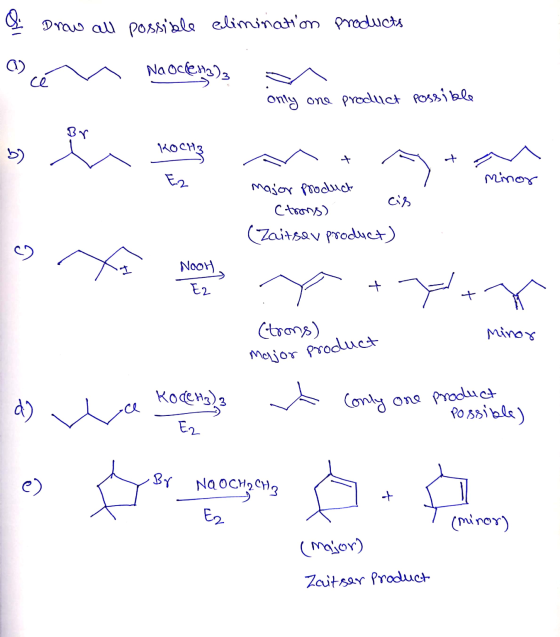
15. Draw all possible elimination products (including cis/trans isomers). Decide which will be the major elimination...
6. Predict which of the following two isomers (cis- or trans-) will undergo an E2 elimination...
 6. Predict which of the following two isomers (cis- or trans-) will undergo an E2 elimination under the treatment with EtoNa in EtOH more rapidly. A) For the explanation of the reaction rate, draw chair conformations for each isomer, determine which conformation is more stable . B) Draw the major product and the mechanism of the reactions. CI cis-isomer trans-isomer
PROBLEM 7-25 For each reaction, decide whether substitution or elimination (or both) is possible, and predict...
 PROBLEM 7-25 For each reaction, decide whether substitution or elimination (or both) is possible, and predict the products you expect. Label the major products. (a) 1-bromo-1-methylcyclohexane + NaOH in acetone (b) 1-bromo-1-methylcyclohexane + triethylamine (EtN:) (c) chlorocyclohexane + NaOCH, in CH, OH (d) chlorocyclohexane + NaOC(CH3)3 in (CH3)3 COH
11/8/19 The cis- and trans-isomers of 1-bromo-2-methylcyclohexane are shown below. One of these isomers undergoes E2...
 11/8/19 The cis- and trans-isomers of 1-bromo-2-methylcyclohexane are shown below. One of these isomers undergoes E2 elimination 50 time faster than the other. Illustrate the E2 mechanism using the chair conformers to explain why one isomer is much faster and give the major product of each reaction. 1-BUOK 1-BOK Illustrate the Sw2 mechanism for the reaction below and show what has happened to the stereochemistry of the compound. NaCN acetone
Draw structural formulas for all possible products of the dichlorination of cyclohexane. include cis-trans isomers
Draw structural formulas for all possible products of the dichlorination of cyclohexane. include cis-trans isomers
Draw structural formulas for all possible products of the dichlorination of cyclohexane. Include cis-trans isomers
Draw structural formulas for all possible products of the dichlorination of cyclohexane. Include cis-trans isomers
3 & 4 please Draw all possible El elimination products and indicate which alkene is the...
 3
& 4 please
Draw all possible El elimination products and indicate which alkene is the major product: CH3OH CH3 a) HC-C-ci CH3 CH3CH2OH CH3C430H CH3CH2OH Br CH3CH2OH I X ORSOGON CH3OH Br brow all possible E2 elimination products and indicate which okene is the major product CH, ON CH, OH CHÚCHONa CH,CH OH CHÚCH ONa CH,CH, OH CH3CH2ONa d YoX CH₂CH₂OH CH,CH OH (CH3),COH TONE CH,(CH)CH,OH CHCH,ONa CH,CH,OH CH,CH, CH,CH,ONa CH,CH, OH CH,
3
& 4 please
Draw all possible El elimination products and indicate which alkene is the major product: CH3OH CH3 a) HC-C-ci CH3 CH3CH2OH CH3C430H CH3CH2OH Br CH3CH2OH I X ORSOGON CH3OH Br brow all possible E2 elimination products and indicate which okene is the major product CH, ON CH, OH CHÚCHONa CH,CH OH CHÚCH ONa CH,CH, OH CH3CH2ONa d YoX CH₂CH₂OH CH,CH OH (CH3),COH TONE CH,(CH)CH,OH CHCH,ONa CH,CH,OH CH,CH, CH,CH,ONa CH,CH, OH CH,
For the molecules whose condensed structural formula is given below, decide if cis-trans isomers are possible....
For the molecules whose condensed structural formula is given below, decide if cis-trans isomers are possible. If they are, enter the name of the cis isomer in the first box and the name of the trans isomer in the second box. a) CH3CH=CHCH3 name of cis isomer or molecule: name of trans isomer or none: b) (CH3)2C=CCl2 name of cis isomer or molecule: name of trans isomer or none:
please show all steps including each mechanism (arrows) and also if SN1 has any rearrangements of...
 please show all steps including each mechanism (arrows) and
also if SN1 has any rearrangements of carbocation intermediate
through a hydride shift and/or methyl shift. DO NOT NEED
ELIMINATION. ONLY SUBSTITUTION.
Sy1/E1 versus S2/E2 Learning Checks Draw the major organic substitution and/or elimination products in the following reactions. If no reaction is possible, write “No Reaction". Substitution Product(s) Elimination Product(s) 2) 2) OH BrCH K* -Ot-Bu NaOCH н"Сн, сн,он нсн, Ph NaOCH Br H CH3OH CH NaOCH NaOH T.CH, I...
please show all steps including each mechanism (arrows) and
also if SN1 has any rearrangements of carbocation intermediate
through a hydride shift and/or methyl shift. DO NOT NEED
ELIMINATION. ONLY SUBSTITUTION.
Sy1/E1 versus S2/E2 Learning Checks Draw the major organic substitution and/or elimination products in the following reactions. If no reaction is possible, write “No Reaction". Substitution Product(s) Elimination Product(s) 2) 2) OH BrCH K* -Ot-Bu NaOCH н"Сн, сн,он нсн, Ph NaOCH Br H CH3OH CH NaOCH NaOH T.CH, I...
Thank you so much! (2 pts) Draw the major elimination products and Identify the mechanism responsible...
 Thank you so much!
(2 pts) Draw the major elimination products and Identify the mechanism responsible (E1 or E2). If both E and Z isomers form, only draw the E alkene. If only one isomer forms, label the alkene "E,""Z," or neither 1. NaOCH3 а. Br НОСHЗ b. НОСНЗ C. CI NaOCH3 d. (6 pts) Draw the substitution and/or elimination product(s) for the following reactions and identify 2. the mechanism responsible (SN1, SN2, E1, or E2) for each product drawn....
Thank you so much!
(2 pts) Draw the major elimination products and Identify the mechanism responsible (E1 or E2). If both E and Z isomers form, only draw the E alkene. If only one isomer forms, label the alkene "E,""Z," or neither 1. NaOCH3 а. Br НОСHЗ b. НОСНЗ C. CI NaOCH3 d. (6 pts) Draw the substitution and/or elimination product(s) for the following reactions and identify 2. the mechanism responsible (SN1, SN2, E1, or E2) for each product drawn....
3.6: Which of the following compounds can exist as cis–trans isomers? Draw each cis–trans pair. ...
3.6: Which of the following compounds can exist as cis–trans isomers? Draw each cis–trans pair. (a) CH3CH=CH2 (b) (CH3)2C=CHCH3 (c) ClCH=CHCl (d) CH3CH2CH=CHCH3 (e) CH3CH2CH=C(Br)CH3 (f) 3-Methylhept-3-ene The answer is c, d, e ,f but I'm not sure how it works
 6. Predict which of the following two isomers (cis- or trans-) will undergo an E2 elimination under the treatment with EtoNa in EtOH more rapidly. A) For the explanation of the reaction rate, draw chair conformations for each isomer, determine which conformation is more stable . B) Draw the major product and the mechanism of the reactions. CI cis-isomer trans-isomer
 PROBLEM 7-25 For each reaction, decide whether substitution or elimination (or both) is possible, and predict the products you expect. Label the major products. (a) 1-bromo-1-methylcyclohexane + NaOH in acetone (b) 1-bromo-1-methylcyclohexane + triethylamine (EtN:) (c) chlorocyclohexane + NaOCH, in CH, OH (d) chlorocyclohexane + NaOC(CH3)3 in (CH3)3 COH
 11/8/19 The cis- and trans-isomers of 1-bromo-2-methylcyclohexane are shown below. One of these isomers undergoes E2 elimination 50 time faster than the other. Illustrate the E2 mechanism using the chair conformers to explain why one isomer is much faster and give the major product of each reaction. 1-BUOK 1-BOK Illustrate the Sw2 mechanism for the reaction below and show what has happened to the stereochemistry of the compound. NaCN acetone
 3
& 4 please
Draw all possible El elimination products and indicate which alkene is the major product: CH3OH CH3 a) HC-C-ci CH3 CH3CH2OH CH3C430H CH3CH2OH Br CH3CH2OH I X ORSOGON CH3OH Br brow all possible E2 elimination products and indicate which okene is the major product CH, ON CH, OH CHÚCHONa CH,CH OH CHÚCH ONa CH,CH, OH CH3CH2ONa d YoX CH₂CH₂OH CH,CH OH (CH3),COH TONE CH,(CH)CH,OH CHCH,ONa CH,CH,OH CH,CH, CH,CH,ONa CH,CH, OH CH,
3
& 4 please
Draw all possible El elimination products and indicate which alkene is the major product: CH3OH CH3 a) HC-C-ci CH3 CH3CH2OH CH3C430H CH3CH2OH Br CH3CH2OH I X ORSOGON CH3OH Br brow all possible E2 elimination products and indicate which okene is the major product CH, ON CH, OH CHÚCHONa CH,CH OH CHÚCH ONa CH,CH, OH CH3CH2ONa d YoX CH₂CH₂OH CH,CH OH (CH3),COH TONE CH,(CH)CH,OH CHCH,ONa CH,CH,OH CH,CH, CH,CH,ONa CH,CH, OH CH,
 please show all steps including each mechanism (arrows) and
also if SN1 has any rearrangements of carbocation intermediate
through a hydride shift and/or methyl shift. DO NOT NEED
ELIMINATION. ONLY SUBSTITUTION.
Sy1/E1 versus S2/E2 Learning Checks Draw the major organic substitution and/or elimination products in the following reactions. If no reaction is possible, write “No Reaction". Substitution Product(s) Elimination Product(s) 2) 2) OH BrCH K* -Ot-Bu NaOCH н"Сн, сн,он нсн, Ph NaOCH Br H CH3OH CH NaOCH NaOH T.CH, I...
please show all steps including each mechanism (arrows) and
also if SN1 has any rearrangements of carbocation intermediate
through a hydride shift and/or methyl shift. DO NOT NEED
ELIMINATION. ONLY SUBSTITUTION.
Sy1/E1 versus S2/E2 Learning Checks Draw the major organic substitution and/or elimination products in the following reactions. If no reaction is possible, write “No Reaction". Substitution Product(s) Elimination Product(s) 2) 2) OH BrCH K* -Ot-Bu NaOCH н"Сн, сн,он нсн, Ph NaOCH Br H CH3OH CH NaOCH NaOH T.CH, I...
 Thank you so much!
(2 pts) Draw the major elimination products and Identify the mechanism responsible (E1 or E2). If both E and Z isomers form, only draw the E alkene. If only one isomer forms, label the alkene "E,""Z," or neither 1. NaOCH3 а. Br НОСHЗ b. НОСНЗ C. CI NaOCH3 d. (6 pts) Draw the substitution and/or elimination product(s) for the following reactions and identify 2. the mechanism responsible (SN1, SN2, E1, or E2) for each product drawn....
Thank you so much!
(2 pts) Draw the major elimination products and Identify the mechanism responsible (E1 or E2). If both E and Z isomers form, only draw the E alkene. If only one isomer forms, label the alkene "E,""Z," or neither 1. NaOCH3 а. Br НОСHЗ b. НОСНЗ C. CI NaOCH3 d. (6 pts) Draw the substitution and/or elimination product(s) for the following reactions and identify 2. the mechanism responsible (SN1, SN2, E1, or E2) for each product drawn....
Most questions answered within 3 hours.
-
Where is the error in this code sequence?
String s1 = "Hello";
String s2 = "ello";...
asked 10 months ago -
Financial data for Joel de Paris, Inc., for last year
follow:
Joel de Paris, Inc.
Balance...
asked 10 months ago -
Consider this reaction:
Al2(SO4)3 (aq)+ BaCl3
(aq) Al2Cl6 (aq)- +
3BaSO4(s) . What is the...
asked 10 months ago -
Suppose that Savneet is considering increasing her
recent random sample from 20 car rentals to 40...
asked 10 months ago -
Trucks arrive at an unloading terminal at an average rate of 120
per hour.
Trucks arrive...
asked 10 months ago -
Why are methanol and ethanol completely soluble in water while
octanol is not very little soluble....
asked 10 months ago -
A facilities manager at a university reads in a research report
that the mean amount of...
asked 10 months ago -
When the CuSO4 is rehydrated by adding water to the anhydrous
compound, is this an endothermic...
asked 10 months ago -
A ray of sunlight is passing from diamond into crown glass; the
angle of incidence is...
asked 10 months ago -
A block of mass 0.249 kg is placed on top of a light, vertical
spring of...
asked 10 months ago -
how do the kidneys compensate in the presences of acidosis
a) trigger hyperventilate
b) reserve acid...
asked 10 months ago -
Question 501 pts
The rental rate of capital to the firm increases. Which of the
following...
asked 10 months ago