


Homework Answers
Add Answer to:
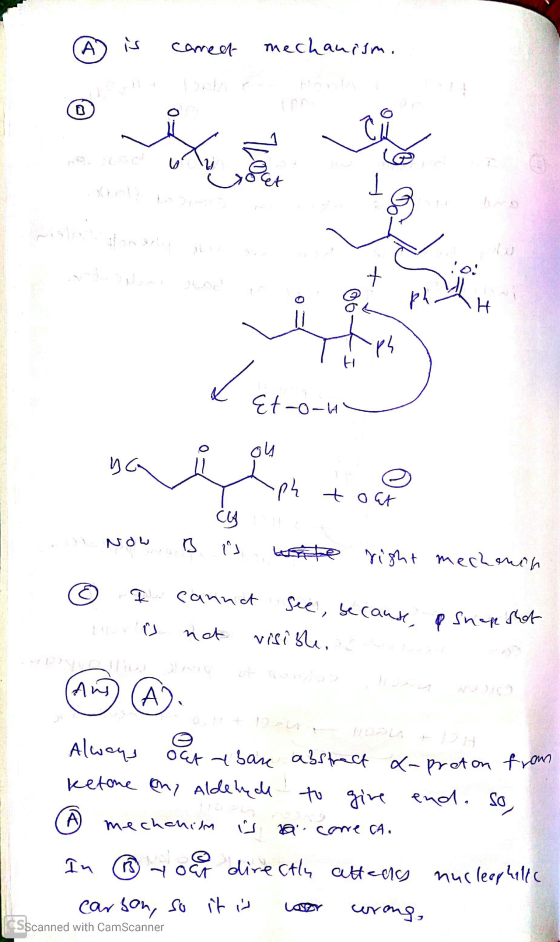
Indicate the correct mechanism for this aldol reaction. Ph 000 HER 0 OH Ph Ph and...
What is the reaction mechanism? OH OH 0 Ph 2 PhCcPh HOAc Ph Ph Ph benzopinacol...
 What is the reaction mechanism?
OH OH 0 Ph 2 PhCcPh HOAc Ph Ph Ph benzopinacol benzopinacalone
What is the reaction mechanism?
OH OH 0 Ph 2 PhCcPh HOAc Ph Ph Ph benzopinacol benzopinacalone
Indicate the correct mechanism. H-OH f POH COH - and H20 oot id and HD TO...
 Indicate the correct mechanism. H-OH f POH COH - and H20 oot id and HD TO etimooth COH TH-OH 00 HO - and HO and H,0 ОН Он-он 00 90 % оҳ, - иммо and H2O @ H OH Loo- оо, ра ms and H.O
Propose a stepwise mechanism for the following reaction of a B-keto ester. Suggest a reason why...
 Propose a stepwise mechanism for the following reaction of a B-keto ester. Suggest a reason why this rearrangement reaction occurs. [1] NaOET EtOH [2] H2O* Step [1]: 00: OET OS OCH CH O OH OCHCH CO2CH.CH v DE :0: LOE :: CO.CHCH OCH CH HOCH.CH Step (2]: OE CO_CHCH SH OEt :O: OCH CH3 :: OE: 70: : Et CO2CH2CH3 OCH₂CH₂ Step (3): Et0 :0 OE :0: 19:0: 1 OCH CH O OCH CH3 :0 OE 0 O: Et:0 CO.CH.CH...
1) Choose the correct structures for X and Y. 2) The following aldol reaction can produce...
 1) Choose the correct structures for X and
Y.
2) The following aldol reaction can produce 4 products. Select
the structure that is not a possible product of the following
reaction.
3) Choose the major compounds present after the following ketone
is treated with dilute aqueous base.
4) Draw the alkyl bromide(s) that is(are) needed to prepare the
following ketone using the acetoacetic ester synthesis.
O Br LDA TMS-CI CH3-Li Br Х Y -78 °C NEt3 1 2 3 A....
1) Choose the correct structures for X and
Y.
2) The following aldol reaction can produce 4 products. Select
the structure that is not a possible product of the following
reaction.
3) Choose the major compounds present after the following ketone
is treated with dilute aqueous base.
4) Draw the alkyl bromide(s) that is(are) needed to prepare the
following ketone using the acetoacetic ester synthesis.
O Br LDA TMS-CI CH3-Li Br Х Y -78 °C NEt3 1 2 3 A....
Problem 5. Indicate according to which mechanism each reaction proceeds. If there are stable intermediates, the...
 Problem 5. Indicate according to which mechanism each reaction proceeds. If there are stable intermediates, the reaction step leading to the final product is relevant. Choose from the following designations. [8 P Addition: Ar (electr. addn.), 1,2-AN. 1,4-AN (mucl. or conjug. addn.), syn-Addn., CA (cycloaddn.). Elimination: a E, E1, ElcB, E2, cyclo-E, Frag.(mentation). Substitution: Sx1, Ss2, SNAC (acyl subst. via Addn./Elim.); aromatic subst: SNAr (nucleoph.), SAr (electroph), Arvne. Rearrangement: Rearr. Radical reactions: Ag. Eg.Su- Reaction Mechanism a) HCI conc. (ag)...
Questions 2-10 please!! 1) A substitution reaction is: [2] a) A reaction during which an OH...
 Questions 2-10 please!!
1) A substitution reaction is: [2] a) A reaction during which an OH group of a molecule is replaced by a halogen. b) A reaction during which water is the leaving group. c) A reaction during which a functional group of a molecule is replaced by an electrophile. d) A reaction during which a functional group of a molecule is replaced by another functional group. V 12 2) Substitution reactions are classified either as electrophilic or nucleophilic...
Questions 2-10 please!!
1) A substitution reaction is: [2] a) A reaction during which an OH group of a molecule is replaced by a halogen. b) A reaction during which water is the leaving group. c) A reaction during which a functional group of a molecule is replaced by an electrophile. d) A reaction during which a functional group of a molecule is replaced by another functional group. V 12 2) Substitution reactions are classified either as electrophilic or nucleophilic...
What is answer of #6??? Lab Section: 0 2 Report: Hydroboration of 1-Methylcyclohexene Mechanism / GC...
 What is answer of #6???
Lab Section: 0 2 Report: Hydroboration of 1-Methylcyclohexene Mechanism / GC Analysis / Calculations 1. After reviewing the GC and 'H NMR spectra, what is the major product of the reaction? a. BHS. THF, OH O a. BH3. THE OH + b. 3 H2O2 3 + 3 c. NaOH OH ОН racemic racemic major 2. Draw the complete curved arrow mechanism for the reaction to produce the major product, including both the hydroboration and oxidation...
What is answer of #6???
Lab Section: 0 2 Report: Hydroboration of 1-Methylcyclohexene Mechanism / GC Analysis / Calculations 1. After reviewing the GC and 'H NMR spectra, what is the major product of the reaction? a. BHS. THF, OH O a. BH3. THE OH + b. 3 H2O2 3 + 3 c. NaOH OH ОН racemic racemic major 2. Draw the complete curved arrow mechanism for the reaction to produce the major product, including both the hydroboration and oxidation...
What is answer of #10?? Report: Hydroboration of 1-Methylcyclohexene Mechanism / GC Analysis / Calculations 1....
 What is answer of #10??
Report: Hydroboration of 1-Methylcyclohexene Mechanism / GC Analysis / Calculations 1. After reviewing the GC and 'H NMR spectra, what is the major product of the reaction? + 3 a. BH: . THF 3 b. 3 H2O2 OH + 3 OH c. NaOH MOH OH racemic racemic major 2. Draw the complete curved arrow mechanism for the reaction to produce the major product, including both the hydroboration and oxidation steps. Repetitive steps need only be...
What is answer of #10??
Report: Hydroboration of 1-Methylcyclohexene Mechanism / GC Analysis / Calculations 1. After reviewing the GC and 'H NMR spectra, what is the major product of the reaction? + 3 a. BH: . THF 3 b. 3 H2O2 OH + 3 OH c. NaOH MOH OH racemic racemic major 2. Draw the complete curved arrow mechanism for the reaction to produce the major product, including both the hydroboration and oxidation steps. Repetitive steps need only be...
What is answer of #9??? Help me Report: Hydroboration of 1-Methylcyclohexene Mechanism / GC Analysis /...
 What is answer of #9???
Help me
Report: Hydroboration of 1-Methylcyclohexene Mechanism / GC Analysis / Calculations 1. After reviewing the GC and 'H NMR spectra, what is the major product of the reaction? + 3 a. BH: . THF 3 b. 3 H2O2 OH + 3 OH c. NaOH MOH OH racemic racemic major 2. Draw the complete curved arrow mechanism for the reaction to produce the major product, including both the hydroboration and oxidation steps. Repetitive steps need...
What is answer of #9???
Help me
Report: Hydroboration of 1-Methylcyclohexene Mechanism / GC Analysis / Calculations 1. After reviewing the GC and 'H NMR spectra, what is the major product of the reaction? + 3 a. BH: . THF 3 b. 3 H2O2 OH + 3 OH c. NaOH MOH OH racemic racemic major 2. Draw the complete curved arrow mechanism for the reaction to produce the major product, including both the hydroboration and oxidation steps. Repetitive steps need...
Grignard reagent THE GRIGNARD REAGENT-PREPARATION AND REACTION In this experiment, you will prepa...
 i need help with the postlab questions please
Grignard reagent THE GRIGNARD REAGENT-PREPARATION AND REACTION In this experiment, you will prepare a Grignard reagent, phenyl magnesium bromide, from bromobenzene and magnesium metal. The Grignard reagent will then react with methyl benzoate to form triphenylmethanol. Introduction Grignard reagents, such as organomagnesium halides, were discovered in 1910 by French chemist Victor Grignard. The Grignard reaction is one of the most general methods for carbon- carbon bond formation in all of organic chemistry....
i need help with the postlab questions please
Grignard reagent THE GRIGNARD REAGENT-PREPARATION AND REACTION In this experiment, you will prepare a Grignard reagent, phenyl magnesium bromide, from bromobenzene and magnesium metal. The Grignard reagent will then react with methyl benzoate to form triphenylmethanol. Introduction Grignard reagents, such as organomagnesium halides, were discovered in 1910 by French chemist Victor Grignard. The Grignard reaction is one of the most general methods for carbon- carbon bond formation in all of organic chemistry....
 What is the reaction mechanism?
OH OH 0 Ph 2 PhCcPh HOAc Ph Ph Ph benzopinacol benzopinacalone
What is the reaction mechanism?
OH OH 0 Ph 2 PhCcPh HOAc Ph Ph Ph benzopinacol benzopinacalone
 Indicate the correct mechanism. H-OH f POH COH - and H20 oot id and HD TO etimooth COH TH-OH 00 HO - and HO and H,0 ОН Он-он 00 90 % оҳ, - иммо and H2O @ H OH Loo- оо, ра ms and H.O
 Propose a stepwise mechanism for the following reaction of a B-keto ester. Suggest a reason why this rearrangement reaction occurs. [1] NaOET EtOH [2] H2O* Step [1]: 00: OET OS OCH CH O OH OCHCH CO2CH.CH v DE :0: LOE :: CO.CHCH OCH CH HOCH.CH Step (2]: OE CO_CHCH SH OEt :O: OCH CH3 :: OE: 70: : Et CO2CH2CH3 OCH₂CH₂ Step (3): Et0 :0 OE :0: 19:0: 1 OCH CH O OCH CH3 :0 OE 0 O: Et:0 CO.CH.CH...
 1) Choose the correct structures for X and
Y.
2) The following aldol reaction can produce 4 products. Select
the structure that is not a possible product of the following
reaction.
3) Choose the major compounds present after the following ketone
is treated with dilute aqueous base.
4) Draw the alkyl bromide(s) that is(are) needed to prepare the
following ketone using the acetoacetic ester synthesis.
O Br LDA TMS-CI CH3-Li Br Х Y -78 °C NEt3 1 2 3 A....
1) Choose the correct structures for X and
Y.
2) The following aldol reaction can produce 4 products. Select
the structure that is not a possible product of the following
reaction.
3) Choose the major compounds present after the following ketone
is treated with dilute aqueous base.
4) Draw the alkyl bromide(s) that is(are) needed to prepare the
following ketone using the acetoacetic ester synthesis.
O Br LDA TMS-CI CH3-Li Br Х Y -78 °C NEt3 1 2 3 A....
 Problem 5. Indicate according to which mechanism each reaction proceeds. If there are stable intermediates, the reaction step leading to the final product is relevant. Choose from the following designations. [8 P Addition: Ar (electr. addn.), 1,2-AN. 1,4-AN (mucl. or conjug. addn.), syn-Addn., CA (cycloaddn.). Elimination: a E, E1, ElcB, E2, cyclo-E, Frag.(mentation). Substitution: Sx1, Ss2, SNAC (acyl subst. via Addn./Elim.); aromatic subst: SNAr (nucleoph.), SAr (electroph), Arvne. Rearrangement: Rearr. Radical reactions: Ag. Eg.Su- Reaction Mechanism a) HCI conc. (ag)...
 Questions 2-10 please!!
1) A substitution reaction is: [2] a) A reaction during which an OH group of a molecule is replaced by a halogen. b) A reaction during which water is the leaving group. c) A reaction during which a functional group of a molecule is replaced by an electrophile. d) A reaction during which a functional group of a molecule is replaced by another functional group. V 12 2) Substitution reactions are classified either as electrophilic or nucleophilic...
Questions 2-10 please!!
1) A substitution reaction is: [2] a) A reaction during which an OH group of a molecule is replaced by a halogen. b) A reaction during which water is the leaving group. c) A reaction during which a functional group of a molecule is replaced by an electrophile. d) A reaction during which a functional group of a molecule is replaced by another functional group. V 12 2) Substitution reactions are classified either as electrophilic or nucleophilic...
 What is answer of #6???
Lab Section: 0 2 Report: Hydroboration of 1-Methylcyclohexene Mechanism / GC Analysis / Calculations 1. After reviewing the GC and 'H NMR spectra, what is the major product of the reaction? a. BHS. THF, OH O a. BH3. THE OH + b. 3 H2O2 3 + 3 c. NaOH OH ОН racemic racemic major 2. Draw the complete curved arrow mechanism for the reaction to produce the major product, including both the hydroboration and oxidation...
What is answer of #6???
Lab Section: 0 2 Report: Hydroboration of 1-Methylcyclohexene Mechanism / GC Analysis / Calculations 1. After reviewing the GC and 'H NMR spectra, what is the major product of the reaction? a. BHS. THF, OH O a. BH3. THE OH + b. 3 H2O2 3 + 3 c. NaOH OH ОН racemic racemic major 2. Draw the complete curved arrow mechanism for the reaction to produce the major product, including both the hydroboration and oxidation...
 What is answer of #10??
Report: Hydroboration of 1-Methylcyclohexene Mechanism / GC Analysis / Calculations 1. After reviewing the GC and 'H NMR spectra, what is the major product of the reaction? + 3 a. BH: . THF 3 b. 3 H2O2 OH + 3 OH c. NaOH MOH OH racemic racemic major 2. Draw the complete curved arrow mechanism for the reaction to produce the major product, including both the hydroboration and oxidation steps. Repetitive steps need only be...
What is answer of #10??
Report: Hydroboration of 1-Methylcyclohexene Mechanism / GC Analysis / Calculations 1. After reviewing the GC and 'H NMR spectra, what is the major product of the reaction? + 3 a. BH: . THF 3 b. 3 H2O2 OH + 3 OH c. NaOH MOH OH racemic racemic major 2. Draw the complete curved arrow mechanism for the reaction to produce the major product, including both the hydroboration and oxidation steps. Repetitive steps need only be...
 What is answer of #9???
Help me
Report: Hydroboration of 1-Methylcyclohexene Mechanism / GC Analysis / Calculations 1. After reviewing the GC and 'H NMR spectra, what is the major product of the reaction? + 3 a. BH: . THF 3 b. 3 H2O2 OH + 3 OH c. NaOH MOH OH racemic racemic major 2. Draw the complete curved arrow mechanism for the reaction to produce the major product, including both the hydroboration and oxidation steps. Repetitive steps need...
What is answer of #9???
Help me
Report: Hydroboration of 1-Methylcyclohexene Mechanism / GC Analysis / Calculations 1. After reviewing the GC and 'H NMR spectra, what is the major product of the reaction? + 3 a. BH: . THF 3 b. 3 H2O2 OH + 3 OH c. NaOH MOH OH racemic racemic major 2. Draw the complete curved arrow mechanism for the reaction to produce the major product, including both the hydroboration and oxidation steps. Repetitive steps need...
 i need help with the postlab questions please
Grignard reagent THE GRIGNARD REAGENT-PREPARATION AND REACTION In this experiment, you will prepare a Grignard reagent, phenyl magnesium bromide, from bromobenzene and magnesium metal. The Grignard reagent will then react with methyl benzoate to form triphenylmethanol. Introduction Grignard reagents, such as organomagnesium halides, were discovered in 1910 by French chemist Victor Grignard. The Grignard reaction is one of the most general methods for carbon- carbon bond formation in all of organic chemistry....
i need help with the postlab questions please
Grignard reagent THE GRIGNARD REAGENT-PREPARATION AND REACTION In this experiment, you will prepare a Grignard reagent, phenyl magnesium bromide, from bromobenzene and magnesium metal. The Grignard reagent will then react with methyl benzoate to form triphenylmethanol. Introduction Grignard reagents, such as organomagnesium halides, were discovered in 1910 by French chemist Victor Grignard. The Grignard reaction is one of the most general methods for carbon- carbon bond formation in all of organic chemistry....
Most questions answered within 3 hours.
-
Where is the error in this code sequence?
String s1 = "Hello";
String s2 = "ello";...
asked 10 months ago -
Financial data for Joel de Paris, Inc., for last year
follow:
Joel de Paris, Inc.
Balance...
asked 10 months ago -
Consider this reaction:
Al2(SO4)3 (aq)+ BaCl3
(aq) Al2Cl6 (aq)- +
3BaSO4(s) . What is the...
asked 10 months ago -
Suppose that Savneet is considering increasing her
recent random sample from 20 car rentals to 40...
asked 10 months ago -
Trucks arrive at an unloading terminal at an average rate of 120
per hour.
Trucks arrive...
asked 10 months ago -
Why are methanol and ethanol completely soluble in water while
octanol is not very little soluble....
asked 10 months ago -
A facilities manager at a university reads in a research report
that the mean amount of...
asked 10 months ago -
When the CuSO4 is rehydrated by adding water to the anhydrous
compound, is this an endothermic...
asked 10 months ago -
A ray of sunlight is passing from diamond into crown glass; the
angle of incidence is...
asked 10 months ago -
A block of mass 0.249 kg is placed on top of a light, vertical
spring of...
asked 10 months ago -
how do the kidneys compensate in the presences of acidosis
a) trigger hyperventilate
b) reserve acid...
asked 10 months ago -
Question 501 pts
The rental rate of capital to the firm increases. Which of the
following...
asked 10 months ago