
Homework Answers
Answer is 2. Because the halo-compounds which have acidic H-
atom, not used to form grignard reagent. So, this compound is not
form stable organolithium and grignard reagent due to the presence
of acidic H.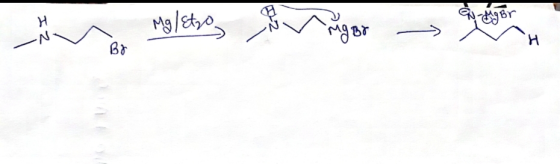
Add Answer to:
Which of the compounds below will not successfully form a stable organolithium or Grignard reagent? Time...
Organolithium compounds react with carbonyl compounds in a way that is similar to that of Grignard...
 Organolithium compounds react with carbonyl compounds in a way
that is similar to that of Grignard reactions.
Draw the structure of the expected product when the compound
below reacts with methyllithium followed by aqueous acid
workup.
organolithium compounds react with carbonyl compounds in a way that is similar to that of Grignard reactions Draw the structure of the expected product when the compound below reacts with methyllithium followed by aqueous acid workup. You do not have to consider stereochemistry. You...
Organolithium compounds react with carbonyl compounds in a way
that is similar to that of Grignard reactions.
Draw the structure of the expected product when the compound
below reacts with methyllithium followed by aqueous acid
workup.
organolithium compounds react with carbonyl compounds in a way that is similar to that of Grignard reactions Draw the structure of the expected product when the compound below reacts with methyllithium followed by aqueous acid workup. You do not have to consider stereochemistry. You...
7. Circle the compounds that could be successfully react with a Grignard reagent as substrates in...
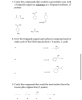 7. Circle the compounds that could be successfully react with a Grignard reagent as substrates in a Grignard synthesis. (5 points) 에 HC) O CH₂ H₃CC-CH3 8. Give the Grignard reagent and carbonyl compound need to make each of the following alcohols. (6 points, 2 each) 9. Circle the compound that would be most acidic (have the lowest pKa, highest Ka) (5 points)
Grignard reagent THE GRIGNARD REAGENT-PREPARATION AND REACTION In this experiment, you will prepa...
 i need help with the prelab questions please
Grignard reagent THE GRIGNARD REAGENT-PREPARATION AND REACTION In this experiment, you will prepare a Grignard reagent, phenyl magnesium bromide, from bromobenzene and magnesium metal. The Grignard reagent will then react with methyl benzoate to form triphenylmethanol. Introduction Grignard reagents, such as organomagnesium halides, were discovered in 1910 by French chemist Victor Grignard. The Grignard reaction is one of the most general methods for carbon- carbon bond formation in all of organic chemistry....
i need help with the prelab questions please
Grignard reagent THE GRIGNARD REAGENT-PREPARATION AND REACTION In this experiment, you will prepare a Grignard reagent, phenyl magnesium bromide, from bromobenzene and magnesium metal. The Grignard reagent will then react with methyl benzoate to form triphenylmethanol. Introduction Grignard reagents, such as organomagnesium halides, were discovered in 1910 by French chemist Victor Grignard. The Grignard reaction is one of the most general methods for carbon- carbon bond formation in all of organic chemistry....
Which compound below is not suitable for conversion to a Grignard reagent? CHE A) B) осна...
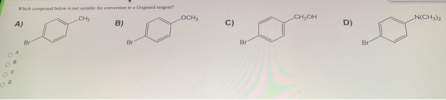 Which compound below is not suitable for conversion to a Grignard reagent? CHE A) B) осна CH2OH -N(CH3)2 c) D) BI Br Br Br
Grignard reagent THE GRIGNARD REAGENT-PREPARATION AND REACTION In this experiment, you will prepa...
 i need help with the postlab questions please
Grignard reagent THE GRIGNARD REAGENT-PREPARATION AND REACTION In this experiment, you will prepare a Grignard reagent, phenyl magnesium bromide, from bromobenzene and magnesium metal. The Grignard reagent will then react with methyl benzoate to form triphenylmethanol. Introduction Grignard reagents, such as organomagnesium halides, were discovered in 1910 by French chemist Victor Grignard. The Grignard reaction is one of the most general methods for carbon- carbon bond formation in all of organic chemistry....
i need help with the postlab questions please
Grignard reagent THE GRIGNARD REAGENT-PREPARATION AND REACTION In this experiment, you will prepare a Grignard reagent, phenyl magnesium bromide, from bromobenzene and magnesium metal. The Grignard reagent will then react with methyl benzoate to form triphenylmethanol. Introduction Grignard reagents, such as organomagnesium halides, were discovered in 1910 by French chemist Victor Grignard. The Grignard reaction is one of the most general methods for carbon- carbon bond formation in all of organic chemistry....
Grignard Reaction 1. Draw your complete reaction, including the formation of the Grignard reagent and the...
 Grignard Reaction 1. Draw your complete reaction, including the formation of the Grignard reagent and the reaction with your carbonyl compound. Below each reagent, write its molecular weight and density (if a liquid). Also write how much of each material you will use in ml (if liquid), grams, and moles. Also include the molecular weight and melting point of your final product. 2. How many moles of Grignard reagent are you synthesizing? What mass of water could fully react with...
Question 7 Which of the following is the most reactive for a Grignard reagent. Propanal Formaldehyde...
 Question 7 Which of the following is the most reactive for a Grignard reagent. Propanal Formaldehyde Ethanol Acetone Question 9 2 pts Which of these compounds would be the most reactive to a nucleophilic attack? thyl butanoate to hide methyl ether butanbir arid
Draw the Grignard reagent you'd expect to form from the following reaction. CI Mg ether Provide...
 Draw the Grignard reagent you'd expect to form from the following reaction. CI Mg ether Provide the product you'd expect from the following reaction? OH SOCI2 e pyridine pyridine Draw the Grignard reagent you'd expect to form from the following reaction. Mg ether Draw the major product you'd expect from the radical bromination of methylcyclohexane. Draw the major product you'd expect from the radical bromination of 2,2,4-trimethylpentane. Draw all possible monochlorinated products you'd expect upon treating 2-methylbutane with Cly and...
Provide methods for synthesizing the following compounds using only a Grignard reaction, plus any necessary workup....
Provide methods for synthesizing the following compounds using only a Grignard reaction, plus any necessary workup. In each case the Grignard reagent, cyclohexylmagnesium bromide, must be used in the synthesis. Express these syntheses in the form of balanced equations, using structural formulae showing all reagents and any specific conditions required. a) Cyclohexylmethanoic acid b) 1,1-dicyclohexyl-1-ethanol c) cyclohexane
Mup Which of the molecules drawn below are capable of serving as electrophiles when added to a Grignard reagent suc...
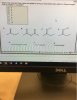 Mup Which of the molecules drawn below are capable of serving as electrophiles when added to a Grignard reagent such as CH MgCl or C.HMgBr? ロロロロロロロ II Solution check Answer Next Ext about carcers privacy policy terms of use DELL
 Organolithium compounds react with carbonyl compounds in a way
that is similar to that of Grignard reactions.
Draw the structure of the expected product when the compound
below reacts with methyllithium followed by aqueous acid
workup.
organolithium compounds react with carbonyl compounds in a way that is similar to that of Grignard reactions Draw the structure of the expected product when the compound below reacts with methyllithium followed by aqueous acid workup. You do not have to consider stereochemistry. You...
Organolithium compounds react with carbonyl compounds in a way
that is similar to that of Grignard reactions.
Draw the structure of the expected product when the compound
below reacts with methyllithium followed by aqueous acid
workup.
organolithium compounds react with carbonyl compounds in a way that is similar to that of Grignard reactions Draw the structure of the expected product when the compound below reacts with methyllithium followed by aqueous acid workup. You do not have to consider stereochemistry. You...
 7. Circle the compounds that could be successfully react with a Grignard reagent as substrates in a Grignard synthesis. (5 points) 에 HC) O CH₂ H₃CC-CH3 8. Give the Grignard reagent and carbonyl compound need to make each of the following alcohols. (6 points, 2 each) 9. Circle the compound that would be most acidic (have the lowest pKa, highest Ka) (5 points)
 i need help with the prelab questions please
Grignard reagent THE GRIGNARD REAGENT-PREPARATION AND REACTION In this experiment, you will prepare a Grignard reagent, phenyl magnesium bromide, from bromobenzene and magnesium metal. The Grignard reagent will then react with methyl benzoate to form triphenylmethanol. Introduction Grignard reagents, such as organomagnesium halides, were discovered in 1910 by French chemist Victor Grignard. The Grignard reaction is one of the most general methods for carbon- carbon bond formation in all of organic chemistry....
i need help with the prelab questions please
Grignard reagent THE GRIGNARD REAGENT-PREPARATION AND REACTION In this experiment, you will prepare a Grignard reagent, phenyl magnesium bromide, from bromobenzene and magnesium metal. The Grignard reagent will then react with methyl benzoate to form triphenylmethanol. Introduction Grignard reagents, such as organomagnesium halides, were discovered in 1910 by French chemist Victor Grignard. The Grignard reaction is one of the most general methods for carbon- carbon bond formation in all of organic chemistry....
 Which compound below is not suitable for conversion to a Grignard reagent? CHE A) B) осна CH2OH -N(CH3)2 c) D) BI Br Br Br
 i need help with the postlab questions please
Grignard reagent THE GRIGNARD REAGENT-PREPARATION AND REACTION In this experiment, you will prepare a Grignard reagent, phenyl magnesium bromide, from bromobenzene and magnesium metal. The Grignard reagent will then react with methyl benzoate to form triphenylmethanol. Introduction Grignard reagents, such as organomagnesium halides, were discovered in 1910 by French chemist Victor Grignard. The Grignard reaction is one of the most general methods for carbon- carbon bond formation in all of organic chemistry....
i need help with the postlab questions please
Grignard reagent THE GRIGNARD REAGENT-PREPARATION AND REACTION In this experiment, you will prepare a Grignard reagent, phenyl magnesium bromide, from bromobenzene and magnesium metal. The Grignard reagent will then react with methyl benzoate to form triphenylmethanol. Introduction Grignard reagents, such as organomagnesium halides, were discovered in 1910 by French chemist Victor Grignard. The Grignard reaction is one of the most general methods for carbon- carbon bond formation in all of organic chemistry....
 Grignard Reaction 1. Draw your complete reaction, including the formation of the Grignard reagent and the reaction with your carbonyl compound. Below each reagent, write its molecular weight and density (if a liquid). Also write how much of each material you will use in ml (if liquid), grams, and moles. Also include the molecular weight and melting point of your final product. 2. How many moles of Grignard reagent are you synthesizing? What mass of water could fully react with...
 Question 7 Which of the following is the most reactive for a Grignard reagent. Propanal Formaldehyde Ethanol Acetone Question 9 2 pts Which of these compounds would be the most reactive to a nucleophilic attack? thyl butanoate to hide methyl ether butanbir arid
 Draw the Grignard reagent you'd expect to form from the following reaction. CI Mg ether Provide the product you'd expect from the following reaction? OH SOCI2 e pyridine pyridine Draw the Grignard reagent you'd expect to form from the following reaction. Mg ether Draw the major product you'd expect from the radical bromination of methylcyclohexane. Draw the major product you'd expect from the radical bromination of 2,2,4-trimethylpentane. Draw all possible monochlorinated products you'd expect upon treating 2-methylbutane with Cly and...
 Mup Which of the molecules drawn below are capable of serving as electrophiles when added to a Grignard reagent such as CH MgCl or C.HMgBr? ロロロロロロロ II Solution check Answer Next Ext about carcers privacy policy terms of use DELL
Most questions answered within 3 hours.
-
Where is the error in this code sequence?
String s1 = "Hello";
String s2 = "ello";...
asked 10 months ago -
Financial data for Joel de Paris, Inc., for last year
follow:
Joel de Paris, Inc.
Balance...
asked 10 months ago -
Consider this reaction:
Al2(SO4)3 (aq)+ BaCl3
(aq) Al2Cl6 (aq)- +
3BaSO4(s) . What is the...
asked 10 months ago -
Suppose that Savneet is considering increasing her
recent random sample from 20 car rentals to 40...
asked 10 months ago -
Trucks arrive at an unloading terminal at an average rate of 120
per hour.
Trucks arrive...
asked 10 months ago -
Why are methanol and ethanol completely soluble in water while
octanol is not very little soluble....
asked 10 months ago -
A facilities manager at a university reads in a research report
that the mean amount of...
asked 10 months ago -
When the CuSO4 is rehydrated by adding water to the anhydrous
compound, is this an endothermic...
asked 10 months ago -
A ray of sunlight is passing from diamond into crown glass; the
angle of incidence is...
asked 10 months ago -
A block of mass 0.249 kg is placed on top of a light, vertical
spring of...
asked 10 months ago -
how do the kidneys compensate in the presences of acidosis
a) trigger hyperventilate
b) reserve acid...
asked 10 months ago -
Question 501 pts
The rental rate of capital to the firm increases. Which of the
following...
asked 10 months ago