When 15.0 mL of a 3.74×10⁻⁴M ammonium sulfide solution is combined with 12.0 mL of a...
When 15.0 mL of a
3.74×10⁻⁴M ammonium
sulfide solution is combined with 12.0 mL
of a 8.12×10⁻⁴M silver
acetate solution does a precipitate form? (yes
or no) _____
For these conditions the Reaction Quotient, Q, is equal to
_____
Homework Answers
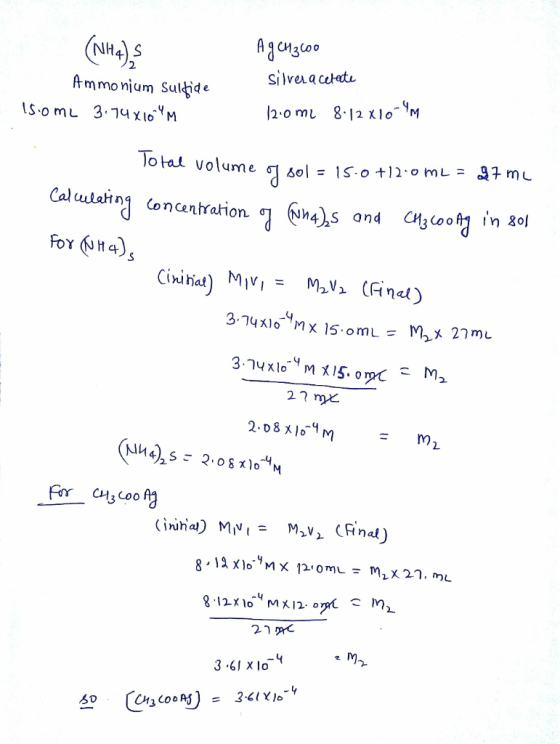
![(MK4)25 - Q NH4 +52 2:08x1014 [s^3= 2: 08 3 low CH3 Coong CH₂ coo- + Ag+ Cagt] = 3.61X10⁻⁴ 2 Ag++ s2- ² Agas Ksp of Ag, S = 6](http://img.homeworklib.com/questions/ce4852c0-d79c-11eb-a037-33fa7b5b2b10.png?x-oss-process=image/resize,w_560)
Add Answer to:
When 15.0 mL of a
3.74×10⁻⁴M ammonium
sulfide solution is combined with 12.0 mL
of a...
1.) When 22.0 mL of a 4.31×10⁻⁴M sodium sulfide solution is combined with 18.0 mL of...
1.) When 22.0 mL of a 4.31×10⁻⁴M sodium sulfide solution is combined with 18.0 mL of a 3.97×10⁻⁴M silver acetate solution does a precipitate form? (yes or no) For these conditions, the Reaction Quotient, Q, is equal to? 2.) When 15.0 mL of a 5.68×10⁻⁴M potassium fluoride solution is combined with 12.0 mL of a 9.12×10⁻⁴M magnesium acetate solution does a precipitate form? (yes or no) For these conditions, the Reaction Quotient, Q, is equal to? 3.) When 12.0 mL of a...
1. When 12.0 mL of a 2.99×10⁻⁴M sodium sulfide solution is combined with 18.0 mL of...
1. When 12.0 mL of a 2.99×10⁻⁴M sodium sulfide solution is combined with 18.0 mL of a 1.16×10⁻⁴M iron(II) chloride solution does a precipitate form? (yes or no) For these conditions the Reaction Quotient, Q, is equal to _____. 2. When 15.0 mL of a 9.29×10⁻⁴M ammonium chloride solution is combined with 25.0 mL of a 1.21×10⁻⁴M silver fluoride solution does a precipitate form? (yes or no) For these conditions the Reaction Quotient, Q, is equal to ______ . 3. When 25.0...
1. When 15.0 mL of a 6.01×10⁻⁴M sodium hydroxide solution is combined with 12.0 mL of...
1. When 15.0 mL of a 6.01×10⁻⁴M sodium hydroxide solution is combined with 12.0 mL of a 5.93×10⁻⁴M zinc nitrate solution does a precipitate form? (yes or no) For these conditions the Reaction Quotient, Q, is equal to 2. When 15.0 mL of a 5.28×10⁻⁴ M chromium(III) nitrate solution is combined with 22.0 mL of a 8.07×10⁻⁴ M sodium phosphate solution does a precipitate form? (yes or no) For these conditions the Reaction Quotient, Q, is equal to 3. When 15.0 mL...
1. When 22.0 mL of a 4.07×10⁻⁴M sodium sulfide solution is combined with 15.0 mL of...
1. When 22.0 mL of a 4.07×10⁻⁴M sodium sulfide solution is combined with 15.0 mL of a 4.60×10⁻⁴M nickel(II) bromide solution does a precipitate form? (yes or no) For these conditions the Reaction Quotient, Q, is equal to ____ 2. When 15.0 mL of a 6.77×10⁻⁴M sodium carbonate solution is combined with 22.0 mL of a 6.39×10⁻⁴M lead nitrate solution does a precipitate form? (yes or no) For these conditions the Reaction Quotient, Q, is equal to ___
When 12.0 mL of a 2.85×10⁻⁴ M silver acetate solution is combined with 15.0 mL of...
When 12.0 mL of a 2.85×10⁻⁴ M silver acetate solution is combined with 15.0 mL of a 5.98×10⁻⁴ M ammonium carbonatesolution does a precipitate form? (yes or no) For these conditions the Reaction Quotient, Q, is equal to .
When 15.0 mL of a 1.60×10⁻⁴ M ammonium carbonate solution is combined with 12.0 mL of...
When 15.0 mL of a 1.60×10⁻⁴ M ammonium carbonate solution is combined with 12.0 mL of a 8.84×10⁻⁴ M magnesium acetate solution does a precipitate form? ______(yes or no) For these conditions the Reaction Quotient, Q, is equal to?______
When 18.0 mL of a 6.99×10⁻⁴ M manganese(II) iodide solution is combined with 12.0 mL of...
When 18.0 mL of a 6.99×10⁻⁴ M manganese(II) iodide solution is combined with 12.0 mL of a 3.75×10⁻⁴ M ammonium sulfide solution does a precipitate form? (yes or no) For these conditions the Reaction Quotient, Q, is equal to ____ When 18.0 mL of a 5.55×10⁻⁴M sodium phosphate solution is combined with 18.0 mL of a 1.62×10⁻⁴M lead acetate solution does a precipitate form? (yes or no) For these conditions the Reaction Quotient, Q, is equal to ____
When 18.0 mL of a 3.59×10⁻⁴M potassium sulfide solution is combined with 22.0 mL of a...
When 18.0 mL of a 3.59×10⁻⁴M potassium sulfide solution is combined with 22.0 mL of a 9.40×10⁻⁴M lead acetate solution does a precipitate form? (yes or no) For these conditions the Reaction Quotient, Q, is equal to .
When 22.0 mL of a 1.04×10⁻⁴M potassium hydroxide solution is combined with 15.0 mL of a...
When 22.0 mL of a 1.04×10⁻⁴M potassium hydroxide solution is combined with 15.0 mL of a 6.49×10⁻⁴M lead acetate solution does a precipitate form? (yes or no) For these conditions the Reaction Quotient, Q, is equal to ___
When 22.0 mL of a 1.04×10⁻⁴M potassium hydroxide solution is combined with 15.0 mL of a...
When 22.0 mL of a 1.04×10⁻⁴M potassium hydroxide solution is combined with 15.0 mL of a 6.49×10⁻⁴M lead acetate solution does a precipitate form? (yes or no) For these conditions the Reaction Quotient, Q, is equal to __
Most questions answered within 3 hours.
-
Where is the error in this code sequence?
String s1 = "Hello";
String s2 = "ello";...
asked 11 months ago -
Financial data for Joel de Paris, Inc., for last year
follow:
Joel de Paris, Inc.
Balance...
asked 11 months ago -
Consider this reaction:
Al2(SO4)3 (aq)+ BaCl3
(aq) Al2Cl6 (aq)- +
3BaSO4(s) . What is the...
asked 11 months ago -
Suppose that Savneet is considering increasing her
recent random sample from 20 car rentals to 40...
asked 11 months ago -
Trucks arrive at an unloading terminal at an average rate of 120
per hour.
Trucks arrive...
asked 11 months ago -
Why are methanol and ethanol completely soluble in water while
octanol is not very little soluble....
asked 11 months ago -
A facilities manager at a university reads in a research report
that the mean amount of...
asked 11 months ago -
When the CuSO4 is rehydrated by adding water to the anhydrous
compound, is this an endothermic...
asked 11 months ago -
A ray of sunlight is passing from diamond into crown glass; the
angle of incidence is...
asked 11 months ago -
A block of mass 0.249 kg is placed on top of a light, vertical
spring of...
asked 11 months ago -
how do the kidneys compensate in the presences of acidosis
a) trigger hyperventilate
b) reserve acid...
asked 11 months ago -
Question 501 pts
The rental rate of capital to the firm increases. Which of the
following...
asked 11 months ago