
Homework Answers
Add Answer to:
Chlorine atoms react with methane, forming HCl and CH3. The rate constant for the reaction was...
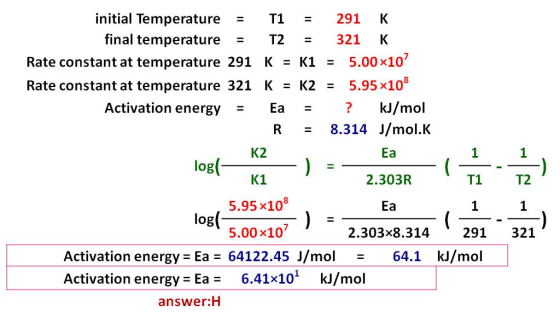
Chlorine atoms react with methane, forming HCl and CH3.
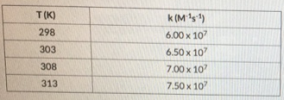 Chlorine atoms react with methane, forming HCl and CH3. The rate constant for the reaction is 6.00 x 10⁷M-1s-1 at 298 K. The experiment was repeated at three other temperatures, resulting in the following data: Part 1 (2 points) Calculate the activation energy for the reaction. Part 2 (2 points) Calculate the frequency factor for the reaction.
A reaction has a rate constant of 0.0177 s-1 at 400.0 K. If the reaction has...
A reaction has a rate constant of 0.0177 s-1 at 400.0 K. If the reaction has activation energy of 125 kJ/mol, calculate the rate constant at 500.0 K.A reaction has a rate constant of 0.0177 s-1 at 400.0 K. If the reaction has activation energy of 125 kJ/mol, calculate the rate constant at 500.0 K.
14 Question e See page 585 (1 point) 1st attempt See Periodic Table See Hint -5 -1 The rate constant for the reaction b...
 14 Question e See page 585 (1 point) 1st attempt See Periodic Table See Hint -5 -1 The rate constant for the reaction below was determined to be 3.241x10 s a 225 kJ/mol. What wou Id be the value of the rate constant at 9.40x10 K? N20(g) > N2 (8) +O (g) 800 K. The activation energy of the reaction is -1
14 Question e See page 585 (1 point) 1st attempt See Periodic Table See Hint -5 -1 The...
14 Question e See page 585 (1 point) 1st attempt See Periodic Table See Hint -5 -1 The rate constant for the reaction below was determined to be 3.241x10 s a 225 kJ/mol. What wou Id be the value of the rate constant at 9.40x10 K? N20(g) > N2 (8) +O (g) 800 K. The activation energy of the reaction is -1
14 Question e See page 585 (1 point) 1st attempt See Periodic Table See Hint -5 -1 The...
For the gas phase isomerization of isopropenyl allyl ether, CH2=C(CH3)-O-CH2CH=CH2– CH3COCH2CH2CH=CH2 the rate constant...
 For the gas phase isomerization of isopropenyl allyl ether, CH2=C(CH3)-O-CH2CH=CH2– CH3COCH2CH2CH=CH2 the rate constant has been determined at several temperatures. When In k in sis plotted against the reciprocal of the Kelvin temperature, the resulting linear plot has a slope of -1.48x10⁴ K and a y-intercept of 26.0. The activation energy for the gas phase isomerization of isopropenyl allyl ether is kJ/mol. Submit Answer Retry Entire Group 8 more group attempts remaining For the gas phase decomposition of isobutyl bromide,...
The activation energy for the gas phase decomposition of t-butyl chloride is 173 kJ/mol. (CH3)3CCl---->(CH3)2C=CH2 +...
The activation energy for the gas phase decomposition of t-butyl chloride is 173 kJ/mol. (CH3)3CCl---->(CH3)2C=CH2 + HCl The rate constant for this reaction is 7.30×10⁻⁵ s-1 at 546 K. What is the rate constant at 589 K? ___s-1
The activation energy for the gas phase decomposition of t-butyl chloride is 173 kJ/mol. (CH3)3CCl--->(CH3)2C=CH2 +...
The activation energy for the gas phase decomposition of t-butyl chloride is 173 kJ/mol. (CH3)3CCl--->(CH3)2C=CH2 + HCl The rate constant for this reaction is 5.58×10⁻⁴ s-1 at 577 K. What is the rate constant at 623 K? ___s-1
Reaction coordination 7. For the reaction below, the rate law was found to be Rate =...
 Reaction coordination 7. For the reaction below, the rate law was found to be Rate = k[C2H$OH(g)][HCl(g)], with a rate constant of 0.045 s'. A catalyst, such as H2SO4, was introduced, lowering the activation energy by 1.3 kJ/mol for the reaction at 55.0 °C. Calculate the rate constant of the catalyzed reaction, including appropriate units. C2H$OH(g) + HCI(g) → C2H$Cl(g) + H2(g) Page 2 of 2
The rate constant for the reaction below was determined to be 3.241×10⁻⁵ s–1 at 800 K....
The rate constant for the reaction below was determined to be 3.241×10⁻⁵ s–1 at 800 K. The activation energy of the reaction is 265 kJ/mol. What would be the value of the rate constant at 9.60×10² K? $$N2O(g) N2(g)+O(g) (explain all steps and including calculator)
Please answer questions 1 and 2 on The rate constant for the reaction answered A +...
 Please answer questions 1 and 2
on The rate constant for the reaction answered A + B->C out of 1.0 is 4.1 x10⁴ U(mol s) at 593 K. The activation energy is 101 kj/mol. question Determine the temperature when the rate constant is 1.2 x10⁻³ L/(mol s)- Answer: 2 One (often inaccurate) rule of thumb in biology is that a 10 °C change increases the rate by a factor of ten. If the lower temperature is 3 °C, what activation...
Please answer questions 1 and 2
on The rate constant for the reaction answered A + B->C out of 1.0 is 4.1 x10⁴ U(mol s) at 593 K. The activation energy is 101 kj/mol. question Determine the temperature when the rate constant is 1.2 x10⁻³ L/(mol s)- Answer: 2 One (often inaccurate) rule of thumb in biology is that a 10 °C change increases the rate by a factor of ten. If the lower temperature is 3 °C, what activation...
23. The rate constant for a particular reaction is 27 activation energy for the reaction in...
 23. The rate constant for a particular reaction is 27 activation energy for the reaction in kj/mol (R at 75 lut 25°C and 6 8.314 J/ mol.K) What is the 24. Initial rate data were obtained for the following reaction: A(g) + 2B(g) C + D(e) initial initial TA, mol/l. [B], molt initial rite Experiment 0.45 0.15 0.30 0.15 0.10 0.10 0.20 1.8 0.9 What are the rate law and k value for the reaction? 25. A mixture of 0.100...
 14 Question e See page 585 (1 point) 1st attempt See Periodic Table See Hint -5 -1 The rate constant for the reaction below was determined to be 3.241x10 s a 225 kJ/mol. What wou Id be the value of the rate constant at 9.40x10 K? N20(g) > N2 (8) +O (g) 800 K. The activation energy of the reaction is -1
14 Question e See page 585 (1 point) 1st attempt See Periodic Table See Hint -5 -1 The...
14 Question e See page 585 (1 point) 1st attempt See Periodic Table See Hint -5 -1 The rate constant for the reaction below was determined to be 3.241x10 s a 225 kJ/mol. What wou Id be the value of the rate constant at 9.40x10 K? N20(g) > N2 (8) +O (g) 800 K. The activation energy of the reaction is -1
14 Question e See page 585 (1 point) 1st attempt See Periodic Table See Hint -5 -1 The...
 For the gas phase isomerization of isopropenyl allyl ether, CH2=C(CH3)-O-CH2CH=CH2– CH3COCH2CH2CH=CH2 the rate constant has been determined at several temperatures. When In k in sis plotted against the reciprocal of the Kelvin temperature, the resulting linear plot has a slope of -1.48x10⁴ K and a y-intercept of 26.0. The activation energy for the gas phase isomerization of isopropenyl allyl ether is kJ/mol. Submit Answer Retry Entire Group 8 more group attempts remaining For the gas phase decomposition of isobutyl bromide,...
 Reaction coordination 7. For the reaction below, the rate law was found to be Rate = k[C2H$OH(g)][HCl(g)], with a rate constant of 0.045 s'. A catalyst, such as H2SO4, was introduced, lowering the activation energy by 1.3 kJ/mol for the reaction at 55.0 °C. Calculate the rate constant of the catalyzed reaction, including appropriate units. C2H$OH(g) + HCI(g) → C2H$Cl(g) + H2(g) Page 2 of 2
 Please answer questions 1 and 2
on The rate constant for the reaction answered A + B->C out of 1.0 is 4.1 x10⁴ U(mol s) at 593 K. The activation energy is 101 kj/mol. question Determine the temperature when the rate constant is 1.2 x10⁻³ L/(mol s)- Answer: 2 One (often inaccurate) rule of thumb in biology is that a 10 °C change increases the rate by a factor of ten. If the lower temperature is 3 °C, what activation...
Please answer questions 1 and 2
on The rate constant for the reaction answered A + B->C out of 1.0 is 4.1 x10⁴ U(mol s) at 593 K. The activation energy is 101 kj/mol. question Determine the temperature when the rate constant is 1.2 x10⁻³ L/(mol s)- Answer: 2 One (often inaccurate) rule of thumb in biology is that a 10 °C change increases the rate by a factor of ten. If the lower temperature is 3 °C, what activation...
 23. The rate constant for a particular reaction is 27 activation energy for the reaction in kj/mol (R at 75 lut 25°C and 6 8.314 J/ mol.K) What is the 24. Initial rate data were obtained for the following reaction: A(g) + 2B(g) C + D(e) initial initial TA, mol/l. [B], molt initial rite Experiment 0.45 0.15 0.30 0.15 0.10 0.10 0.20 1.8 0.9 What are the rate law and k value for the reaction? 25. A mixture of 0.100...
Most questions answered within 3 hours.
-
Where is the error in this code sequence?
String s1 = "Hello";
String s2 = "ello";...
asked 11 months ago -
Financial data for Joel de Paris, Inc., for last year
follow:
Joel de Paris, Inc.
Balance...
asked 11 months ago -
Consider this reaction:
Al2(SO4)3 (aq)+ BaCl3
(aq) Al2Cl6 (aq)- +
3BaSO4(s) . What is the...
asked 11 months ago -
Suppose that Savneet is considering increasing her
recent random sample from 20 car rentals to 40...
asked 11 months ago -
Trucks arrive at an unloading terminal at an average rate of 120
per hour.
Trucks arrive...
asked 11 months ago -
Why are methanol and ethanol completely soluble in water while
octanol is not very little soluble....
asked 11 months ago -
A facilities manager at a university reads in a research report
that the mean amount of...
asked 11 months ago -
When the CuSO4 is rehydrated by adding water to the anhydrous
compound, is this an endothermic...
asked 11 months ago -
A ray of sunlight is passing from diamond into crown glass; the
angle of incidence is...
asked 11 months ago -
A block of mass 0.249 kg is placed on top of a light, vertical
spring of...
asked 11 months ago -
how do the kidneys compensate in the presences of acidosis
a) trigger hyperventilate
b) reserve acid...
asked 11 months ago -
Question 501 pts
The rental rate of capital to the firm increases. Which of the
following...
asked 11 months ago