When carbonyl compounds react with primary amines, an imine is usually produced while a secondary amine...
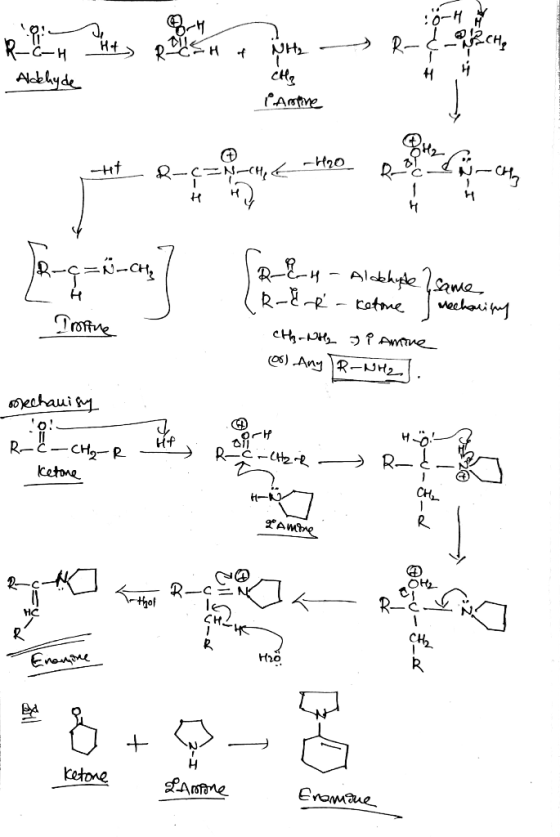
When carbonyl compounds react with primary amines, an imine is usually produced while a secondary amine gives an enamine. Propose a mechanism to explain this
Homework Answers
the reaction mechanisms for the formation of imine and
enamine as follows
Add Answer to:
When carbonyl compounds react with primary amines, an imine is
usually produced while a secondary amine...
Classify each of the compounds as a primary, secondary, or tertiary amine. Primary amine Secondary amine
 Classify each of the compounds as a primary, secondary, or tertiary amine. Primary amine Secondary amine
oleh Secondary amines add to aldehydes and ketones to give enamines. Enamines are formed in a...
 oleh Secondary amines add to aldehydes and ketones to give enamines. Enamines are formed in a reversible, acid-catalyzed process that begins with nucleophilic addition of the secondary amine to the carbonyl group, followed by transfer of the proton to yield a neutral carbinolamine. Protonation of the hydroxyl group converts it into a good leaving group, however there is no hydrogen left on the nitrogen to be lost to form a neutral imine product. Instead, a proton is lost from the...
CH3 CH2 Secondary amines add to aldehydes and ketones to give enamines. Enamines are formed in...
 CH3 CH2 Secondary amines add to aldehydes and ketones to give enamines. Enamines are formed in a reversible, acid-catalyzed proces nucleophilic addition of the secondary amine to the carbonyl group, followed by transfer of the proton to yield a neutral carbinolanine Prosonation of the hydroxyl group converts it into a good leaving group, is no Instead, a proton is lost from the neighboring carbon to form an enamine. p, however there is no hydrogen left on the nitrogen to be...
Primary and secondary amines form hydrogen bonds among themselves. Assume you have a solution of ethanamine...
Primary and secondary amines form hydrogen bonds among themselves. Assume you have a solution of ethanamine (ethylamine). Several proposed amine dimers are presented with the hydrogen bond highlighted as a dotted line. Select the compounds that show a valid hydrogen bond.
answer all parts Predict the two structures of the major products obtained when the following compound...
 answer all parts
Predict the two structures of the major products obtained when the following compound undergoes acid hydrolysis. CH, HO Hint: This compound is an enamine, formed from a carbonyl compound (ketone or aldehyde) and a secondary amine. Predict the two structures of the major products obtained when the following compound undergoes acid hydrolysis. Hint: This compound is an enamine, formed from a carbonyl compound (ketone or aldehyde) and a secondary amine. Predict the two structures of the major...
answer all parts
Predict the two structures of the major products obtained when the following compound undergoes acid hydrolysis. CH, HO Hint: This compound is an enamine, formed from a carbonyl compound (ketone or aldehyde) and a secondary amine. Predict the two structures of the major products obtained when the following compound undergoes acid hydrolysis. Hint: This compound is an enamine, formed from a carbonyl compound (ketone or aldehyde) and a secondary amine. Predict the two structures of the major...
2. A reaction discussed in class involved treating a primary amine with chloroform under basic! conditions to...
 2. A reaction discussed in class involved treating a primary amine with chloroform under basic! conditions to form an isocyanide. When a secondary amine was used instead, an amide was formed: NaOH NaOH CHCIE R-NEC + CHCIE RNH2 + Lº amine RỌNH 2° amine HANR2 2. A reaction discussed in class involved treating a primary amine with chloroform under basic conditions to form an isocyanide. When a secondary amine was used instead, an amide was formed: NaOH NaOH CHCIE R-NEC...
When acyl halides (R?COX) or acid anhydrides (R?OC?O?CO?R) react with primary amines (R?NH2) or secondary amines...
 When acyl halides (R?COX) or acid anhydrides (R?OC?O?CO?R) react
with primary amines (R?NH2) or secondary amines (R2NH), the
reaction yields an amide:
O || R?C?NR2
where R may be an alkyl group or hydrogen atom.
For example, propanoyl chloride
( O ||CH3CH2C?Cl)
reacts with ethanamine (CH3CH2NH2) to form
(O || CH3CH2C?NHCH2CH3).
The IUPAC name for the product isN-ethyl propanamide, as
it is formed from ethanamine and propanoyl
chloride.
Match the names of the products for the following reactions.
Identify the products by dragging the appropriate labels...
When acyl halides (R?COX) or acid anhydrides (R?OC?O?CO?R) react
with primary amines (R?NH2) or secondary amines (R2NH), the
reaction yields an amide:
O || R?C?NR2
where R may be an alkyl group or hydrogen atom.
For example, propanoyl chloride
( O ||CH3CH2C?Cl)
reacts with ethanamine (CH3CH2NH2) to form
(O || CH3CH2C?NHCH2CH3).
The IUPAC name for the product isN-ethyl propanamide, as
it is formed from ethanamine and propanoyl
chloride.
Match the names of the products for the following reactions.
Identify the products by dragging the appropriate labels...
1. Reductive amination (Carey, Section 22.10) is an important C-N bond forming strategy widely used in...
 1. Reductive amination (Carey, Section 22.10) is an important C-N bond forming strategy widely used in the synthesis of biologically active natural product. It's a powerful and reliable strategy that avoids the problem of overalkylation that often accompanies direct alkylation of amines with alkyl halides (Figure 1). secondary amine r tiary amine quemary sa Figure 1: Yields are generally poor as product amines are more nucleophilic and can also react with halide. The result is often a mixture of amines...
COURSE TITE & CODE-Organic Chemistry-II (CHEM3201) EXERCISE NO-1 Exercise: 1. How is classification of amines different...
 COURSE TITE & CODE-Organic Chemistry-II (CHEM3201) EXERCISE NO-1 Exercise: 1. How is classification of amines different from that of alcohols? Exercise: 2. Amines are more basic than comparable alcohols. Exercise: 3. How will you distinguish between (a) Aniline and methyl amine (b) Di-methyl amine and tri-methyl amine. Exercise: 4. Write structure and IUPAC name of The amide which gives propanamine by Hofmann bromamide reaction (ii) The salt which gives methylene cyclohexene & trimethylamine by the Hoffman elimination reaction. Exercise: 5....
O EtOCOET H N Eto EtOH Reactions of a primary or secondary amine with diethyl carbonate...
 O EtOCOET H N Eto EtOH Reactions of a primary or secondary amine with diethyl carbonate under controlled conditions gives a carbamic ester. Write a detailed mechanism for this reaction (shown above) which proceeds in 4 steps, including proton transfer steps. Then draw Intermediate 3 in the window provided. The mechanism is detailed as follows: Step 1: Nucleophilic attack to yield zwitterion intermediate 1. Step 2: Protonation/deprotonation (i.e. "proton transfer") of zwitterion 1 to yield intermediate 2. Step 3: Intramolecular...
 Classify each of the compounds as a primary, secondary, or tertiary amine. Primary amine Secondary amine
 oleh Secondary amines add to aldehydes and ketones to give enamines. Enamines are formed in a reversible, acid-catalyzed process that begins with nucleophilic addition of the secondary amine to the carbonyl group, followed by transfer of the proton to yield a neutral carbinolamine. Protonation of the hydroxyl group converts it into a good leaving group, however there is no hydrogen left on the nitrogen to be lost to form a neutral imine product. Instead, a proton is lost from the...
 CH3 CH2 Secondary amines add to aldehydes and ketones to give enamines. Enamines are formed in a reversible, acid-catalyzed proces nucleophilic addition of the secondary amine to the carbonyl group, followed by transfer of the proton to yield a neutral carbinolanine Prosonation of the hydroxyl group converts it into a good leaving group, is no Instead, a proton is lost from the neighboring carbon to form an enamine. p, however there is no hydrogen left on the nitrogen to be...
 answer all parts
Predict the two structures of the major products obtained when the following compound undergoes acid hydrolysis. CH, HO Hint: This compound is an enamine, formed from a carbonyl compound (ketone or aldehyde) and a secondary amine. Predict the two structures of the major products obtained when the following compound undergoes acid hydrolysis. Hint: This compound is an enamine, formed from a carbonyl compound (ketone or aldehyde) and a secondary amine. Predict the two structures of the major...
answer all parts
Predict the two structures of the major products obtained when the following compound undergoes acid hydrolysis. CH, HO Hint: This compound is an enamine, formed from a carbonyl compound (ketone or aldehyde) and a secondary amine. Predict the two structures of the major products obtained when the following compound undergoes acid hydrolysis. Hint: This compound is an enamine, formed from a carbonyl compound (ketone or aldehyde) and a secondary amine. Predict the two structures of the major...
 2. A reaction discussed in class involved treating a primary amine with chloroform under basic! conditions to form an isocyanide. When a secondary amine was used instead, an amide was formed: NaOH NaOH CHCIE R-NEC + CHCIE RNH2 + Lº amine RỌNH 2° amine HANR2 2. A reaction discussed in class involved treating a primary amine with chloroform under basic conditions to form an isocyanide. When a secondary amine was used instead, an amide was formed: NaOH NaOH CHCIE R-NEC...
 When acyl halides (R?COX) or acid anhydrides (R?OC?O?CO?R) react
with primary amines (R?NH2) or secondary amines (R2NH), the
reaction yields an amide:
O || R?C?NR2
where R may be an alkyl group or hydrogen atom.
For example, propanoyl chloride
( O ||CH3CH2C?Cl)
reacts with ethanamine (CH3CH2NH2) to form
(O || CH3CH2C?NHCH2CH3).
The IUPAC name for the product isN-ethyl propanamide, as
it is formed from ethanamine and propanoyl
chloride.
Match the names of the products for the following reactions.
Identify the products by dragging the appropriate labels...
When acyl halides (R?COX) or acid anhydrides (R?OC?O?CO?R) react
with primary amines (R?NH2) or secondary amines (R2NH), the
reaction yields an amide:
O || R?C?NR2
where R may be an alkyl group or hydrogen atom.
For example, propanoyl chloride
( O ||CH3CH2C?Cl)
reacts with ethanamine (CH3CH2NH2) to form
(O || CH3CH2C?NHCH2CH3).
The IUPAC name for the product isN-ethyl propanamide, as
it is formed from ethanamine and propanoyl
chloride.
Match the names of the products for the following reactions.
Identify the products by dragging the appropriate labels...
 1. Reductive amination (Carey, Section 22.10) is an important C-N bond forming strategy widely used in the synthesis of biologically active natural product. It's a powerful and reliable strategy that avoids the problem of overalkylation that often accompanies direct alkylation of amines with alkyl halides (Figure 1). secondary amine r tiary amine quemary sa Figure 1: Yields are generally poor as product amines are more nucleophilic and can also react with halide. The result is often a mixture of amines...
 COURSE TITE & CODE-Organic Chemistry-II (CHEM3201) EXERCISE NO-1 Exercise: 1. How is classification of amines different from that of alcohols? Exercise: 2. Amines are more basic than comparable alcohols. Exercise: 3. How will you distinguish between (a) Aniline and methyl amine (b) Di-methyl amine and tri-methyl amine. Exercise: 4. Write structure and IUPAC name of The amide which gives propanamine by Hofmann bromamide reaction (ii) The salt which gives methylene cyclohexene & trimethylamine by the Hoffman elimination reaction. Exercise: 5....
 O EtOCOET H N Eto EtOH Reactions of a primary or secondary amine with diethyl carbonate under controlled conditions gives a carbamic ester. Write a detailed mechanism for this reaction (shown above) which proceeds in 4 steps, including proton transfer steps. Then draw Intermediate 3 in the window provided. The mechanism is detailed as follows: Step 1: Nucleophilic attack to yield zwitterion intermediate 1. Step 2: Protonation/deprotonation (i.e. "proton transfer") of zwitterion 1 to yield intermediate 2. Step 3: Intramolecular...
Most questions answered within 3 hours.
-
Where is the error in this code sequence?
String s1 = "Hello";
String s2 = "ello";...
asked 10 months ago -
Financial data for Joel de Paris, Inc., for last year
follow:
Joel de Paris, Inc.
Balance...
asked 10 months ago -
Consider this reaction:
Al2(SO4)3 (aq)+ BaCl3
(aq) Al2Cl6 (aq)- +
3BaSO4(s) . What is the...
asked 10 months ago -
Suppose that Savneet is considering increasing her
recent random sample from 20 car rentals to 40...
asked 10 months ago -
Trucks arrive at an unloading terminal at an average rate of 120
per hour.
Trucks arrive...
asked 10 months ago -
Why are methanol and ethanol completely soluble in water while
octanol is not very little soluble....
asked 10 months ago -
A facilities manager at a university reads in a research report
that the mean amount of...
asked 10 months ago -
When the CuSO4 is rehydrated by adding water to the anhydrous
compound, is this an endothermic...
asked 10 months ago -
A ray of sunlight is passing from diamond into crown glass; the
angle of incidence is...
asked 10 months ago -
A block of mass 0.249 kg is placed on top of a light, vertical
spring of...
asked 10 months ago -
how do the kidneys compensate in the presences of acidosis
a) trigger hyperventilate
b) reserve acid...
asked 10 months ago -
Question 501 pts
The rental rate of capital to the firm increases. Which of the
following...
asked 10 months ago