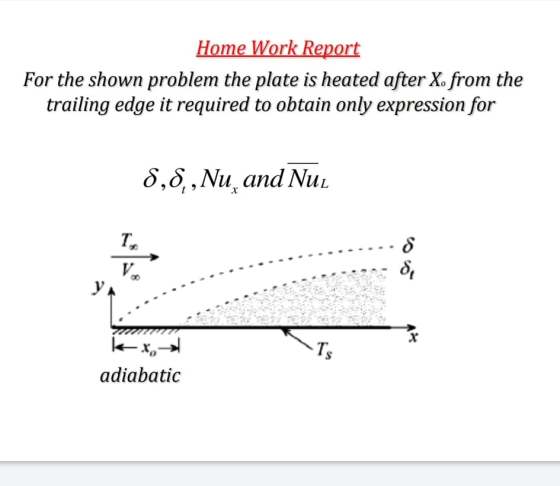
for the shown proplem the plate is heated after x0 from the trailing edge it reqired to obtain only expression for.....
Homework Answers
Request Answer!
We need at least 10 more requests to produce the answer.
0 / 10 have requested this problem solution
The more requests, the faster the answer.
Add Answer to:
for the shown proplem the plate is heated after x0 from the trailing edge it reqired to obtain only expression for.....
for the shown proplem the plate is heated after x0 from the trailing edge it reqired to obtain only expression for.....
 <p><img src="https://img.homeworklib.com/uploads/ueditor/20210628/1624880049511478.jpg" title="1624880049511478.jpg" alt="208892554_4095572467222714_4697777210856601985_n.jpg"/></p>
The image below is of an aluminium plate that will be heated from the bottom. If...
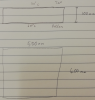 The image below is of an aluminium plate that will be heated
from the bottom. If the temperature at the bottom of the plate is
600 degrees Celsius and 20 degrees at the top, how long will it
take for the top of the plate to reach 200 degrees Celsius?
Thermal conductivity = 200 W/mK
Specific heat = 921.096 J/kgK
mass of plate = 70kg
ToP 100 Battom 5 00 mm
ToP 100 Battom 5 00 mm
The image below is of an aluminium plate that will be heated
from the bottom. If the temperature at the bottom of the plate is
600 degrees Celsius and 20 degrees at the top, how long will it
take for the top of the plate to reach 200 degrees Celsius?
Thermal conductivity = 200 W/mK
Specific heat = 921.096 J/kgK
mass of plate = 70kg
ToP 100 Battom 5 00 mm
ToP 100 Battom 5 00 mm
For the mechanism shown, obtain the following: The mobility of the system Develop an analytical expression...
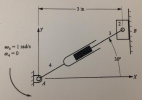 For the mechanism shown, obtain the following:
The mobility of the system
Develop an analytical expression to determine the position of
point B with 4as input.
Find an analytical expression to determine the velocity of
point B with 4as input.
Find the instantaneous centers for the system.
3 in 2 = 1 rad/s 4 30° 4
For the mechanism shown, obtain the following:
The mobility of the system
Develop an analytical expression to determine the position of
point B with 4as input.
Find an analytical expression to determine the velocity of
point B with 4as input.
Find the instantaneous centers for the system.
3 in 2 = 1 rad/s 4 30° 4
2) Consider the arrangement of currents shown A. Obtain a symbolic expression for the total force...
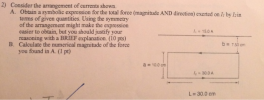 2) Consider the arrangement of currents shown A. Obtain a symbolic expression for the total force (magnitude AND direction) exerted on li by l2in terms of given quantities. Using the symmetry of the arrangement might make the expression easier to obtain, but you should justify your reasoning with a BRIEF explanation. (10 pts) Calculate the numerical magnitude of the force you found in A. (1 pt) ,15.0 A B. 7.50 cm a 10.0 cm 30.0A L-30.0 cm
i About Exercise 9.5.8 For the circuit shown in the figure above: Obtain an expression for...
 i About Exercise 9.5.8 For the circuit shown in the figure above: Obtain an expression for H (u) = Ve /V, in standard form. Generate spectral plots for the magnitude and phase of H(w), given that R 1000. L 0.1 mH, and C 1/LF. Determine the cutoff frequency we and the slope of the magnitude (in dB) when w/w, 》 1. Feedback?
1) Determine the distance from the leading edge of a flat plate at which transition will...
 1) Determine the distance from the leading edge of a flat plate at which transition will occur for each of the following fluids when u., = 2 m/s and film temperature of 127 C: atmospheric air, hydrogen and mercury. 2) Repeat the calculations for fluid film temperature of 177 °C.
Problem 5: 1) Determine the distance from the leading edge of a flat plate at which...
 Problem 5: 1) Determine the distance from the leading edge of a flat plate at which transition will occur for each of the following fluids when u, = 2 m/s and film temperature of 127 °C: atmospheric air, hydrogen, and mercury. 2) Repeat the calculations for fluid film temperature of 177 °C.
A grasshopper leaps into the air from the edge of a vertical cliff, as shown in...
A grasshopper leaps into the air from the edge of a vertical cliff, as shown in the figure below (Figure 1). Assume that d1=7.26cm, d2=1.07m, and that θ=46∘ A) Use the information given to find the initial speed of the grasshopper. Express your answer in meters per second to three significant figures. B) Use the information given to find the height of the cliff. Express your answer in meters to three significant figures.
person threw a ball from the edge of a vertical cliff , as shown in Fig...
 person threw a ball from the edge of a vertical cliff
, as shown in Fig . ( I ) . Ignore the air resistance and find the
following : ( a ) The initial speed of the ball ( b ) Height of the
cliff .
6.74 cm 50.0° Not to scale 1.06 m Fig.(1)
person threw a ball from the edge of a vertical cliff
, as shown in Fig . ( I ) . Ignore the air resistance and find the
following : ( a ) The initial speed of the ball ( b ) Height of the
cliff .
6.74 cm 50.0° Not to scale 1.06 m Fig.(1)
Microbiology. How would you obtain a pure culture of a single bacterial species from agar plate...
Microbiology. How would you obtain a pure culture of a single bacterial species from agar plate holding a mixed population of bacteria? What methods would you use to identify this bacterium that you have isolated?
 The image below is of an aluminium plate that will be heated
from the bottom. If the temperature at the bottom of the plate is
600 degrees Celsius and 20 degrees at the top, how long will it
take for the top of the plate to reach 200 degrees Celsius?
Thermal conductivity = 200 W/mK
Specific heat = 921.096 J/kgK
mass of plate = 70kg
ToP 100 Battom 5 00 mm
ToP 100 Battom 5 00 mm
The image below is of an aluminium plate that will be heated
from the bottom. If the temperature at the bottom of the plate is
600 degrees Celsius and 20 degrees at the top, how long will it
take for the top of the plate to reach 200 degrees Celsius?
Thermal conductivity = 200 W/mK
Specific heat = 921.096 J/kgK
mass of plate = 70kg
ToP 100 Battom 5 00 mm
ToP 100 Battom 5 00 mm
 For the mechanism shown, obtain the following:
The mobility of the system
Develop an analytical expression to determine the position of
point B with 4as input.
Find an analytical expression to determine the velocity of
point B with 4as input.
Find the instantaneous centers for the system.
3 in 2 = 1 rad/s 4 30° 4
For the mechanism shown, obtain the following:
The mobility of the system
Develop an analytical expression to determine the position of
point B with 4as input.
Find an analytical expression to determine the velocity of
point B with 4as input.
Find the instantaneous centers for the system.
3 in 2 = 1 rad/s 4 30° 4
 2) Consider the arrangement of currents shown A. Obtain a symbolic expression for the total force (magnitude AND direction) exerted on li by l2in terms of given quantities. Using the symmetry of the arrangement might make the expression easier to obtain, but you should justify your reasoning with a BRIEF explanation. (10 pts) Calculate the numerical magnitude of the force you found in A. (1 pt) ,15.0 A B. 7.50 cm a 10.0 cm 30.0A L-30.0 cm
 i About Exercise 9.5.8 For the circuit shown in the figure above: Obtain an expression for H (u) = Ve /V, in standard form. Generate spectral plots for the magnitude and phase of H(w), given that R 1000. L 0.1 mH, and C 1/LF. Determine the cutoff frequency we and the slope of the magnitude (in dB) when w/w, 》 1. Feedback?
 1) Determine the distance from the leading edge of a flat plate at which transition will occur for each of the following fluids when u., = 2 m/s and film temperature of 127 C: atmospheric air, hydrogen and mercury. 2) Repeat the calculations for fluid film temperature of 177 °C.
 Problem 5: 1) Determine the distance from the leading edge of a flat plate at which transition will occur for each of the following fluids when u, = 2 m/s and film temperature of 127 °C: atmospheric air, hydrogen, and mercury. 2) Repeat the calculations for fluid film temperature of 177 °C.
 person threw a ball from the edge of a vertical cliff
, as shown in Fig . ( I ) . Ignore the air resistance and find the
following : ( a ) The initial speed of the ball ( b ) Height of the
cliff .
6.74 cm 50.0° Not to scale 1.06 m Fig.(1)
person threw a ball from the edge of a vertical cliff
, as shown in Fig . ( I ) . Ignore the air resistance and find the
following : ( a ) The initial speed of the ball ( b ) Height of the
cliff .
6.74 cm 50.0° Not to scale 1.06 m Fig.(1)
Most questions answered within 3 hours.
-
Where is the error in this code sequence?
String s1 = "Hello";
String s2 = "ello";...
asked 10 months ago -
Financial data for Joel de Paris, Inc., for last year
follow:
Joel de Paris, Inc.
Balance...
asked 10 months ago -
Consider this reaction:
Al2(SO4)3 (aq)+ BaCl3
(aq) Al2Cl6 (aq)- +
3BaSO4(s) . What is the...
asked 10 months ago -
Suppose that Savneet is considering increasing her
recent random sample from 20 car rentals to 40...
asked 10 months ago -
Trucks arrive at an unloading terminal at an average rate of 120
per hour.
Trucks arrive...
asked 10 months ago -
Why are methanol and ethanol completely soluble in water while
octanol is not very little soluble....
asked 10 months ago -
A facilities manager at a university reads in a research report
that the mean amount of...
asked 10 months ago -
When the CuSO4 is rehydrated by adding water to the anhydrous
compound, is this an endothermic...
asked 10 months ago -
A ray of sunlight is passing from diamond into crown glass; the
angle of incidence is...
asked 10 months ago -
A block of mass 0.249 kg is placed on top of a light, vertical
spring of...
asked 10 months ago -
how do the kidneys compensate in the presences of acidosis
a) trigger hyperventilate
b) reserve acid...
asked 10 months ago -
Question 501 pts
The rental rate of capital to the firm increases. Which of the
following...
asked 10 months ago