
Homework Answers

Add Answer to:
Question 23 15 pts Consider the following reaction: N2O(g) + NO2(g) 3NO(g) AH = 155.7 kJ...
Suppose a reaction occurs with the following mechanism: Step 1: 2AD Step 2: D+E- (fast) B+C...
 Suppose a reaction occurs with the following mechanism: Step 1: 2AD Step 2: D+E- (fast) B+C (slow) 1. What is the overall reaction? [Select] 2. What is the intermediate in the mechanism? (Select] 3. What is the molecularity of step 1? (Select 4. Which step is the rate determining step? [Select) 5. What is the rate law predicted by this mechanism? [Select) Question 22 15 pts Consider the following reaction at equilibrium: CO(g) + 2H2(g) CH2OH(g) AH=-18 kJ How will...
8) The rate law for the following reaction N2O(g) + NO2(g) → 3NO(g) is Rate =...
8) The rate law for the following reaction N2O(g) + NO2(g) → 3NO(g) is Rate = k [N2O][NO2]2. Fill in the blank in the table below. Experiment [N2O], M [NO2], M Initial Rate, MS-1 1 0.100 0.100 2.0x10⁻³ 2 0.300 0.100 6.0x10⁻³ 3 0.100 0.200 ? a) 2.0x10⁻³ Ms−1 b) 4.0x10⁻³ Ms−1 c) 8.0x10⁻³ Ms−1 d) 6.0x10⁻³ Ms-1 e) 1.0x10⁻² Ms−1
Given the following equation, N2O(g)+NO2(g) ---> 3NO(g) deltaG° rxn=-23.0 kj Calculating deltaG° rxn for the following...
Given the following equation, N2O(g)+NO2(g) ---> 3NO(g) deltaG° rxn=-23.0 kj Calculating deltaG° rxn for the following reaction. 18 NO(g) ---> 6N2O(g)+6NO2(g)
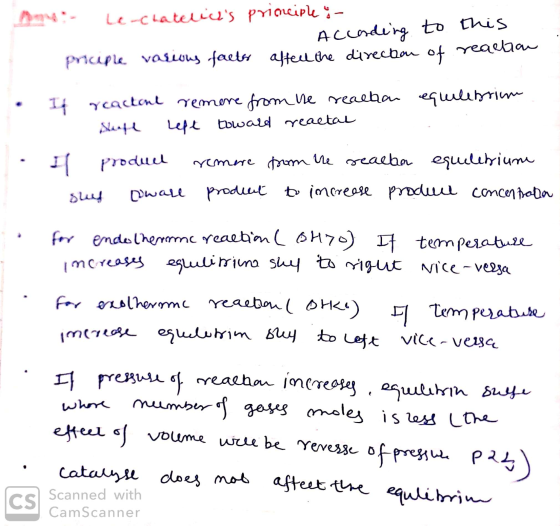
le chatelier's principle question. 3NO->N2O+NO2 (all gas, exothemic reaction) 1)Add inert gas to the equilibrium mixt...
le chatelier's principle question. 3NO->N2O+NO2 (all gas, exothemic reaction) 1)Add inert gas to the equilibrium mixture while maintaining constant overall pressure and temperature. 2)Add inert gas to the equilibrium mixture without changing volume. 1) <- (left) 2) no reaction are the answer, please explain why...!!!!! + Please correct my oppinion
0.0455 O 0.0330 QUESTION 8 Consider the reaction shown below. AH is positive for the reaction....
 0.0455 O 0.0330 QUESTION 8 Consider the reaction shown below. AH is positive for the reaction. 4CuO (s) + CH4 (9) CO2(g) + 4Cu (s) + 2H20 (9) State whether each change will cause the reaction to shift to the left, to the right, or no change. Enter the words "left","right" or "no change (without the quotation marks) into each blank. A coldfinger is added to condense out water vapor (H20 (g)) in the reaction mixture. The partial pressure of...
Consider the following reaction at equilibrium, 2Cl2(g)+2H2O(g)⇌4HCl(g)+O2(g) This equilbrium can be shifted to the right by:...
Consider the following reaction at equilibrium, 2Cl2(g)+2H2O(g)⇌4HCl(g)+O2(g) This equilbrium can be shifted to the right by: A.) decreasing the volume. B.) increasing the volume of the mixture. C.) removing H20 from the mixture. D. adding Ne(g) to the mixture. E. adding more 02 to the mixture.
10. (5 pts) Consider the following reaction in equilibrium H2(g) + Br(g) → 2 HBr (g) AH = +68 kJ How will each of t...
 10. (5 pts) Consider the following reaction in equilibrium H2(g) + Br(g) → 2 HBr (g) AH = +68 kJ How will each of the following changes affect the equilibrium concentrations of each chemical: a) addition of HBr(s) b) increasing temperature and timor od moment c) increasing pressure d) decreasing volume of the reacting vessel at constant temperature. e) addition of bromine f) addition of argon neonatology g) addition of catalyst bobb s oods Laboratorio
StUP 7. (5 pts) The equilibrium constant for dissociation of silver chloride AgCl (s) Ag' (aq)...
 StUP 7. (5 pts) The equilibrium constant for dissociation of silver chloride AgCl (s) Ag' (aq) + CI (aq) Is 1.8x10¹⁰ Find concentration of silver and chloride ions in saturated aqueous solution of silver chloride (10 pts) The equilibrium constant at certain temperature for 8 H2(g) +1:(g) 2 HI(g) is 55.17. If 10mole of hydrogen and 1.0 mole of iodine are placed in 0.5L flask, what is the equilibrium concentration of hydrogen iodide? (10 pts) Solid ammonium carbamate decomposes to...
Consider the reaction H2(g) + Cl2(g) ⇌ 2HCl(g) which of the following stresses will cause the...
Consider the reaction H2(g) + Cl2(g) ⇌ 2HCl(g) which of the following stresses will cause the reaction shift in the forward direction? a. decreasing the pressure b. removing some HCl(g) c. increasing the pressure d. removing some H2(g) Consider the reaction N2(g)+2O2(g)→2NO2(g), which stress will cause the reaction shift to the left a. increasing the pressure b. removing some NO2(g) c. adding a catalyst d. decreasing the pressure Phenolphthalein is an indicator with a pH range from 8.3 to 10.0....
10. (5 pts) Consider the following reaction in equilibrium H2(g) + Brz(g) → 2 HBr (g)...
 10. (5 pts) Consider the following reaction in equilibrium H2(g) + Brz(g) → 2 HBr (g) AH = + 68 kJ How will each of the following changes affect the equilibrium concentrations of each chemical: a) addition of HBr(g) b) increasing temperature c) increasing pressure d) decreasing volume of the reacting vessel at constant temperature. e) addition of bromine f) addition of argon g) addition of catalyst
 Suppose a reaction occurs with the following mechanism: Step 1: 2AD Step 2: D+E- (fast) B+C (slow) 1. What is the overall reaction? [Select] 2. What is the intermediate in the mechanism? (Select] 3. What is the molecularity of step 1? (Select 4. Which step is the rate determining step? [Select) 5. What is the rate law predicted by this mechanism? [Select) Question 22 15 pts Consider the following reaction at equilibrium: CO(g) + 2H2(g) CH2OH(g) AH=-18 kJ How will...
 0.0455 O 0.0330 QUESTION 8 Consider the reaction shown below. AH is positive for the reaction. 4CuO (s) + CH4 (9) CO2(g) + 4Cu (s) + 2H20 (9) State whether each change will cause the reaction to shift to the left, to the right, or no change. Enter the words "left","right" or "no change (without the quotation marks) into each blank. A coldfinger is added to condense out water vapor (H20 (g)) in the reaction mixture. The partial pressure of...
 10. (5 pts) Consider the following reaction in equilibrium H2(g) + Br(g) → 2 HBr (g) AH = +68 kJ How will each of the following changes affect the equilibrium concentrations of each chemical: a) addition of HBr(s) b) increasing temperature and timor od moment c) increasing pressure d) decreasing volume of the reacting vessel at constant temperature. e) addition of bromine f) addition of argon neonatology g) addition of catalyst bobb s oods Laboratorio
 StUP 7. (5 pts) The equilibrium constant for dissociation of silver chloride AgCl (s) Ag' (aq) + CI (aq) Is 1.8x10¹⁰ Find concentration of silver and chloride ions in saturated aqueous solution of silver chloride (10 pts) The equilibrium constant at certain temperature for 8 H2(g) +1:(g) 2 HI(g) is 55.17. If 10mole of hydrogen and 1.0 mole of iodine are placed in 0.5L flask, what is the equilibrium concentration of hydrogen iodide? (10 pts) Solid ammonium carbamate decomposes to...
 10. (5 pts) Consider the following reaction in equilibrium H2(g) + Brz(g) → 2 HBr (g) AH = + 68 kJ How will each of the following changes affect the equilibrium concentrations of each chemical: a) addition of HBr(g) b) increasing temperature c) increasing pressure d) decreasing volume of the reacting vessel at constant temperature. e) addition of bromine f) addition of argon g) addition of catalyst
Most questions answered within 3 hours.
-
Where is the error in this code sequence?
String s1 = "Hello";
String s2 = "ello";...
asked 10 months ago -
Financial data for Joel de Paris, Inc., for last year
follow:
Joel de Paris, Inc.
Balance...
asked 10 months ago -
Consider this reaction:
Al2(SO4)3 (aq)+ BaCl3
(aq) Al2Cl6 (aq)- +
3BaSO4(s) . What is the...
asked 10 months ago -
Suppose that Savneet is considering increasing her
recent random sample from 20 car rentals to 40...
asked 10 months ago -
Trucks arrive at an unloading terminal at an average rate of 120
per hour.
Trucks arrive...
asked 10 months ago -
Why are methanol and ethanol completely soluble in water while
octanol is not very little soluble....
asked 10 months ago -
A facilities manager at a university reads in a research report
that the mean amount of...
asked 10 months ago -
When the CuSO4 is rehydrated by adding water to the anhydrous
compound, is this an endothermic...
asked 10 months ago -
A ray of sunlight is passing from diamond into crown glass; the
angle of incidence is...
asked 10 months ago -
A block of mass 0.249 kg is placed on top of a light, vertical
spring of...
asked 10 months ago -
how do the kidneys compensate in the presences of acidosis
a) trigger hyperventilate
b) reserve acid...
asked 10 months ago -
Question 501 pts
The rental rate of capital to the firm increases. Which of the
following...
asked 10 months ago