When comparing the spectra for the starting material and
the product – where do you observe the biggest
change(s)?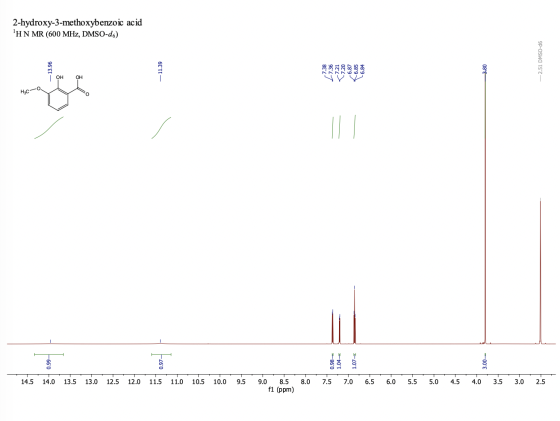
Homework Answers
Carboxylic acid hydrogens occur as broad or very broad singlets due to chemical exchange. Their exact chemical shift depends on concentration, temperature, and solvent but usually you will found the peaks beyond 10 around 14 or 15 ppm( not fixed.)
So the two peaks beyond 10 one is of OH of carboxylic acid and another is of Alcoholic OH.
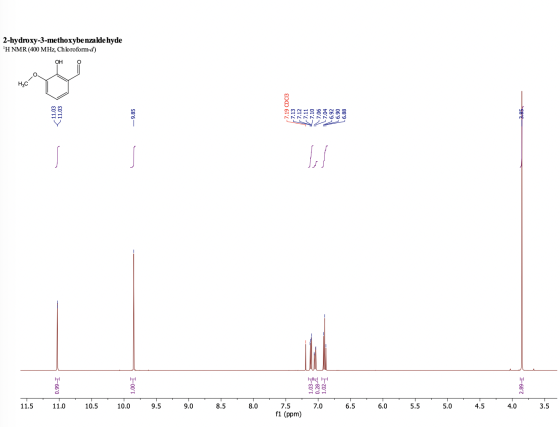
When you convert carboxylic acid to aldehyde you will find an additional peak in between 9.5 to 10.5 for aldehydic Hydrogen ( fixed) Maximum time you will fijd at around 9.8 ppm.
Here also if you say the only major change is at 9.8 fir aldehydic Hydrogen and absence of peak at 14.
Other things remaining same.
Thanks for asking the question.
Add Answer to:
When comparing the spectra for the starting material and
the product – where do you observe...
When comparing the spectra for the starting material and the product – where do you observe...
 When comparing the spectra for the starting material and
the product – where do you observe the biggest
change(s)?
2-hydroxy-3-methoxybenzoic acid HN MR (600 MHz, DMSO-do) -251DMS0-d6 -13.96 1139 ;2.38 7:21 7.20 L89- 6.85 17.36 .6.84 380 он он ܢ0-Hac 0.98- ܓ104 107z 3.00- 14.5 14.0 13.5 13.0_12.5 12.0 115 11. 010.5_10.0 9. 5 _8.0 7. 5 7 . 0 6.5 _6. 0 5 . 5 5 .0 4. 5 4 .0 _3.5 _3.0 _2.5 9.0 _8.5 f1 (ppm) 2-hydroxy-3-methoxybenzaldehyde...
When comparing the spectra for the starting material and
the product – where do you observe the biggest
change(s)?
2-hydroxy-3-methoxybenzoic acid HN MR (600 MHz, DMSO-do) -251DMS0-d6 -13.96 1139 ;2.38 7:21 7.20 L89- 6.85 17.36 .6.84 380 он он ܢ0-Hac 0.98- ܓ104 107z 3.00- 14.5 14.0 13.5 13.0_12.5 12.0 115 11. 010.5_10.0 9. 5 _8.0 7. 5 7 . 0 6.5 _6. 0 5 . 5 5 .0 4. 5 4 .0 _3.5 _3.0 _2.5 9.0 _8.5 f1 (ppm) 2-hydroxy-3-methoxybenzaldehyde...
When comparing the spectra for the starting material and the product - where do you observe...
 When comparing the spectra for the starting material and the product - where do you observe the biggest change(s)? 2-hydroxy-3-methoxybenzaldehyde 13C-NMR (400 MHz, Chloroforat)- - 196.60 - 151.66 - 148.31 124.54 120.79 119.56 117.95 77.34 CDC13 77.02 CDC13 76.71 CDC3 77.23 -4000 DE'95 — - 3500 3000 2500 2000 1500 1000 500 210 200 190 180 170160 150 140 130 120 110 100 90 fi (ppm) 80 70 60 50 40 30 20 10 0 -10 -o zoo OH O...
 When comparing the spectra for the starting material and
the product – where do you observe the biggest
change(s)?
2-hydroxy-3-methoxybenzoic acid HN MR (600 MHz, DMSO-do) -251DMS0-d6 -13.96 1139 ;2.38 7:21 7.20 L89- 6.85 17.36 .6.84 380 он он ܢ0-Hac 0.98- ܓ104 107z 3.00- 14.5 14.0 13.5 13.0_12.5 12.0 115 11. 010.5_10.0 9. 5 _8.0 7. 5 7 . 0 6.5 _6. 0 5 . 5 5 .0 4. 5 4 .0 _3.5 _3.0 _2.5 9.0 _8.5 f1 (ppm) 2-hydroxy-3-methoxybenzaldehyde...
When comparing the spectra for the starting material and
the product – where do you observe the biggest
change(s)?
2-hydroxy-3-methoxybenzoic acid HN MR (600 MHz, DMSO-do) -251DMS0-d6 -13.96 1139 ;2.38 7:21 7.20 L89- 6.85 17.36 .6.84 380 он он ܢ0-Hac 0.98- ܓ104 107z 3.00- 14.5 14.0 13.5 13.0_12.5 12.0 115 11. 010.5_10.0 9. 5 _8.0 7. 5 7 . 0 6.5 _6. 0 5 . 5 5 .0 4. 5 4 .0 _3.5 _3.0 _2.5 9.0 _8.5 f1 (ppm) 2-hydroxy-3-methoxybenzaldehyde...
 When comparing the spectra for the starting material and the product - where do you observe the biggest change(s)? 2-hydroxy-3-methoxybenzaldehyde 13C-NMR (400 MHz, Chloroforat)- - 196.60 - 151.66 - 148.31 124.54 120.79 119.56 117.95 77.34 CDC13 77.02 CDC13 76.71 CDC3 77.23 -4000 DE'95 — - 3500 3000 2500 2000 1500 1000 500 210 200 190 180 170160 150 140 130 120 110 100 90 fi (ppm) 80 70 60 50 40 30 20 10 0 -10 -o zoo OH O...
Most questions answered within 3 hours.
-
Where is the error in this code sequence?
String s1 = "Hello";
String s2 = "ello";...
asked 10 months ago -
Financial data for Joel de Paris, Inc., for last year
follow:
Joel de Paris, Inc.
Balance...
asked 10 months ago -
Consider this reaction:
Al2(SO4)3 (aq)+ BaCl3
(aq) Al2Cl6 (aq)- +
3BaSO4(s) . What is the...
asked 10 months ago -
Suppose that Savneet is considering increasing her
recent random sample from 20 car rentals to 40...
asked 10 months ago -
Trucks arrive at an unloading terminal at an average rate of 120
per hour.
Trucks arrive...
asked 10 months ago -
Why are methanol and ethanol completely soluble in water while
octanol is not very little soluble....
asked 10 months ago -
A facilities manager at a university reads in a research report
that the mean amount of...
asked 10 months ago -
When the CuSO4 is rehydrated by adding water to the anhydrous
compound, is this an endothermic...
asked 10 months ago -
A ray of sunlight is passing from diamond into crown glass; the
angle of incidence is...
asked 10 months ago -
A block of mass 0.249 kg is placed on top of a light, vertical
spring of...
asked 10 months ago -
how do the kidneys compensate in the presences of acidosis
a) trigger hyperventilate
b) reserve acid...
asked 10 months ago -
Question 501 pts
The rental rate of capital to the firm increases. Which of the
following...
asked 10 months ago