
Homework Answers
Add Answer to:
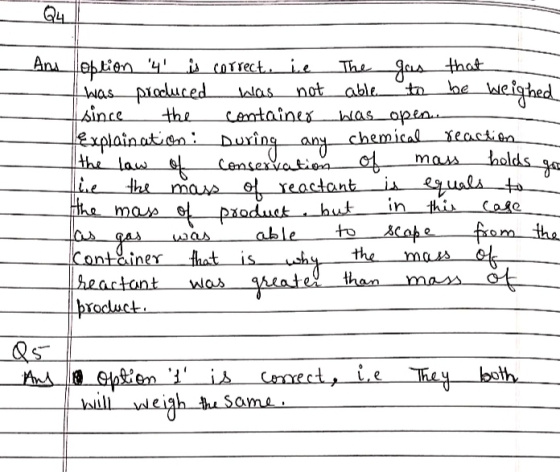
Q4. Suppose a reaction were to happen in an open container in a lab. During the...
Font Open the Le Chatler's Principle Activity found in your textbook, Interactive General Chemistry. (Section 15.6,...
 Font Open the Le Chatler's Principle Activity found in your textbook, Interactive General Chemistry. (Section 15.6, Figure 15.9), run the simulation and complete the following questions. 1. Start with the default settings where K = 1.00. a. Write the expression based on the chemical equation in the upper right corner. b. Under the initial conditions of (A) = 2.00 M, and (B) = 4.00 M, is the reaction at equilibrium? How can you tell? c. Compare how Q is affected...
Use the law of conservation of mass to answer the questions. Consider a hypothetical reaction in...
 Use the law of conservation of mass to answer the questions. Consider a hypothetical reaction in which A and B are reactants and C and D are products. If 13 g of A completely reacts with 21 g of B to produce 18 g of C, how many grams of D will be produced? A 3.6 g sample of sodium hydrogen carbonate is added to a solution of acetic acid weighing 10.1 g. The two substances react, releasing carbon dioxide...
= 1-Lab from Chapter 15 Eq and Le Chat - Word Search Design Layout References Mailings...
 = 1-Lab from Chapter 15 Eq and Le Chat - Word Search Design Layout References Mailings Review View Help Add i nk Ink to Ink to Drawing Ink Pen Editor Shape Math C anvas Replay Convert Replay Open the Le Chatlier's Principle Activity found in your textbook, Interactive General Chemistry. (Section 15.6, Figure 15.9), run the simulation and complete the following questions. Pens insert 1. Start with the default settings where K - 1.00. a. Write the expression based on...
You will be observing a reaction in this lab. As with most reactions, this reaction occurs...
 You will be observing a reaction in this lab. As with most reactions, this reaction occurs by the breaking of some bonds in the reactants and the formation of new bonds in the products. During the reaction, the gas that is produced will fizz away. After the reaction is complete, one of the products can be removed. Then you will determine the mass of the other product this will be your actual (or experimental) yield. You will compare this value...
help in filling in the Data sheet need help in the data sheet Data Sheet Name...
 help in filling in the Data sheet
need help in the data sheet
Data Sheet Name Section: 23170 Mass Data Collected Mass of Container" (g) Mass of Container +KCIO(g) (before heating) ing Constant Mass Data: Mass of Container + KClig) after 1" heating 37.3273 37.3209 after 2d heating after 39 heating 37.5142 37.5114 final heating *All masses of container include the catalyst, MnO, and plastic holder (the same throughout the experiment) Results and calculations: Show your calculations in the right...
help in filling in the Data sheet
need help in the data sheet
Data Sheet Name Section: 23170 Mass Data Collected Mass of Container" (g) Mass of Container +KCIO(g) (before heating) ing Constant Mass Data: Mass of Container + KClig) after 1" heating 37.3273 37.3209 after 2d heating after 39 heating 37.5142 37.5114 final heating *All masses of container include the catalyst, MnO, and plastic holder (the same throughout the experiment) Results and calculations: Show your calculations in the right...
this is a lab of Percentage of Oxygen in Potassium Chlorate Percentage of Oxygen in Potassium...
 this is a lab of Percentage of Oxygen in Potassium
Chlorate
Percentage of Oxygen in Potassium Chlorate Purpose of the lab Te esperimentar e te m o rgen in een constante decoration of poche Introduction The thermal decomposition of potassium chore can be described by the following 2KCIO 2 Cl +30 Ent epeal tehnic p e cale from the KCIO We poschodecomposes simply by heating the reaction is very Actitud is a m a ture accent the reaction, we not...
this is a lab of Percentage of Oxygen in Potassium
Chlorate
Percentage of Oxygen in Potassium Chlorate Purpose of the lab Te esperimentar e te m o rgen in een constante decoration of poche Introduction The thermal decomposition of potassium chore can be described by the following 2KCIO 2 Cl +30 Ent epeal tehnic p e cale from the KCIO We poschodecomposes simply by heating the reaction is very Actitud is a m a ture accent the reaction, we not...
Experiment 8 Conservation of Mass kussion: action: 170 Mole wt. g/mol Aqual the combined masses of...
 Experiment 8 Conservation of Mass kussion: action: 170 Mole wt. g/mol Aqual the combined masses of all the reactants that were initially present. Furthermore, we fter any chemical reaction, the total mass of new products and any left over reactants) will a predict the mass of each product that will be formed if we know the molecular weight or the formula (from which we can predict the molecular weight). As an example, consider the dissolve the two substances in water,...
Please answer questions 1-7 and fill out the equation at the top. Thanks! LAB-Stoichiometry/Empirical formula Name...
 Please answer questions 1-7 and fill out the equation at the
top. Thanks!
LAB-Stoichiometry/Empirical formula Name Purpose: To predict the mass of magnesium oxide (MgO) formed by reacting To determine actual yield, theoretical yield and percent yield of pro Balance the equation: Moterials: Mg ribbon, Bunsen burner, balance, crucible tongs, crucible w/id etc- Procedure: place a check after you perform each step 1Go to the scale, check for zero. Record the mass of the crucible +lid and d it below...
Please answer questions 1-7 and fill out the equation at the
top. Thanks!
LAB-Stoichiometry/Empirical formula Name Purpose: To predict the mass of magnesium oxide (MgO) formed by reacting To determine actual yield, theoretical yield and percent yield of pro Balance the equation: Moterials: Mg ribbon, Bunsen burner, balance, crucible tongs, crucible w/id etc- Procedure: place a check after you perform each step 1Go to the scale, check for zero. Record the mass of the crucible +lid and d it below...
Below is a lab hand out for the questions. All my data for the questions are...
Below is a lab hand out for the questions. All my data for the questions are filled out below in BOLD LETTERING. All the questions I need answered are at the bottom with boxes where to put the answers. Background Alka-Seltzer� is an over-the-counter antacid and pain relief drug. The tablet contains aspirin (acetylsalicylic acid), citric acid, and sodium bicarbonate (NaHCO3). Sodium bicarbonate (NaHCO3) is responsible for the effervescent action of Alka-Seltzer. In this lab we will investigate the reaction...
I just need the blank data table with all the reactions shown. I need ALL 36...
 I just need the blank data table with
all the reactions shown. I need ALL 36 spaces for reacting
solutions. I don't need the observations. Please
help.
ARE hem 310 LAB EXPERIMENT #6 Chemical Reactions: Double Replacements I. OBJECTIVES 1. To perform and record observations of some chemical reactions. 2. To gain skill in writing balanced equations from observations of chemical reactions using known reactants. 3. To look for ions that, if present, may cause the compounds to be insoluble...
I just need the blank data table with
all the reactions shown. I need ALL 36 spaces for reacting
solutions. I don't need the observations. Please
help.
ARE hem 310 LAB EXPERIMENT #6 Chemical Reactions: Double Replacements I. OBJECTIVES 1. To perform and record observations of some chemical reactions. 2. To gain skill in writing balanced equations from observations of chemical reactions using known reactants. 3. To look for ions that, if present, may cause the compounds to be insoluble...
 Font Open the Le Chatler's Principle Activity found in your textbook, Interactive General Chemistry. (Section 15.6, Figure 15.9), run the simulation and complete the following questions. 1. Start with the default settings where K = 1.00. a. Write the expression based on the chemical equation in the upper right corner. b. Under the initial conditions of (A) = 2.00 M, and (B) = 4.00 M, is the reaction at equilibrium? How can you tell? c. Compare how Q is affected...
 Use the law of conservation of mass to answer the questions. Consider a hypothetical reaction in which A and B are reactants and C and D are products. If 13 g of A completely reacts with 21 g of B to produce 18 g of C, how many grams of D will be produced? A 3.6 g sample of sodium hydrogen carbonate is added to a solution of acetic acid weighing 10.1 g. The two substances react, releasing carbon dioxide...
 = 1-Lab from Chapter 15 Eq and Le Chat - Word Search Design Layout References Mailings Review View Help Add i nk Ink to Ink to Drawing Ink Pen Editor Shape Math C anvas Replay Convert Replay Open the Le Chatlier's Principle Activity found in your textbook, Interactive General Chemistry. (Section 15.6, Figure 15.9), run the simulation and complete the following questions. Pens insert 1. Start with the default settings where K - 1.00. a. Write the expression based on...
 You will be observing a reaction in this lab. As with most reactions, this reaction occurs by the breaking of some bonds in the reactants and the formation of new bonds in the products. During the reaction, the gas that is produced will fizz away. After the reaction is complete, one of the products can be removed. Then you will determine the mass of the other product this will be your actual (or experimental) yield. You will compare this value...
 help in filling in the Data sheet
need help in the data sheet
Data Sheet Name Section: 23170 Mass Data Collected Mass of Container" (g) Mass of Container +KCIO(g) (before heating) ing Constant Mass Data: Mass of Container + KClig) after 1" heating 37.3273 37.3209 after 2d heating after 39 heating 37.5142 37.5114 final heating *All masses of container include the catalyst, MnO, and plastic holder (the same throughout the experiment) Results and calculations: Show your calculations in the right...
help in filling in the Data sheet
need help in the data sheet
Data Sheet Name Section: 23170 Mass Data Collected Mass of Container" (g) Mass of Container +KCIO(g) (before heating) ing Constant Mass Data: Mass of Container + KClig) after 1" heating 37.3273 37.3209 after 2d heating after 39 heating 37.5142 37.5114 final heating *All masses of container include the catalyst, MnO, and plastic holder (the same throughout the experiment) Results and calculations: Show your calculations in the right...
 this is a lab of Percentage of Oxygen in Potassium
Chlorate
Percentage of Oxygen in Potassium Chlorate Purpose of the lab Te esperimentar e te m o rgen in een constante decoration of poche Introduction The thermal decomposition of potassium chore can be described by the following 2KCIO 2 Cl +30 Ent epeal tehnic p e cale from the KCIO We poschodecomposes simply by heating the reaction is very Actitud is a m a ture accent the reaction, we not...
this is a lab of Percentage of Oxygen in Potassium
Chlorate
Percentage of Oxygen in Potassium Chlorate Purpose of the lab Te esperimentar e te m o rgen in een constante decoration of poche Introduction The thermal decomposition of potassium chore can be described by the following 2KCIO 2 Cl +30 Ent epeal tehnic p e cale from the KCIO We poschodecomposes simply by heating the reaction is very Actitud is a m a ture accent the reaction, we not...
 Experiment 8 Conservation of Mass kussion: action: 170 Mole wt. g/mol Aqual the combined masses of all the reactants that were initially present. Furthermore, we fter any chemical reaction, the total mass of new products and any left over reactants) will a predict the mass of each product that will be formed if we know the molecular weight or the formula (from which we can predict the molecular weight). As an example, consider the dissolve the two substances in water,...
 Please answer questions 1-7 and fill out the equation at the
top. Thanks!
LAB-Stoichiometry/Empirical formula Name Purpose: To predict the mass of magnesium oxide (MgO) formed by reacting To determine actual yield, theoretical yield and percent yield of pro Balance the equation: Moterials: Mg ribbon, Bunsen burner, balance, crucible tongs, crucible w/id etc- Procedure: place a check after you perform each step 1Go to the scale, check for zero. Record the mass of the crucible +lid and d it below...
Please answer questions 1-7 and fill out the equation at the
top. Thanks!
LAB-Stoichiometry/Empirical formula Name Purpose: To predict the mass of magnesium oxide (MgO) formed by reacting To determine actual yield, theoretical yield and percent yield of pro Balance the equation: Moterials: Mg ribbon, Bunsen burner, balance, crucible tongs, crucible w/id etc- Procedure: place a check after you perform each step 1Go to the scale, check for zero. Record the mass of the crucible +lid and d it below...
 I just need the blank data table with
all the reactions shown. I need ALL 36 spaces for reacting
solutions. I don't need the observations. Please
help.
ARE hem 310 LAB EXPERIMENT #6 Chemical Reactions: Double Replacements I. OBJECTIVES 1. To perform and record observations of some chemical reactions. 2. To gain skill in writing balanced equations from observations of chemical reactions using known reactants. 3. To look for ions that, if present, may cause the compounds to be insoluble...
I just need the blank data table with
all the reactions shown. I need ALL 36 spaces for reacting
solutions. I don't need the observations. Please
help.
ARE hem 310 LAB EXPERIMENT #6 Chemical Reactions: Double Replacements I. OBJECTIVES 1. To perform and record observations of some chemical reactions. 2. To gain skill in writing balanced equations from observations of chemical reactions using known reactants. 3. To look for ions that, if present, may cause the compounds to be insoluble...
Most questions answered within 3 hours.
-
Where is the error in this code sequence?
String s1 = "Hello";
String s2 = "ello";...
asked 11 months ago -
Financial data for Joel de Paris, Inc., for last year
follow:
Joel de Paris, Inc.
Balance...
asked 11 months ago -
Consider this reaction:
Al2(SO4)3 (aq)+ BaCl3
(aq) Al2Cl6 (aq)- +
3BaSO4(s) . What is the...
asked 11 months ago -
Suppose that Savneet is considering increasing her
recent random sample from 20 car rentals to 40...
asked 11 months ago -
Trucks arrive at an unloading terminal at an average rate of 120
per hour.
Trucks arrive...
asked 11 months ago -
Why are methanol and ethanol completely soluble in water while
octanol is not very little soluble....
asked 11 months ago -
A facilities manager at a university reads in a research report
that the mean amount of...
asked 11 months ago -
When the CuSO4 is rehydrated by adding water to the anhydrous
compound, is this an endothermic...
asked 11 months ago -
A ray of sunlight is passing from diamond into crown glass; the
angle of incidence is...
asked 11 months ago -
A block of mass 0.249 kg is placed on top of a light, vertical
spring of...
asked 11 months ago -
how do the kidneys compensate in the presences of acidosis
a) trigger hyperventilate
b) reserve acid...
asked 11 months ago -
Question 501 pts
The rental rate of capital to the firm increases. Which of the
following...
asked 11 months ago