
Homework Answers
Add Answer to:
6.) Consider the following four energy diag (10 pe A) Which diagrams correspond with a two-step...
3. Consider the following four energy diagrams rxn a. Which diagrams correspond with a two-step mechanism?...
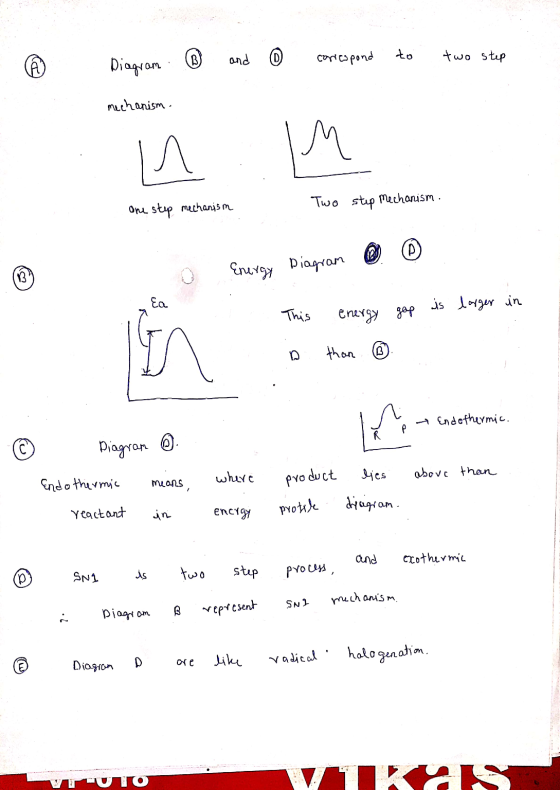
 3. Consider the following four energy diagrams rxn a. Which diagrams correspond with a two-step mechanism? b. Which diagrams correspond with a one-step mechanism? c. Compare diagrams A and C. Which has a relatively larger E,? d. Compare diagrams A and C, which has a negative ΔG? e. Compare diagrams A and D, which has a positive ΔG?
6.27 Consider the following four energy diagrams: Potential energy Potential energy Reaction coordinate Reaction coordinate Potential...
 6.27 Consider the following four energy diagrams: Potential energy Potential energy Reaction coordinate Reaction coordinate Potential energy =th -th Potential energy Reaction coordinate Reaction coordinate (a) Which diagrams correspond with a two-step mechanism? (b) which diagrams correspond with a one-step mechanism? (C) Compare energy diagrams A and C. Which has a relatively larger E,? (d) Compare diagrams A and C. Which has a negative AG? (e) Compare diagrams A and D. Which has a positive AG? (1) Compare all four...
6.26 Consider the folloving four energy diagrams: Potential energy Potential energy Reaction coordinate Reaction coordinate Potential...
 6.26 Consider the folloving four energy diagrams: Potential energy Potential energy Reaction coordinate Reaction coordinate Potential energy Potential energy n Reaction coordinate Reaction coordinate (a) Which diagrams correspond with a two-step mechanism? (b) Which diagrams correspond with a one-step mechanism? (c) Compare energy diagrams A and C. Which has a relatively larger E.? (d) Compare diagrams A and C. Which has a negative AG? (e) Compare diagrams A and D. Which has a positive AG? (f) Compare all four energy...
Justify Answers. Consider the energy diagram below showing the conversion of A to G a) How...
 Justify Answers.
Consider the energy diagram below showing the conversion of A to G a) How many steps are included in this overall reaction mechanism? b) Label each step as endothermic or exothermic. Is the overall reaction endothermid or exothermic? c) Label ΔE and Ea for each step. Label ΔEnn for the reaction overall. d) Which step is rate-determining? e) Which points correspond to transitions states? f) Which points correspond to intermediates? g) Indicate whether each transition state most resembles...
Justify Answers.
Consider the energy diagram below showing the conversion of A to G a) How many steps are included in this overall reaction mechanism? b) Label each step as endothermic or exothermic. Is the overall reaction endothermid or exothermic? c) Label ΔE and Ea for each step. Label ΔEnn for the reaction overall. d) Which step is rate-determining? e) Which points correspond to transitions states? f) Which points correspond to intermediates? g) Indicate whether each transition state most resembles...
3. Look at Figure 16.22 (p.727), the reaction energy diagrams for the two step reactions of...
 3. Look at Figure 16.22 (p.727), the reaction energy diagrams for the two step reactions of a) NO, and F, and b) NO and O2 Write down the mechanisms for both reactions, and these mechanisms based on the corresponding reaction energy diagrams. IMG_0338.jpg v Q Search Depicting a Multistep Mechanism with a Reaction Energy Diagram Figu re 16.22 shows reaction energy diagrams for two reactions, each of which has a two-step mechanism, shown below the diagram. The reaction of NO,...
8. (20 points) Consider the following mechanism, with the accompanying energy diagram, which has been suggested...
 8. (20 points) Consider the following mechanism, with the accompanying energy diagram, which has been suggested for the following overall reaction in the presence of a Cl catalyst: 03 +0 202 Step 1: Step 2: 03 + Cl → OCl + O2 OCl + 0 + 02 + Cl +---Ea, Energy - - - - AHrxn --- - Reaction progress- A. Based on the energy diagram, which step is rate limiting? Which step is the fastest? (4 Points) B. Identify...
30. Describe the difference between transition state and intermediate using energy diagrams. 31. For enzymes in whic...
 30. Describe the difference between transition state and intermediate using energy diagrams. 31. For enzymes in which the slowest (rate-limiting) step is the reaction k2 ES P Km becomes equivalent to: A. Kcat- B. the [S], where Vo Vmax C. the dissociation constant, Ka, for the ES complex. D. the maximal velocity. E. the turnover number. 33. Draw a schematic for sequential mechanism 32. An enzyme "ABase" catalyzes the following reaction: A B. You found that for [E] 4 nM,...
3. Please answer the following questions concerning the two energy diagrams depicted below. (10 pts) Energy...
 3. Please answer the following questions concerning the two energy diagrams depicted below. (10 pts) Energy Diagram A 20 Energy Diagram B (a) Do the energy diagrams represent concerted or stepwise reactions? (b) Label the axes, the reactants (R), products (P), any intermediates (1), activation energy (E.), enthalpy of reaction (AH"), and transition state(s) (TS) on the above diagrams. (c) Do the energy diagrams represent endothermic or exothermic reactions? (d) Which energy diagram represents the faster reaction? (e) Which energy...
3. Please answer the following questions concerning the two energy diagrams depicted below. (10 pts) Energy...
 3. Please answer the following questions concerning the two energy diagrams depicted below. (10 pts) Energy Diagram A Energy Diagram B (a) Do the energy diagrams represent concerted or stepwise reactions? (b) Label the axes, the reactants (R), products (P), any intermediates (1), activation energy (E.), enthalpy of reaction (AH'), and transition state(s) (TS) on the above diagrams. (C) Do the energy diagrams represent endothermic or exothermic reactions? (d) Which energy diagram represents the faster reaction? (e) Which energy diagram...
6. Consider the following substitution reaction: (10) Pr NaN NaBr MDMSOM (a) Determine whether this reaction...
 6. Consider the following substitution reaction: (10) Pr NaN NaBr MDMSOM (a) Determine whether this reaction proceeds via an SN1 or SN2 process. (b) Draw the mechanism of this reaction. (c) What is the rate equation of this reaction? (d) Would the reaction occur at a faster rate if the concentration of cyanide were doubled? (e) Draw an energy diagram of the reaction above.
 3. Consider the following four energy diagrams rxn a. Which diagrams correspond with a two-step mechanism? b. Which diagrams correspond with a one-step mechanism? c. Compare diagrams A and C. Which has a relatively larger E,? d. Compare diagrams A and C, which has a negative ΔG? e. Compare diagrams A and D, which has a positive ΔG?
 6.27 Consider the following four energy diagrams: Potential energy Potential energy Reaction coordinate Reaction coordinate Potential energy =th -th Potential energy Reaction coordinate Reaction coordinate (a) Which diagrams correspond with a two-step mechanism? (b) which diagrams correspond with a one-step mechanism? (C) Compare energy diagrams A and C. Which has a relatively larger E,? (d) Compare diagrams A and C. Which has a negative AG? (e) Compare diagrams A and D. Which has a positive AG? (1) Compare all four...
 6.26 Consider the folloving four energy diagrams: Potential energy Potential energy Reaction coordinate Reaction coordinate Potential energy Potential energy n Reaction coordinate Reaction coordinate (a) Which diagrams correspond with a two-step mechanism? (b) Which diagrams correspond with a one-step mechanism? (c) Compare energy diagrams A and C. Which has a relatively larger E.? (d) Compare diagrams A and C. Which has a negative AG? (e) Compare diagrams A and D. Which has a positive AG? (f) Compare all four energy...
 Justify Answers.
Consider the energy diagram below showing the conversion of A to G a) How many steps are included in this overall reaction mechanism? b) Label each step as endothermic or exothermic. Is the overall reaction endothermid or exothermic? c) Label ΔE and Ea for each step. Label ΔEnn for the reaction overall. d) Which step is rate-determining? e) Which points correspond to transitions states? f) Which points correspond to intermediates? g) Indicate whether each transition state most resembles...
Justify Answers.
Consider the energy diagram below showing the conversion of A to G a) How many steps are included in this overall reaction mechanism? b) Label each step as endothermic or exothermic. Is the overall reaction endothermid or exothermic? c) Label ΔE and Ea for each step. Label ΔEnn for the reaction overall. d) Which step is rate-determining? e) Which points correspond to transitions states? f) Which points correspond to intermediates? g) Indicate whether each transition state most resembles...
 3. Look at Figure 16.22 (p.727), the reaction energy diagrams for the two step reactions of a) NO, and F, and b) NO and O2 Write down the mechanisms for both reactions, and these mechanisms based on the corresponding reaction energy diagrams. IMG_0338.jpg v Q Search Depicting a Multistep Mechanism with a Reaction Energy Diagram Figu re 16.22 shows reaction energy diagrams for two reactions, each of which has a two-step mechanism, shown below the diagram. The reaction of NO,...
 8. (20 points) Consider the following mechanism, with the accompanying energy diagram, which has been suggested for the following overall reaction in the presence of a Cl catalyst: 03 +0 202 Step 1: Step 2: 03 + Cl → OCl + O2 OCl + 0 + 02 + Cl +---Ea, Energy - - - - AHrxn --- - Reaction progress- A. Based on the energy diagram, which step is rate limiting? Which step is the fastest? (4 Points) B. Identify...
 30. Describe the difference between transition state and intermediate using energy diagrams. 31. For enzymes in which the slowest (rate-limiting) step is the reaction k2 ES P Km becomes equivalent to: A. Kcat- B. the [S], where Vo Vmax C. the dissociation constant, Ka, for the ES complex. D. the maximal velocity. E. the turnover number. 33. Draw a schematic for sequential mechanism 32. An enzyme "ABase" catalyzes the following reaction: A B. You found that for [E] 4 nM,...
 3. Please answer the following questions concerning the two energy diagrams depicted below. (10 pts) Energy Diagram A 20 Energy Diagram B (a) Do the energy diagrams represent concerted or stepwise reactions? (b) Label the axes, the reactants (R), products (P), any intermediates (1), activation energy (E.), enthalpy of reaction (AH"), and transition state(s) (TS) on the above diagrams. (c) Do the energy diagrams represent endothermic or exothermic reactions? (d) Which energy diagram represents the faster reaction? (e) Which energy...
 3. Please answer the following questions concerning the two energy diagrams depicted below. (10 pts) Energy Diagram A Energy Diagram B (a) Do the energy diagrams represent concerted or stepwise reactions? (b) Label the axes, the reactants (R), products (P), any intermediates (1), activation energy (E.), enthalpy of reaction (AH'), and transition state(s) (TS) on the above diagrams. (C) Do the energy diagrams represent endothermic or exothermic reactions? (d) Which energy diagram represents the faster reaction? (e) Which energy diagram...
 6. Consider the following substitution reaction: (10) Pr NaN NaBr MDMSOM (a) Determine whether this reaction proceeds via an SN1 or SN2 process. (b) Draw the mechanism of this reaction. (c) What is the rate equation of this reaction? (d) Would the reaction occur at a faster rate if the concentration of cyanide were doubled? (e) Draw an energy diagram of the reaction above.
Most questions answered within 3 hours.
-
Where is the error in this code sequence?
String s1 = "Hello";
String s2 = "ello";...
asked 11 months ago -
Financial data for Joel de Paris, Inc., for last year
follow:
Joel de Paris, Inc.
Balance...
asked 11 months ago -
Consider this reaction:
Al2(SO4)3 (aq)+ BaCl3
(aq) Al2Cl6 (aq)- +
3BaSO4(s) . What is the...
asked 11 months ago -
Suppose that Savneet is considering increasing her
recent random sample from 20 car rentals to 40...
asked 11 months ago -
Trucks arrive at an unloading terminal at an average rate of 120
per hour.
Trucks arrive...
asked 11 months ago -
Why are methanol and ethanol completely soluble in water while
octanol is not very little soluble....
asked 11 months ago -
A facilities manager at a university reads in a research report
that the mean amount of...
asked 11 months ago -
When the CuSO4 is rehydrated by adding water to the anhydrous
compound, is this an endothermic...
asked 11 months ago -
A ray of sunlight is passing from diamond into crown glass; the
angle of incidence is...
asked 11 months ago -
A block of mass 0.249 kg is placed on top of a light, vertical
spring of...
asked 11 months ago -
how do the kidneys compensate in the presences of acidosis
a) trigger hyperventilate
b) reserve acid...
asked 11 months ago -
Question 501 pts
The rental rate of capital to the firm increases. Which of the
following...
asked 11 months ago