

Homework Answers
Add Answer to:
5. For today's experiment, you will be performing the first step of your multistep synthesis to...
PLEASE ANSWER QUESTIONS 8-10 PLEASE ANSWER # 8-10!!!! Your goal for this experiment is to design...
 PLEASE ANSWER QUESTIONS 8-10
PLEASE
ANSWER # 8-10!!!!
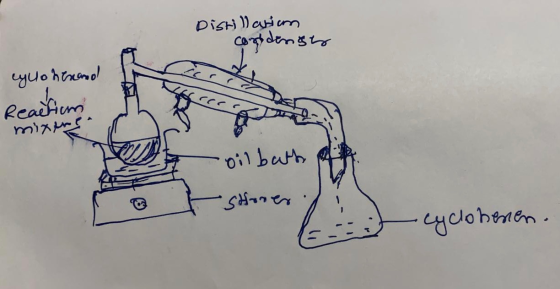
Your goal for this experiment is to design a synthesis for: o- Experiment Questions How do I design a multi-step syntheses given starting material and product? • How can I synthesize trans-1,2-cyclohexanediol from hexanol using reactions already learned in lecture and lab? Experiment Techniques · Using distillation as a separation technique. • Using washing (a type of extraction) for purification Introduction So far this semester, you have performed three different types of...
PLEASE ANSWER QUESTIONS 8-10
PLEASE
ANSWER # 8-10!!!!
Your goal for this experiment is to design a synthesis for: o- Experiment Questions How do I design a multi-step syntheses given starting material and product? • How can I synthesize trans-1,2-cyclohexanediol from hexanol using reactions already learned in lecture and lab? Experiment Techniques · Using distillation as a separation technique. • Using washing (a type of extraction) for purification Introduction So far this semester, you have performed three different types of...
3. (4 pts) The key step involves a base pulling off one of the benzylic hydrogens...
 3. (4 pts) The key step involves a base pulling off one of the benzylic hydrogens in the starting material. Given that the pk of an alkane hydrogen is > 50 and the pk, of a benzylic hydrogen is < 40, explain why potassium hydroxide can be used instead of sodium amide to synthesize 1,2-diphenylethyne from a vicinal dibromide. 4. (4 pts) Fill in the following table showing amounts to use and theoretical yield. Show your work. Product 1,2-diphenylethyne Amounts...
Experiment Questions What is an epoxide and how is it useful with respect to synthesis design?...
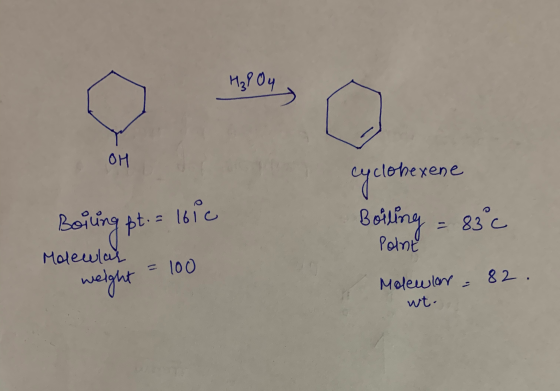
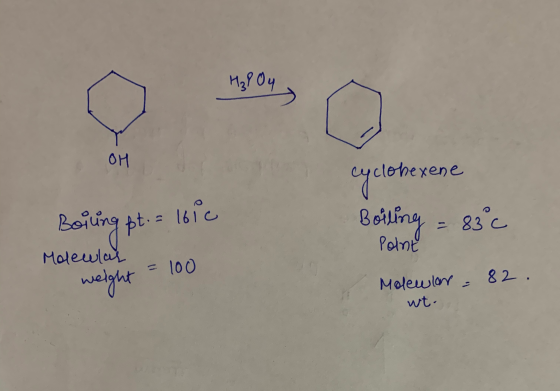
 Experiment Questions What is an epoxide and how is it useful with respect to synthesis design? • What are typical reagents used for epoxidation? • What is the mechanism for epoxidation? Must stereospecificity be considered? Experiment Techniques • Use of sodium bisulfite wash to remove excess peroxy acid from reaction mixture. Introduction By now you are well aware that the product of previous experiment (reaction of cyclohexanol and acid) is an alkene. You should also be storing key reactions of...
fill in the blanks please! Pre-Lab for Lidocaine Analog Synthesis - Step 2 Complete the reaction...
 fill in the blanks please!
Pre-Lab for Lidocaine Analog Synthesis - Step 2 Complete the reaction table above, including the quantities you used in the reaction, prior to the addition of extra diethylamine. HN Toluene HAN 1 + 2 HN Reflux a-chloro-2,6- dimethylacetanilide piperidine Toluene N-(2,6-dimethylphenyl)-2- (piperidin-1-yl)acetamide FW g/mol g/mol g/mol g/mL Amount mg mL g (Theory) (Theory) mmol Equivs.
fill in the blanks please!
Pre-Lab for Lidocaine Analog Synthesis - Step 2 Complete the reaction table above, including the quantities you used in the reaction, prior to the addition of extra diethylamine. HN Toluene HAN 1 + 2 HN Reflux a-chloro-2,6- dimethylacetanilide piperidine Toluene N-(2,6-dimethylphenyl)-2- (piperidin-1-yl)acetamide FW g/mol g/mol g/mol g/mL Amount mg mL g (Theory) (Theory) mmol Equivs.
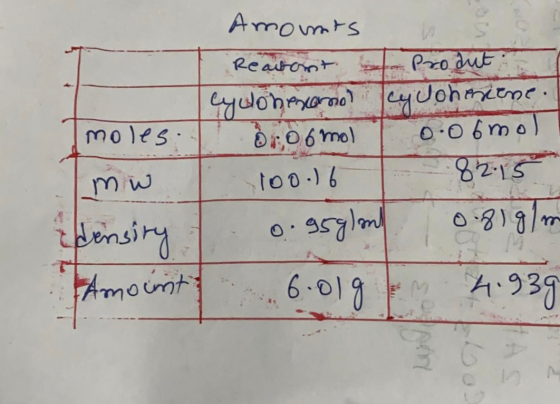
5. Fill in the following table to show amounts to use and theoretical yield. Product Epoxide...
 5. Fill in the following table to show amounts to use and theoretical yield. Product Epoxide product Moles MW Density Amount Amounts Reactant Reactant MCPBA Product from last experiment 22 mmol 22 mmol 172.57 g/mol 82.14 g/mol NA 0.83 g/ml Calculate and Calculate and write write in pre-lab in pre-lab notes notes 22 mmol 98.14 g/mol NA This amount will be your theoretical yield.
Page 1 Synthesis using Carbonyl O-Substitution Chemistry Preamble This experiment involves the synthesis of target molecules...
 Page 1 Synthesis using Carbonyl O-Substitution Chemistry Preamble This experiment involves the synthesis of target molecules using a-substitution chemistry. You are assigned two target molecules, one of which is best synthesized by an alkylation approach, while the other is best synthesized by an addition or condensation approach. You must do the following: 1. Perform a retrosynthetic analysis on the two target molecules assigned to you. In each case the organic starting material (what you have to work backwards toward) depends...
Synthesis using Carbonyla-Substitution Chemistry Preamble This experiment involves the synthesis of target molecules using a-substitution chemistry....
 Synthesis using Carbonyla-Substitution Chemistry Preamble This experiment involves the synthesis of target molecules using a-substitution chemistry. You are assigned two target molecules, one of which is best synthesized by an alkylation approach, while the other is best synthesized by an addition or condensation approach. My two target molecules are number 2 and number 12 in the last page. You must do the following: 1. Perform a retrosynthetic analysis on the two target molecules assigned to you. In each case the...
Fill in the boxes over each arrow with the letter that corresponds to the reagents needed to perform each step of the multistep synthesis show below. Reagents may be used more than once, or not at all...
 Fill in the boxes over each arrow with the letter that
corresponds to the reagents needed to perform each step of the
multistep synthesis show below. Reagents may be used more than
once, or not at all. Pay close attention to the numbered carbons in
the starting material, and be sure that your answer accounts for
the position of these carbons in the final product.
pts) Fill in the boxes over each arrow with the letter that corresponds to the...
Fill in the boxes over each arrow with the letter that
corresponds to the reagents needed to perform each step of the
multistep synthesis show below. Reagents may be used more than
once, or not at all. Pay close attention to the numbered carbons in
the starting material, and be sure that your answer accounts for
the position of these carbons in the final product.
pts) Fill in the boxes over each arrow with the letter that corresponds to the...
4 Synthesis of lohexene by Dehydration - Pre-Lab Assignment de drated with a strong and high...
 4 Synthesis of lohexene by Dehydration - Pre-Lab Assignment de drated with a strong and high A w a y 's G UPAC 3) Explain why two products are formed from the dehydration of 3-hexanol, but only ONE product is formed from the dehydration of 3-pentanol. (Consider tr a d isomers only, not cis/trans stereoisomers.) 2. In an organic synthesis, reactions are sometimes performed in sequence to convert one functional group into another Complete this multi-step reaction sequence on paper:...
Specify the reagent you would use in each step of the following synthesis: step 1 step...
 Specify the reagent you would use in each step of the following synthesis: step 1 step 2 step 2 Reagents Available a. LIAIHA f. PBr3 b. H2SO4 c. HCI d. HBO e. SOC2 k. CH3CH MgBr g. Dess-Martin periodinane (DMP) I. CH.MgBr (phenylmagnesium bromide) h. Nah m. (CH3)2CHMgBr 1. NaOH n. Croz J. CH3MgBr Write the letters of the reagents in the boxes below. Reagent for step 1 Reagent for step 2 Submit Answer Retry Entire Group 9 more group...
 PLEASE ANSWER QUESTIONS 8-10
PLEASE
ANSWER # 8-10!!!!
Your goal for this experiment is to design a synthesis for: o- Experiment Questions How do I design a multi-step syntheses given starting material and product? • How can I synthesize trans-1,2-cyclohexanediol from hexanol using reactions already learned in lecture and lab? Experiment Techniques · Using distillation as a separation technique. • Using washing (a type of extraction) for purification Introduction So far this semester, you have performed three different types of...
PLEASE ANSWER QUESTIONS 8-10
PLEASE
ANSWER # 8-10!!!!
Your goal for this experiment is to design a synthesis for: o- Experiment Questions How do I design a multi-step syntheses given starting material and product? • How can I synthesize trans-1,2-cyclohexanediol from hexanol using reactions already learned in lecture and lab? Experiment Techniques · Using distillation as a separation technique. • Using washing (a type of extraction) for purification Introduction So far this semester, you have performed three different types of...
 3. (4 pts) The key step involves a base pulling off one of the benzylic hydrogens in the starting material. Given that the pk of an alkane hydrogen is > 50 and the pk, of a benzylic hydrogen is < 40, explain why potassium hydroxide can be used instead of sodium amide to synthesize 1,2-diphenylethyne from a vicinal dibromide. 4. (4 pts) Fill in the following table showing amounts to use and theoretical yield. Show your work. Product 1,2-diphenylethyne Amounts...
 Experiment Questions What is an epoxide and how is it useful with respect to synthesis design? • What are typical reagents used for epoxidation? • What is the mechanism for epoxidation? Must stereospecificity be considered? Experiment Techniques • Use of sodium bisulfite wash to remove excess peroxy acid from reaction mixture. Introduction By now you are well aware that the product of previous experiment (reaction of cyclohexanol and acid) is an alkene. You should also be storing key reactions of...
 fill in the blanks please!
Pre-Lab for Lidocaine Analog Synthesis - Step 2 Complete the reaction table above, including the quantities you used in the reaction, prior to the addition of extra diethylamine. HN Toluene HAN 1 + 2 HN Reflux a-chloro-2,6- dimethylacetanilide piperidine Toluene N-(2,6-dimethylphenyl)-2- (piperidin-1-yl)acetamide FW g/mol g/mol g/mol g/mL Amount mg mL g (Theory) (Theory) mmol Equivs.
fill in the blanks please!
Pre-Lab for Lidocaine Analog Synthesis - Step 2 Complete the reaction table above, including the quantities you used in the reaction, prior to the addition of extra diethylamine. HN Toluene HAN 1 + 2 HN Reflux a-chloro-2,6- dimethylacetanilide piperidine Toluene N-(2,6-dimethylphenyl)-2- (piperidin-1-yl)acetamide FW g/mol g/mol g/mol g/mL Amount mg mL g (Theory) (Theory) mmol Equivs.
 5. Fill in the following table to show amounts to use and theoretical yield. Product Epoxide product Moles MW Density Amount Amounts Reactant Reactant MCPBA Product from last experiment 22 mmol 22 mmol 172.57 g/mol 82.14 g/mol NA 0.83 g/ml Calculate and Calculate and write write in pre-lab in pre-lab notes notes 22 mmol 98.14 g/mol NA This amount will be your theoretical yield.
 Page 1 Synthesis using Carbonyl O-Substitution Chemistry Preamble This experiment involves the synthesis of target molecules using a-substitution chemistry. You are assigned two target molecules, one of which is best synthesized by an alkylation approach, while the other is best synthesized by an addition or condensation approach. You must do the following: 1. Perform a retrosynthetic analysis on the two target molecules assigned to you. In each case the organic starting material (what you have to work backwards toward) depends...
 Synthesis using Carbonyla-Substitution Chemistry Preamble This experiment involves the synthesis of target molecules using a-substitution chemistry. You are assigned two target molecules, one of which is best synthesized by an alkylation approach, while the other is best synthesized by an addition or condensation approach. My two target molecules are number 2 and number 12 in the last page. You must do the following: 1. Perform a retrosynthetic analysis on the two target molecules assigned to you. In each case the...
 Fill in the boxes over each arrow with the letter that
corresponds to the reagents needed to perform each step of the
multistep synthesis show below. Reagents may be used more than
once, or not at all. Pay close attention to the numbered carbons in
the starting material, and be sure that your answer accounts for
the position of these carbons in the final product.
pts) Fill in the boxes over each arrow with the letter that corresponds to the...
Fill in the boxes over each arrow with the letter that
corresponds to the reagents needed to perform each step of the
multistep synthesis show below. Reagents may be used more than
once, or not at all. Pay close attention to the numbered carbons in
the starting material, and be sure that your answer accounts for
the position of these carbons in the final product.
pts) Fill in the boxes over each arrow with the letter that corresponds to the...
 4 Synthesis of lohexene by Dehydration - Pre-Lab Assignment de drated with a strong and high A w a y 's G UPAC 3) Explain why two products are formed from the dehydration of 3-hexanol, but only ONE product is formed from the dehydration of 3-pentanol. (Consider tr a d isomers only, not cis/trans stereoisomers.) 2. In an organic synthesis, reactions are sometimes performed in sequence to convert one functional group into another Complete this multi-step reaction sequence on paper:...
 Specify the reagent you would use in each step of the following synthesis: step 1 step 2 step 2 Reagents Available a. LIAIHA f. PBr3 b. H2SO4 c. HCI d. HBO e. SOC2 k. CH3CH MgBr g. Dess-Martin periodinane (DMP) I. CH.MgBr (phenylmagnesium bromide) h. Nah m. (CH3)2CHMgBr 1. NaOH n. Croz J. CH3MgBr Write the letters of the reagents in the boxes below. Reagent for step 1 Reagent for step 2 Submit Answer Retry Entire Group 9 more group...
Most questions answered within 3 hours.
-
Where is the error in this code sequence?
String s1 = "Hello";
String s2 = "ello";...
asked 10 months ago -
Financial data for Joel de Paris, Inc., for last year
follow:
Joel de Paris, Inc.
Balance...
asked 10 months ago -
Consider this reaction:
Al2(SO4)3 (aq)+ BaCl3
(aq) Al2Cl6 (aq)- +
3BaSO4(s) . What is the...
asked 10 months ago -
Suppose that Savneet is considering increasing her
recent random sample from 20 car rentals to 40...
asked 10 months ago -
Trucks arrive at an unloading terminal at an average rate of 120
per hour.
Trucks arrive...
asked 10 months ago -
Why are methanol and ethanol completely soluble in water while
octanol is not very little soluble....
asked 10 months ago -
A facilities manager at a university reads in a research report
that the mean amount of...
asked 10 months ago -
When the CuSO4 is rehydrated by adding water to the anhydrous
compound, is this an endothermic...
asked 10 months ago -
A ray of sunlight is passing from diamond into crown glass; the
angle of incidence is...
asked 10 months ago -
A block of mass 0.249 kg is placed on top of a light, vertical
spring of...
asked 10 months ago -
how do the kidneys compensate in the presences of acidosis
a) trigger hyperventilate
b) reserve acid...
asked 10 months ago -
Question 501 pts
The rental rate of capital to the firm increases. Which of the
following...
asked 10 months ago