
Homework Answers
Add Answer to:
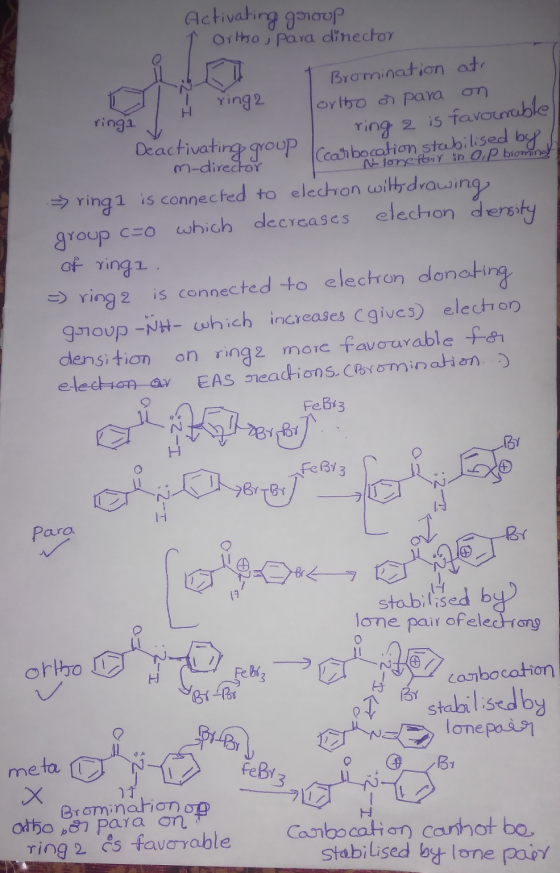
5. At what position and on what ring would you expect bromination of benzanilide to occur?...
Which ring of benzanilide would you expect to undergo electrophilic substitution more readily? (b) Write resonance...
 Which ring of benzanilide would you expect to undergo electrophilic substitution more readily? (b) Write resonance structures that explain your choice Done by Felix N ngassa for CHM 242: Orgamic Chermistry for Life Sceiences 2. gVSU, Winter 2014
Is bromination of Phenyl benzoate expected to occur?
 At what position, and on what ring, is bromination of phenyl benzoate expected to occur? Show your product and explain your answer.
If a dinitration product were formed in the reaction, at what position on the ring would...
If a dinitration product were formed in the reaction, at what position on the ring would the second nitro group be added? Explain the reasoning behind your answer and draw relevant resonance structures to reinforce your rationale.
#1. Using curved arrows to symbolize electrons, write a complete reaction mechanism for the bromination of...
#1. Using curved arrows to symbolize electrons, write a complete reaction mechanism for the bromination of acetanilide to create the product. Include the resonance structures for any charged, delocalized intermediates that are involved. #2. Why does performing the experiment at 0 degrees Celsius help you identify some of the relative rates of reactivity? #3. Explain why a methyl group is a mildly activating group while a methoxy group is strong activating. #4. Explain why-- NH2 act as an activator and--...
Which of the position(s) shown is where a single bromination of phenyl benzoate expected to occur...
 Which of the position(s) shown is where a single bromination of phenyl benzoate expected to occur most often? Briefly explain your answer.
4) A) Explain the regiochemistry of the following bromination using key resonance structures (there should be...
 4) A) Explain the regiochemistry of the following bromination using key resonance structures (there should be three) and predict the final product. Hint: Drawing these resonance structures is key to tell you if this substituent will direct bromination ortho/para or meta (3 polnts for the correct product, 4 polnts for the resonance structures, 7 points total). Brz FeBr, B) Predict the products (3 points each). b) OCH, a) HNO, H,SO AIC Br 1) S c) (p P. CH PHPh "Chem...
3. Draw the stereoisomeric structure of the products that you would expect from the bromination of...
 3. Draw the stereoisomeric structure of the products that you would expect from the bromination of the following Compounds using Br2 in CCl4. Use sawhorse projections. A. cis-3-hexene B. trans-3-hexene
3. (25 points) All six membered ring sugars, in the presence of acid and a nucleophile,...
 3. (25 points) All six membered ring sugars, in the presence of acid and a nucleophile, proceed via an Sn1 mechanism to yield only 1 product (as shown below). A) Provide a mechanism for the following reaction. Include all intermediates, resonance structures, charges, and electron pushing arrows to obtain full credit. B Why does the reaction not occur at the other 4 possible positions where there are alcohols? You may use mechanisms or intermediates to explain your answer. ООН OCH,...
7. Using resonance structures show how the amino group would effect the electron density on the...
 7. Using resonance structures show how the amino group would
effect the electron density on the ring carbons of the following
compound. Would you expect an electrophile to attack this molecule
at the ortho, meta or para position(s)?
8. Draw the structure of (3R,
4R)-3-(3-fluorophenyl)-4-formylhexan-2-one
ing resonance structures, show how the amino group would effect the electron density on the ring carbons of the following compound. Would you expect an electrophile to attack this molecule at the ortho, meta or...
7. Using resonance structures show how the amino group would
effect the electron density on the ring carbons of the following
compound. Would you expect an electrophile to attack this molecule
at the ortho, meta or para position(s)?
8. Draw the structure of (3R,
4R)-3-(3-fluorophenyl)-4-formylhexan-2-one
ing resonance structures, show how the amino group would effect the electron density on the ring carbons of the following compound. Would you expect an electrophile to attack this molecule at the ortho, meta or...
Indicate, by letter(s), the position(s) on the ring at which substitution occurs when the aromatic compounds...
 Indicate, by letter(s), the position(s) on the ring at which
substitution occurs when the aromatic compounds shown undergo
bromination with Br2, FeBr3 (when necessary).
If you can explain the reasoning for each answer, that'd be
appreaciated
Picture 1:
Picture 2:
Picture 3:
Indicate, by letter(s), the position(s) on the ring at which substitution occurs when the aromatic compounds shown undergo bromination with Br2. FeBr3 (when necessary Ph NO2 OH
Indicate, by letter(s), the position(s) on the ring at which
substitution occurs when the aromatic compounds shown undergo
bromination with Br2, FeBr3 (when necessary).
If you can explain the reasoning for each answer, that'd be
appreaciated
Picture 1:
Picture 2:
Picture 3:
Indicate, by letter(s), the position(s) on the ring at which substitution occurs when the aromatic compounds shown undergo bromination with Br2. FeBr3 (when necessary Ph NO2 OH
 Which ring of benzanilide would you expect to undergo electrophilic substitution more readily? (b) Write resonance structures that explain your choice Done by Felix N ngassa for CHM 242: Orgamic Chermistry for Life Sceiences 2. gVSU, Winter 2014
 Which of the position(s) shown is where a single bromination of phenyl benzoate expected to occur most often? Briefly explain your answer.
 4) A) Explain the regiochemistry of the following bromination using key resonance structures (there should be three) and predict the final product. Hint: Drawing these resonance structures is key to tell you if this substituent will direct bromination ortho/para or meta (3 polnts for the correct product, 4 polnts for the resonance structures, 7 points total). Brz FeBr, B) Predict the products (3 points each). b) OCH, a) HNO, H,SO AIC Br 1) S c) (p P. CH PHPh "Chem...
 3. Draw the stereoisomeric structure of the products that you would expect from the bromination of the following Compounds using Br2 in CCl4. Use sawhorse projections. A. cis-3-hexene B. trans-3-hexene
 3. (25 points) All six membered ring sugars, in the presence of acid and a nucleophile, proceed via an Sn1 mechanism to yield only 1 product (as shown below). A) Provide a mechanism for the following reaction. Include all intermediates, resonance structures, charges, and electron pushing arrows to obtain full credit. B Why does the reaction not occur at the other 4 possible positions where there are alcohols? You may use mechanisms or intermediates to explain your answer. ООН OCH,...
 7. Using resonance structures show how the amino group would
effect the electron density on the ring carbons of the following
compound. Would you expect an electrophile to attack this molecule
at the ortho, meta or para position(s)?
8. Draw the structure of (3R,
4R)-3-(3-fluorophenyl)-4-formylhexan-2-one
ing resonance structures, show how the amino group would effect the electron density on the ring carbons of the following compound. Would you expect an electrophile to attack this molecule at the ortho, meta or...
7. Using resonance structures show how the amino group would
effect the electron density on the ring carbons of the following
compound. Would you expect an electrophile to attack this molecule
at the ortho, meta or para position(s)?
8. Draw the structure of (3R,
4R)-3-(3-fluorophenyl)-4-formylhexan-2-one
ing resonance structures, show how the amino group would effect the electron density on the ring carbons of the following compound. Would you expect an electrophile to attack this molecule at the ortho, meta or...
 Indicate, by letter(s), the position(s) on the ring at which
substitution occurs when the aromatic compounds shown undergo
bromination with Br2, FeBr3 (when necessary).
If you can explain the reasoning for each answer, that'd be
appreaciated
Picture 1:
Picture 2:
Picture 3:
Indicate, by letter(s), the position(s) on the ring at which substitution occurs when the aromatic compounds shown undergo bromination with Br2. FeBr3 (when necessary Ph NO2 OH
Indicate, by letter(s), the position(s) on the ring at which
substitution occurs when the aromatic compounds shown undergo
bromination with Br2, FeBr3 (when necessary).
If you can explain the reasoning for each answer, that'd be
appreaciated
Picture 1:
Picture 2:
Picture 3:
Indicate, by letter(s), the position(s) on the ring at which substitution occurs when the aromatic compounds shown undergo bromination with Br2. FeBr3 (when necessary Ph NO2 OH
Most questions answered within 3 hours.
-
Where is the error in this code sequence?
String s1 = "Hello";
String s2 = "ello";...
asked 10 months ago -
Financial data for Joel de Paris, Inc., for last year
follow:
Joel de Paris, Inc.
Balance...
asked 10 months ago -
Consider this reaction:
Al2(SO4)3 (aq)+ BaCl3
(aq) Al2Cl6 (aq)- +
3BaSO4(s) . What is the...
asked 10 months ago -
Suppose that Savneet is considering increasing her
recent random sample from 20 car rentals to 40...
asked 10 months ago -
Trucks arrive at an unloading terminal at an average rate of 120
per hour.
Trucks arrive...
asked 10 months ago -
Why are methanol and ethanol completely soluble in water while
octanol is not very little soluble....
asked 10 months ago -
A facilities manager at a university reads in a research report
that the mean amount of...
asked 10 months ago -
When the CuSO4 is rehydrated by adding water to the anhydrous
compound, is this an endothermic...
asked 10 months ago -
A ray of sunlight is passing from diamond into crown glass; the
angle of incidence is...
asked 10 months ago -
A block of mass 0.249 kg is placed on top of a light, vertical
spring of...
asked 10 months ago -
how do the kidneys compensate in the presences of acidosis
a) trigger hyperventilate
b) reserve acid...
asked 10 months ago -
Question 501 pts
The rental rate of capital to the firm increases. Which of the
following...
asked 10 months ago