
Homework Answers
Add Answer to:
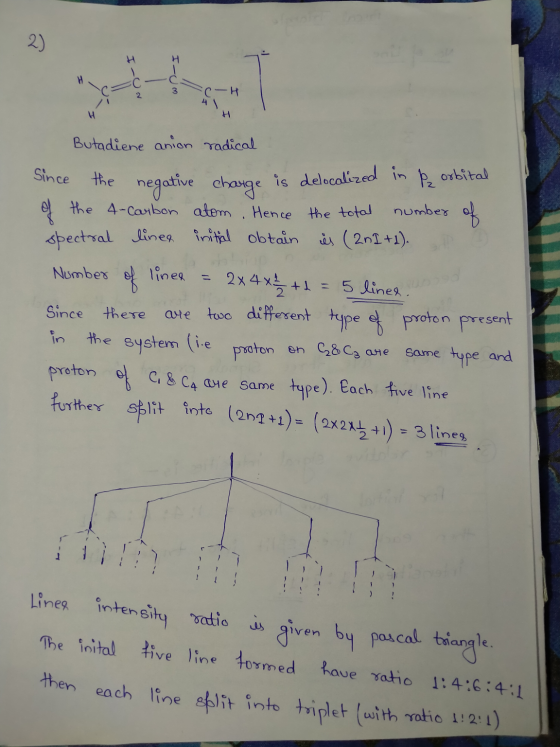
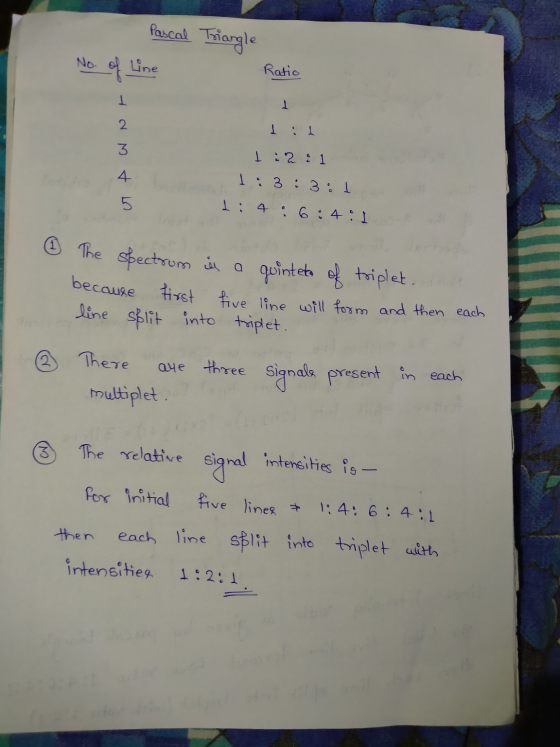
2. Below is the observed ESR spectrum of the butadiene anion radical. Interpret the spectrum (i.e.,...
The EPR spectrum of a cyclo-tetrasilane radical anion is shown below. a) Explain the observed coupling....
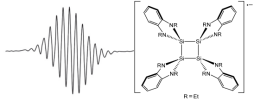 The EPR spectrum of a cyclo-tetrasilane radical anion is shown
below. a) Explain the observed coupling. (Hint: 1H:
I=1/2, 99% abundant; 13C: I=1/2, 1.0% abundant;
14N: I=1. 99.9% abundant; 29Si: I=1/2, 5.0%
abundant; not all the expected lines may be observed.)
b) Based on your explanation of the observed coupling in part
a), explain the relative intensities of the lines in this spectrum
(Hint: You may need to construct a Pascal's triangle for a nucleus
with I>1/2).
The EPR spectrum of a cyclo-tetrasilane radical anion is shown
below. a) Explain the observed coupling. (Hint: 1H:
I=1/2, 99% abundant; 13C: I=1/2, 1.0% abundant;
14N: I=1. 99.9% abundant; 29Si: I=1/2, 5.0%
abundant; not all the expected lines may be observed.)
b) Based on your explanation of the observed coupling in part
a), explain the relative intensities of the lines in this spectrum
(Hint: You may need to construct a Pascal's triangle for a nucleus
with I>1/2).
Hi could you help me with this problem please? The following spectroscopic data were obtained for...
Hi could you help me with this problem please? The following spectroscopic data were obtained for an organic compound: i. MS (relative abundance in parentheses): M+ = 86 ; signals at 29 (92) and 41 (100) among others ii. IR (cm-1): 3100 (weak sharp), 2970 (medium sharp), 2850 (medium), 1650 (weak sharp), 1100 (strong sharp) iii. H1 NMR : Signal A at 4 ppm (3H, triplet), Signal B at 3.53 ppm (2H quartet), Signal C at 4.01...
NMR IR CAN YOU PLEASE ANSWER AS SOON AS POSSIBLE THANK YOU PLEASE EXPLAIN IT IN DETAIL THANK YOU Experimental Data Only report the IR absorptions that provide diagnosis...
 NMR
IR
CAN YOU PLEASE ANSWER AS SOON AS POSSIBLE THANK
YOU
PLEASE EXPLAIN IT IN DETAIL THANK YOU
Experimental Data Only report the IR absorptions that provide diagnosis for the major functional groups. Copies of your spectra will be included in your lab report with this information written on the spectra. However, the information should also be included in the body of the report in a text format similar to the example given below IR cm1: 1735 (C-o); MS:...
NMR
IR
CAN YOU PLEASE ANSWER AS SOON AS POSSIBLE THANK
YOU
PLEASE EXPLAIN IT IN DETAIL THANK YOU
Experimental Data Only report the IR absorptions that provide diagnosis for the major functional groups. Copies of your spectra will be included in your lab report with this information written on the spectra. However, the information should also be included in the body of the report in a text format similar to the example given below IR cm1: 1735 (C-o); MS:...
 The EPR spectrum of a cyclo-tetrasilane radical anion is shown
below. a) Explain the observed coupling. (Hint: 1H:
I=1/2, 99% abundant; 13C: I=1/2, 1.0% abundant;
14N: I=1. 99.9% abundant; 29Si: I=1/2, 5.0%
abundant; not all the expected lines may be observed.)
b) Based on your explanation of the observed coupling in part
a), explain the relative intensities of the lines in this spectrum
(Hint: You may need to construct a Pascal's triangle for a nucleus
with I>1/2).
The EPR spectrum of a cyclo-tetrasilane radical anion is shown
below. a) Explain the observed coupling. (Hint: 1H:
I=1/2, 99% abundant; 13C: I=1/2, 1.0% abundant;
14N: I=1. 99.9% abundant; 29Si: I=1/2, 5.0%
abundant; not all the expected lines may be observed.)
b) Based on your explanation of the observed coupling in part
a), explain the relative intensities of the lines in this spectrum
(Hint: You may need to construct a Pascal's triangle for a nucleus
with I>1/2).
 NMR
IR
CAN YOU PLEASE ANSWER AS SOON AS POSSIBLE THANK
YOU
PLEASE EXPLAIN IT IN DETAIL THANK YOU
Experimental Data Only report the IR absorptions that provide diagnosis for the major functional groups. Copies of your spectra will be included in your lab report with this information written on the spectra. However, the information should also be included in the body of the report in a text format similar to the example given below IR cm1: 1735 (C-o); MS:...
NMR
IR
CAN YOU PLEASE ANSWER AS SOON AS POSSIBLE THANK
YOU
PLEASE EXPLAIN IT IN DETAIL THANK YOU
Experimental Data Only report the IR absorptions that provide diagnosis for the major functional groups. Copies of your spectra will be included in your lab report with this information written on the spectra. However, the information should also be included in the body of the report in a text format similar to the example given below IR cm1: 1735 (C-o); MS:...
Most questions answered within 3 hours.
-
Where is the error in this code sequence?
String s1 = "Hello";
String s2 = "ello";...
asked 11 months ago -
Financial data for Joel de Paris, Inc., for last year
follow:
Joel de Paris, Inc.
Balance...
asked 11 months ago -
Consider this reaction:
Al2(SO4)3 (aq)+ BaCl3
(aq) Al2Cl6 (aq)- +
3BaSO4(s) . What is the...
asked 11 months ago -
Suppose that Savneet is considering increasing her
recent random sample from 20 car rentals to 40...
asked 11 months ago -
Trucks arrive at an unloading terminal at an average rate of 120
per hour.
Trucks arrive...
asked 11 months ago -
Why are methanol and ethanol completely soluble in water while
octanol is not very little soluble....
asked 11 months ago -
A facilities manager at a university reads in a research report
that the mean amount of...
asked 11 months ago -
When the CuSO4 is rehydrated by adding water to the anhydrous
compound, is this an endothermic...
asked 11 months ago -
A ray of sunlight is passing from diamond into crown glass; the
angle of incidence is...
asked 11 months ago -
A block of mass 0.249 kg is placed on top of a light, vertical
spring of...
asked 11 months ago -
how do the kidneys compensate in the presences of acidosis
a) trigger hyperventilate
b) reserve acid...
asked 11 months ago -
Question 501 pts
The rental rate of capital to the firm increases. Which of the
following...
asked 11 months ago