![1. You collected the following data in lab for the endothermic chemical reaction CO(g) + Cl2(g) → COC12(9) Trial # [CO] (M) [](http://img.homeworklib.com/questions/3ea0f7b0-d98f-11eb-acb1-2f95477401da.png?x-oss-process=image/resize,w_560)
Homework Answers
![9 Colg, & cla Cg) - Cody cg), DH = the doubles while ) and (3) [cle] concentration remain constant doing this a doubles the f](http://img.homeworklib.com/questions/a9ed3810-d98f-11eb-9375-bf5a33cb84ee.png?x-oss-process=image/resize,w_560)
 Le-
chatelier's principle : It states that if a chemical reaction at
equilibrium is subjected to a change in temperature, pressure or
concentration, the equilibrium shifts to that direction by which
the effect of the change is minimised.
Le-
chatelier's principle : It states that if a chemical reaction at
equilibrium is subjected to a change in temperature, pressure or
concentration, the equilibrium shifts to that direction by which
the effect of the change is minimised.
Add Answer to:
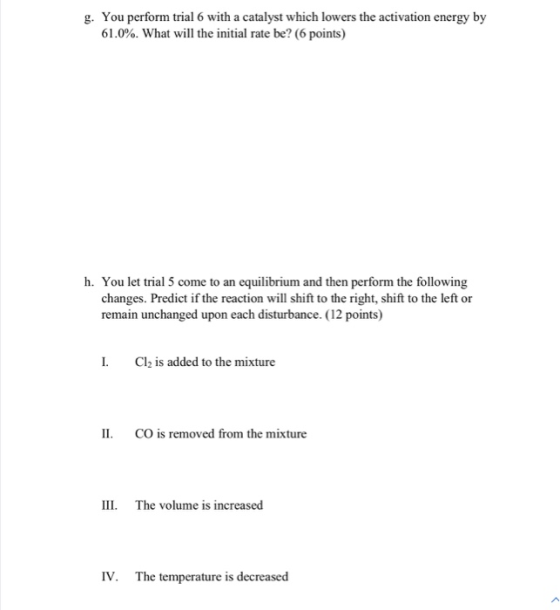
Use the following table to answer g and h
1. You collected the following data in...
The equilibrium constant, K, for the following reaction is 2.52x10⁻² at 620 K. COC12(g) * CO(g)...
 The equilibrium constant, K, for the following reaction is 2.52x10⁻² at 620 K. COC12(g) * CO(g) + Cl2(g) An equilibrium mixture of the three gases in a 10.5 L container at 620 K contains 0.264 M COCl2, 8.15x10⁻² M CO and 8.15x10⁻² M Cl. What will be the concentrations of the three gases once equilibrium has been reestablished, if the equilibrium mixture is compressed at constant temperature to a volume of 4.32 L? M [COCl2] = [CO] = [Cl2] =...
The data below were collected for the following reaction at 500 ∘C: CH3CN(g)→CH3NC(g) Time (h) [CH3CN]...
The data below were collected for the following reaction at 500 ∘C: CH3CN(g)→CH3NC(g) Time (h) [CH3CN] (M) 0.0 1.000 5.0 0.794 10.0 0.631 15.0 0.501 20.0 0.398 25.0 0.316 Determine the order of the reaction at this temperature. What is the half-life for this reaction (at the initial concentration)? How long will it take for 80% of the CH3CN to convert to CH3NC?
Consider the following reaction: COCl2(g) = CO(g) + Cl2(8) A reaction mixture initially contains 1.6 M...
 Consider the following reaction: COCl2(g) = CO(g) + Cl2(8) A reaction mixture initially contains 1.6 M COC12. Determine the equilibrium concentrations of COCI, CO, and Cl2 if Kc for the reaction at this temperature is 8.33 x 10⁻⁴. Calculate this based on the assumption that the answer is negligible compared to 1.6. Use x is small approximation. Show Q Validity check [Cl2] = [CO]= [COCI2] = Calculate the reaction quotient, Q A % Validity Check A Calculate the A/ equilibrium...
Now let us do some Le Chatelier C(s)+H2O (g)←→CO (g) +H2 (g)AH-+131 kJ (in case you...
 Now let us do some Le Chatelier C(s)+H2O (g)←→CO (g) +H2 (g)AH-+131 kJ (in case you don't remember, this is an endothermic reaction). 4. A rigid container holds a mixture of graphite pellets (C(s)), water vapor, carbon monoxide gas, and hydrogen gas at equilibrium. State whether the number of moles of CO (g) in the container will increase, decrease, or remain the same after each of the following disturbances is applied to the original mixture. For each case, assume that...
Additional Questions Consider the following reaction at equilibrium: PCB (g) + Cl2(g) ---PC1s (8) + Heat...
 Additional Questions Consider the following reaction at equilibrium: PCB (g) + Cl2(g) ---PC1s (8) + Heat Fill in the table below by indicating what direction the equilibrium will shift when the changes indicated are made, and the shift will have on each species in the reaction mixture. You may use lelt and right arrows for the shift, and up or down arrows to indicate concentration changes. Indicate no change by writing NC Stress Eq Shift PCI, Conc. Cl2 Conc. PCIs...
1) For the following reaction: SO2Cl2(g)<-> SO2(g) + Cl2 (g) Kp=2.91x10^3 at 298K In the reaction...
1) For the following reaction: SO2Cl2(g)<-> SO2(g) + Cl2 (g) Kp=2.91x10^3 at 298K In the reaction at equilibrium, the partial pressure of SO2 is 137 torr and that of CL2 is 285 torr. The partial pressure of SO2Cl2 is [x]torr. 2) For the following reaction:NH4HS(s)<->NH3(g) + H2S (g) Kc=8.5x10^-3 At any given point the reaction mixture has solid NH4HS, NH3 at 0.166M and H2S at 0.166M. a) Is the reaction at equilibrium? b)Will more of the solid form, or will...
Question 1 Glucose metabolism can be represented by the following chemical reaction: C6H12O6(aq)+6O2(g)6CO2(g)+6H2O(l) H for...
 Question 1
Glucose metabolism can be represented by the following chemical
reaction:
C6H12O6(aq)+6O2(g)6CO2(g)+6H2O(l)
H for the
reaction is -2837 kJ/mole.
Is this reaction endothermic or exothermic?
Write an expression for the equilibrium constant for this
reaction.
Given that the value of the equilibrium constant is very large,
would you expect this reaction to be fast or slow?
Explain the effect on equilibrium of
Increasing temperature
Increasing pressure by decreasing the volume
Decreasing concentration of oxygen
Increasing the concentration of...
Question 1
Glucose metabolism can be represented by the following chemical
reaction:
C6H12O6(aq)+6O2(g)6CO2(g)+6H2O(l)
H for the
reaction is -2837 kJ/mole.
Is this reaction endothermic or exothermic?
Write an expression for the equilibrium constant for this
reaction.
Given that the value of the equilibrium constant is very large,
would you expect this reaction to be fast or slow?
Explain the effect on equilibrium of
Increasing temperature
Increasing pressure by decreasing the volume
Decreasing concentration of oxygen
Increasing the concentration of...
pages 1-4 go together, and last question is separate but needs an answer. separate question: Which...
 pages 1-4 go together, and last question is separate but needs
an answer.
separate question: Which state of matter is the most
energetic? give a reason for your answer.
CHEM&121 WS-11: Equilibrium Worksheet 1. Write the equilibrium expression for the following reactions: a. 200+ 0 2CO b. COCl2 CO + Cl2 c. CS2 + 4H CH. +2H:S d. 2SO2 + 0 2SO e. 2C1:05 O2 + 4CIO 1 2. A sample of gaseous BrCl is allowed to decompose in a...
pages 1-4 go together, and last question is separate but needs
an answer.
separate question: Which state of matter is the most
energetic? give a reason for your answer.
CHEM&121 WS-11: Equilibrium Worksheet 1. Write the equilibrium expression for the following reactions: a. 200+ 0 2CO b. COCl2 CO + Cl2 c. CS2 + 4H CH. +2H:S d. 2SO2 + 0 2SO e. 2C1:05 O2 + 4CIO 1 2. A sample of gaseous BrCl is allowed to decompose in a...
F19 CHM 202 HW 8 1. A reaction mixture at 350 C was found to have the following concentrations: THI] = 0.024 M; [H.]...
 F19 CHM 202 HW 8 1. A reaction mixture at 350 C was found to have the following concentrations: THI] = 0.024 M; [H.] =0.025 M and [1] =0.025 M H.(e)+ble) 2 HI(e), K = 57.0 a) Determine whether the mixture is at equilibrium or not b) If the mixture is not at equilibrium, tell the direction of the shift to reach equilibrium, and calculate the equilibrium concentrations of Hz, 12 and HI. 2. Consider the Haber Process for the...
uestion 1 Decrease in temperature of the following reaction results in shift towards 2502(g) + O2(g)...
 uestion 1 Decrease in temperature of the following reaction results in shift towards 2502(g) + O2(g) 2503(g) + heat Reactants No Change Products Insufficient Information A Moving to another question will save this response. Question 2 As the reaction progress with time what happens to the followings: (1) Rate of the forward reaction (II) Concentration of products Increase, Increase Increase, Decrease Decrease, Increase Decrease, Decrease Which of the following is NOT true about catalyst Shifts direction of equilibrium reaction O...
 The equilibrium constant, K, for the following reaction is 2.52x10⁻² at 620 K. COC12(g) * CO(g) + Cl2(g) An equilibrium mixture of the three gases in a 10.5 L container at 620 K contains 0.264 M COCl2, 8.15x10⁻² M CO and 8.15x10⁻² M Cl. What will be the concentrations of the three gases once equilibrium has been reestablished, if the equilibrium mixture is compressed at constant temperature to a volume of 4.32 L? M [COCl2] = [CO] = [Cl2] =...
 Consider the following reaction: COCl2(g) = CO(g) + Cl2(8) A reaction mixture initially contains 1.6 M COC12. Determine the equilibrium concentrations of COCI, CO, and Cl2 if Kc for the reaction at this temperature is 8.33 x 10⁻⁴. Calculate this based on the assumption that the answer is negligible compared to 1.6. Use x is small approximation. Show Q Validity check [Cl2] = [CO]= [COCI2] = Calculate the reaction quotient, Q A % Validity Check A Calculate the A/ equilibrium...
 Now let us do some Le Chatelier C(s)+H2O (g)←→CO (g) +H2 (g)AH-+131 kJ (in case you don't remember, this is an endothermic reaction). 4. A rigid container holds a mixture of graphite pellets (C(s)), water vapor, carbon monoxide gas, and hydrogen gas at equilibrium. State whether the number of moles of CO (g) in the container will increase, decrease, or remain the same after each of the following disturbances is applied to the original mixture. For each case, assume that...
 Additional Questions Consider the following reaction at equilibrium: PCB (g) + Cl2(g) ---PC1s (8) + Heat Fill in the table below by indicating what direction the equilibrium will shift when the changes indicated are made, and the shift will have on each species in the reaction mixture. You may use lelt and right arrows for the shift, and up or down arrows to indicate concentration changes. Indicate no change by writing NC Stress Eq Shift PCI, Conc. Cl2 Conc. PCIs...
 Question 1
Glucose metabolism can be represented by the following chemical
reaction:
C6H12O6(aq)+6O2(g)6CO2(g)+6H2O(l)
H for the
reaction is -2837 kJ/mole.
Is this reaction endothermic or exothermic?
Write an expression for the equilibrium constant for this
reaction.
Given that the value of the equilibrium constant is very large,
would you expect this reaction to be fast or slow?
Explain the effect on equilibrium of
Increasing temperature
Increasing pressure by decreasing the volume
Decreasing concentration of oxygen
Increasing the concentration of...
Question 1
Glucose metabolism can be represented by the following chemical
reaction:
C6H12O6(aq)+6O2(g)6CO2(g)+6H2O(l)
H for the
reaction is -2837 kJ/mole.
Is this reaction endothermic or exothermic?
Write an expression for the equilibrium constant for this
reaction.
Given that the value of the equilibrium constant is very large,
would you expect this reaction to be fast or slow?
Explain the effect on equilibrium of
Increasing temperature
Increasing pressure by decreasing the volume
Decreasing concentration of oxygen
Increasing the concentration of...
 pages 1-4 go together, and last question is separate but needs
an answer.
separate question: Which state of matter is the most
energetic? give a reason for your answer.
CHEM&121 WS-11: Equilibrium Worksheet 1. Write the equilibrium expression for the following reactions: a. 200+ 0 2CO b. COCl2 CO + Cl2 c. CS2 + 4H CH. +2H:S d. 2SO2 + 0 2SO e. 2C1:05 O2 + 4CIO 1 2. A sample of gaseous BrCl is allowed to decompose in a...
pages 1-4 go together, and last question is separate but needs
an answer.
separate question: Which state of matter is the most
energetic? give a reason for your answer.
CHEM&121 WS-11: Equilibrium Worksheet 1. Write the equilibrium expression for the following reactions: a. 200+ 0 2CO b. COCl2 CO + Cl2 c. CS2 + 4H CH. +2H:S d. 2SO2 + 0 2SO e. 2C1:05 O2 + 4CIO 1 2. A sample of gaseous BrCl is allowed to decompose in a...
 F19 CHM 202 HW 8 1. A reaction mixture at 350 C was found to have the following concentrations: THI] = 0.024 M; [H.] =0.025 M and [1] =0.025 M H.(e)+ble) 2 HI(e), K = 57.0 a) Determine whether the mixture is at equilibrium or not b) If the mixture is not at equilibrium, tell the direction of the shift to reach equilibrium, and calculate the equilibrium concentrations of Hz, 12 and HI. 2. Consider the Haber Process for the...
 uestion 1 Decrease in temperature of the following reaction results in shift towards 2502(g) + O2(g) 2503(g) + heat Reactants No Change Products Insufficient Information A Moving to another question will save this response. Question 2 As the reaction progress with time what happens to the followings: (1) Rate of the forward reaction (II) Concentration of products Increase, Increase Increase, Decrease Decrease, Increase Decrease, Decrease Which of the following is NOT true about catalyst Shifts direction of equilibrium reaction O...
Most questions answered within 3 hours.
-
Where is the error in this code sequence?
String s1 = "Hello";
String s2 = "ello";...
asked 11 months ago -
Financial data for Joel de Paris, Inc., for last year
follow:
Joel de Paris, Inc.
Balance...
asked 11 months ago -
Consider this reaction:
Al2(SO4)3 (aq)+ BaCl3
(aq) Al2Cl6 (aq)- +
3BaSO4(s) . What is the...
asked 11 months ago -
Suppose that Savneet is considering increasing her
recent random sample from 20 car rentals to 40...
asked 11 months ago -
Trucks arrive at an unloading terminal at an average rate of 120
per hour.
Trucks arrive...
asked 11 months ago -
Why are methanol and ethanol completely soluble in water while
octanol is not very little soluble....
asked 11 months ago -
A facilities manager at a university reads in a research report
that the mean amount of...
asked 11 months ago -
When the CuSO4 is rehydrated by adding water to the anhydrous
compound, is this an endothermic...
asked 11 months ago -
A ray of sunlight is passing from diamond into crown glass; the
angle of incidence is...
asked 11 months ago -
A block of mass 0.249 kg is placed on top of a light, vertical
spring of...
asked 11 months ago -
how do the kidneys compensate in the presences of acidosis
a) trigger hyperventilate
b) reserve acid...
asked 11 months ago -
Question 501 pts
The rental rate of capital to the firm increases. Which of the
following...
asked 11 months ago