An amount of an ideal gas expands from 10.1 L to 26.9 L at a constant...
An amount of an ideal gas expands from 10.1 L to 26.9 L at a constant pressure of 1.00 atm. Then the gas is cooled at a constant volume of 26.9 back to its original temperature. Then it contracts back at a constant temperature to its original volume. Find the total heat flow for this entire process.
Homework Answers
process is isobaric expansion followed by isochoric cooling and the isothermal compression
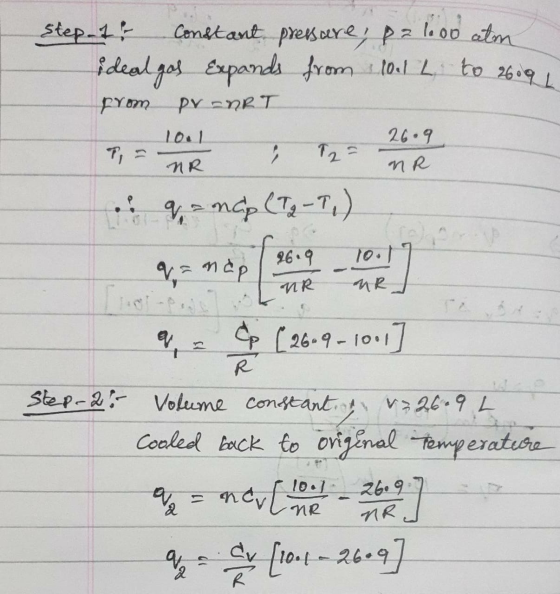
![Step 3: Temperature constant, Tank contracts back to original volume qaweane ( ] (2:303) top 90 =(10-1}{2-303) boy fotot Tota](http://img.homeworklib.com/questions/5b5f8690-d9c3-11eb-830d-a9afd404360e.png?x-oss-process=image/resize,w_560)
Add Answer to:
An amount of an ideal gas expands from 10.1 L to 26.9 L at a
constant...
An ideal gas expands from 26.0 L to 80.0 L at a constant pressure of 1.00...
 An ideal gas expands from 26.0 L to 80.0 L at a constant pressure of 1.00 atm. Then, the gas is cooled at a constant volume of 80.0L back to its original temperature. It then contracts back to its original volume without changing temperature. Find the total heat flow, in joules, for the entire process. total heat flow:
An ideal gas expands from 26.0 L to 80.0 L at a constant pressure of 1.00...
 An ideal gas expands from 26.0 L to 80.0 L at a constant pressure of 1.00 atm. Then, the gas is cooled at a constant volume of 80.0L back to its original temperature. It then contracts back to its original volume without changing temperature. Find the total heat flow, in joules, for the entire process. total heat flow: TOOLS x10
An ideal gas expands from 14.0 L to 76.0 L at a constant pressure of 1.00...
 An ideal gas expands from 14.0 L to 76.0 L at a constant pressure of 1.00 atm. Then, the gas is cooled at a constant volume of 76.0 L back to its original temperature. It then contracts back to its original volume without changing temperature. Find the total heat flow, in joules, for the entire process. total heat flow: If you combine 440.0 mL of water at 25.00 °C and 130.0 mL of water at 95.00 °C, what is the...
An ideal gas expands at a constant total pressure of 2.8 atm from 420 mL to...
An ideal gas expands at a constant total pressure of 2.8 atm from 420 mL to 770 mL . Heat then flows out of the gas at constant volume, and the pressure and temperature are allowed to drop until the temperature reaches its original value. A)calculate the total work done by the gas in the process B)calculate the total heat flow into the gas?
An ideal gas expands at a constant total pressure of 2.9 atm from 500 mL to...
An ideal gas expands at a constant total pressure of 2.9 atm from 500 mL to 710 mL . Heat then flows out of the gas at constant volume, and the pressure and temperature are allowed to drop until the temperature reaches its original value. A) Calculate the total work done by the gas in the process. Express your answer to two significant figures and include the appropriate units. W = ________ B) Calculate the total heat flow into the...
An ideal gas expands at a constant total pressure of 3.0 atm from 450 mL to...
An ideal gas expands at a constant total pressure of 3.0 atm from 450 mL to 850 mL . Heat then flows out of the gas at constant volume, and the pressure and temperature are allowed to drop until the temperature reaches its original value. Part A Calculate the total work done by the gas in the process. Express your answer to two significant figures and include the appropriate units. Part B Calculate the total heat flow into the gas....
10.0 L of an ideal diatomic gas at 1.00 atm and 200 K are contained in...
 10.0 L of an ideal diatomic gas at 1.00 atm and 200 K are contained in a cylinder with a piston. The gas first expands isobarically to 30.0 L (step 1). It then contracts adiabatically back to its original volume (step 2), and then cools isochorically back to its original pressure (step 3). a) Show the series of processes on a pV diagram. b) Calculate the temperature, pressure, and volume of the system at the end of each step in...
10 moles of an ideal gas expands irreversibly against an unknown constant external pres- sure, Pert,...
 10 moles of an ideal gas expands irreversibly against an unknown constant external pres- sure, Pert, from an initial volume Vİ-1 L to a final volume ½ 11 L. In the process, the temperature of the gas falls from T350 K to T2 250 K, and it absorbs heat q+7 L atm from the surroundings. (a) What is the external pressure, Pert (in atm)? [Note: this is an ideal gas, so its internal energy depends only on its temperature.] (b)...
Problem 19.31 7 Constants Peric Consider the following two-step process. Heat is allowed to flow out...
 Problem 19.31 7 Constants Peric Consider the following two-step process. Heat is allowed to flow out of an ideal gas al constant volume so that its pressure drops from 22 atm to 1.4 atm. Then the gas expands at constant pressure, from a volume of 5.9 L to 9.3 L, where the temperature reaches its original value. (See Part A Calculate the total work done by the gas in the process. Express your answer using two significant figures. Figure (...
(1) An ideal monatomic gas expands isothermally from 0.600 m3 to 1.25 m3 at a constant...
(1) An ideal monatomic gas expands isothermally from 0.600 m3 to 1.25 m3 at a constant temperature of 640 K. If the initial pressure is 1.01 ✕ 105 Pa find the following. (a) the work done on the gas J (b) the thermal energy transfer Q J (c) the change in the internal energy J (2) Gas in a container is at a pressure of 1.2 atm and a volume of 5.0 m3. (a) What is the work done on...
 An ideal gas expands from 26.0 L to 80.0 L at a constant pressure of 1.00 atm. Then, the gas is cooled at a constant volume of 80.0L back to its original temperature. It then contracts back to its original volume without changing temperature. Find the total heat flow, in joules, for the entire process. total heat flow:
 An ideal gas expands from 26.0 L to 80.0 L at a constant pressure of 1.00 atm. Then, the gas is cooled at a constant volume of 80.0L back to its original temperature. It then contracts back to its original volume without changing temperature. Find the total heat flow, in joules, for the entire process. total heat flow: TOOLS x10
 An ideal gas expands from 14.0 L to 76.0 L at a constant pressure of 1.00 atm. Then, the gas is cooled at a constant volume of 76.0 L back to its original temperature. It then contracts back to its original volume without changing temperature. Find the total heat flow, in joules, for the entire process. total heat flow: If you combine 440.0 mL of water at 25.00 °C and 130.0 mL of water at 95.00 °C, what is the...
 10.0 L of an ideal diatomic gas at 1.00 atm and 200 K are contained in a cylinder with a piston. The gas first expands isobarically to 30.0 L (step 1). It then contracts adiabatically back to its original volume (step 2), and then cools isochorically back to its original pressure (step 3). a) Show the series of processes on a pV diagram. b) Calculate the temperature, pressure, and volume of the system at the end of each step in...
 10 moles of an ideal gas expands irreversibly against an unknown constant external pres- sure, Pert, from an initial volume Vİ-1 L to a final volume ½ 11 L. In the process, the temperature of the gas falls from T350 K to T2 250 K, and it absorbs heat q+7 L atm from the surroundings. (a) What is the external pressure, Pert (in atm)? [Note: this is an ideal gas, so its internal energy depends only on its temperature.] (b)...
 Problem 19.31 7 Constants Peric Consider the following two-step process. Heat is allowed to flow out of an ideal gas al constant volume so that its pressure drops from 22 atm to 1.4 atm. Then the gas expands at constant pressure, from a volume of 5.9 L to 9.3 L, where the temperature reaches its original value. (See Part A Calculate the total work done by the gas in the process. Express your answer using two significant figures. Figure (...
Most questions answered within 3 hours.
-
Where is the error in this code sequence?
String s1 = "Hello";
String s2 = "ello";...
asked 11 months ago -
Financial data for Joel de Paris, Inc., for last year
follow:
Joel de Paris, Inc.
Balance...
asked 11 months ago -
Consider this reaction:
Al2(SO4)3 (aq)+ BaCl3
(aq) Al2Cl6 (aq)- +
3BaSO4(s) . What is the...
asked 11 months ago -
Suppose that Savneet is considering increasing her
recent random sample from 20 car rentals to 40...
asked 11 months ago -
Trucks arrive at an unloading terminal at an average rate of 120
per hour.
Trucks arrive...
asked 11 months ago -
Why are methanol and ethanol completely soluble in water while
octanol is not very little soluble....
asked 11 months ago -
A facilities manager at a university reads in a research report
that the mean amount of...
asked 11 months ago -
When the CuSO4 is rehydrated by adding water to the anhydrous
compound, is this an endothermic...
asked 11 months ago -
A ray of sunlight is passing from diamond into crown glass; the
angle of incidence is...
asked 11 months ago -
A block of mass 0.249 kg is placed on top of a light, vertical
spring of...
asked 11 months ago -
how do the kidneys compensate in the presences of acidosis
a) trigger hyperventilate
b) reserve acid...
asked 11 months ago -
Question 501 pts
The rental rate of capital to the firm increases. Which of the
following...
asked 11 months ago