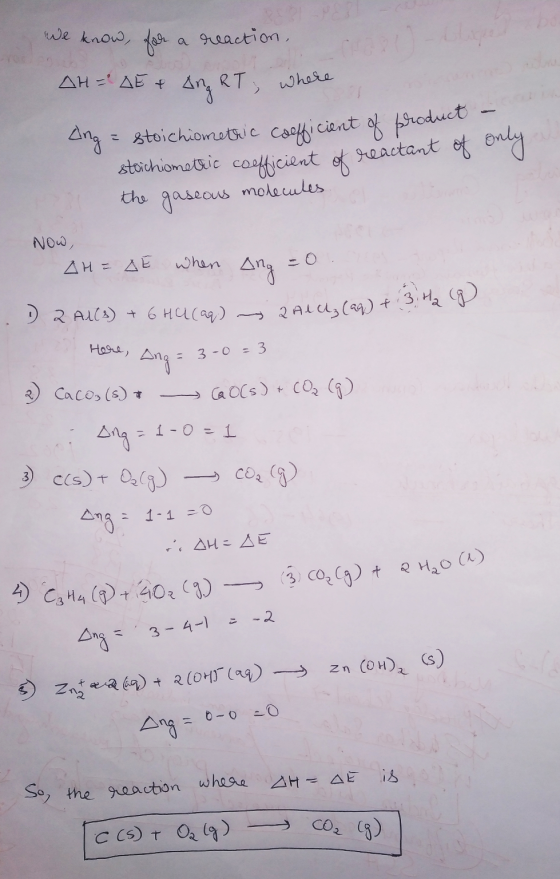
Which of the following reactions would ΔH = ΔE? 2Al(s) + 6HCl(aq) --> 2AlCl3(aq) + 3H2(g)...
Which of the following reactions would ΔH = ΔE?
-
2Al(s) + 6HCl(aq) --> 2AlCl3(aq) + 3H2(g)
-
CaCO3(s) --> CaO(s) + CO2(g)
-
C(s) + O2(g) --> CO2(g)
-
C3H4(g) + 4O2(g) --> 3CO2(g) + 2H2O(l)
-
Zn+2(aq) + 2OH-(aq) --> Zn(OH)2(s)
Homework Answers
NOTE- Kindly comment if you have any doubt. Please give a positive rating if you find my answer helpful. Thank you.
Add Answer to:
Which of the following reactions would ΔH = ΔE?
2Al(s) + 6HCl(aq) --> 2AlCl3(aq) +
3H2(g)...
dela E? Which of the following reactions would ΔΗ = ΔΕ? Multiple Choice O C(s) +...
 dela E?
Which of the following reactions would ΔΗ = ΔΕ? Multiple Choice O C(s) + O2(9) --> CO2(g) Zn+2(aq) + 2OH(aq) --> Zn(OH)2(s) C3H4(g) + 402(g) --> 3CO2(g) + 2H2O(1) CaCO3(s) --> CaO(s) + CO2(g) 2Al(s) + 6HCl(aq) --> 2AlCl3(aq) + 3H2(g)
dela E?
Which of the following reactions would ΔΗ = ΔΕ? Multiple Choice O C(s) + O2(9) --> CO2(g) Zn+2(aq) + 2OH(aq) --> Zn(OH)2(s) C3H4(g) + 402(g) --> 3CO2(g) + 2H2O(1) CaCO3(s) --> CaO(s) + CO2(g) 2Al(s) + 6HCl(aq) --> 2AlCl3(aq) + 3H2(g)
When aluminum is placed in concentrated hydrochloric acid, hydrogen gas is produced. 2Al(s)+6HCl(aq)⟶2AlCl3(aq)+3H2(g)2Al(s)+6HCl(aq)⟶2AlCl3(aq)+3H2(g) What volume of...
When aluminum is placed in concentrated hydrochloric acid, hydrogen gas is produced. 2Al(s)+6HCl(aq)⟶2AlCl3(aq)+3H2(g)2Al(s)+6HCl(aq)⟶2AlCl3(aq)+3H2(g) What volume of H2(g)H2(g) is produced when 3.30 g of Al(s) reacts at STP?
Consider the following balanced equation: 6HCl(aq) + 2Al(s) → 3H2(g) + 2AlCl3(s) If 17.3 moles of...
Consider the following balanced equation: 6HCl(aq) + 2Al(s) → 3H2(g) + 2AlCl3(s) If 17.3 moles of HCl(aq) and 7.07 moles of Al(s) are allowed to react, and the percent yield is 71.8%, how many moles of AlCl3(s) will actually be produced?
When aluminum is placed in concentrated hydrochloric acid, hydrogen gas is produced. 2Al(s)+6HCl(aq)⟶2AlCl3(aq)+3H2(g) What volume of...
When aluminum is placed in concentrated hydrochloric acid, hydrogen gas is produced. 2Al(s)+6HCl(aq)⟶2AlCl3(aq)+3H2(g) What volume of H2(g) is produced when 3.90 g Al(s) reacts at STP?
When aluminum reacts with concentrated hydrochloric acid, hydrogen gas is produced. 2Al(s)+6HCl(aq)⟶2AlCl3(aq)+3H2(g) What mass of Al(s)...
When aluminum reacts with concentrated hydrochloric acid, hydrogen gas is produced. 2Al(s)+6HCl(aq)⟶2AlCl3(aq)+3H2(g) What mass of Al(s) is required to produce 658.5 mL of H2(g) at STP? mass: g Al
3 .Which one of the following reactions is a redox reaction? 1. 2Al(s) + 2KOH(aq)...
3 .Which one of the following reactions is a redox reaction? 1. 2Al(s) + 2KOH(aq) + 6H2O(l) → 2KAl(OH)4(aq) + 3H2(g) 2. Pb(NO3)2(aq) + 2HCl(aq) → PbCl2(s) + 2HNO3(aq) 3. Zn(OH)2(aq) + H2SO4(aq) → ZnSO4(aq) + 2H2O(l)
Time Remaining:04:12:6 Consider the following balanced equation: 6HCl(aq) + 2Al(s) + 3H2(g) + 2AlCl3(S) 11 1.80x10²...
 Time Remaining:04:12:6 Consider the following balanced equation: 6HCl(aq) + 2Al(s) + 3H2(g) + 2AlCl3(S) 11 1.80x10² grams of HCl(aq) reacts with an excess of Al(s), and the percent yield is 53.6%, how many grams AlCl3(s) will actually be produced? 2.76x10⁹ 3.54x1099 9.88x1099 1.18*109 5.02*1099 Use the slider to rate your confidence on this question 100 Not at all confident Very confident
The enthalpy change, ΔH, for a reaction at constant pressure is defined as: ΔH = ΔE...
The enthalpy change, ΔH, for a reaction at constant pressure is defined as: ΔH = ΔE + PΔV. For which of the following reactions will ΔH be approximately equal to ΔE? Select all that apply. Group of answer choices 2 NO2(g) -> N2(g) + 2 O2(g) Ca(OH)2(aq) + H2SO4(aq) -> 2 H2O(l) + CaSO4(s) C(s) + O2(g) -> CO2(g) None of the above
For which of these reactions will the difference betweenΔH° and ΔE° be the greatest? a. 2H2O2(l)...
 For which of these reactions will the difference betweenΔH° and ΔE°
be the greatest?
a.
2H2O2(l) →2H2O(l)
+ O2(g)
b.
CaCO3(s)→ CaO(s)
+CO2(g)
c.
NO(g) +O3(g) → NO2(g) +
O2(g)
d.
2C2H6(g) +7O2(g)
→ 4CO2(g) + 6H2O(l)
e.
4NH3(g)+ 5O2(g) → 4NO(g) +
6H2O(g)
For which of these reactions will the difference betweenΔH° and ΔE°
be the greatest?
a.
2H2O2(l) →2H2O(l)
+ O2(g)
b.
CaCO3(s)→ CaO(s)
+CO2(g)
c.
NO(g) +O3(g) → NO2(g) +
O2(g)
d.
2C2H6(g) +7O2(g)
→ 4CO2(g) + 6H2O(l)
e.
4NH3(g)+ 5O2(g) → 4NO(g) +
6H2O(g)
Hydrogen gas is produced by the reaction between metallic aluminum and aqueous hydrochloric acid. 2Al(s)+6HCl(aq)⟶2AlCl3(aq)+3H2(g) The...
Hydrogen gas is produced by the reaction between metallic aluminum and aqueous hydrochloric acid. 2Al(s)+6HCl(aq)⟶2AlCl3(aq)+3H2(g) The hydrogen gas produced by this reaction is typically collected via water displacement. During this process, the hydrogen gas becomes saturated with water vapor. If 281.7 mL of gas with a total pressure of 1.02 atm is collected via water displacement at 29.4 ∘C, what is the partial pressure of the hydrogen gas in the sample? The vapor pressure of water at 29.4 ∘C is...
 dela E?
Which of the following reactions would ΔΗ = ΔΕ? Multiple Choice O C(s) + O2(9) --> CO2(g) Zn+2(aq) + 2OH(aq) --> Zn(OH)2(s) C3H4(g) + 402(g) --> 3CO2(g) + 2H2O(1) CaCO3(s) --> CaO(s) + CO2(g) 2Al(s) + 6HCl(aq) --> 2AlCl3(aq) + 3H2(g)
dela E?
Which of the following reactions would ΔΗ = ΔΕ? Multiple Choice O C(s) + O2(9) --> CO2(g) Zn+2(aq) + 2OH(aq) --> Zn(OH)2(s) C3H4(g) + 402(g) --> 3CO2(g) + 2H2O(1) CaCO3(s) --> CaO(s) + CO2(g) 2Al(s) + 6HCl(aq) --> 2AlCl3(aq) + 3H2(g)
 Time Remaining:04:12:6 Consider the following balanced equation: 6HCl(aq) + 2Al(s) + 3H2(g) + 2AlCl3(S) 11 1.80x10² grams of HCl(aq) reacts with an excess of Al(s), and the percent yield is 53.6%, how many grams AlCl3(s) will actually be produced? 2.76x10⁹ 3.54x1099 9.88x1099 1.18*109 5.02*1099 Use the slider to rate your confidence on this question 100 Not at all confident Very confident
Most questions answered within 3 hours.
-
Where is the error in this code sequence?
String s1 = "Hello";
String s2 = "ello";...
asked 11 months ago -
Financial data for Joel de Paris, Inc., for last year
follow:
Joel de Paris, Inc.
Balance...
asked 11 months ago -
Consider this reaction:
Al2(SO4)3 (aq)+ BaCl3
(aq) Al2Cl6 (aq)- +
3BaSO4(s) . What is the...
asked 11 months ago -
Suppose that Savneet is considering increasing her
recent random sample from 20 car rentals to 40...
asked 11 months ago -
Trucks arrive at an unloading terminal at an average rate of 120
per hour.
Trucks arrive...
asked 11 months ago -
Why are methanol and ethanol completely soluble in water while
octanol is not very little soluble....
asked 11 months ago -
A facilities manager at a university reads in a research report
that the mean amount of...
asked 11 months ago -
When the CuSO4 is rehydrated by adding water to the anhydrous
compound, is this an endothermic...
asked 11 months ago -
A ray of sunlight is passing from diamond into crown glass; the
angle of incidence is...
asked 11 months ago -
A block of mass 0.249 kg is placed on top of a light, vertical
spring of...
asked 11 months ago -
how do the kidneys compensate in the presences of acidosis
a) trigger hyperventilate
b) reserve acid...
asked 11 months ago -
Question 501 pts
The rental rate of capital to the firm increases. Which of the
following...
asked 11 months ago