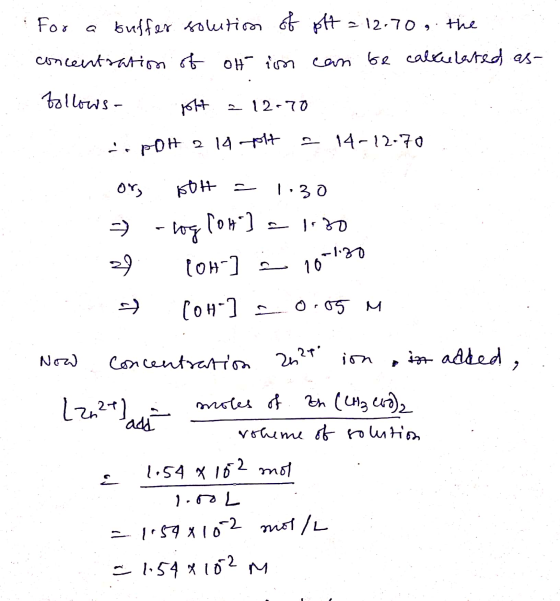
In the presence of excess OH-, the Zn2+(aq) ion forms a hydroxide complex ion, Zn(OH)42-. Calculate...
In the presence of excess OH-, the
Zn2+(aq) ion forms a hydroxide complex
ion, Zn(OH)42-. Calculate
the concentration of free Zn2+ ion when
1.54×10⁻² mol
Zn(CH3COO)2(s) is added to
1.00 L of solution in which [OH- ] is held constant
(buffered at pH 12.70). For
Zn(OH)42-, Kf =
4.6×10¹⁷.
[Zn2+] = M
Homework Answers
![As LOH] » [2224] hence the addition of 2n (C208)2 in the buffer solution, will formi hydroxide complex in , ?n 20H)472- as fo](http://img.homeworklib.com/questions/55a16ff0-d9c4-11eb-b66b-03ef1c68a929.png?x-oss-process=image/resize,w_560)
Add Answer to:
In the presence of excess OH-, the
Zn2+(aq) ion forms a hydroxide complex
ion, Zn(OH)42-. Calculate...
In the presence of excess OH-, the Zn2+(aq) ion forms a hydroxide complex ion, Zn(OH)42-. Calculate...
In the presence of excess OH-, the Zn2+(aq) ion forms a hydroxide complex ion, Zn(OH)42-. Calculate the concentration of free Zn2+ ion when 1.57×10⁻² mol Zn(NO3)2(s) is added to 1.00 L of solution in which [OH- ] is held constant (buffered at pH 12.20). For Zn(OH)42-, Kf = 4.6×10¹⁷. [Zn2+]=___M please explain
1- In the presence of excess OH-, the Zn2+(aq) ion forms a hydroxide complex ion, Zn(OH)42-....
1- In the presence of excess OH-, the Zn2+(aq) ion forms a hydroxide complex ion, Zn(OH)42-. Calculate the concentration of free Zn2+ ion when 1.32×10⁻²mol ZnSO4(s) is added to 1.00 L of solution in which [OH- ] is held constant (buffered at pH 12.40). For Zn(OH)42-, Kf = 4.6×10¹⁷. [Zn2+] = ------ M 2- What is the approximate concentration of free Hg2+ ion at equilibrium when 1.86×10⁻² mol mercury(II) nitrate is added to 1.00 L of solution that is 1.310...
In the presence of excess OH-, the Al3+(aq) ion forms a hydroxide complex ion, Al(OH)4-. Calculate the concentration of...
In the presence of excess OH-, the Al3+(aq) ion forms a hydroxide complex ion, Al(OH)4-. Calculate the concentration of free Al3+ ion when 1.32×10⁻² mol Al(NO3)3(s) is added to 1.00 L of solution in which [OH- ] is held constant (buffered at pH 13.00). For Al(OH)4-, Kf = 1.1×1033. [Al3+] = ?M
Calculate concentration of species in a solution containing a complex ion. Close Problem In the p...
Calculate concentration of species in a solution containing a complex ion. Close Problem In the presence of excess OH-, the Al3+(aq) ion forms a hydroxide complex ion, Al(OH)4-. Calculate the concentration of free Al3+ ion when 1.21×10⁻² mol Al(CH3COO)3(s) is added to 1.00 L of solution in which [OH- ] is held constant (buffered at pH 12.60). For Al(OH)4-, Kf = 1.1×1033. [Al3+] = M
Calculate concentration of species in a solution containing a complex ion In the presence of excess...
 Calculate concentration of species in a solution containing a complex ion In the presence of excess OH, the Al3 (aq) ion forms a hydroxide complex ion, AIOH)4. Calculate the concentration of free Al3 ion when 1.46*102 mol Al(NO3)3(s) is added to 1.00 L of solution in which [OH-] is held constant (buffered at pH 12.60). For Al(OH)4, K?1.1x1033.
Calculate concentration of species in a solution containing a complex ion. In the presence of excess...
 Calculate concentration of species in a solution containing a complex ion. In the presence of excess OH^ -, the Al^ 3+ (aq) ion forms a hydroxide complex ion, Al(OH)^ -_4. Calculate the concentration of free Al^ 3+ ion when 1.64 times 10^-2 mol Al(CH_3COO)_3(s) is added to 1.00 L of solution in which [OH^ -] is held constant (buffered at pH 12.10). For Al(OH)_4^ -, K_f = 1.1 times 10^33.
Calculate the concentration of free Zn2+ ion at equilibrium when 1.90×10⁻² mol zinc nitrate is added...
Calculate the concentration of free Zn2+ ion at equilibrium when 1.90×10⁻² mol zinc nitrate is added to 1.00 L of solution that is buffered at pH 12.30. For Zn(OH)42-, Kf = 4.6×10¹⁷.
please help What is the approximate concentration of free Cu* ion at equilibrium when 1.57x10² mol...
 please help
What is the approximate concentration of free Cu* ion at equilibrium when 1.57x10² mol copperII) nitrate is added to 1.00 L of solution that is 1.380 M in NH3. For [Cu(NH3)4j2, Kf 2.1 1013 [Cu2 м What is the approximate concentration of free Fe2* ion at equilibrium when 1.42x10²mol iron(II) nitrate is added to 1.00 L of solution that is 1.38so M in CN. For [Fe(CN)6]4, Kf=1.0x1035 [Fe"]= In the presence of excess OH, the Al*(aq) ion forms...
please help
What is the approximate concentration of free Cu* ion at equilibrium when 1.57x10² mol copperII) nitrate is added to 1.00 L of solution that is 1.380 M in NH3. For [Cu(NH3)4j2, Kf 2.1 1013 [Cu2 м What is the approximate concentration of free Fe2* ion at equilibrium when 1.42x10²mol iron(II) nitrate is added to 1.00 L of solution that is 1.38so M in CN. For [Fe(CN)6]4, Kf=1.0x1035 [Fe"]= In the presence of excess OH, the Al*(aq) ion forms...
A) Consider the insoluble compound zinc hydroxide, Zn(OH)2. The zinc ion also forms a complex with...
A) Consider the insoluble compound zinc hydroxide, Zn(OH)2. The zinc ion also forms a complex with ammonia. Write a balanced net ionic equation to show why the solubility of Zn(OH)2(s) increases in the presence of ammonia and calculate the equilibrium constant for this reaction. For Zn(NH3)42+, Kf = 2.9×10⁹. Specify states such as (aq) or (s) and provide K. K = ______ B) Consider the insoluble compound nickel(II) hydroxide, Ni(OH)2. The nickel ion also forms a complex with cyanide ions....
The solubility-product constant for Zn(OH)2 is Ksp=3.00×10⁻¹⁶. The formation constant for the hydroxo complex, Zn(OH)42−, is...
The solubility-product constant for Zn(OH)2 is Ksp=3.00×10⁻¹⁶. The formation constant for the hydroxo complex, Zn(OH)42−, is Kf=4.60×10¹⁷. A solubility-product constant, Ksp, corresponds to a reaction with the following general format: salt(s)⇌cation(aq)+anion(aq) A formation constant, Kf, corresponds to a reaction with the following general format: metal ion(aq)+Lewis base(aq)⇌complex ion(aq) Part A When Zn(OH)2(s) was added to 1.00 L of a basic solution, 1.11×10⁻² mol of the solid dissolved. What is the concentration of OH− in the final solution?
 Calculate concentration of species in a solution containing a complex ion In the presence of excess OH, the Al3 (aq) ion forms a hydroxide complex ion, AIOH)4. Calculate the concentration of free Al3 ion when 1.46*102 mol Al(NO3)3(s) is added to 1.00 L of solution in which [OH-] is held constant (buffered at pH 12.60). For Al(OH)4, K?1.1x1033.
 Calculate concentration of species in a solution containing a complex ion. In the presence of excess OH^ -, the Al^ 3+ (aq) ion forms a hydroxide complex ion, Al(OH)^ -_4. Calculate the concentration of free Al^ 3+ ion when 1.64 times 10^-2 mol Al(CH_3COO)_3(s) is added to 1.00 L of solution in which [OH^ -] is held constant (buffered at pH 12.10). For Al(OH)_4^ -, K_f = 1.1 times 10^33.
 please help
What is the approximate concentration of free Cu* ion at equilibrium when 1.57x10² mol copperII) nitrate is added to 1.00 L of solution that is 1.380 M in NH3. For [Cu(NH3)4j2, Kf 2.1 1013 [Cu2 м What is the approximate concentration of free Fe2* ion at equilibrium when 1.42x10²mol iron(II) nitrate is added to 1.00 L of solution that is 1.38so M in CN. For [Fe(CN)6]4, Kf=1.0x1035 [Fe"]= In the presence of excess OH, the Al*(aq) ion forms...
please help
What is the approximate concentration of free Cu* ion at equilibrium when 1.57x10² mol copperII) nitrate is added to 1.00 L of solution that is 1.380 M in NH3. For [Cu(NH3)4j2, Kf 2.1 1013 [Cu2 м What is the approximate concentration of free Fe2* ion at equilibrium when 1.42x10²mol iron(II) nitrate is added to 1.00 L of solution that is 1.38so M in CN. For [Fe(CN)6]4, Kf=1.0x1035 [Fe"]= In the presence of excess OH, the Al*(aq) ion forms...
Most questions answered within 3 hours.
-
Where is the error in this code sequence?
String s1 = "Hello";
String s2 = "ello";...
asked 11 months ago -
Financial data for Joel de Paris, Inc., for last year
follow:
Joel de Paris, Inc.
Balance...
asked 11 months ago -
Consider this reaction:
Al2(SO4)3 (aq)+ BaCl3
(aq) Al2Cl6 (aq)- +
3BaSO4(s) . What is the...
asked 11 months ago -
Suppose that Savneet is considering increasing her
recent random sample from 20 car rentals to 40...
asked 11 months ago -
Trucks arrive at an unloading terminal at an average rate of 120
per hour.
Trucks arrive...
asked 11 months ago -
Why are methanol and ethanol completely soluble in water while
octanol is not very little soluble....
asked 11 months ago -
A facilities manager at a university reads in a research report
that the mean amount of...
asked 11 months ago -
When the CuSO4 is rehydrated by adding water to the anhydrous
compound, is this an endothermic...
asked 11 months ago -
A ray of sunlight is passing from diamond into crown glass; the
angle of incidence is...
asked 11 months ago -
A block of mass 0.249 kg is placed on top of a light, vertical
spring of...
asked 11 months ago -
how do the kidneys compensate in the presences of acidosis
a) trigger hyperventilate
b) reserve acid...
asked 11 months ago -
Question 501 pts
The rental rate of capital to the firm increases. Which of the
following...
asked 11 months ago