
Homework Answers
Add Answer to:
These 5 questions are all linked
together from the same reaction scheme. Could you help explain...
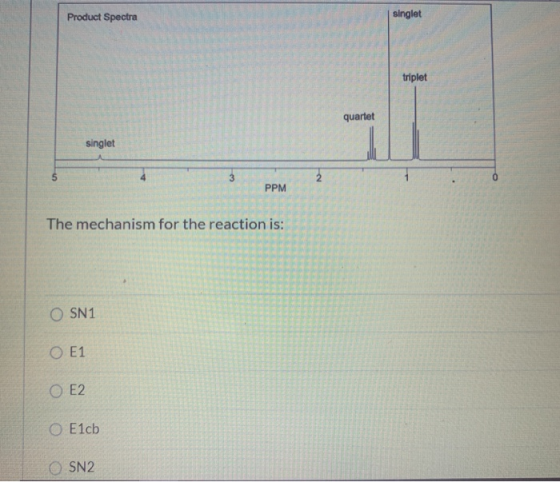
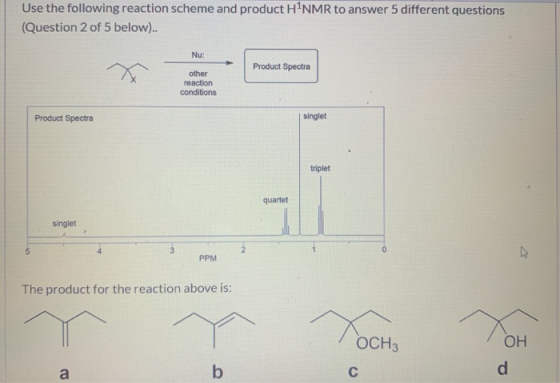
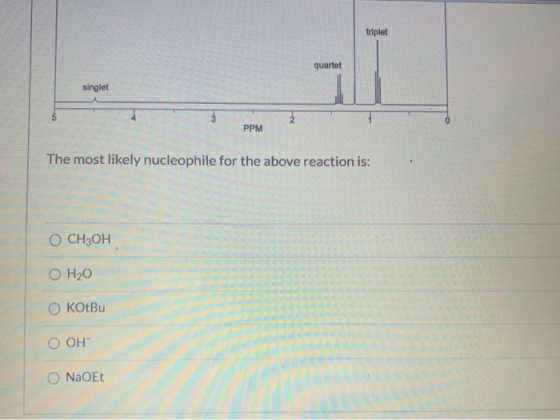
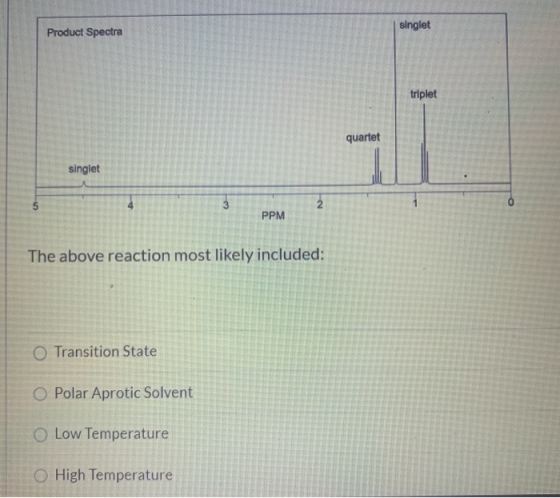
Use the first picture to answer the following 5 questions. plz and thank you! Nu: Product...
 Use
the first picture to answer the following 5 questions. plz and
thank you!
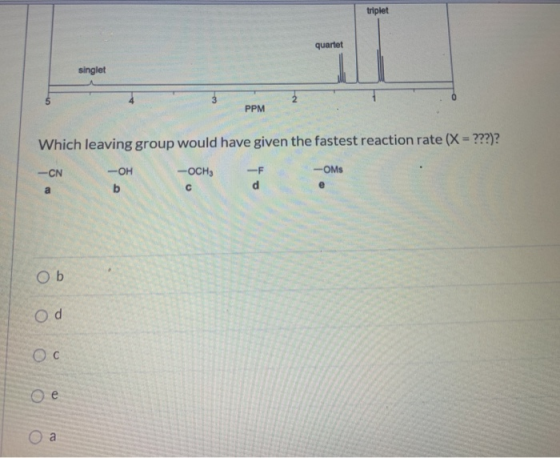
Nu: Product Spectra other reaction conditions Product Spectra singlet triplet quartet singlet PPM The mechanism for the reaction is: O E2 O E1cb o E1 O SN1 OSN2 Mert PPM The product for the reaction above is: ОН Ob D C The most likely nucleophile for the above reaction is: O CH3OH окоtBu O NaOEt оон ОН,0 The above reaction most likely included: O Polar Aprotic...
Use
the first picture to answer the following 5 questions. plz and
thank you!
Nu: Product Spectra other reaction conditions Product Spectra singlet triplet quartet singlet PPM The mechanism for the reaction is: O E2 O E1cb o E1 O SN1 OSN2 Mert PPM The product for the reaction above is: ОН Ob D C The most likely nucleophile for the above reaction is: O CH3OH окоtBu O NaOEt оон ОН,0 The above reaction most likely included: O Polar Aprotic...
1 of 5 below). Nur Product Spectra other reaction and on Product Spectra triplet PPM The...
 1 of 5 below). Nur Product Spectra other reaction and on Product Spectra triplet PPM The mechanism for the reaction is: Use the following reaction scheme and product H NMR to answer 5 different questions (Question 1 of 5 below). ņ a Creations The mechanism for the reaction is: Elcb SN1 reaction quartet PPM The product for the reaction above is: OCH3 OH singlet PPM The most likely nucleophile for the above reaction is: ОСНОН ОкоtBu NaOEt OOH он20 Product...
I need help with scheme 1 please. Scheme 1: Compound 1 Compound 2 (b) OH (a)...
 I need help with scheme 1 please.
Scheme 1: Compound 1 Compound 2 (b) OH (a) + OH Compound 3 Compound 4 Scheme 2: pka increased from 3 (salicylic acid) to 8.5 (Compound 1) H: 607 Laboratory Data: Compound 1: MW: 166.18 C. 65.05 0:28.88 Compound 2: MW: 167.00 C: 28.77 IR: 1739 cm (broad, strong) 'H NMR: H: 423 Br. 47.85 O: 19.15 singlet, 2H quartet, 2H triplet, 3H 2 PPM 13C NMR: 180 160 140 120 100 PPM...
I need help with scheme 1 please.
Scheme 1: Compound 1 Compound 2 (b) OH (a) + OH Compound 3 Compound 4 Scheme 2: pka increased from 3 (salicylic acid) to 8.5 (Compound 1) H: 607 Laboratory Data: Compound 1: MW: 166.18 C. 65.05 0:28.88 Compound 2: MW: 167.00 C: 28.77 IR: 1739 cm (broad, strong) 'H NMR: H: 423 Br. 47.85 O: 19.15 singlet, 2H quartet, 2H triplet, 3H 2 PPM 13C NMR: 180 160 140 120 100 PPM...
QUESTION 1 Any reaction involving a carbonyl group and a strong acid begins with the same...
QUESTION 1 Any reaction involving a carbonyl group and a strong acid begins with the same first step, which is __________________ of the carbonyl oxygen. QUESTION 2 Using condensed molecular formulas (C#H#X#Y#) for your answers, predict the products of the reactions of C6H5CH2CHO (phenylacetaldehyde) with these reagents, and identify the functional group produced in the product. Note that the Tx symbol above allows you to do a subscript. a. NaBH4 / CH3OH b. 1. CH3MgBr; 2. H2O c. Ph3P=CHCH3 d....
need help with the boxed bullet point. writing the chemical reaction scheme for the experiment. Synthesis of an A...
 need help with the boxed bullet point. writing the chemical
reaction scheme for the experiment.
Synthesis of an Alkyl Halide: A Nucleophilic Substitution Reaction, Part I Pre-lab Assignment for Synthesis of an Alkyl Halide: A Nucleophilic Substitution Reaction, Part 1 1. From The Organic Chem Lab Survival Manual ( edition) by Zubrick • Review pages 201-204: Standard Reflux. • Review pages 127-140: Extraction • Review pages 164-189: Distillation, Simple Distillation. The Distillation Example, and The Distillation Mistake. 2. Read this...
need help with the boxed bullet point. writing the chemical
reaction scheme for the experiment.
Synthesis of an Alkyl Halide: A Nucleophilic Substitution Reaction, Part I Pre-lab Assignment for Synthesis of an Alkyl Halide: A Nucleophilic Substitution Reaction, Part 1 1. From The Organic Chem Lab Survival Manual ( edition) by Zubrick • Review pages 201-204: Standard Reflux. • Review pages 127-140: Extraction • Review pages 164-189: Distillation, Simple Distillation. The Distillation Example, and The Distillation Mistake. 2. Read this...
can you help me solve these 5 questions please? thank you :) 1.) 2.) 3.) 4.)...
 can you help me solve these 5 questions please? thank you
:)
1.)
2.)
3.)
4.)
5.)
Give the major substitution product of the following reaction. Br CH3CO2H ? heat OH SCH O NH2 O o There is no reaction under these conditions or the correct product is not listed here. Give the major substitution product of the following reaction. Br CH3OH ? heat There is no reaction under these conditions or the correct product is not listed here. OH...
can you help me solve these 5 questions please? thank you
:)
1.)
2.)
3.)
4.)
5.)
Give the major substitution product of the following reaction. Br CH3CO2H ? heat OH SCH O NH2 O o There is no reaction under these conditions or the correct product is not listed here. Give the major substitution product of the following reaction. Br CH3OH ? heat There is no reaction under these conditions or the correct product is not listed here. OH...
50. For the following compound how many different signals would you see in the proton NMR?...
 50. For the following compound how many different signals would you see in the proton NMR? (Assume that you can see them all.) A) 4 B) 5 C) 6 D) 7 E) 8 . An organic compound absorbs strongly in the IR at 1687 em. Its 'H NMR spectrum consists of two signals, a singlet at 2.1 ppm and a multiplet centered at 7.1 ppm. Its mass spectrum shows significant peaks at m/z 120, m/z 105 and m/z 77. This...
please help asap in all sections!! Question 5 Methyl 4-methylpentanoate is one of 120 volatile compournds...
 please help asap in all sections!!
Question 5 Methyl 4-methylpentanoate is one of 120 volatile compournds identified in a study of metabolites from Streptomyces bacteria (Actinomycetologica 2009, 23, 27-33) Mathy 4-methylpentanoate The synthesis of Methyl 4-methylpentanoate using 2-methylbutane involves several steps. Part-1 of the reaction scheme (2-methylbutane to 3-methyl-1-butene) is illustrated below. Identity the reagent involved in each step and arange them accordingly Br A by NaOH; Os and H20; HBr/ROOR; NaOEt/EtOH NaOH; O and HyO; NaDE/EROH; HBr/RDOR Br: NaOE/EOH;...
please help asap in all sections!!
Question 5 Methyl 4-methylpentanoate is one of 120 volatile compournds identified in a study of metabolites from Streptomyces bacteria (Actinomycetologica 2009, 23, 27-33) Mathy 4-methylpentanoate The synthesis of Methyl 4-methylpentanoate using 2-methylbutane involves several steps. Part-1 of the reaction scheme (2-methylbutane to 3-methyl-1-butene) is illustrated below. Identity the reagent involved in each step and arange them accordingly Br A by NaOH; Os and H20; HBr/ROOR; NaOEt/EtOH NaOH; O and HyO; NaDE/EROH; HBr/RDOR Br: NaOE/EOH;...
I simply need help on these three questions. Thank you Number 3 is asking for the...
 I simply need help on these three questions. Thank you
Number 3 is asking for the mechanism but I believe there is a
typo.
I'll have to do number 4 on my own.
Number 5 is asking for a mechanism.
3. Give the reagents/conditions and show the mechanism for the following reaction (15 pts) OH CH3 CH3 4. Dr. Goodchem is making an intermediate. He conducted the reactions below using the conditions given. Explain the rationale behind the methylation of...
I simply need help on these three questions. Thank you
Number 3 is asking for the mechanism but I believe there is a
typo.
I'll have to do number 4 on my own.
Number 5 is asking for a mechanism.
3. Give the reagents/conditions and show the mechanism for the following reaction (15 pts) OH CH3 CH3 4. Dr. Goodchem is making an intermediate. He conducted the reactions below using the conditions given. Explain the rationale behind the methylation of...
Please help me and answer all 5 questions. 1. What is the name of the reaction?...
 Please help me and answer all 5 questions.
1. What is the name of the reaction?
2. Identify the number of unique carbons and protons in each of
the starting materials and in the product
3. Predict the product of the reaction.
4. Illustrate the mechanism of the reaction based on notes or
book as a reference. You can use the structures from the book/notes
instead of your assigned compounds, especially if your starting
materials are complicated.
5. Give advice...
Please help me and answer all 5 questions.
1. What is the name of the reaction?
2. Identify the number of unique carbons and protons in each of
the starting materials and in the product
3. Predict the product of the reaction.
4. Illustrate the mechanism of the reaction based on notes or
book as a reference. You can use the structures from the book/notes
instead of your assigned compounds, especially if your starting
materials are complicated.
5. Give advice...
 Use
the first picture to answer the following 5 questions. plz and
thank you!
Nu: Product Spectra other reaction conditions Product Spectra singlet triplet quartet singlet PPM The mechanism for the reaction is: O E2 O E1cb o E1 O SN1 OSN2 Mert PPM The product for the reaction above is: ОН Ob D C The most likely nucleophile for the above reaction is: O CH3OH окоtBu O NaOEt оон ОН,0 The above reaction most likely included: O Polar Aprotic...
Use
the first picture to answer the following 5 questions. plz and
thank you!
Nu: Product Spectra other reaction conditions Product Spectra singlet triplet quartet singlet PPM The mechanism for the reaction is: O E2 O E1cb o E1 O SN1 OSN2 Mert PPM The product for the reaction above is: ОН Ob D C The most likely nucleophile for the above reaction is: O CH3OH окоtBu O NaOEt оон ОН,0 The above reaction most likely included: O Polar Aprotic...
 1 of 5 below). Nur Product Spectra other reaction and on Product Spectra triplet PPM The mechanism for the reaction is: Use the following reaction scheme and product H NMR to answer 5 different questions (Question 1 of 5 below). ņ a Creations The mechanism for the reaction is: Elcb SN1 reaction quartet PPM The product for the reaction above is: OCH3 OH singlet PPM The most likely nucleophile for the above reaction is: ОСНОН ОкоtBu NaOEt OOH он20 Product...
 I need help with scheme 1 please.
Scheme 1: Compound 1 Compound 2 (b) OH (a) + OH Compound 3 Compound 4 Scheme 2: pka increased from 3 (salicylic acid) to 8.5 (Compound 1) H: 607 Laboratory Data: Compound 1: MW: 166.18 C. 65.05 0:28.88 Compound 2: MW: 167.00 C: 28.77 IR: 1739 cm (broad, strong) 'H NMR: H: 423 Br. 47.85 O: 19.15 singlet, 2H quartet, 2H triplet, 3H 2 PPM 13C NMR: 180 160 140 120 100 PPM...
I need help with scheme 1 please.
Scheme 1: Compound 1 Compound 2 (b) OH (a) + OH Compound 3 Compound 4 Scheme 2: pka increased from 3 (salicylic acid) to 8.5 (Compound 1) H: 607 Laboratory Data: Compound 1: MW: 166.18 C. 65.05 0:28.88 Compound 2: MW: 167.00 C: 28.77 IR: 1739 cm (broad, strong) 'H NMR: H: 423 Br. 47.85 O: 19.15 singlet, 2H quartet, 2H triplet, 3H 2 PPM 13C NMR: 180 160 140 120 100 PPM...
 need help with the boxed bullet point. writing the chemical
reaction scheme for the experiment.
Synthesis of an Alkyl Halide: A Nucleophilic Substitution Reaction, Part I Pre-lab Assignment for Synthesis of an Alkyl Halide: A Nucleophilic Substitution Reaction, Part 1 1. From The Organic Chem Lab Survival Manual ( edition) by Zubrick • Review pages 201-204: Standard Reflux. • Review pages 127-140: Extraction • Review pages 164-189: Distillation, Simple Distillation. The Distillation Example, and The Distillation Mistake. 2. Read this...
need help with the boxed bullet point. writing the chemical
reaction scheme for the experiment.
Synthesis of an Alkyl Halide: A Nucleophilic Substitution Reaction, Part I Pre-lab Assignment for Synthesis of an Alkyl Halide: A Nucleophilic Substitution Reaction, Part 1 1. From The Organic Chem Lab Survival Manual ( edition) by Zubrick • Review pages 201-204: Standard Reflux. • Review pages 127-140: Extraction • Review pages 164-189: Distillation, Simple Distillation. The Distillation Example, and The Distillation Mistake. 2. Read this...
 can you help me solve these 5 questions please? thank you
:)
1.)
2.)
3.)
4.)
5.)
Give the major substitution product of the following reaction. Br CH3CO2H ? heat OH SCH O NH2 O o There is no reaction under these conditions or the correct product is not listed here. Give the major substitution product of the following reaction. Br CH3OH ? heat There is no reaction under these conditions or the correct product is not listed here. OH...
can you help me solve these 5 questions please? thank you
:)
1.)
2.)
3.)
4.)
5.)
Give the major substitution product of the following reaction. Br CH3CO2H ? heat OH SCH O NH2 O o There is no reaction under these conditions or the correct product is not listed here. Give the major substitution product of the following reaction. Br CH3OH ? heat There is no reaction under these conditions or the correct product is not listed here. OH...
 50. For the following compound how many different signals would you see in the proton NMR? (Assume that you can see them all.) A) 4 B) 5 C) 6 D) 7 E) 8 . An organic compound absorbs strongly in the IR at 1687 em. Its 'H NMR spectrum consists of two signals, a singlet at 2.1 ppm and a multiplet centered at 7.1 ppm. Its mass spectrum shows significant peaks at m/z 120, m/z 105 and m/z 77. This...
 please help asap in all sections!!
Question 5 Methyl 4-methylpentanoate is one of 120 volatile compournds identified in a study of metabolites from Streptomyces bacteria (Actinomycetologica 2009, 23, 27-33) Mathy 4-methylpentanoate The synthesis of Methyl 4-methylpentanoate using 2-methylbutane involves several steps. Part-1 of the reaction scheme (2-methylbutane to 3-methyl-1-butene) is illustrated below. Identity the reagent involved in each step and arange them accordingly Br A by NaOH; Os and H20; HBr/ROOR; NaOEt/EtOH NaOH; O and HyO; NaDE/EROH; HBr/RDOR Br: NaOE/EOH;...
please help asap in all sections!!
Question 5 Methyl 4-methylpentanoate is one of 120 volatile compournds identified in a study of metabolites from Streptomyces bacteria (Actinomycetologica 2009, 23, 27-33) Mathy 4-methylpentanoate The synthesis of Methyl 4-methylpentanoate using 2-methylbutane involves several steps. Part-1 of the reaction scheme (2-methylbutane to 3-methyl-1-butene) is illustrated below. Identity the reagent involved in each step and arange them accordingly Br A by NaOH; Os and H20; HBr/ROOR; NaOEt/EtOH NaOH; O and HyO; NaDE/EROH; HBr/RDOR Br: NaOE/EOH;...
 I simply need help on these three questions. Thank you
Number 3 is asking for the mechanism but I believe there is a
typo.
I'll have to do number 4 on my own.
Number 5 is asking for a mechanism.
3. Give the reagents/conditions and show the mechanism for the following reaction (15 pts) OH CH3 CH3 4. Dr. Goodchem is making an intermediate. He conducted the reactions below using the conditions given. Explain the rationale behind the methylation of...
I simply need help on these three questions. Thank you
Number 3 is asking for the mechanism but I believe there is a
typo.
I'll have to do number 4 on my own.
Number 5 is asking for a mechanism.
3. Give the reagents/conditions and show the mechanism for the following reaction (15 pts) OH CH3 CH3 4. Dr. Goodchem is making an intermediate. He conducted the reactions below using the conditions given. Explain the rationale behind the methylation of...
 Please help me and answer all 5 questions.
1. What is the name of the reaction?
2. Identify the number of unique carbons and protons in each of
the starting materials and in the product
3. Predict the product of the reaction.
4. Illustrate the mechanism of the reaction based on notes or
book as a reference. You can use the structures from the book/notes
instead of your assigned compounds, especially if your starting
materials are complicated.
5. Give advice...
Please help me and answer all 5 questions.
1. What is the name of the reaction?
2. Identify the number of unique carbons and protons in each of
the starting materials and in the product
3. Predict the product of the reaction.
4. Illustrate the mechanism of the reaction based on notes or
book as a reference. You can use the structures from the book/notes
instead of your assigned compounds, especially if your starting
materials are complicated.
5. Give advice...
Most questions answered within 3 hours.
-
Where is the error in this code sequence?
String s1 = "Hello";
String s2 = "ello";...
asked 10 months ago -
Financial data for Joel de Paris, Inc., for last year
follow:
Joel de Paris, Inc.
Balance...
asked 10 months ago -
Consider this reaction:
Al2(SO4)3 (aq)+ BaCl3
(aq) Al2Cl6 (aq)- +
3BaSO4(s) . What is the...
asked 10 months ago -
Suppose that Savneet is considering increasing her
recent random sample from 20 car rentals to 40...
asked 10 months ago -
Trucks arrive at an unloading terminal at an average rate of 120
per hour.
Trucks arrive...
asked 10 months ago -
Why are methanol and ethanol completely soluble in water while
octanol is not very little soluble....
asked 10 months ago -
A facilities manager at a university reads in a research report
that the mean amount of...
asked 10 months ago -
When the CuSO4 is rehydrated by adding water to the anhydrous
compound, is this an endothermic...
asked 10 months ago -
A ray of sunlight is passing from diamond into crown glass; the
angle of incidence is...
asked 10 months ago -
A block of mass 0.249 kg is placed on top of a light, vertical
spring of...
asked 10 months ago -
how do the kidneys compensate in the presences of acidosis
a) trigger hyperventilate
b) reserve acid...
asked 10 months ago -
Question 501 pts
The rental rate of capital to the firm increases. Which of the
following...
asked 10 months ago