
Homework Answers
Add Answer to:
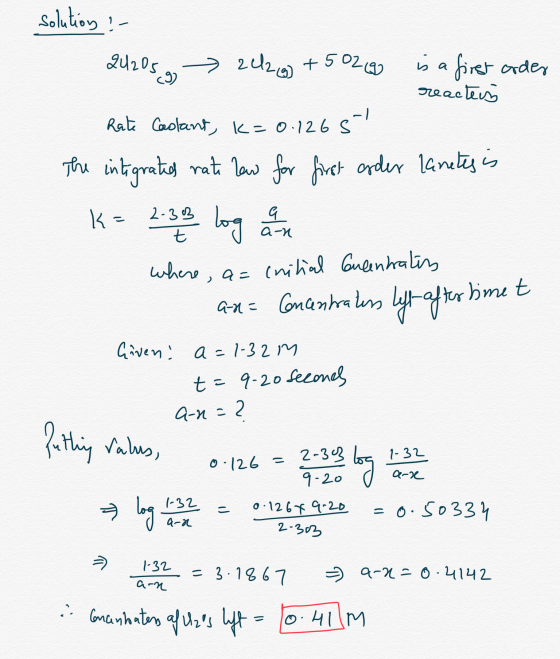
At a certain temperature this reaction follows first-order kinetics with a rate constant of 0.126 s':...
At a certain temperature this reaction follows first-order kinetics with a rate constant of Suppose a...
 At a certain temperature this reaction follows first-order
kinetics with a rate constant of Suppose a vessel contains at a
concentration of . Calculate how long it takes for the
concentration of to decrease to . You may assume no other reaction
is important. Round your answer to significant digits.
At a certain temperature this reaction follows first-order kinetics with a rate constant of 0.0366 s ": 250z (g) 2502(g) +0,(g) Suppose a vessel contains SO, at a concentration of...
At a certain temperature this reaction follows first-order
kinetics with a rate constant of Suppose a vessel contains at a
concentration of . Calculate how long it takes for the
concentration of to decrease to . You may assume no other reaction
is important. Round your answer to significant digits.
At a certain temperature this reaction follows first-order kinetics with a rate constant of 0.0366 s ": 250z (g) 2502(g) +0,(g) Suppose a vessel contains SO, at a concentration of...
- 1 At a certain temperature this reaction follows second-order kinetics with a rate constant of...
 - 1 At a certain temperature this reaction follows second-order kinetics with a rate constant of 11.7 M is : 2NH3(g) → N2(g) + 3H2(g) Suppose a vessel contains NH, at a concentration of 0.670 M. Calculate the concentration of NH, in the vessel 0.510 seconds later. You may assume no other reaction is important. Round your answer to 2 significant digits. x 6 ?
At a certain temperature this reaction follows first-order kinetics with a rate constant of 0.817 NH,OH(aq)...
 At a certain temperature this reaction follows first-order kinetics with a rate constant of 0.817 NH,OH(aq) - NH, (aq) +H,0 (aq) Suppose a vessel contains NH OH at a concentration of 0.380 M. Calculate the concentration of NH OH in the vessel 0.830 seconds later. You may assume no other reaction is important. Round your answer to 2 significant digits.
At a certain temperature this reaction follows second-order kinetics with a rate constant of 0.653 M...
 At a certain temperature this reaction follows second-order kinetics with a rate constant of 0.653 M -1 -1 is : 2803 (g) → 2802(g) +O2(g) Suppose a vessel contains SO, at a concentration of 0.360 M. Calculate the concentration of SO, in the vessel 43.0 seconds later. You may assume no other reaction is important. Round your answer to 2 significant digits. x 6 ?
At a certain temperature this reaction follows second-order kinetics with a rate constant of 0.0569·M−1s−1: ClCH2CH2Cl(g)...
At a certain temperature this reaction follows second-order kinetics with a rate constant of 0.0569·M−1s−1: ClCH2CH2Cl(g) → CH2CHCl(g) + HCl(g) Suppose a vessel contains ClCH2CH2Cl at a concentration of 0.730M. Calculate the concentration of ClCH2CH2Cl in the vessel 320. seconds later. You may assume no other reaction is important. Round your answer to 2 significant digits. _ M
At a certain temperature this reaction follows second-order kinetics with a rate constant of 0.186 M−1:s−1...
At a certain temperature this reaction follows second-order kinetics with a rate constant of 0.186 M−1:s−1 2NH3g -> N2g + 3H2g Suppose a vessel contains NH3 at a concentration of 0.440M. Calculate how long it takes for the concentration of NH3 to decrease by 77.0%. You may assume no other reaction is important. Round your answer to 2 significant digits.
At a certain temperature this reaction follows second-order kinetics with a rate constant of 12. M1-1...
 At a certain temperature this reaction follows second-order kinetics with a rate constant of 12. M1-1 2H,PO4 (aq) + P,0, (aq) +3H,0(aq) Suppose a vessel contains H,PO, at a concentration of 1.42 M. Calculate how long it takes for the concentration of H,PO, to decrease by 92.%. You may assume no other reaction is important. Round your answer to 2 significant digits. 0 X ?
At a certain temperature the rate of this reaction is first order in H.CO, with a...
 At a certain temperature the rate of this reaction is first order in H.CO, with a rate constant of 0.0130 H.00,(aq) H20 (aq) + CO2(aq) Suppose a vessel contains H,Co, at a concentration of 0.680 M. Calculate the concentration of H.CO, in the vessel 68.0 seconds later. You may assume no other reaction is important. Round your answer to 2 significant digits. XS ?
O KINETICS AND EQUILIBRIUM Using a second order integrated rato low to find concentration '. At...
 O KINETICS AND EQUILIBRIUM Using a second order integrated rato low to find concentration '. At a certain temperature this reaction follows second-order kinetics with a rate constant of 13.1 M 250,() 250,()+0,6) Suppose a vessel contains so, at a concentration of 0.130 M. Calculate the concentration of SO, in the vessel 9.20 seconds later. You may assume no other reaction is important Round your answer to 2 significant digits. O KINETICS AND EQUILIRIUM Using the Arrhenius equation to calculate...
At a certain temperature the rate of this reaction is second order in NH3 with a...
At a certain temperature the rate of this reaction is second order in NH3 with a rate constant of 2.64·M−1s−1 , 2NH3g---> N2 g + 3H2 g Suppose a vessel contains NH3 at a concentration of 1.36M. Calculate the concentration of NH3 in the vessel 0.990 seconds later. You may assume no other reaction is important. Round your answer to 2 significant digits
 At a certain temperature this reaction follows first-order
kinetics with a rate constant of Suppose a vessel contains at a
concentration of . Calculate how long it takes for the
concentration of to decrease to . You may assume no other reaction
is important. Round your answer to significant digits.
At a certain temperature this reaction follows first-order kinetics with a rate constant of 0.0366 s ": 250z (g) 2502(g) +0,(g) Suppose a vessel contains SO, at a concentration of...
At a certain temperature this reaction follows first-order
kinetics with a rate constant of Suppose a vessel contains at a
concentration of . Calculate how long it takes for the
concentration of to decrease to . You may assume no other reaction
is important. Round your answer to significant digits.
At a certain temperature this reaction follows first-order kinetics with a rate constant of 0.0366 s ": 250z (g) 2502(g) +0,(g) Suppose a vessel contains SO, at a concentration of...
 - 1 At a certain temperature this reaction follows second-order kinetics with a rate constant of 11.7 M is : 2NH3(g) → N2(g) + 3H2(g) Suppose a vessel contains NH, at a concentration of 0.670 M. Calculate the concentration of NH, in the vessel 0.510 seconds later. You may assume no other reaction is important. Round your answer to 2 significant digits. x 6 ?
 At a certain temperature this reaction follows first-order kinetics with a rate constant of 0.817 NH,OH(aq) - NH, (aq) +H,0 (aq) Suppose a vessel contains NH OH at a concentration of 0.380 M. Calculate the concentration of NH OH in the vessel 0.830 seconds later. You may assume no other reaction is important. Round your answer to 2 significant digits.
 At a certain temperature this reaction follows second-order kinetics with a rate constant of 0.653 M -1 -1 is : 2803 (g) → 2802(g) +O2(g) Suppose a vessel contains SO, at a concentration of 0.360 M. Calculate the concentration of SO, in the vessel 43.0 seconds later. You may assume no other reaction is important. Round your answer to 2 significant digits. x 6 ?
 At a certain temperature this reaction follows second-order kinetics with a rate constant of 12. M1-1 2H,PO4 (aq) + P,0, (aq) +3H,0(aq) Suppose a vessel contains H,PO, at a concentration of 1.42 M. Calculate how long it takes for the concentration of H,PO, to decrease by 92.%. You may assume no other reaction is important. Round your answer to 2 significant digits. 0 X ?
 At a certain temperature the rate of this reaction is first order in H.CO, with a rate constant of 0.0130 H.00,(aq) H20 (aq) + CO2(aq) Suppose a vessel contains H,Co, at a concentration of 0.680 M. Calculate the concentration of H.CO, in the vessel 68.0 seconds later. You may assume no other reaction is important. Round your answer to 2 significant digits. XS ?
 O KINETICS AND EQUILIBRIUM Using a second order integrated rato low to find concentration '. At a certain temperature this reaction follows second-order kinetics with a rate constant of 13.1 M 250,() 250,()+0,6) Suppose a vessel contains so, at a concentration of 0.130 M. Calculate the concentration of SO, in the vessel 9.20 seconds later. You may assume no other reaction is important Round your answer to 2 significant digits. O KINETICS AND EQUILIRIUM Using the Arrhenius equation to calculate...
Most questions answered within 3 hours.
-
Where is the error in this code sequence?
String s1 = "Hello";
String s2 = "ello";...
asked 10 months ago -
Financial data for Joel de Paris, Inc., for last year
follow:
Joel de Paris, Inc.
Balance...
asked 10 months ago -
Consider this reaction:
Al2(SO4)3 (aq)+ BaCl3
(aq) Al2Cl6 (aq)- +
3BaSO4(s) . What is the...
asked 10 months ago -
Suppose that Savneet is considering increasing her
recent random sample from 20 car rentals to 40...
asked 10 months ago -
Trucks arrive at an unloading terminal at an average rate of 120
per hour.
Trucks arrive...
asked 10 months ago -
Why are methanol and ethanol completely soluble in water while
octanol is not very little soluble....
asked 10 months ago -
A facilities manager at a university reads in a research report
that the mean amount of...
asked 10 months ago -
When the CuSO4 is rehydrated by adding water to the anhydrous
compound, is this an endothermic...
asked 10 months ago -
A ray of sunlight is passing from diamond into crown glass; the
angle of incidence is...
asked 10 months ago -
A block of mass 0.249 kg is placed on top of a light, vertical
spring of...
asked 10 months ago -
how do the kidneys compensate in the presences of acidosis
a) trigger hyperventilate
b) reserve acid...
asked 10 months ago -
Question 501 pts
The rental rate of capital to the firm increases. Which of the
following...
asked 10 months ago