
Homework Answers
Add Answer to:
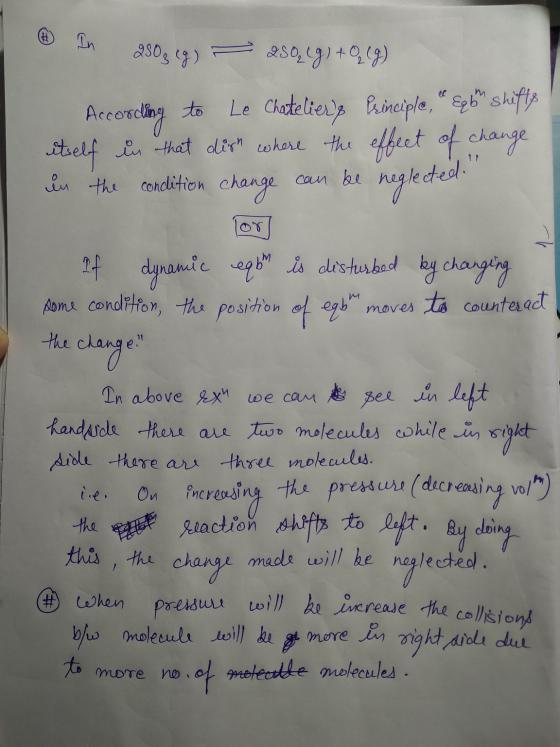
which reaction will shift to the left in response to a
decrease in volume (increase in...
1) Which reaction will shift to the left in response to a decrease in volume? A)...
 1) Which reaction will shift to the left in response to a decrease in volume? A) 2 SO3 (8) 2 SO2(g) + O2(8) B) N2(g) + 3H2(g) + 2NH3(g) C) 2H1 (8) H2(g) + 12 (8) D) 4 Fe (8) +32(g) 2 Fe2O3 (s) E) H2 (8) + Cl2(g) 2 HCl (g) Explain 2) Based on Le Châtelier's principle, increasing pressure at constant temperature in the following reaction will not change the concentrations of reactants and products. A) N2 (8)...
EY The reaction is at yumunu 7) - 7) of the following equilibria, only will shift...
 EY The reaction is at yumunu 7) - 7) of the following equilibria, only will shift to the right in response to a decrease in volume. A) N2(g) + 3H2(g) + 2NH3 (8) B) H2(g) + Cl2 (8) 2 HCl (g) C) 2 Fe2O3 (s) = 4 Fe (s) + 302 (8) D) 2HI (8) H2(g) + 12 (8) E) 2 SO3 (8) 2 SO2(g) + O2(g) 8) 8) The magnitude of Kw indicates that A) water autoionizes very slowly...
For the reaction: 4 HCl(g) + O2(g) = 2 Cl 2(g) + 2 H 20()), the...
 For the reaction: 4 HCl(g) + O2(g) = 2 Cl 2(g) + 2 H 20()), the equilibrium constant is 0.063 at 400 K. If the reaction quotient, Q, is 0.100, which of the following statements is correct? O A. [Cl 2] will increase. O B. [HCl] will increase. Which change in the system will drive equilibrium to the left in the reaction below? N 20 5(g) = NO 2(g) + NO 3(g) O A. increase the volume O B. increase...
9. Which of the following will have no shift in equilibrium if the volume is decreased?...
 9. Which of the following will have no shift in equilibrium if the volume is decreased? 2H2O(g) + N2(g) + 2H2(g) + 2NO(g) SiO2(g) + 4HF(g) SiF4(g) + 2H2O(g) CO(g) + H2(g) C(g) + H2O(g) C6H1206(s) + 602 6CO2(g) + 6H2O(g) 10. Which of the following will shift this endothermic reaction to the REACTANT side? 302(g) 203(g) Increase the pressure Decrease the O2 gas Increase the temperature Remove the ozone, O3
muruple choice must be on scantron MOLTIPLE CHOICE. Choose the one alternative that best completes the...
 muruple choice must be on scantron MOLTIPLE CHOICE. Choose the one alternative that best completes the statement or answers the question. 1) Which reaction will shift to the left in response to a decrease in volume? A) 2 SO3 (8) 2 SO2 (8) + O2 (8) B) N2 (8) + 3H2 (8) 2 NH3 (8) C) 2HI (8) H2(g) + 12 (g) D) 4 Fe (s) + 3 O2 (g) 2 Fe203 (s) E) H2 (8) + Cl2 (8) 2...
15. Which of the changes listed will shift the equilibrium to the left for the following...
15. Which of the changes listed will shift the equilibrium to the left for the following reversible reaction? 2 NO(g) + 2 CO(g) N2(g) + 2 CO2(g) + heat add krypton gas increase [CO] decrease volume increase temperature decrease [CO2]
Which of the changes listed below will shift the equilibrium to the left for the following reversible...
 Which of the changes listed below will shift the equilibrium to
the left for the following reversible reaction
in an aqueous solution?
NH 4OH( aq) NH
4+( aq) + OH -(
aq)
increase [NH4OH]
add solid NH4Cl
add solid NaCl
decrease pH
add hydrochloric acid
Which of the changes listed below will shift the equilibrium to
the left for the following reversible reaction
in an aqueous solution?
NH 4OH( aq) NH
4+( aq) + OH -(
aq)
increase [NH4OH]
add solid NH4Cl
add solid NaCl
decrease pH
add hydrochloric acid
5. Consider the reaction: N: (g) + 3 H2(g) = 2 NH, (g) + heat Determine...
 5. Consider the reaction: N: (g) + 3 H2(g) = 2 NH, (g) + heat Determine the effects of the following stresses on the equilibrium. State whether the equilibrium will shift to the left, to the right or not at all. a. Increase [N:] b. Decrease [NH] c. Decrease [H:] d. Increase temperature e. Decrease total pressure f. Decrease volume g. Add helium in a container with fixed volume h. Add helium in a container with variable volume
16. Which of the changes listed will shift the equilibrium to the left for the following...
16. Which of the changes listed will shift the equilibrium to the left for the following reversible reaction? CO(g) + H2O(g) CO2(g) + H2(g) + heat add a catalyst decrease [CO2] increase temperature increase [H2O] decrease volume
Indicate which direction the reaction Ishown below would shift in response to the change described &...
 Indicate which direction the reaction Ishown below would shift in response to the change described & why? Ha(g) + CO2(gl H2O(g) + Coigo АН ran +9.9kcal a.) addition of CO2 b.) addition of H2O ci) addition of a catalyst d.) Increase in temperature eil decrease in volume of the containe
 1) Which reaction will shift to the left in response to a decrease in volume? A) 2 SO3 (8) 2 SO2(g) + O2(8) B) N2(g) + 3H2(g) + 2NH3(g) C) 2H1 (8) H2(g) + 12 (8) D) 4 Fe (8) +32(g) 2 Fe2O3 (s) E) H2 (8) + Cl2(g) 2 HCl (g) Explain 2) Based on Le Châtelier's principle, increasing pressure at constant temperature in the following reaction will not change the concentrations of reactants and products. A) N2 (8)...
 EY The reaction is at yumunu 7) - 7) of the following equilibria, only will shift to the right in response to a decrease in volume. A) N2(g) + 3H2(g) + 2NH3 (8) B) H2(g) + Cl2 (8) 2 HCl (g) C) 2 Fe2O3 (s) = 4 Fe (s) + 302 (8) D) 2HI (8) H2(g) + 12 (8) E) 2 SO3 (8) 2 SO2(g) + O2(g) 8) 8) The magnitude of Kw indicates that A) water autoionizes very slowly...
 For the reaction: 4 HCl(g) + O2(g) = 2 Cl 2(g) + 2 H 20()), the equilibrium constant is 0.063 at 400 K. If the reaction quotient, Q, is 0.100, which of the following statements is correct? O A. [Cl 2] will increase. O B. [HCl] will increase. Which change in the system will drive equilibrium to the left in the reaction below? N 20 5(g) = NO 2(g) + NO 3(g) O A. increase the volume O B. increase...
 9. Which of the following will have no shift in equilibrium if the volume is decreased? 2H2O(g) + N2(g) + 2H2(g) + 2NO(g) SiO2(g) + 4HF(g) SiF4(g) + 2H2O(g) CO(g) + H2(g) C(g) + H2O(g) C6H1206(s) + 602 6CO2(g) + 6H2O(g) 10. Which of the following will shift this endothermic reaction to the REACTANT side? 302(g) 203(g) Increase the pressure Decrease the O2 gas Increase the temperature Remove the ozone, O3
 muruple choice must be on scantron MOLTIPLE CHOICE. Choose the one alternative that best completes the statement or answers the question. 1) Which reaction will shift to the left in response to a decrease in volume? A) 2 SO3 (8) 2 SO2 (8) + O2 (8) B) N2 (8) + 3H2 (8) 2 NH3 (8) C) 2HI (8) H2(g) + 12 (g) D) 4 Fe (s) + 3 O2 (g) 2 Fe203 (s) E) H2 (8) + Cl2 (8) 2...
 Which of the changes listed below will shift the equilibrium to
the left for the following reversible reaction
in an aqueous solution?
NH 4OH( aq) NH
4+( aq) + OH -(
aq)
increase [NH4OH]
add solid NH4Cl
add solid NaCl
decrease pH
add hydrochloric acid
Which of the changes listed below will shift the equilibrium to
the left for the following reversible reaction
in an aqueous solution?
NH 4OH( aq) NH
4+( aq) + OH -(
aq)
increase [NH4OH]
add solid NH4Cl
add solid NaCl
decrease pH
add hydrochloric acid
 5. Consider the reaction: N: (g) + 3 H2(g) = 2 NH, (g) + heat Determine the effects of the following stresses on the equilibrium. State whether the equilibrium will shift to the left, to the right or not at all. a. Increase [N:] b. Decrease [NH] c. Decrease [H:] d. Increase temperature e. Decrease total pressure f. Decrease volume g. Add helium in a container with fixed volume h. Add helium in a container with variable volume
 Indicate which direction the reaction Ishown below would shift in response to the change described & why? Ha(g) + CO2(gl H2O(g) + Coigo АН ran +9.9kcal a.) addition of CO2 b.) addition of H2O ci) addition of a catalyst d.) Increase in temperature eil decrease in volume of the containe
Most questions answered within 3 hours.
-
Where is the error in this code sequence?
String s1 = "Hello";
String s2 = "ello";...
asked 10 months ago -
Financial data for Joel de Paris, Inc., for last year
follow:
Joel de Paris, Inc.
Balance...
asked 10 months ago -
Consider this reaction:
Al2(SO4)3 (aq)+ BaCl3
(aq) Al2Cl6 (aq)- +
3BaSO4(s) . What is the...
asked 10 months ago -
Suppose that Savneet is considering increasing her
recent random sample from 20 car rentals to 40...
asked 10 months ago -
Trucks arrive at an unloading terminal at an average rate of 120
per hour.
Trucks arrive...
asked 10 months ago -
Why are methanol and ethanol completely soluble in water while
octanol is not very little soluble....
asked 10 months ago -
A facilities manager at a university reads in a research report
that the mean amount of...
asked 10 months ago -
When the CuSO4 is rehydrated by adding water to the anhydrous
compound, is this an endothermic...
asked 10 months ago -
A ray of sunlight is passing from diamond into crown glass; the
angle of incidence is...
asked 10 months ago -
A block of mass 0.249 kg is placed on top of a light, vertical
spring of...
asked 10 months ago -
how do the kidneys compensate in the presences of acidosis
a) trigger hyperventilate
b) reserve acid...
asked 10 months ago -
Question 501 pts
The rental rate of capital to the firm increases. Which of the
following...
asked 10 months ago