Given an initial 0.128 g Cu (II) and 3mL of HNO3
Homework Answers
We have to balance the following equation:
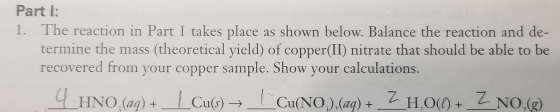
HNO3 + Cu→ Cu(NO3)2 + H2O + NO2
(The states of the reactant and product have not been written since they are irrelevant for balancing).
While balancing, we have to try to make the number of atoms/ions of each element same on both sides. Generally, O, H and N are balanced last since they tend to occur in multiple reactants and products.
Balancing using hit and trial method we get:
4HNO3 + Cu→ Cu(NO3)2 + 2H2O + 2NO2
To solve the next part, the following points must be kept in mind:
· To calculate molar mass of a compound, add the atomic masses of each component atom.
· Equ1: No of moles = 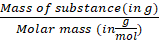
· To find how much substance is produced or consumed, always compare the number of moles from the balanced chemical reaction.
· Theoretical yield is the amount of product obtained when one of the reactants (limiting reagent) has been completely exhausted.
Balanced reaction :
4HNO3 + Cu→ Cu(NO3)2 + 2H2O + 2NO2
0.128g of Cu is consumed. Molar mass of Cu = 63.5 g/mol
Using the above formula, no. of moles of Cu =  = 2.016 x
10-3 moles
= 2.016 x
10-3 moles
From the balanced equation, 1 mole Cu gives 1 mole Cu(NO3)2
Thus, 2.016 x 10⁻³ moles Cu gives  = 2.016 x
10-3 moles Cu(NO3)2.
= 2.016 x
10-3 moles Cu(NO3)2.
Mass of Cu(NO3)2(molar mass = 187.5g/mol) (using equ1) = 2.016 x 10⁻³ moles x 187.5g/mol = 0.378g
So, theoretical yield = 0.378 g
Add Answer to:
Given an initial 0.128 g Cu (II) and 3mL of
HNO3
Part I: 1. The reaction...
the mass 0.43 Analysis Part I: 1. The reaction in Part 1 takes place as shown...
 the
mass 0.43
Analysis Part I: 1. The reaction in Part 1 takes place as shown below. Balance the reaction and de- termine the mass (theoretical yield) of copper(II) nitrate that should be able to be recovered from your copper sample. Show your calculations. HNO (aq) + —_Cu(s) → Cu(NO),(aq) + __H,0(0) + —NO,) Part II: 1. The reaction in Part II takes place as shown below. Balance the reaction and deter- mine the theoretical yield of copper(II) hydroxide (in...
the
mass 0.43
Analysis Part I: 1. The reaction in Part 1 takes place as shown below. Balance the reaction and de- termine the mass (theoretical yield) of copper(II) nitrate that should be able to be recovered from your copper sample. Show your calculations. HNO (aq) + —_Cu(s) → Cu(NO),(aq) + __H,0(0) + —NO,) Part II: 1. The reaction in Part II takes place as shown below. Balance the reaction and deter- mine the theoretical yield of copper(II) hydroxide (in...
1. Balance the three copper reactions: +H20 (1) +NO2 (g) Cu(NO3)2 (aq) i) Cu (s) HNO3...
 1. Balance the three copper reactions: +H20 (1) +NO2 (g) Cu(NO3)2 (aq) i) Cu (s) HNO3 (aq) NANO3 (aq) NaOH (aq) Cu(OH)2 (s) + ii) Cu(NOs)2 (aq) + H2O (1I) CuO (s) iii) Cu(OH)2 (s) 2. In reaction (i), suppose you add 4.0 mL of 6M nitric acid to a sphere of copper metal that weighs 0.65 grams. Which reactant is the limiting reagent? (Show your work)
Use scratch paper if necessary, and copy your completed calculations to this sheet. Shown below are the 4 reactions...
 Use scratch paper if necessary, and copy your completed calculations to this sheet. Shown below are the 4 reactions involved in the Cu cycle listed in random order Cus(PO4)2 (s)+HCI (aq)CuCl2 (aq) + HsPOs (aq) CuCl2 (aq)+ Mg (s) MgCl2 (aq)+ Cu (s) Cu (s)+4 HNO, (aq) Cu(NOs)2 (aq) +2 NO2 (8) + 2 H2O () Cu(NO) (aq)+ Na POs (aq)Cus(PO)2 (s) + NaNO, (aq) Place them in the proper order such that the first reaction starts with elemental copper...
1. Balance the three copper reactions: + H20 (1) Cu(NO3)2 (aq) + NO2(g) i) Cu (s)...
 1. Balance the three copper reactions: + H20 (1) Cu(NO3)2 (aq) + NO2(g) i) Cu (s) + HNO3 (aq) ii) Cu(NO3)2 (aq) + NaOH(aq) Cu(OH)2 (s) + NaNO3(aq) (aq) - iii) Cu(OH)2 (S) Cuo(s) + H2O (1) 2. In reaction (i), suppose you add 4.0 mL of 6 M nitric acid to a sphere of copper metal that weighs 0.65 grams. Which reactant is the limiting reagent? (Show your work)
use 1.7g of Zn 1. The reaction in Part V takes place as shown below. Using...
 use 1.7g of Zn
1. The reaction in Part V takes place as shown below. Using what you know about reactions, determine the missing product, then balance the reaction and determine the theoretical yield of copper (in grams). Show your calculations. | Cuso,(aq) +_ | Zn() → _Cu(s) + 12.50 2. What should your theoretical yield of copper metal be for your last step? Explain your reasoning. Calculate your percent yield for the entire copper cycle. Show work
use 1.7g of Zn
1. The reaction in Part V takes place as shown below. Using what you know about reactions, determine the missing product, then balance the reaction and determine the theoretical yield of copper (in grams). Show your calculations. | Cuso,(aq) +_ | Zn() → _Cu(s) + 12.50 2. What should your theoretical yield of copper metal be for your last step? Explain your reasoning. Calculate your percent yield for the entire copper cycle. Show work
1.) An aqueous solution containing 5.66 g of lead(II) nitrate is added to an aqueous solution...
1.) An aqueous solution containing 5.66 g of lead(II) nitrate is added to an aqueous solution containing 6.30 g of potassium chloride. Enter the balanced chemical equation for this reaction. Be sure to include all physical states. balanced chemical equation What is the limiting reactant? The percent yield for the reaction is 79.2 % . How many grams of precipitate is recovered? precipitate recovered: How many grams of the excess reactant remain? excess reactant remaining: 2.) Chlorine gas can be...
3. a. Why should the Cu(OH)2 precipitate that is formed during reaction (ii) be heated slowly...
 3. a. Why should the Cu(OH)2 precipitate that is formed during reaction (ii) be heated slowly during reaction (ii)? b. Why does reaction (i) have to be carried out in the fume hood? 4. Reaction (iii) is considered to be c) decomposition d) acid-base e) precipitation b) single displacement a) combination EXPERIMENT 9 REACTION OF COPPER AND ITS COMPOUNDS PRE-LABORATORY QUESTIONS The following preparatory questions should be answered before coming to lab. They are intended to introduce you to several...
part of one question perform ice stable on 2 all information needed is given, please read...
 part of one question perform ice stable on 2
all
information needed is given, please read the question carefully on
#1 it's all connected
Green Limiting Reagent IN ne Write the balanced chemical equation for the reaction and complete the table below. Be sure use the correct number of significant figures. Remember that leading zeros are not considered nificant Reaction = Initial moles Change moles End moles End moles numerical + What does x equal? Calculate the molar masses for...
part of one question perform ice stable on 2
all
information needed is given, please read the question carefully on
#1 it's all connected
Green Limiting Reagent IN ne Write the balanced chemical equation for the reaction and complete the table below. Be sure use the correct number of significant figures. Remember that leading zeros are not considered nificant Reaction = Initial moles Change moles End moles End moles numerical + What does x equal? Calculate the molar masses for...
Date La Than Mews TA Classifying Reactions in the Copper Cycle Report Sheet 1. Initial mass...
 Date La Than Mews TA Classifying Reactions in the Copper Cycle Report Sheet 1. Initial mass of copper 2. Mass of copper and evaporating dish 3. Mass of evaporating dish 4. Mass of uncovered copper 5 Percent yield (show calculations) 6. Describe the reaction Cu(s) + HNO (aq) + 7. Describe the reaction Cu(NO).(aq) + NaOH(aq)- - B. Describe the reaction Cu(OH),() - SUUDIO 9. What are you removing by this washing? 10. What copper compound is present in the...
Question 1: Consider the following oxidation-reduction reaction: I−(aq)+Cu+(aq)→IO4−(aq)+Cu(s) A: What are the initial a...
Question 1: Consider the following oxidation-reduction reaction: I−(aq)+Cu+(aq)→IO4−(aq)+Cu(s) A: What are the initial and final oxidation states of iodine? B: What are the initial and final oxidation states of copper? C: What element is reduced? D:What is the reducing agent? E: What element is oxidized? F: What is the oxidizing agent? G: Give the atom- and electron-balanced oxidation half-reaction occurring in acidic solution. Express your answer as a chemical equation. Include all phases. H: Give the atom- and electron-balanced reduction...
 the
mass 0.43
Analysis Part I: 1. The reaction in Part 1 takes place as shown below. Balance the reaction and de- termine the mass (theoretical yield) of copper(II) nitrate that should be able to be recovered from your copper sample. Show your calculations. HNO (aq) + —_Cu(s) → Cu(NO),(aq) + __H,0(0) + —NO,) Part II: 1. The reaction in Part II takes place as shown below. Balance the reaction and deter- mine the theoretical yield of copper(II) hydroxide (in...
the
mass 0.43
Analysis Part I: 1. The reaction in Part 1 takes place as shown below. Balance the reaction and de- termine the mass (theoretical yield) of copper(II) nitrate that should be able to be recovered from your copper sample. Show your calculations. HNO (aq) + —_Cu(s) → Cu(NO),(aq) + __H,0(0) + —NO,) Part II: 1. The reaction in Part II takes place as shown below. Balance the reaction and deter- mine the theoretical yield of copper(II) hydroxide (in...
 1. Balance the three copper reactions: +H20 (1) +NO2 (g) Cu(NO3)2 (aq) i) Cu (s) HNO3 (aq) NANO3 (aq) NaOH (aq) Cu(OH)2 (s) + ii) Cu(NOs)2 (aq) + H2O (1I) CuO (s) iii) Cu(OH)2 (s) 2. In reaction (i), suppose you add 4.0 mL of 6M nitric acid to a sphere of copper metal that weighs 0.65 grams. Which reactant is the limiting reagent? (Show your work)
 Use scratch paper if necessary, and copy your completed calculations to this sheet. Shown below are the 4 reactions involved in the Cu cycle listed in random order Cus(PO4)2 (s)+HCI (aq)CuCl2 (aq) + HsPOs (aq) CuCl2 (aq)+ Mg (s) MgCl2 (aq)+ Cu (s) Cu (s)+4 HNO, (aq) Cu(NOs)2 (aq) +2 NO2 (8) + 2 H2O () Cu(NO) (aq)+ Na POs (aq)Cus(PO)2 (s) + NaNO, (aq) Place them in the proper order such that the first reaction starts with elemental copper...
 1. Balance the three copper reactions: + H20 (1) Cu(NO3)2 (aq) + NO2(g) i) Cu (s) + HNO3 (aq) ii) Cu(NO3)2 (aq) + NaOH(aq) Cu(OH)2 (s) + NaNO3(aq) (aq) - iii) Cu(OH)2 (S) Cuo(s) + H2O (1) 2. In reaction (i), suppose you add 4.0 mL of 6 M nitric acid to a sphere of copper metal that weighs 0.65 grams. Which reactant is the limiting reagent? (Show your work)
 use 1.7g of Zn
1. The reaction in Part V takes place as shown below. Using what you know about reactions, determine the missing product, then balance the reaction and determine the theoretical yield of copper (in grams). Show your calculations. | Cuso,(aq) +_ | Zn() → _Cu(s) + 12.50 2. What should your theoretical yield of copper metal be for your last step? Explain your reasoning. Calculate your percent yield for the entire copper cycle. Show work
use 1.7g of Zn
1. The reaction in Part V takes place as shown below. Using what you know about reactions, determine the missing product, then balance the reaction and determine the theoretical yield of copper (in grams). Show your calculations. | Cuso,(aq) +_ | Zn() → _Cu(s) + 12.50 2. What should your theoretical yield of copper metal be for your last step? Explain your reasoning. Calculate your percent yield for the entire copper cycle. Show work
 3. a. Why should the Cu(OH)2 precipitate that is formed during reaction (ii) be heated slowly during reaction (ii)? b. Why does reaction (i) have to be carried out in the fume hood? 4. Reaction (iii) is considered to be c) decomposition d) acid-base e) precipitation b) single displacement a) combination EXPERIMENT 9 REACTION OF COPPER AND ITS COMPOUNDS PRE-LABORATORY QUESTIONS The following preparatory questions should be answered before coming to lab. They are intended to introduce you to several...
 part of one question perform ice stable on 2
all
information needed is given, please read the question carefully on
#1 it's all connected
Green Limiting Reagent IN ne Write the balanced chemical equation for the reaction and complete the table below. Be sure use the correct number of significant figures. Remember that leading zeros are not considered nificant Reaction = Initial moles Change moles End moles End moles numerical + What does x equal? Calculate the molar masses for...
part of one question perform ice stable on 2
all
information needed is given, please read the question carefully on
#1 it's all connected
Green Limiting Reagent IN ne Write the balanced chemical equation for the reaction and complete the table below. Be sure use the correct number of significant figures. Remember that leading zeros are not considered nificant Reaction = Initial moles Change moles End moles End moles numerical + What does x equal? Calculate the molar masses for...
 Date La Than Mews TA Classifying Reactions in the Copper Cycle Report Sheet 1. Initial mass of copper 2. Mass of copper and evaporating dish 3. Mass of evaporating dish 4. Mass of uncovered copper 5 Percent yield (show calculations) 6. Describe the reaction Cu(s) + HNO (aq) + 7. Describe the reaction Cu(NO).(aq) + NaOH(aq)- - B. Describe the reaction Cu(OH),() - SUUDIO 9. What are you removing by this washing? 10. What copper compound is present in the...
Most questions answered within 3 hours.
-
Where is the error in this code sequence?
String s1 = "Hello";
String s2 = "ello";...
asked 11 months ago -
Financial data for Joel de Paris, Inc., for last year
follow:
Joel de Paris, Inc.
Balance...
asked 11 months ago -
Consider this reaction:
Al2(SO4)3 (aq)+ BaCl3
(aq) Al2Cl6 (aq)- +
3BaSO4(s) . What is the...
asked 11 months ago -
Suppose that Savneet is considering increasing her
recent random sample from 20 car rentals to 40...
asked 11 months ago -
Trucks arrive at an unloading terminal at an average rate of 120
per hour.
Trucks arrive...
asked 11 months ago -
Why are methanol and ethanol completely soluble in water while
octanol is not very little soluble....
asked 11 months ago -
A facilities manager at a university reads in a research report
that the mean amount of...
asked 11 months ago -
When the CuSO4 is rehydrated by adding water to the anhydrous
compound, is this an endothermic...
asked 11 months ago -
A ray of sunlight is passing from diamond into crown glass; the
angle of incidence is...
asked 11 months ago -
A block of mass 0.249 kg is placed on top of a light, vertical
spring of...
asked 11 months ago -
how do the kidneys compensate in the presences of acidosis
a) trigger hyperventilate
b) reserve acid...
asked 11 months ago -
Question 501 pts
The rental rate of capital to the firm increases. Which of the
following...
asked 11 months ago