
Homework Answers
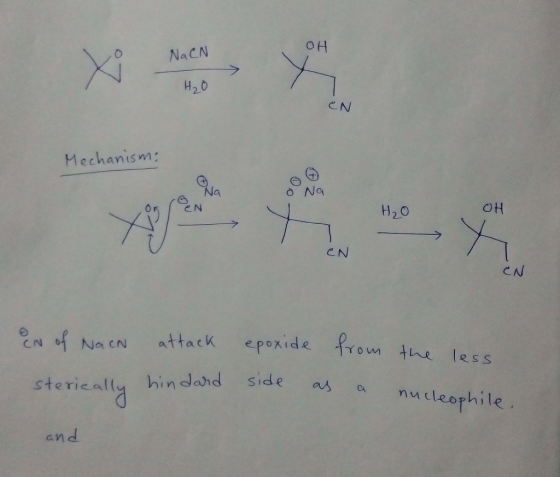
Cyanide addition to the 1-degree carbon of the epoxide.
Add Answer to:
23. The mechanism of the reaction shown below includes: NaCN A. Protonation of the epoxide oxygen...
Which of the following statement is correct about the mechanism of hemiacetal and acetal formation? A....
 Which of the following statement is correct about the mechanism of hemiacetal and acetal formation? A. In the hemiacetal formation mechanism, the oxygen on the alcohol uses its lone pair to "attack the carbonyl carbon before the protonation of the carbonyl oxygen B. The carbocation formation is not favored during the hemiacetal formation mechanism, this is why hemiacetal are generally unstable and very reactive C. In the acetal formation mechanism, hydrolysis of water to the hemiacetal carbon center occurs as...
Which mechanism is most likely for the reaction shown? (More than one choice may be possible)...
 Which mechanism is most likely for the reaction shown? (More than one choice may be possible) SN2 BSN1 Radical Addition Br2 (1 equiv.) CsHg 1 h at 80 °C light Which mechanism is most likely for the reaction shown? (More than one choice may be possible) SN2 B SN1 Radical Addition NaCN DMF 50 °C Which mechanism is most likely for the reaction shown? (More than one choice may be possible) SN2 SN1 D Radical Addition Сн,ОН K2CO3 100 °C...
The product is the epoxide shown below. H3C b Write a mechanism for the reaction using...
 The product is the epoxide shown below. H3C b Write a mechanism for the reaction using curved arrows to show electron reorganization. Arrow-pushing Instructions no-X HH :0: H₃C CH₃
Draw the mechanism of the Sn-1-like Sn2 reaction of tertiary epoxide illustrated below. Upload a PDF...
 Draw the mechanism of the Sn-1-like Sn2 reaction of tertiary epoxide illustrated below. Upload a PDF file of your answer. Br HBr OH
For the synthetic scheme below, please indicate the following: reagents and reaction conditions s...
 For the synthetic scheme below, please indicate the following: reagents and reaction conditions step (above/below the arrows), name of each reaction, and the generic name of each product (15 pts). for each MgBr Names of reactions: Give generic names of compounds: B: D: G: ctly draw the mechanism for the reaction above 1. The first step in that reaction is A) Deprotonation of acetylenic H atom with R-X B) Formation of acetylide anion. C) Deprotonation of acetylenic H atom with...
18. The mechanism of the following reaction is CH20-S-OCH3 + 2 NaCN - Na2SO4 + 2...
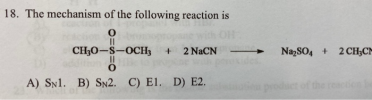 18. The mechanism of the following reaction is CH20-S-OCH3 + 2 NaCN - Na2SO4 + 2 CH3CM A) Sn1. B) SN2. C) E1. D) E2.
19. Draw the mechanism of the acid-catalyzed reaction shown below. Note that it occurs in 6...
 19. Draw the mechanism of the acid-catalyzed reaction shown below. Note that it occurs in 6 steps, and that in each step only one of the four basic mechanistic processes occurs (protonation, deprotonation, nucleophilic attack, elimination).
For the synthetic scheme below, please indicate the following: reagents and reaction conditions step (above/below the...
 For the synthetic scheme below, please indicate the following: reagents and reaction conditions step (above/below the arrows), name of each reaction, and the generic name of each product (15 pts). for each MgBr Names of reactions: Give generic names of compounds: B: D: G: ctly draw the mechanism for the reaction above 1. The first step in that reaction is A) Deprotonation of acetylenic H atom with R-X B) Formation of acetylide anion. C) Deprotonation of acetylenic H atom with...
What statement is TRUE about the mechanism for the reaction shown here? CH(CH) COACH CHỊ(CH3CO,CH NaOH...
 What statement is TRUE about the mechanism for the reaction shown here? CH(CH) COACH CHỊ(CH3CO,CH NaOH excess heat CH,(CH2)2CO CHỊ Water attacks the carbonyl carbon to form a tetrahedral intermediate The first step of the reaction involves protonation of the ester carbonyl oxygen. One of the products formed is CH3(CH2)2CO Na. Water deprotonates the alpha carbon.
What statement is TRUE about the mechanism for the reaction shown here? CHỊ(CH4)2COẠCH, CH,(CHỊ) CO,CH 2,...
 What statement is TRUE about the mechanism for the reaction shown here? CHỊ(CH4)2COẠCH, CH,(CHỊ) CO,CH 2, CO,CH NAOH excess heat CHỊ(CH) CÓ CH, Water attacks the carbonyl carbon to form a tetrahedral intermediate. The first step of the reaction involves protonation of the ester carbonyl oxygen. One of the products formed is CH3(CH2)2CO2Na. Water deprotonates the alpha carbon.
 Which of the following statement is correct about the mechanism of hemiacetal and acetal formation? A. In the hemiacetal formation mechanism, the oxygen on the alcohol uses its lone pair to "attack the carbonyl carbon before the protonation of the carbonyl oxygen B. The carbocation formation is not favored during the hemiacetal formation mechanism, this is why hemiacetal are generally unstable and very reactive C. In the acetal formation mechanism, hydrolysis of water to the hemiacetal carbon center occurs as...
 Which mechanism is most likely for the reaction shown? (More than one choice may be possible) SN2 BSN1 Radical Addition Br2 (1 equiv.) CsHg 1 h at 80 °C light Which mechanism is most likely for the reaction shown? (More than one choice may be possible) SN2 B SN1 Radical Addition NaCN DMF 50 °C Which mechanism is most likely for the reaction shown? (More than one choice may be possible) SN2 SN1 D Radical Addition Сн,ОН K2CO3 100 °C...
 The product is the epoxide shown below. H3C b Write a mechanism for the reaction using curved arrows to show electron reorganization. Arrow-pushing Instructions no-X HH :0: H₃C CH₃
 Draw the mechanism of the Sn-1-like Sn2 reaction of tertiary epoxide illustrated below. Upload a PDF file of your answer. Br HBr OH
 For the synthetic scheme below, please indicate the following: reagents and reaction conditions step (above/below the arrows), name of each reaction, and the generic name of each product (15 pts). for each MgBr Names of reactions: Give generic names of compounds: B: D: G: ctly draw the mechanism for the reaction above 1. The first step in that reaction is A) Deprotonation of acetylenic H atom with R-X B) Formation of acetylide anion. C) Deprotonation of acetylenic H atom with...
 18. The mechanism of the following reaction is CH20-S-OCH3 + 2 NaCN - Na2SO4 + 2 CH3CM A) Sn1. B) SN2. C) E1. D) E2.
 19. Draw the mechanism of the acid-catalyzed reaction shown below. Note that it occurs in 6 steps, and that in each step only one of the four basic mechanistic processes occurs (protonation, deprotonation, nucleophilic attack, elimination).
 For the synthetic scheme below, please indicate the following: reagents and reaction conditions step (above/below the arrows), name of each reaction, and the generic name of each product (15 pts). for each MgBr Names of reactions: Give generic names of compounds: B: D: G: ctly draw the mechanism for the reaction above 1. The first step in that reaction is A) Deprotonation of acetylenic H atom with R-X B) Formation of acetylide anion. C) Deprotonation of acetylenic H atom with...
 What statement is TRUE about the mechanism for the reaction shown here? CH(CH) COACH CHỊ(CH3CO,CH NaOH excess heat CH,(CH2)2CO CHỊ Water attacks the carbonyl carbon to form a tetrahedral intermediate The first step of the reaction involves protonation of the ester carbonyl oxygen. One of the products formed is CH3(CH2)2CO Na. Water deprotonates the alpha carbon.
 What statement is TRUE about the mechanism for the reaction shown here? CHỊ(CH4)2COẠCH, CH,(CHỊ) CO,CH 2, CO,CH NAOH excess heat CHỊ(CH) CÓ CH, Water attacks the carbonyl carbon to form a tetrahedral intermediate. The first step of the reaction involves protonation of the ester carbonyl oxygen. One of the products formed is CH3(CH2)2CO2Na. Water deprotonates the alpha carbon.
Most questions answered within 3 hours.
-
Where is the error in this code sequence?
String s1 = "Hello";
String s2 = "ello";...
asked 11 months ago -
Financial data for Joel de Paris, Inc., for last year
follow:
Joel de Paris, Inc.
Balance...
asked 11 months ago -
Consider this reaction:
Al2(SO4)3 (aq)+ BaCl3
(aq) Al2Cl6 (aq)- +
3BaSO4(s) . What is the...
asked 11 months ago -
Suppose that Savneet is considering increasing her
recent random sample from 20 car rentals to 40...
asked 11 months ago -
Trucks arrive at an unloading terminal at an average rate of 120
per hour.
Trucks arrive...
asked 11 months ago -
Why are methanol and ethanol completely soluble in water while
octanol is not very little soluble....
asked 11 months ago -
A facilities manager at a university reads in a research report
that the mean amount of...
asked 11 months ago -
When the CuSO4 is rehydrated by adding water to the anhydrous
compound, is this an endothermic...
asked 11 months ago -
A ray of sunlight is passing from diamond into crown glass; the
angle of incidence is...
asked 11 months ago -
A block of mass 0.249 kg is placed on top of a light, vertical
spring of...
asked 11 months ago -
how do the kidneys compensate in the presences of acidosis
a) trigger hyperventilate
b) reserve acid...
asked 11 months ago -
Question 501 pts
The rental rate of capital to the firm increases. Which of the
following...
asked 11 months ago