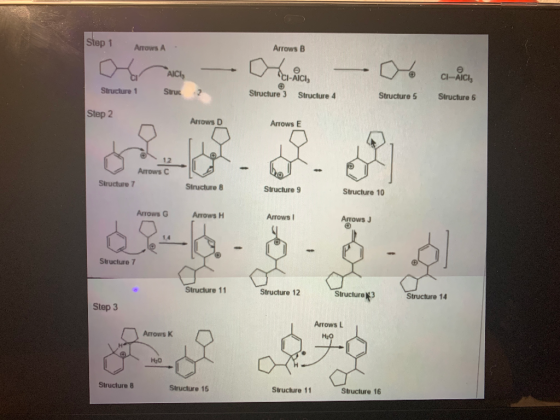
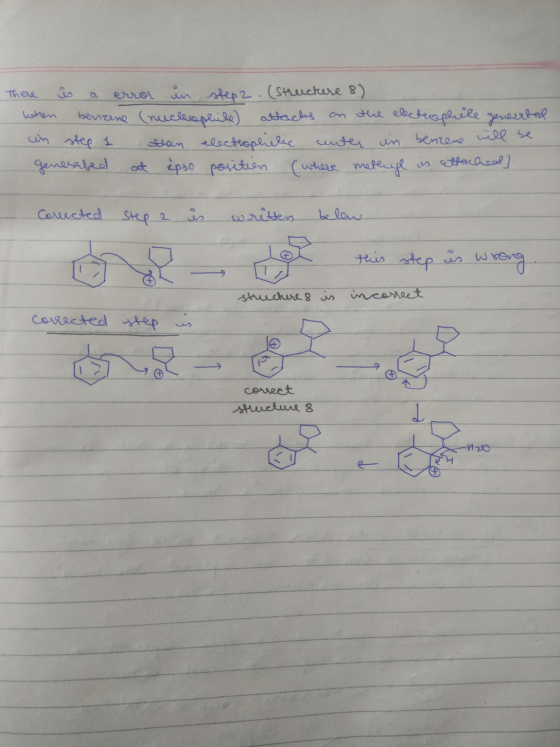
Identify errors in the mechanism shown and explain briefly what the errors are and how to fix it. Reference labeled steps and intermediate structures that have errors to make sure your answer is clear.
Homework Answers
Add Answer to:
Identify errors in the mechanism shown and explain briefly what
the errors are and how to...
Review the following mechanism submitted by a student last spring. Identify the errors in the mechanism...
 Review the following mechanism submitted by a student last spring. Identify the errors in the mechanism shown and explain briefly in one concise phrase what the error is and how to fix it. Reference the labeled steps and intermediate structures that have errors to make sure your answer is clear. Arrows A Arrows B Arrows C HO H+ cat. Step 1 Step 2 Structure 1 Structure 2 Structure 3 Step 3 Arrows E Arrows D но Step 5 Step 4...
Identify all of the errors in the mechanism below Label ALL o the errors, ТЕРА Arrows...
 Identify all of the errors in the mechanism below
Label ALL o the errors, ТЕРА Arrows 8 Arrows A SAIE Structure calcis o c.id Structurel strac. Struc. 4 struc. 5 struc. 6 STEP 2 Arrows o Arrows E Arrows C struc7 Struc. 8 struc. a struc.lo Arrows Arrows Arrows e Arrows J > struc 7 strucll Struc. 12 struc. is struc. 14 STEP 3 Arrowsk Arrows L Struc. 8 Struc. 15 struc. Il struc 16
Identify all of the errors in the mechanism below
Label ALL o the errors, ТЕРА Arrows 8 Arrows A SAIE Structure calcis o c.id Structurel strac. Struc. 4 struc. 5 struc. 6 STEP 2 Arrows o Arrows E Arrows C struc7 Struc. 8 struc. a struc.lo Arrows Arrows Arrows e Arrows J > struc 7 strucll Struc. 12 struc. is struc. 14 STEP 3 Arrowsk Arrows L Struc. 8 Struc. 15 struc. Il struc 16
7) [28 pts.] L-Proline was recently found to catalytically promote the quantitative stereochemical isomerization of the aldehyde shown below. The proposed mechanism proceeds through the enamine deriv...
 7) [28 pts.] L-Proline was recently found to catalytically promote the quantitative stereochemical isomerization of the aldehyde shown below. The proposed mechanism proceeds through the enamine derivative of L-Proline, and involves intramolecular general acid and general base catalyzed steps. Provide the missing structures in boxes 1-4 and arrows where requested. Boxes 2 and 3 are to display different faces of a prochiral double bond, brought about by a conformational change. (Reference J. Org. Chen. 2007, 72, 10279) OR OR OR...
please explain How many "curved arrows are needed to describe the mechanism for formation of this...
 please explain
How many "curved arrows are needed to describe the mechanism for formation of this intermediate? CH [D] 1 (EJ 2 IA 3 IC) 3 [B] 4 Explanation for your choice (3 pts) How can this transformation be accomplished? OH снен A. Br/CCL B. HYPd-C C.O.CH.OH G. HO/acid D. BryH.0 H. BẠH. E. Zn F.H.O I. H-0./NaOH J. CI HO K. NaH L. mCPBA M. HSO/A N. TsCpy O. KMnO/KOH TAJ H then G P. NaOH [B] O then...
please explain
How many "curved arrows are needed to describe the mechanism for formation of this intermediate? CH [D] 1 (EJ 2 IA 3 IC) 3 [B] 4 Explanation for your choice (3 pts) How can this transformation be accomplished? OH снен A. Br/CCL B. HYPd-C C.O.CH.OH G. HO/acid D. BryH.0 H. BẠH. E. Zn F.H.O I. H-0./NaOH J. CI HO K. NaH L. mCPBA M. HSO/A N. TsCpy O. KMnO/KOH TAJ H then G P. NaOH [B] O then...
Question 3. Predict the major products of the reactions below. Draw the full mechanism for the...
 Question 3. Predict the major products of the reactions below. Draw the full mechanism for the reactions, using appropriate arrows to indicate electron movement and the full structures of any intermediate(s). Use the mechanism of the reaction to provide a rationale for why the major product formed. OM (1 equivalent) ansole Bry Febr (1 culle brambenzone Fer (1 equivalent Priloromethylbenzene (9 marks) Question 4. Predict the major product from the treatment of 2,5-dibromopyridine with ammonia. Draw the full mechanism for...
I know the answer is A but can someone show the mechanism steps to get there....
 I know the answer is A but can someone show the mechanism
steps to get there. The structure in the 1st step is throwing me
off.
D E O out of 2 points What is the major isolated organic product of this multistep reaction? 1. AICI: A. 2. Zn(Hg), HCI 3. SOCI2 4. AICI: 3. NaBH4, H20 4. PBr3 5. NaOET 6. 1,3-butadiene B. D. E. none of these or more than one
I know the answer is A but can someone show the mechanism
steps to get there. The structure in the 1st step is throwing me
off.
D E O out of 2 points What is the major isolated organic product of this multistep reaction? 1. AICI: A. 2. Zn(Hg), HCI 3. SOCI2 4. AICI: 3. NaBH4, H20 4. PBr3 5. NaOET 6. 1,3-butadiene B. D. E. none of these or more than one
please short answers and clear handwriting 2. Explain briefly the history of biophysics. State examples of...
 please short answers and clear handwriting
2. Explain briefly the history of biophysics. State examples of scientist. 3. Describe scopes and topics covered in biophysics. 4. List THREE (3) biophysical techniques and applications. 5. Differentiate between polymers and residues. 6. Define biopolymers. 7. Elaborate FOUR (4) levels of structure in biological structures. 8. Explain structure function relationships 9. Describe conformational transitions. 10.Explain subunit with an example
please short answers and clear handwriting
2. Explain briefly the history of biophysics. State examples of scientist. 3. Describe scopes and topics covered in biophysics. 4. List THREE (3) biophysical techniques and applications. 5. Differentiate between polymers and residues. 6. Define biopolymers. 7. Elaborate FOUR (4) levels of structure in biological structures. 8. Explain structure function relationships 9. Describe conformational transitions. 10.Explain subunit with an example
1. Provide a multiple step synthesis for the transformation shown below. 2. Identify the carboxylic acid...
 1. Provide a multiple step synthesis for the transformation
shown below.
2. Identify the carboxylic acid and alcohol needed to make the
ester shown below.
3. Propose a mechanism for the reaction shown below.
4. Show all the important resonance structures for the anion
shown below. Include arrows that show how to reach each form.
Indicate which resonance structure makes the greatest
contribution to the resonance hybrid and which resonance structure
makes the least contribution to the resonance
hybrid.
1....
1. Provide a multiple step synthesis for the transformation
shown below.
2. Identify the carboxylic acid and alcohol needed to make the
ester shown below.
3. Propose a mechanism for the reaction shown below.
4. Show all the important resonance structures for the anion
shown below. Include arrows that show how to reach each form.
Indicate which resonance structure makes the greatest
contribution to the resonance hybrid and which resonance structure
makes the least contribution to the resonance
hybrid.
1....
Consider an El mechanism for the reaction of bromocyclopentane with hydroxide as shown below. Which elementary...
 Consider an El mechanism for the reaction of bromocyclopentane with hydroxide as shown below. Which elementary step or sequence of steps from the list below would outline the step(s) for an El mechanism? Η. Η Η ΕΙ + OH ***BE Η. Η Η Η. Η (1) H "Br + Br Η. Η Η H (2) Η CUBI Θ + Br ΝΗ, Η Η HO (3) IBI + HO + Br Η. Η Η HO Θ CBI + HO + Br"...
Draw the arrows for the 7-step mechanism in formation of the mixed acetal shown. Map CH,OH...
 Draw the arrows for the 7-step mechanism in formation of the mixed acetal shown. Map CH,OH OH mi # + HO ht Mixed ACETAL HEMIACETAL click to edit H. 0 Step он H Step w HỘ One H Two HⓇ H H 16 Step 3. Step HÖCH3 Step + H H Five Four Step 6 Draw the arrows for the 7-step mechanism for hydrolysis of an acetal to a carbonyl. Map . H2O Hö: H,O L; E i + CH,CH,OH...
 Review the following mechanism submitted by a student last spring. Identify the errors in the mechanism shown and explain briefly in one concise phrase what the error is and how to fix it. Reference the labeled steps and intermediate structures that have errors to make sure your answer is clear. Arrows A Arrows B Arrows C HO H+ cat. Step 1 Step 2 Structure 1 Structure 2 Structure 3 Step 3 Arrows E Arrows D но Step 5 Step 4...
 Identify all of the errors in the mechanism below
Label ALL o the errors, ТЕРА Arrows 8 Arrows A SAIE Structure calcis o c.id Structurel strac. Struc. 4 struc. 5 struc. 6 STEP 2 Arrows o Arrows E Arrows C struc7 Struc. 8 struc. a struc.lo Arrows Arrows Arrows e Arrows J > struc 7 strucll Struc. 12 struc. is struc. 14 STEP 3 Arrowsk Arrows L Struc. 8 Struc. 15 struc. Il struc 16
Identify all of the errors in the mechanism below
Label ALL o the errors, ТЕРА Arrows 8 Arrows A SAIE Structure calcis o c.id Structurel strac. Struc. 4 struc. 5 struc. 6 STEP 2 Arrows o Arrows E Arrows C struc7 Struc. 8 struc. a struc.lo Arrows Arrows Arrows e Arrows J > struc 7 strucll Struc. 12 struc. is struc. 14 STEP 3 Arrowsk Arrows L Struc. 8 Struc. 15 struc. Il struc 16
 7) [28 pts.] L-Proline was recently found to catalytically promote the quantitative stereochemical isomerization of the aldehyde shown below. The proposed mechanism proceeds through the enamine derivative of L-Proline, and involves intramolecular general acid and general base catalyzed steps. Provide the missing structures in boxes 1-4 and arrows where requested. Boxes 2 and 3 are to display different faces of a prochiral double bond, brought about by a conformational change. (Reference J. Org. Chen. 2007, 72, 10279) OR OR OR...
 please explain
How many "curved arrows are needed to describe the mechanism for formation of this intermediate? CH [D] 1 (EJ 2 IA 3 IC) 3 [B] 4 Explanation for your choice (3 pts) How can this transformation be accomplished? OH снен A. Br/CCL B. HYPd-C C.O.CH.OH G. HO/acid D. BryH.0 H. BẠH. E. Zn F.H.O I. H-0./NaOH J. CI HO K. NaH L. mCPBA M. HSO/A N. TsCpy O. KMnO/KOH TAJ H then G P. NaOH [B] O then...
please explain
How many "curved arrows are needed to describe the mechanism for formation of this intermediate? CH [D] 1 (EJ 2 IA 3 IC) 3 [B] 4 Explanation for your choice (3 pts) How can this transformation be accomplished? OH снен A. Br/CCL B. HYPd-C C.O.CH.OH G. HO/acid D. BryH.0 H. BẠH. E. Zn F.H.O I. H-0./NaOH J. CI HO K. NaH L. mCPBA M. HSO/A N. TsCpy O. KMnO/KOH TAJ H then G P. NaOH [B] O then...
 Question 3. Predict the major products of the reactions below. Draw the full mechanism for the reactions, using appropriate arrows to indicate electron movement and the full structures of any intermediate(s). Use the mechanism of the reaction to provide a rationale for why the major product formed. OM (1 equivalent) ansole Bry Febr (1 culle brambenzone Fer (1 equivalent Priloromethylbenzene (9 marks) Question 4. Predict the major product from the treatment of 2,5-dibromopyridine with ammonia. Draw the full mechanism for...
 I know the answer is A but can someone show the mechanism
steps to get there. The structure in the 1st step is throwing me
off.
D E O out of 2 points What is the major isolated organic product of this multistep reaction? 1. AICI: A. 2. Zn(Hg), HCI 3. SOCI2 4. AICI: 3. NaBH4, H20 4. PBr3 5. NaOET 6. 1,3-butadiene B. D. E. none of these or more than one
I know the answer is A but can someone show the mechanism
steps to get there. The structure in the 1st step is throwing me
off.
D E O out of 2 points What is the major isolated organic product of this multistep reaction? 1. AICI: A. 2. Zn(Hg), HCI 3. SOCI2 4. AICI: 3. NaBH4, H20 4. PBr3 5. NaOET 6. 1,3-butadiene B. D. E. none of these or more than one
 please short answers and clear handwriting
2. Explain briefly the history of biophysics. State examples of scientist. 3. Describe scopes and topics covered in biophysics. 4. List THREE (3) biophysical techniques and applications. 5. Differentiate between polymers and residues. 6. Define biopolymers. 7. Elaborate FOUR (4) levels of structure in biological structures. 8. Explain structure function relationships 9. Describe conformational transitions. 10.Explain subunit with an example
please short answers and clear handwriting
2. Explain briefly the history of biophysics. State examples of scientist. 3. Describe scopes and topics covered in biophysics. 4. List THREE (3) biophysical techniques and applications. 5. Differentiate between polymers and residues. 6. Define biopolymers. 7. Elaborate FOUR (4) levels of structure in biological structures. 8. Explain structure function relationships 9. Describe conformational transitions. 10.Explain subunit with an example
 1. Provide a multiple step synthesis for the transformation
shown below.
2. Identify the carboxylic acid and alcohol needed to make the
ester shown below.
3. Propose a mechanism for the reaction shown below.
4. Show all the important resonance structures for the anion
shown below. Include arrows that show how to reach each form.
Indicate which resonance structure makes the greatest
contribution to the resonance hybrid and which resonance structure
makes the least contribution to the resonance
hybrid.
1....
1. Provide a multiple step synthesis for the transformation
shown below.
2. Identify the carboxylic acid and alcohol needed to make the
ester shown below.
3. Propose a mechanism for the reaction shown below.
4. Show all the important resonance structures for the anion
shown below. Include arrows that show how to reach each form.
Indicate which resonance structure makes the greatest
contribution to the resonance hybrid and which resonance structure
makes the least contribution to the resonance
hybrid.
1....
 Consider an El mechanism for the reaction of bromocyclopentane with hydroxide as shown below. Which elementary step or sequence of steps from the list below would outline the step(s) for an El mechanism? Η. Η Η ΕΙ + OH ***BE Η. Η Η Η. Η (1) H "Br + Br Η. Η Η H (2) Η CUBI Θ + Br ΝΗ, Η Η HO (3) IBI + HO + Br Η. Η Η HO Θ CBI + HO + Br"...
 Draw the arrows for the 7-step mechanism in formation of the mixed acetal shown. Map CH,OH OH mi # + HO ht Mixed ACETAL HEMIACETAL click to edit H. 0 Step он H Step w HỘ One H Two HⓇ H H 16 Step 3. Step HÖCH3 Step + H H Five Four Step 6 Draw the arrows for the 7-step mechanism for hydrolysis of an acetal to a carbonyl. Map . H2O Hö: H,O L; E i + CH,CH,OH...
Most questions answered within 3 hours.
-
Where is the error in this code sequence?
String s1 = "Hello";
String s2 = "ello";...
asked 10 months ago -
Financial data for Joel de Paris, Inc., for last year
follow:
Joel de Paris, Inc.
Balance...
asked 10 months ago -
Consider this reaction:
Al2(SO4)3 (aq)+ BaCl3
(aq) Al2Cl6 (aq)- +
3BaSO4(s) . What is the...
asked 10 months ago -
Suppose that Savneet is considering increasing her
recent random sample from 20 car rentals to 40...
asked 10 months ago -
Trucks arrive at an unloading terminal at an average rate of 120
per hour.
Trucks arrive...
asked 10 months ago -
Why are methanol and ethanol completely soluble in water while
octanol is not very little soluble....
asked 10 months ago -
A facilities manager at a university reads in a research report
that the mean amount of...
asked 10 months ago -
When the CuSO4 is rehydrated by adding water to the anhydrous
compound, is this an endothermic...
asked 10 months ago -
A ray of sunlight is passing from diamond into crown glass; the
angle of incidence is...
asked 10 months ago -
A block of mass 0.249 kg is placed on top of a light, vertical
spring of...
asked 10 months ago -
how do the kidneys compensate in the presences of acidosis
a) trigger hyperventilate
b) reserve acid...
asked 10 months ago -
Question 501 pts
The rental rate of capital to the firm increases. Which of the
following...
asked 10 months ago