
Homework Answers
Add Answer to:
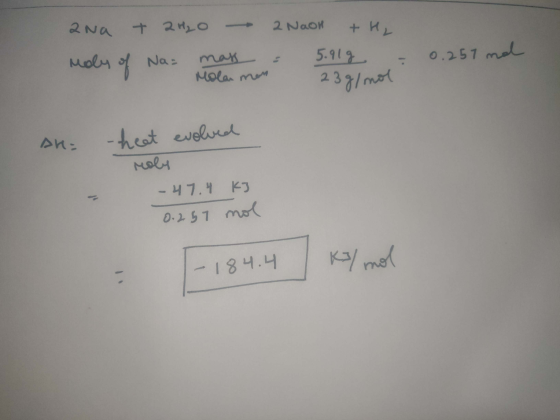
The reaction of sodium(s) with water(l) to form sodium hydroxide(aq) and hydrogen(g) proceeds as follows: 2Na(s)...
Sodium reacts with water according to the reaction: 2Na(s)+2H2O(l)→2NaOH(aq)+H2(g) Identify the oxidizing agent. a) H2O(l) b)...
Sodium reacts with water according to the reaction: 2Na(s)+2H2O(l)→2NaOH(aq)+H2(g) Identify the oxidizing agent. a) H2O(l) b) NaOH(aq) c) Na(s) d) H2 (g)
The reaction of nitrogen monoxide(g) with hydrogen(g) to form nitrogen(g) and water(l) proceeds as follows: 2NO(g)...
The reaction of nitrogen monoxide(g) with hydrogen(g) to form nitrogen(g) and water(l) proceeds as follows: 2NO(g) + 2H2(g) N2(g) + 2H2O(l) When 6.39 g NO(g) reacts with sufficient H2(g), 80.1 kJ is evolved. Calculate the value of deltaH for the chemical equation given.
Sodium metal reacts with water to produce hydrogen gas according to the following equation: 2Na(s) +...
Sodium metal reacts with water to produce hydrogen gas according to the following equation: 2Na(s) + 2H2O(l)2NaOH(aq) + H2(g) The product gas, H2, is collected over water at a temperature of 20 °C and a pressure of 753 mm Hg. If the wet H2 gas formed occupies a volume of 5.60 L, the number of moles of Na reacted was ____ mol. The vapor pressure of water is 17.5 mm Hg at 20 °C.
For the reaction 2Na(s) + 2H2O(1) -2NaOH(aq) + H2(g) AH° -368.6 kJ and AS --15.3 J/K...
 For the reaction 2Na(s) + 2H2O(1) -2NaOH(aq) + H2(g) AH° -368.6 kJ and AS --15.3 J/K The maximum amount of work that could be done when 2.20 moles of Na(s) react at 261 K, 1 atm is kJ. Assume that AH and AS are independent of temperature.
Sodium reacts with Hydrochloric acid to form sodium chloride and hydrogen gas. 2Na(s)+ 2 HCl(aq)-> 2...
Sodium reacts with Hydrochloric acid to form sodium chloride and hydrogen gas. 2Na(s)+ 2 HCl(aq)-> 2 NaCl(aq) +H2(g) A) Using the balanced equation above, what is the oxidation number of Na in Na(s) B) Using the balanced equation in Question 1, what is the oxidation number of H in H2(g) C) Using the balanced equation in Question 1, which element was oxidized and which was reduced?
Collecting Gas over water Sodium metal reacts with water to produce hydrogen gas according to the...
 Collecting Gas over water
Sodium metal reacts with water to produce hydrogen gas according to the following equation: 2Na(s) + 2H20(1)—>2NaOH(aq) + H2(g) The product gas, H2, is collected over water at a temperature of 25 °C and a pressure of 746 mm Hg. If the wet H2 gas formed occupies a volume of 7.28 L, the number of grams of H, formed is g. The vapor pressure of water is 23.8 mm Hg at 25 °C.
Collecting Gas over water
Sodium metal reacts with water to produce hydrogen gas according to the following equation: 2Na(s) + 2H20(1)—>2NaOH(aq) + H2(g) The product gas, H2, is collected over water at a temperature of 25 °C and a pressure of 746 mm Hg. If the wet H2 gas formed occupies a volume of 7.28 L, the number of grams of H, formed is g. The vapor pressure of water is 23.8 mm Hg at 25 °C.
The reaction of Fe304(s) with hydrogen(g) to form iron(s) and water(g) proceeds as follows: >3 Fe(s)...
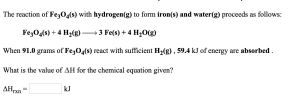 The reaction of Fe304(s) with hydrogen(g) to form iron(s) and water(g) proceeds as follows: >3 Fe(s) + 4 H2O(g) Fe304(s) 4 H2(g) When 91.0 grams of Fe304(s) react with sufficient H2(g), 59.4 kJ of energy are absorbed What is the value of AH for the chemical equation given? kJ AHxn
For the following reaction, 6.87 grams of water are mixed with excess sodium. The reaction yields...
For the following reaction, 6.87 grams of water are mixed with excess sodium. The reaction yields 12.6 grams of sodium hydroxide. 2Na(s)+2H2O(l)---->2NaOH(aq)+H2(g) What is the theoretical yield of sodium hydroxide? g What is the percent yield for this reaction? %
TUTOR Enthalpy Changes The reaction of hydrogen sulfide(g) with oxygen(g) to form water(g) and sulfur dioxide()...
 TUTOR Enthalpy Changes The reaction of hydrogen sulfide(g) with oxygen(g) to form water(g) and sulfur dioxide() proceeds as follows: 2H2S(g) + 302(g)— 2H2O(g) + 2SO2(g) When 11.2 g H2S(g) reacts with sufficient O2(g), 171 kJ is evolved. Calculate the value of AH for the chemical equation given -454.4 X kJ/mol Resubmit Show Approach Hide Tutor Steps
Enter your answer in the provided box. Consider the reaction 2Na(s) + 2H2O(1) 2NaOH(aq) + H2)...
 Enter your answer in the provided box. Consider the reaction 2Na(s) + 2H2O(1) 2NaOH(aq) + H2) When 2 moles of Na react with water at 25°C and 1 atm, the volume of H2 formed is 24.5 L. Calculate the magnitude of work done in joules when 0.25 g of Na reacts with water under the same conditions. (The conversion factor is 1 L atm = 101.3 J.) J
 For the reaction 2Na(s) + 2H2O(1) -2NaOH(aq) + H2(g) AH° -368.6 kJ and AS --15.3 J/K The maximum amount of work that could be done when 2.20 moles of Na(s) react at 261 K, 1 atm is kJ. Assume that AH and AS are independent of temperature.
 Collecting Gas over water
Sodium metal reacts with water to produce hydrogen gas according to the following equation: 2Na(s) + 2H20(1)—>2NaOH(aq) + H2(g) The product gas, H2, is collected over water at a temperature of 25 °C and a pressure of 746 mm Hg. If the wet H2 gas formed occupies a volume of 7.28 L, the number of grams of H, formed is g. The vapor pressure of water is 23.8 mm Hg at 25 °C.
Collecting Gas over water
Sodium metal reacts with water to produce hydrogen gas according to the following equation: 2Na(s) + 2H20(1)—>2NaOH(aq) + H2(g) The product gas, H2, is collected over water at a temperature of 25 °C and a pressure of 746 mm Hg. If the wet H2 gas formed occupies a volume of 7.28 L, the number of grams of H, formed is g. The vapor pressure of water is 23.8 mm Hg at 25 °C.
 The reaction of Fe304(s) with hydrogen(g) to form iron(s) and water(g) proceeds as follows: >3 Fe(s) + 4 H2O(g) Fe304(s) 4 H2(g) When 91.0 grams of Fe304(s) react with sufficient H2(g), 59.4 kJ of energy are absorbed What is the value of AH for the chemical equation given? kJ AHxn
 TUTOR Enthalpy Changes The reaction of hydrogen sulfide(g) with oxygen(g) to form water(g) and sulfur dioxide() proceeds as follows: 2H2S(g) + 302(g)— 2H2O(g) + 2SO2(g) When 11.2 g H2S(g) reacts with sufficient O2(g), 171 kJ is evolved. Calculate the value of AH for the chemical equation given -454.4 X kJ/mol Resubmit Show Approach Hide Tutor Steps
 Enter your answer in the provided box. Consider the reaction 2Na(s) + 2H2O(1) 2NaOH(aq) + H2) When 2 moles of Na react with water at 25°C and 1 atm, the volume of H2 formed is 24.5 L. Calculate the magnitude of work done in joules when 0.25 g of Na reacts with water under the same conditions. (The conversion factor is 1 L atm = 101.3 J.) J
Most questions answered within 3 hours.
-
Where is the error in this code sequence?
String s1 = "Hello";
String s2 = "ello";...
asked 11 months ago -
Financial data for Joel de Paris, Inc., for last year
follow:
Joel de Paris, Inc.
Balance...
asked 11 months ago -
Consider this reaction:
Al2(SO4)3 (aq)+ BaCl3
(aq) Al2Cl6 (aq)- +
3BaSO4(s) . What is the...
asked 11 months ago -
Suppose that Savneet is considering increasing her
recent random sample from 20 car rentals to 40...
asked 11 months ago -
Trucks arrive at an unloading terminal at an average rate of 120
per hour.
Trucks arrive...
asked 11 months ago -
Why are methanol and ethanol completely soluble in water while
octanol is not very little soluble....
asked 11 months ago -
A facilities manager at a university reads in a research report
that the mean amount of...
asked 11 months ago -
When the CuSO4 is rehydrated by adding water to the anhydrous
compound, is this an endothermic...
asked 11 months ago -
A ray of sunlight is passing from diamond into crown glass; the
angle of incidence is...
asked 11 months ago -
A block of mass 0.249 kg is placed on top of a light, vertical
spring of...
asked 11 months ago -
how do the kidneys compensate in the presences of acidosis
a) trigger hyperventilate
b) reserve acid...
asked 11 months ago -
Question 501 pts
The rental rate of capital to the firm increases. Which of the
following...
asked 11 months ago