The measured conductivity of a 0.05445 M solution is 7451 µS/cm. Calculate the molar conductivity in...
The measured conductivity of a 0.05445 M solution is 7451 µS/cm. Calculate the molar conductivity in SI units.
Homework Answers

Add Answer to:
The measured conductivity of a 0.05445 M solution is 7451 µS/cm.
Calculate the molar conductivity in...
Conductivity Record the specific conductivity and calculate the molar conductivity of both complexes. Briefly comment o...
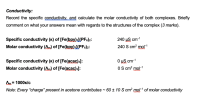 Conductivity Record the specific conductivity and calculate the molar conductivity of both complexes. Briefly comment on what your answers mean with regards to the structures of the complex (3 marks). Specific conductivity (k) of [Fe(bpy)a1(P F6)2: 240 JS cm 240 S cm2 mol Molar conductivity (Am) of [Fe(bpv)al(PF6)2: Specific conductivity (K) of [Fe(acac)] Molar conductivity (Am) of [Fe(acac)] oS cm2 mol 1000K/c Am= 60 t 10 S cm2 mot of molar conductivity Every "charge" present in one co
Conductivity Record...
Conductivity Record the specific conductivity and calculate the molar conductivity of both complexes. Briefly comment on what your answers mean with regards to the structures of the complex (3 marks). Specific conductivity (k) of [Fe(bpy)a1(P F6)2: 240 JS cm 240 S cm2 mol Molar conductivity (Am) of [Fe(bpv)al(PF6)2: Specific conductivity (K) of [Fe(acac)] Molar conductivity (Am) of [Fe(acac)] oS cm2 mol 1000K/c Am= 60 t 10 S cm2 mot of molar conductivity Every "charge" present in one co
Conductivity Record...
Calculate the expected absorbance of solution of a 5.50x10⁻⁶ M solution of Blue # measured at...
 Calculate the expected absorbance of solution of a 5.50x10⁻⁶ M solution of Blue # measured at 629 nm in a 1.50cm cell. The molar absorptivity for Blue #1 is 1.30×10⁵ M-1cm-1 at 629 nm 4. A 2.50x10⁻⁵ M solution of a specific dye has an absorbance value of 1.300 when measured at 525 nm in a cell with a path length of 2.00 cm. Calculate the molar absorptivity of this dye at this wavelength 5.
1. Conductivity: (15 marks total) The limiting molar conductivity of Na,SO4(aq) is 259.8 ? 1 mor'...
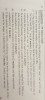 1. Conductivity: (15 marks total) The limiting molar conductivity of Na,SO4(aq) is 259.8 ? 1 mor' cm2 at 25°C and l atm and the transport number of the cation is 0.386. a) Using only the information above find the limiting molar ionic conductivities of Na (aq) and SO4 (aq) (4 marks). If you can't work this part out please use values of 20 and 60 cm-moll ?) respectively for subsequent sections b) Calculate the ionic mobility of each ion (2...
5. The device used in this experiment only measured the relative conductivity of the solution tested,...
5. The device used in this experiment only measured the relative conductivity of the solution tested, that is, whether the solution contained a strong, weak or non-electrolyte. A more elaborate conductivity meter can determine a numerical value that can be related to the number of ions in solution. Arrange the following 0.1 M solutions in order of increasing conductivity and explain why you chose this order. 0.1 M FeCl3 0.1 M MgCl2 0.1 M NaCl 0.1 M glucose (C6H12O6) 78.
Using the calibration curve, calculate the molar concentration for a solution with a measured absorbance of...
 Using the calibration curve, calculate the molar concentration for
a solution with a measured absorbance of 0.143.
Concentration = M
0.7 0.6 y = 0.337x 0.5 0.4 Absorbance 0.3 0.2 0.1 o o 0.2 0.4 0.6 0.8 1 1.2 1.4 1.6 1.8 2 Concentration, M
Using the calibration curve, calculate the molar concentration for
a solution with a measured absorbance of 0.143.
Concentration = M
0.7 0.6 y = 0.337x 0.5 0.4 Absorbance 0.3 0.2 0.1 o o 0.2 0.4 0.6 0.8 1 1.2 1.4 1.6 1.8 2 Concentration, M
Calculate the conductivity, in (12-cm) 1, of extrinsic Si doped with 2.02 x 10¹⁷ atoms/cm of...
 Calculate the conductivity, in (12-cm) 1, of extrinsic Si doped with 2.02 x 10¹⁷ atoms/cm of arsenic. The electron and hole mobilities are 1350 and 450 cm2 V-s respectively. (answer format X.X)
A standard solution of KCl is known to have a conductivity of κ=1.06296 x 10⁻⁸ S...
A standard solution of KCl is known to have a conductivity of κ=1.06296 x 10⁻⁸ S cm-1 and is used to standardise a conductance cell. A resistance reading, R of 4.2156 Ω is given. Calculate the cell constant, k showing all working. The same cell is then filled with a solution of HCl and a resistance of 1.0326 Ω is measured. Calculate the conductivity of this solution in S cm-1 showing all working.
The table below gives conductivity data at infinite dilution measured at 25 °C. Electrolyte Aº/mS mmol.'...
 The table below gives conductivity data at infinite dilution measured at 25 °C. Electrolyte Aº/mS mmol.' KOOCH 12.81 HCI 42.60 KC 14.99 (a) Why can the limiting molar conductivity of methanoic (formic) acid not be measured directly? (b) Calculate the limiting molar conductivity of methanoic acid. The molar conductivity of 0.020 M HCOOH(aq) is 3.83 mS mmol"!. What is the pk, value for methanoic acid? The following questions are about electrochemistry, Explain how the electrochemical series can be used to...
3. A 2.50x10-M solution of a dye has an absorbance of 0.520 when measured in a 1.00 cm cell at 625 nm. Calculate th...
 3. A 2.50x10-M solution of a dye has an absorbance of 0.520 when measured in a 1.00 cm cell at 625 nm. Calculate the %Transmittance of the solution. Will the %Transmittance increase or decrease if the concentration of the dye is increased. CamScanner
QUESTION 43 (10 Marks) a) Calculate the conductivity of an intrinsic silicon (SI) semiconductor at 27°C...
 QUESTION 43 (10 Marks) a) Calculate the conductivity of an intrinsic silicon (SI) semiconductor at 27°C if the hole mobility is 460 cm V's and the electron mobility is 1350 cm? Vis! Assume an intrinsic carrier density of 1.45 x 10 carriers/cm' and an electron charge of -0.16 x 10⁻⁴C (3 marks) b) Using Figure 8, calculate the conductivity of the Si intrinsic semiconductor if the temperature is increased to 150°C, assuming the same electron and hole mobilities (2 marks)...
 Conductivity Record the specific conductivity and calculate the molar conductivity of both complexes. Briefly comment on what your answers mean with regards to the structures of the complex (3 marks). Specific conductivity (k) of [Fe(bpy)a1(P F6)2: 240 JS cm 240 S cm2 mol Molar conductivity (Am) of [Fe(bpv)al(PF6)2: Specific conductivity (K) of [Fe(acac)] Molar conductivity (Am) of [Fe(acac)] oS cm2 mol 1000K/c Am= 60 t 10 S cm2 mot of molar conductivity Every "charge" present in one co
Conductivity Record...
Conductivity Record the specific conductivity and calculate the molar conductivity of both complexes. Briefly comment on what your answers mean with regards to the structures of the complex (3 marks). Specific conductivity (k) of [Fe(bpy)a1(P F6)2: 240 JS cm 240 S cm2 mol Molar conductivity (Am) of [Fe(bpv)al(PF6)2: Specific conductivity (K) of [Fe(acac)] Molar conductivity (Am) of [Fe(acac)] oS cm2 mol 1000K/c Am= 60 t 10 S cm2 mot of molar conductivity Every "charge" present in one co
Conductivity Record...
 Calculate the expected absorbance of solution of a 5.50x10⁻⁶ M solution of Blue # measured at 629 nm in a 1.50cm cell. The molar absorptivity for Blue #1 is 1.30×10⁵ M-1cm-1 at 629 nm 4. A 2.50x10⁻⁵ M solution of a specific dye has an absorbance value of 1.300 when measured at 525 nm in a cell with a path length of 2.00 cm. Calculate the molar absorptivity of this dye at this wavelength 5.
 1. Conductivity: (15 marks total) The limiting molar conductivity of Na,SO4(aq) is 259.8 ? 1 mor' cm2 at 25°C and l atm and the transport number of the cation is 0.386. a) Using only the information above find the limiting molar ionic conductivities of Na (aq) and SO4 (aq) (4 marks). If you can't work this part out please use values of 20 and 60 cm-moll ?) respectively for subsequent sections b) Calculate the ionic mobility of each ion (2...
 Using the calibration curve, calculate the molar concentration for
a solution with a measured absorbance of 0.143.
Concentration = M
0.7 0.6 y = 0.337x 0.5 0.4 Absorbance 0.3 0.2 0.1 o o 0.2 0.4 0.6 0.8 1 1.2 1.4 1.6 1.8 2 Concentration, M
Using the calibration curve, calculate the molar concentration for
a solution with a measured absorbance of 0.143.
Concentration = M
0.7 0.6 y = 0.337x 0.5 0.4 Absorbance 0.3 0.2 0.1 o o 0.2 0.4 0.6 0.8 1 1.2 1.4 1.6 1.8 2 Concentration, M
 Calculate the conductivity, in (12-cm) 1, of extrinsic Si doped with 2.02 x 10¹⁷ atoms/cm of arsenic. The electron and hole mobilities are 1350 and 450 cm2 V-s respectively. (answer format X.X)
 The table below gives conductivity data at infinite dilution measured at 25 °C. Electrolyte Aº/mS mmol.' KOOCH 12.81 HCI 42.60 KC 14.99 (a) Why can the limiting molar conductivity of methanoic (formic) acid not be measured directly? (b) Calculate the limiting molar conductivity of methanoic acid. The molar conductivity of 0.020 M HCOOH(aq) is 3.83 mS mmol"!. What is the pk, value for methanoic acid? The following questions are about electrochemistry, Explain how the electrochemical series can be used to...
 3. A 2.50x10-M solution of a dye has an absorbance of 0.520 when measured in a 1.00 cm cell at 625 nm. Calculate the %Transmittance of the solution. Will the %Transmittance increase or decrease if the concentration of the dye is increased. CamScanner
 QUESTION 43 (10 Marks) a) Calculate the conductivity of an intrinsic silicon (SI) semiconductor at 27°C if the hole mobility is 460 cm V's and the electron mobility is 1350 cm? Vis! Assume an intrinsic carrier density of 1.45 x 10 carriers/cm' and an electron charge of -0.16 x 10⁻⁴C (3 marks) b) Using Figure 8, calculate the conductivity of the Si intrinsic semiconductor if the temperature is increased to 150°C, assuming the same electron and hole mobilities (2 marks)...
Most questions answered within 3 hours.
-
Where is the error in this code sequence?
String s1 = "Hello";
String s2 = "ello";...
asked 10 months ago -
Financial data for Joel de Paris, Inc., for last year
follow:
Joel de Paris, Inc.
Balance...
asked 10 months ago -
Consider this reaction:
Al2(SO4)3 (aq)+ BaCl3
(aq) Al2Cl6 (aq)- +
3BaSO4(s) . What is the...
asked 10 months ago -
Suppose that Savneet is considering increasing her
recent random sample from 20 car rentals to 40...
asked 10 months ago -
Trucks arrive at an unloading terminal at an average rate of 120
per hour.
Trucks arrive...
asked 10 months ago -
Why are methanol and ethanol completely soluble in water while
octanol is not very little soluble....
asked 10 months ago -
A facilities manager at a university reads in a research report
that the mean amount of...
asked 10 months ago -
When the CuSO4 is rehydrated by adding water to the anhydrous
compound, is this an endothermic...
asked 10 months ago -
A ray of sunlight is passing from diamond into crown glass; the
angle of incidence is...
asked 10 months ago -
A block of mass 0.249 kg is placed on top of a light, vertical
spring of...
asked 10 months ago -
how do the kidneys compensate in the presences of acidosis
a) trigger hyperventilate
b) reserve acid...
asked 10 months ago -
Question 501 pts
The rental rate of capital to the firm increases. Which of the
following...
asked 10 months ago