
Homework Answers
Add Answer to:
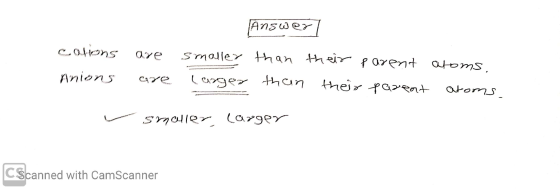
Question 14 5 pts Cations (positive ions) are __then their parent atoms; Anions (negative ions) are...
Question 14 5 pts Cations (positive ions) are then their parent atoms; Anions (negative ions) are...
 Question 14 5 pts Cations (positive ions) are then their parent atoms; Anions (negative ions) are then their parent atoms. Smaller, Smaller Larger, Larger Smaller, Larger Larger, Smaller Question 15 5 pts Moving top to bottom down a group, atomic radius__and ionization energy - Decreases, Increases Increases, Decreases Decreases, Decreases Increases, Increases Question 16 5 pts Which element would have the largest radius? Ca Na Mg Question 17 5 pts Which of the following is not a property of metals?...
5. According to the figure below, we can say that cations are smaller than their parent...
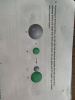 5. According to the figure below, we can say that cations are smaller than their parent atom, whereas anions are larger than their parent atom. Do you agree with it? Support your answer with a chemical reason. Lit F LI d Give
Classify each of the ions as a cation or an anion. Cations Anions Answer Bank Li+...
 Classify each of the ions as a cation or an anion. Cations Anions Answer Bank Li+ | 0 | NHÀ o | Ca + 1 F- F Hg + 1 PO BrO; Cort
ULF C. Explain the reasons behind these 'atomic/ionic size differences: (15) i) atoms decrease in radius...
 ULF C. Explain the reasons behind these 'atomic/ionic size differences: (15) i) atoms decrease in radius across a period ii) Group Il cations are smaller than the parent atom iii) anions are larger than the parent atom
Soluble Ions 1. Cations 2. Anions Empirical Solubility Rules The presence of these ions tend to...
 Soluble Ions 1. Cations 2. Anions Empirical Solubility Rules The presence of these ions tend to make the ionic compound water soluble (note exceptions). Ions Exceptions (compounds are insoluble despite having these cations) Li", Na, K, Exceptions = Li,Co, and LigPO4 NH Exceptions (compounds are insoluble Ious despite having these anions) NO,, nitrate ion No exceptions, all nitrates are water soluble C₂H₂O₂: No exceptions, all acetates are water soluble No acetate ion CIO4, CIO3. No exceptions, all perchlorate and chlorate...
Question 7 4 pts It was determined that an unknown ionic compound contains cations and anions...
 Question 7 4 pts It was determined that an unknown ionic compound contains cations and anions in a 1:1 ratio. Which of the following could be the identity of this compound? sodium oxide sodium nitrate aluminum oxide aluminum chloride magnesium nitrate Question 8 Which of the following compounds has the greatest mass percent hydrogen (H)? O C₂H6 CHA O C₂H4 • CoHo ОСН2
(5 pts) If calcium cations and phosphate anions are each present at 0.20 mg/L in an...
(5 pts) If calcium cations and phosphate anions are each present at 0.20 mg/L in an aqueous solution, is the solid calcium phosphate expected to precipitate? See Table 2.3, p.62: Ca3(PO4)2(s) 3Ca+2(aq) + 2PO4-3(aq); Ksp=1.0x10⁻²⁷. Molar masses: Ca3(PO4)2, 310.2; Ca+2, 40.1; PO4-3, 95.0.
The ideal perovskite (ABO3) structure consists of AOs closest packed layers (ordered Am cations and O2-anions)...
 The ideal perovskite (ABO3) structure consists of AOs closest packed layers (ordered Am cations and O2-anions) with B cations in ¼ of the octahedral holes. What pairs of charges are possible for A and B (there is more than one combination of charges)? For each pair, say which cation will likely sit in the closest packed layers and which will likely sit in the holes. Without specific examples of ions (e.g., Ca, Ti+), base your answer around the fact that...
Need help with question 5-10. compounds are formed by the attraction between cations and anions, 3....
 Need help with question 5-10.
compounds are formed by the attraction between cations and anions, 3. Dozen is to 12 as mole is to 4. One mole of chlorine gas weighs grams. 5-10 Complete the following table with the formula of the compound Cation/anion NO, N- ΝΗ, Section 2: True False (4 pts) Answer true or false. If the answer is false, correct the statement. 11. The correct name for P:O10 is phosphorus decoxide. 12 A molecule with polar bonds...
Need help with question 5-10.
compounds are formed by the attraction between cations and anions, 3. Dozen is to 12 as mole is to 4. One mole of chlorine gas weighs grams. 5-10 Complete the following table with the formula of the compound Cation/anion NO, N- ΝΗ, Section 2: True False (4 pts) Answer true or false. If the answer is false, correct the statement. 11. The correct name for P:O10 is phosphorus decoxide. 12 A molecule with polar bonds...
Which of the following atoms would be expected to form negative ions in. bnary lonic compounds...
 Which of the following atoms would be expected to form negative ions in. bnary lonic compounds & which would be expected to form positive ions ? K, Li, o,V, Rb, cl, Au, I, Bi Expected to form negative ions! Expeeded to form positive ions? 11 Rank in (< the bonds (H-I, C-Br, IF, N-H) order of increasing Plarity using =, or ) 2. 0/0.3 points Previous Answers Predict which of the following compounds are ionic and which are covalent based...
 Question 14 5 pts Cations (positive ions) are then their parent atoms; Anions (negative ions) are then their parent atoms. Smaller, Smaller Larger, Larger Smaller, Larger Larger, Smaller Question 15 5 pts Moving top to bottom down a group, atomic radius__and ionization energy - Decreases, Increases Increases, Decreases Decreases, Decreases Increases, Increases Question 16 5 pts Which element would have the largest radius? Ca Na Mg Question 17 5 pts Which of the following is not a property of metals?...
 5. According to the figure below, we can say that cations are smaller than their parent atom, whereas anions are larger than their parent atom. Do you agree with it? Support your answer with a chemical reason. Lit F LI d Give
 Classify each of the ions as a cation or an anion. Cations Anions Answer Bank Li+ | 0 | NHÀ o | Ca + 1 F- F Hg + 1 PO BrO; Cort
 ULF C. Explain the reasons behind these 'atomic/ionic size differences: (15) i) atoms decrease in radius across a period ii) Group Il cations are smaller than the parent atom iii) anions are larger than the parent atom
 Soluble Ions 1. Cations 2. Anions Empirical Solubility Rules The presence of these ions tend to make the ionic compound water soluble (note exceptions). Ions Exceptions (compounds are insoluble despite having these cations) Li", Na, K, Exceptions = Li,Co, and LigPO4 NH Exceptions (compounds are insoluble Ious despite having these anions) NO,, nitrate ion No exceptions, all nitrates are water soluble C₂H₂O₂: No exceptions, all acetates are water soluble No acetate ion CIO4, CIO3. No exceptions, all perchlorate and chlorate...
 Question 7 4 pts It was determined that an unknown ionic compound contains cations and anions in a 1:1 ratio. Which of the following could be the identity of this compound? sodium oxide sodium nitrate aluminum oxide aluminum chloride magnesium nitrate Question 8 Which of the following compounds has the greatest mass percent hydrogen (H)? O C₂H6 CHA O C₂H4 • CoHo ОСН2
 The ideal perovskite (ABO3) structure consists of AOs closest packed layers (ordered Am cations and O2-anions) with B cations in ¼ of the octahedral holes. What pairs of charges are possible for A and B (there is more than one combination of charges)? For each pair, say which cation will likely sit in the closest packed layers and which will likely sit in the holes. Without specific examples of ions (e.g., Ca, Ti+), base your answer around the fact that...
 Need help with question 5-10.
compounds are formed by the attraction between cations and anions, 3. Dozen is to 12 as mole is to 4. One mole of chlorine gas weighs grams. 5-10 Complete the following table with the formula of the compound Cation/anion NO, N- ΝΗ, Section 2: True False (4 pts) Answer true or false. If the answer is false, correct the statement. 11. The correct name for P:O10 is phosphorus decoxide. 12 A molecule with polar bonds...
Need help with question 5-10.
compounds are formed by the attraction between cations and anions, 3. Dozen is to 12 as mole is to 4. One mole of chlorine gas weighs grams. 5-10 Complete the following table with the formula of the compound Cation/anion NO, N- ΝΗ, Section 2: True False (4 pts) Answer true or false. If the answer is false, correct the statement. 11. The correct name for P:O10 is phosphorus decoxide. 12 A molecule with polar bonds...
 Which of the following atoms would be expected to form negative ions in. bnary lonic compounds & which would be expected to form positive ions ? K, Li, o,V, Rb, cl, Au, I, Bi Expected to form negative ions! Expeeded to form positive ions? 11 Rank in (< the bonds (H-I, C-Br, IF, N-H) order of increasing Plarity using =, or ) 2. 0/0.3 points Previous Answers Predict which of the following compounds are ionic and which are covalent based...
Most questions answered within 3 hours.
-
Where is the error in this code sequence?
String s1 = "Hello";
String s2 = "ello";...
asked 10 months ago -
Financial data for Joel de Paris, Inc., for last year
follow:
Joel de Paris, Inc.
Balance...
asked 10 months ago -
Consider this reaction:
Al2(SO4)3 (aq)+ BaCl3
(aq) Al2Cl6 (aq)- +
3BaSO4(s) . What is the...
asked 10 months ago -
Suppose that Savneet is considering increasing her
recent random sample from 20 car rentals to 40...
asked 10 months ago -
Trucks arrive at an unloading terminal at an average rate of 120
per hour.
Trucks arrive...
asked 10 months ago -
Why are methanol and ethanol completely soluble in water while
octanol is not very little soluble....
asked 10 months ago -
A facilities manager at a university reads in a research report
that the mean amount of...
asked 10 months ago -
When the CuSO4 is rehydrated by adding water to the anhydrous
compound, is this an endothermic...
asked 10 months ago -
A ray of sunlight is passing from diamond into crown glass; the
angle of incidence is...
asked 10 months ago -
A block of mass 0.249 kg is placed on top of a light, vertical
spring of...
asked 10 months ago -
how do the kidneys compensate in the presences of acidosis
a) trigger hyperventilate
b) reserve acid...
asked 10 months ago -
Question 501 pts
The rental rate of capital to the firm increases. Which of the
following...
asked 10 months ago