
Homework Answers
Add Answer to:
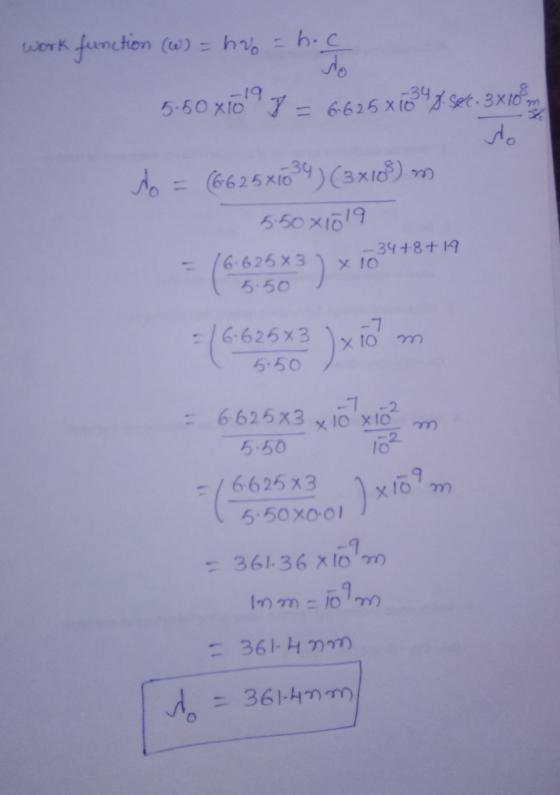
See Periodic Table See Hint The work function () for a metal is 5.50x 10⁻¹⁹ J....
Il See Periodic Table See Hint The work function () for a metal is 4.80x10J. What...
 Il See Periodic Table See Hint The work function () for a metal is 4.80x10J. What is the longest wavelength of electromagnetic radiation that can eject an electron from the surface of a piece of the metal? nm
The work function (Φ) for a metal is 7.50×10⁻¹⁹ J. What is the longest wavelength (nm)...
The work function (Φ) for a metal is 7.50×10⁻¹⁹ J. What is the longest wavelength (nm) of electromagnetic radiation that can eject an electron from the surface of a piece of the metal?
The work function (Φ) for a metal is 7.80×10⁻¹⁹ J. What is the longest wavelength of...
The work function (Φ) for a metal is 7.80×10⁻¹⁹ J. What is the longest wavelength of electromagnetic radiation that can eject an electron from the surface of a piece of the metal?
The work function (Φ) for a metal is 5.60×10⁻¹⁹ J. What is the longest wavelength of...
The work function (Φ) for a metal is 5.60×10⁻¹⁹ J. What is the longest wavelength of electromagnetic radiation that can eject an electron from the surface of a piece of the metal?
A metal element was used to in coating cathode surface of a phototube. It was studied...
A metal element was used to in coating cathode surface of a phototube. It was studied for its work function by impinging EM radiation with wavelength of 207 nm and measuring its stopping potential as 0.982 eV. What is the longest wavelength of EM radiation required to eject an electron from the cathode surface? 1eV = 1.6022 x 10⁻¹⁹ J? How does stopping potential factor into this equation?
The photoelectric work function energy for gold metal is 4.82 eV (per electron). What wavelength of...
 The photoelectric work function energy for gold metal is 4.82 eV
(per electron). What wavelength of radiation must be directed at
the surface of gold metal in order to eject electrons electrons
having a maximum kinetic energy of 3.20×10 –20 Joules/electron.
[Note: The electron volt (eV) is a common energy unit for work
function energies. 1 eV = 1.602×10 –19 Joules.]
-20 The photoelectric work function energy for gold metal is 4.82 eV (per electron). What wavelength of radiation must...
The photoelectric work function energy for gold metal is 4.82 eV
(per electron). What wavelength of radiation must be directed at
the surface of gold metal in order to eject electrons electrons
having a maximum kinetic energy of 3.20×10 –20 Joules/electron.
[Note: The electron volt (eV) is a common energy unit for work
function energies. 1 eV = 1.602×10 –19 Joules.]
-20 The photoelectric work function energy for gold metal is 4.82 eV (per electron). What wavelength of radiation must...
17. It takes 254 kJ/mol to eject electrons from a certain metal surface. What is the...
 17. It takes 254 kJ/mol to eject electrons from a certain metal surface. What is the longest wavelength of light (nm) that can be used to eject electrons from the surface of this metal via the photoelectric effect 18. Why does this question ask you about the 'longest wavelength of radiation, rather than the 'shortest'? 19. When radiation of wavelength 2.45 x 10'm falls on a metal surface, the maximum kinetic energy of the emitted electrons is found to be...
The binding energy of electrons to a chromium metal surface is 7.21 × 10⁻¹⁹ J. What is the...
The binding energy of electrons to a chromium metal surface is 7.21 × 10⁻¹⁹ J. What is the longest wavelength of light (in nm) that will eject electrons from chromiummetal? What frequency is required to give electrons with kinetic energy of 5.09E-19 J? What wavelength (in nm) is required to give electrons with kinetic energy of5.09E-19 J?
The photoelectric work function energy for manganese metal is 3.76 eV (per electron). What wavelength of...
The photoelectric work function energy for manganese metal is 3.76 eV (per electron). What wavelength of radiation must be directed at the surface of manganese metal in order to eject electrons electrons having a maximum kinetic energy of 2.00×10 –19 Joules/electron. [Note: The electron volt (eV) is a common energy unit for work function energies. 1 eV = 1.602×10 –19 Joules.] Wavelength (λ) = Answer nm
Constants Periodic Table The work function of a surface is 5.0x10⁻¹⁹ J Part A the surface?...
 Constants Periodic Table The work function of a surface is 5.0x10⁻¹⁹ J Part A the surface? If light of wavelength of 230 um is incident on the surface, what is the maxirrur kinetic energy of the photoelectronis ejected Express your answer using two significant figures. ΤΙ ΑΣφ th 2 Submit Request Answer Provide Feedback Next > Item 6 < Constants Perl When ultraviolet light with a wavelength of 400 fun falls on a certain metal surface, the maximum kinetic energy...
 Il See Periodic Table See Hint The work function () for a metal is 4.80x10J. What is the longest wavelength of electromagnetic radiation that can eject an electron from the surface of a piece of the metal? nm
 The photoelectric work function energy for gold metal is 4.82 eV
(per electron). What wavelength of radiation must be directed at
the surface of gold metal in order to eject electrons electrons
having a maximum kinetic energy of 3.20×10 –20 Joules/electron.
[Note: The electron volt (eV) is a common energy unit for work
function energies. 1 eV = 1.602×10 –19 Joules.]
-20 The photoelectric work function energy for gold metal is 4.82 eV (per electron). What wavelength of radiation must...
The photoelectric work function energy for gold metal is 4.82 eV
(per electron). What wavelength of radiation must be directed at
the surface of gold metal in order to eject electrons electrons
having a maximum kinetic energy of 3.20×10 –20 Joules/electron.
[Note: The electron volt (eV) is a common energy unit for work
function energies. 1 eV = 1.602×10 –19 Joules.]
-20 The photoelectric work function energy for gold metal is 4.82 eV (per electron). What wavelength of radiation must...
 17. It takes 254 kJ/mol to eject electrons from a certain metal surface. What is the longest wavelength of light (nm) that can be used to eject electrons from the surface of this metal via the photoelectric effect 18. Why does this question ask you about the 'longest wavelength of radiation, rather than the 'shortest'? 19. When radiation of wavelength 2.45 x 10'm falls on a metal surface, the maximum kinetic energy of the emitted electrons is found to be...
 Constants Periodic Table The work function of a surface is 5.0x10⁻¹⁹ J Part A the surface? If light of wavelength of 230 um is incident on the surface, what is the maxirrur kinetic energy of the photoelectronis ejected Express your answer using two significant figures. ΤΙ ΑΣφ th 2 Submit Request Answer Provide Feedback Next > Item 6 < Constants Perl When ultraviolet light with a wavelength of 400 fun falls on a certain metal surface, the maximum kinetic energy...
Most questions answered within 3 hours.
-
Where is the error in this code sequence?
String s1 = "Hello";
String s2 = "ello";...
asked 10 months ago -
Financial data for Joel de Paris, Inc., for last year
follow:
Joel de Paris, Inc.
Balance...
asked 10 months ago -
Consider this reaction:
Al2(SO4)3 (aq)+ BaCl3
(aq) Al2Cl6 (aq)- +
3BaSO4(s) . What is the...
asked 10 months ago -
Suppose that Savneet is considering increasing her
recent random sample from 20 car rentals to 40...
asked 10 months ago -
Trucks arrive at an unloading terminal at an average rate of 120
per hour.
Trucks arrive...
asked 10 months ago -
Why are methanol and ethanol completely soluble in water while
octanol is not very little soluble....
asked 10 months ago -
A facilities manager at a university reads in a research report
that the mean amount of...
asked 10 months ago -
When the CuSO4 is rehydrated by adding water to the anhydrous
compound, is this an endothermic...
asked 10 months ago -
A ray of sunlight is passing from diamond into crown glass; the
angle of incidence is...
asked 10 months ago -
A block of mass 0.249 kg is placed on top of a light, vertical
spring of...
asked 10 months ago -
how do the kidneys compensate in the presences of acidosis
a) trigger hyperventilate
b) reserve acid...
asked 10 months ago -
Question 501 pts
The rental rate of capital to the firm increases. Which of the
following...
asked 10 months ago