


Homework Answers
 plz
give up thumb for rating.
plz
give up thumb for rating.
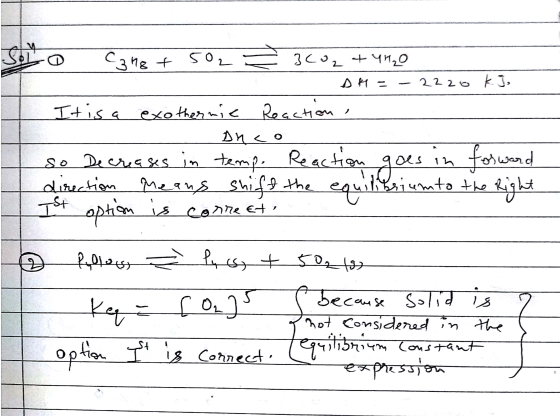
1) 2) 3) C3H8(g) + 5 O2(g) = 3 CO2(g) + 4H2O(1) AH = -2220 kJ...
 1)
2)
3)
C3H8(g) + 5 O2(g) = 3 CO2(g) + 4H2O(1) AH = -2220 kJ Decreasing the temperature will result in shift the equilibrium to the right shift the equilibrium to the left Keq is decreased O no effect in shifting the equilibrium more information is needed Which of the following expressions is the correct equilibrium-constant expression for the reaction below? P4010(s) = P4(s) + 5 O2(g) [02]-5 O [0215 [P4010] [Pd][02] [P][0215 O [P4010] [P4010) [P][0,1175 A proposed...
1)
2)
3)
C3H8(g) + 5 O2(g) = 3 CO2(g) + 4H2O(1) AH = -2220 kJ Decreasing the temperature will result in shift the equilibrium to the right shift the equilibrium to the left Keq is decreased O no effect in shifting the equilibrium more information is needed Which of the following expressions is the correct equilibrium-constant expression for the reaction below? P4010(s) = P4(s) + 5 O2(g) [02]-5 O [0215 [P4010] [Pd][02] [P][0215 O [P4010] [P4010) [P][0,1175 A proposed...
QUESTION 10 A proposed mechanism for the decomposition of ozone in the atmosphere is: Step 1:...
 QUESTION 10 A proposed mechanism for the decomposition of ozone in the atmosphere is: Step 1: 03(g) + hvO(g) + O2(g) (fast) Step 2: O(g) + O2(g) +202() (slow) What is the molecularity of the rate-determining step? unimolecular bimolecular zeromolecular More information is needed. termolecular QUESTION 11 At a certain temperature the equilibrium equals 0.11 for the reaction: 2 ICI(g) =12(g) + Cl2(g). What is the equilibrium concentration of Cl2 if 2.78 mol of 12 and 2.78 mol of Cl2...
Support shift the equilibrium to the left QUESTION 24 A proposed mechanism is: Step 1: C2...
 Support shift the equilibrium to the left QUESTION 24 A proposed mechanism is: Step 1: C2 → 2C (slow) Step 2: C +DCD (fast) What is the molecularity of the rate-determining step? O termolecular o unimolecular obimolecular zeromolecular More information is needed. QUESTION 25
A three-step mechanism has been suggested for the formation of carbonyl chloride: Step 1: Cl2 ===> 2 Cl (fast equlibrium) Step 2: Cl + CO ===> COCl (fast equilibrium) Step 3: COCl + Cl2 ===> COCl2 + Cl (slow) What is the molecularit
1. A three-step mechanism has been suggested for the formation of carbonyl chloride: Step 1: Cl2 ===> 2 Cl (fast equlibrium) Step 2: Cl + CO ===> COCl (fast equilibrium) Step 3: COCl + Cl2 ===> COCl2 + Cl (slow) What is the molecularity of the rate-determining step? unimolecular bimolecular termolelcular none of these 2. The elementary reaction representing the formation of ozone, O2(g) + O(g) + M(g) ===> O3(g) + M*(g) is an example of a _________ reaction. unimolecular...
사oposedmechanism for the decomposition ofozone in the stratosphere is Step 2: ClO(8)+0,)Cl(g)+2 0(8 What is the...
 사oposedmechanism for the decomposition ofozone in the stratosphere is Step 2: ClO(8)+0,)Cl(g)+2 0(8 What is the molecularity of step 11? a. zeromolecular b. unimolecular c. bimolecular e. More information is needed. 4. A proposed mechanism for the reduction of nitrogen as NO by hydrogen is: Step 1: H2(2)+2 NOG)-N+H) Step 2: NO(g)+H2(g) → N2(g) + HO(g) What is the rate law for step 1? (slow) (fast) e. More information is needed. c. 서Halz[NO] 5. The mechanism forthe first-order reaction 2HOfag)→2HOO-gin...
14-99. The mechanism for the reaction 2H,0, (aq) ® 2H,00) +0,) in the presence of I...
 14-99. The mechanism for the reaction 2H,0, (aq) ® 2H,00) +0,) in the presence of I (aq) is proposed to be: Step 1: H,02(aq) + I (aq) ® H,0(0) + Ol (aq) Step 2: H,0, (aq) + 01 (aq) ® H,00) + 0,(g) + 1 (aq) (slow) (fast) What is the molecularity of the rate-determining step? Select one: a. zero molecular b. unimolecular c. bimolecular d. termolecular e. More information is needed to answer this question.
QUESTION 21 A proposed mechanism for the decomposition of ozone in the atmosphere is: Step 1:...
 QUESTION 21 A proposed mechanism for the decomposition of ozone in the atmosphere is: Step 1: 03(g) + hv → O(g) + O2(g) Step 2: O(g) + O3(g) → 202(0) Does this reaction mechanism have an intermediate and/or catalyst? Only a catalyst Only an intermediate An intermediate and a catalyst More information is needed O Neither an intermediate nor a catalyst
Consider the following equilibrium reaction. P4S3(g) + 8O2(g) = P4010(s) + 3SO2(9) AH = -3677 kJ...
 Consider the following equilibrium reaction. P4S3(g) + 8O2(g) = P4010(s) + 3SO2(9) AH = -3677 kJ If heat is removed from an equilibrium mixture of P4S3, P4010, O2, and SO2, then O Keq will decrease. the system will remain at equilibrium with no change in concentrations. the system will shift toward reactants to re-achieve equilibrium. O the system will shift toward products to re-achieve equilibrium. more information is needed to determine the effect on the equilibrium.
Consider the combustion reaction of propane: C3H8(g)+ 5 02(g)3 CO2(g) +4 H20(g), where AH= -531 kcal....
 Consider the combustion reaction of propane: C3H8(g)+ 5 02(g)3 CO2(g) +4 H20(g), where AH= -531 kcal. If 6.70 x 10⁴ kcal of energy is released in the reaction, how many grams of oxygen were consumed? ed 12.6 g of O2 2.02x 10⁴ g of O2 wer X 63.1g of O2 404 g of O2 Byt Hack
D18 Kinetics Review Sheets 8 H*(aq) + 4 Cl(aq) + MnO4 (aq) - 2 Cl(g) +...
 D18 Kinetics Review Sheets 8 H*(aq) + 4 Cl(aq) + MnO4 (aq) - 2 Cl(g) + Mn(aq) + 4H2O(l) 1. Cl2 (9) can be generated in the laboratory by reacting potassium permanganate with an acidified solution of sodium chloride. The net-ionic equation for the reaction is given above. a. A 25.00 mL sample of 0.250 M NaCl reacts completely with excess KMnO.(aq). The Cl(a) produced is dried and stored in a sealed container. At 22°C the pressure of the Cl2(g)...
 1)
2)
3)
C3H8(g) + 5 O2(g) = 3 CO2(g) + 4H2O(1) AH = -2220 kJ Decreasing the temperature will result in shift the equilibrium to the right shift the equilibrium to the left Keq is decreased O no effect in shifting the equilibrium more information is needed Which of the following expressions is the correct equilibrium-constant expression for the reaction below? P4010(s) = P4(s) + 5 O2(g) [02]-5 O [0215 [P4010] [Pd][02] [P][0215 O [P4010] [P4010) [P][0,1175 A proposed...
1)
2)
3)
C3H8(g) + 5 O2(g) = 3 CO2(g) + 4H2O(1) AH = -2220 kJ Decreasing the temperature will result in shift the equilibrium to the right shift the equilibrium to the left Keq is decreased O no effect in shifting the equilibrium more information is needed Which of the following expressions is the correct equilibrium-constant expression for the reaction below? P4010(s) = P4(s) + 5 O2(g) [02]-5 O [0215 [P4010] [Pd][02] [P][0215 O [P4010] [P4010) [P][0,1175 A proposed...
 QUESTION 10 A proposed mechanism for the decomposition of ozone in the atmosphere is: Step 1: 03(g) + hvO(g) + O2(g) (fast) Step 2: O(g) + O2(g) +202() (slow) What is the molecularity of the rate-determining step? unimolecular bimolecular zeromolecular More information is needed. termolecular QUESTION 11 At a certain temperature the equilibrium equals 0.11 for the reaction: 2 ICI(g) =12(g) + Cl2(g). What is the equilibrium concentration of Cl2 if 2.78 mol of 12 and 2.78 mol of Cl2...
 Support shift the equilibrium to the left QUESTION 24 A proposed mechanism is: Step 1: C2 → 2C (slow) Step 2: C +DCD (fast) What is the molecularity of the rate-determining step? O termolecular o unimolecular obimolecular zeromolecular More information is needed. QUESTION 25
 사oposedmechanism for the decomposition ofozone in the stratosphere is Step 2: ClO(8)+0,)Cl(g)+2 0(8 What is the molecularity of step 11? a. zeromolecular b. unimolecular c. bimolecular e. More information is needed. 4. A proposed mechanism for the reduction of nitrogen as NO by hydrogen is: Step 1: H2(2)+2 NOG)-N+H) Step 2: NO(g)+H2(g) → N2(g) + HO(g) What is the rate law for step 1? (slow) (fast) e. More information is needed. c. 서Halz[NO] 5. The mechanism forthe first-order reaction 2HOfag)→2HOO-gin...
 14-99. The mechanism for the reaction 2H,0, (aq) ® 2H,00) +0,) in the presence of I (aq) is proposed to be: Step 1: H,02(aq) + I (aq) ® H,0(0) + Ol (aq) Step 2: H,0, (aq) + 01 (aq) ® H,00) + 0,(g) + 1 (aq) (slow) (fast) What is the molecularity of the rate-determining step? Select one: a. zero molecular b. unimolecular c. bimolecular d. termolecular e. More information is needed to answer this question.
 QUESTION 21 A proposed mechanism for the decomposition of ozone in the atmosphere is: Step 1: 03(g) + hv → O(g) + O2(g) Step 2: O(g) + O3(g) → 202(0) Does this reaction mechanism have an intermediate and/or catalyst? Only a catalyst Only an intermediate An intermediate and a catalyst More information is needed O Neither an intermediate nor a catalyst
 Consider the following equilibrium reaction. P4S3(g) + 8O2(g) = P4010(s) + 3SO2(9) AH = -3677 kJ If heat is removed from an equilibrium mixture of P4S3, P4010, O2, and SO2, then O Keq will decrease. the system will remain at equilibrium with no change in concentrations. the system will shift toward reactants to re-achieve equilibrium. O the system will shift toward products to re-achieve equilibrium. more information is needed to determine the effect on the equilibrium.
 Consider the combustion reaction of propane: C3H8(g)+ 5 02(g)3 CO2(g) +4 H20(g), where AH= -531 kcal. If 6.70 x 10⁴ kcal of energy is released in the reaction, how many grams of oxygen were consumed? ed 12.6 g of O2 2.02x 10⁴ g of O2 wer X 63.1g of O2 404 g of O2 Byt Hack
 D18 Kinetics Review Sheets 8 H*(aq) + 4 Cl(aq) + MnO4 (aq) - 2 Cl(g) + Mn(aq) + 4H2O(l) 1. Cl2 (9) can be generated in the laboratory by reacting potassium permanganate with an acidified solution of sodium chloride. The net-ionic equation for the reaction is given above. a. A 25.00 mL sample of 0.250 M NaCl reacts completely with excess KMnO.(aq). The Cl(a) produced is dried and stored in a sealed container. At 22°C the pressure of the Cl2(g)...
Most questions answered within 3 hours.
-
Where is the error in this code sequence?
String s1 = "Hello";
String s2 = "ello";...
asked 11 months ago -
Financial data for Joel de Paris, Inc., for last year
follow:
Joel de Paris, Inc.
Balance...
asked 11 months ago -
Consider this reaction:
Al2(SO4)3 (aq)+ BaCl3
(aq) Al2Cl6 (aq)- +
3BaSO4(s) . What is the...
asked 11 months ago -
Suppose that Savneet is considering increasing her
recent random sample from 20 car rentals to 40...
asked 11 months ago -
Trucks arrive at an unloading terminal at an average rate of 120
per hour.
Trucks arrive...
asked 11 months ago -
Why are methanol and ethanol completely soluble in water while
octanol is not very little soluble....
asked 11 months ago -
A facilities manager at a university reads in a research report
that the mean amount of...
asked 11 months ago -
When the CuSO4 is rehydrated by adding water to the anhydrous
compound, is this an endothermic...
asked 11 months ago -
A ray of sunlight is passing from diamond into crown glass; the
angle of incidence is...
asked 11 months ago -
A block of mass 0.249 kg is placed on top of a light, vertical
spring of...
asked 11 months ago -
how do the kidneys compensate in the presences of acidosis
a) trigger hyperventilate
b) reserve acid...
asked 11 months ago -
Question 501 pts
The rental rate of capital to the firm increases. Which of the
following...
asked 11 months ago