

Homework Answers
Solution: According Gas law equation-

Add Answer to:
This question has multiple parts. Work all the parts to get the most points. A gas...
This question has multiple parts. Work all the parts to get the most points. The average...
 This question has multiple parts. Work all the parts to get the most points. The average lung capacity of a human is 59 L. How many moles of air are in your lungs when you are in the following situations? Asume air behaves ideally and has an average moler mass of 29.0 g/mol. At sea level (T-298 K, P - 1.00 atm). Moles b The average lung capacity of a human is 59 L. How many moles of air are...
This question has multiple parts. Work all the parts to get the most points. a The average lung capacity of a human is...
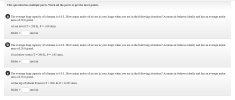 This question has multiple parts. Work all the parts to get the most points. a The average lung capacity of a human is 6.0 L. How many moles of air are in your lungs when you are in the following situations? Assume air behaves ideally and has an average molar mass of 29.0 g/mol. At sea level (T = 298 K, P= 1.00 atm). Moles = mol air b The average lung capacity of a human is 6.0 L. How...
This question has multiple parts. Work all the parts to get the most points. Consider the...
 This question has multiple parts. Work all the parts to get the most points. Consider the following reaction: CH() +20,(g) → CO.() +2H0(1) AH=-891 kJ a calculate the enthalpy change if 230 g methane is burned in excess oxygen Enthalpy change b Calculate the enthalpy change if 2.15 x 10 methane gas at 741 torr and 25°C is burned in excess oxygen. The density of CH() at these conditions is 0.640 Enthalpy change kJ
15. This question has multiple parts. Work all the parts to get the most points. At...
 15.
This question has multiple parts. Work all the parts to get the most points. At 35°C, K-1.1 x 10° for the reaction 2 NOCI(g) 근 2N0(g) + Cl2 (g) Calculate the concentrations of all species at equilibrium for each of the following original mixtures a3.8 moles of pure NOCl in a 2.0-L flask [NOCI] = NO] [C12] = b1.0 mole of NOCI and 1.0 mole of NO in a 1.0-L flask NOCI NO Numeric input field 3.8 mole of...
15.
This question has multiple parts. Work all the parts to get the most points. At 35°C, K-1.1 x 10° for the reaction 2 NOCI(g) 근 2N0(g) + Cl2 (g) Calculate the concentrations of all species at equilibrium for each of the following original mixtures a3.8 moles of pure NOCl in a 2.0-L flask [NOCI] = NO] [C12] = b1.0 mole of NOCI and 1.0 mole of NO in a 1.0-L flask NOCI NO Numeric input field 3.8 mole of...
Raferences) This question has multiple parts. Work all the parts to get the most points. A...
 Raferences) This question has multiple parts. Work all the parts to get the most points. A buffer consists of 0.96-M propanoic acid (K-1.4 x 10) and 0.88-M sodium propanoate. a Calculate the pH of this buffer. pH-4.81 Correct b Calculate the pH after the addition of 2.1 mL of 0.10-M HCl to 0.010 L of the buffer pH-4.79 Correct c Calculate the pH after the addition of 8.8 mL of 1.0-M HCl to 0.010 L of the buffer. pH Submit...
This question has multiple parts. Work all the parts to get the most points. A 0.054...
This question has multiple parts. Work all the parts to get the most points. A 0.054 L sample of 0.0160 M Ag2SO4 s added to 0.015 L of 0.0110 M PbCl2 a What is the net ionic equation for the reaction that occurs? (Use the lowest possible coefficients. Use the pull-down boxes to specify states such as (aq) or (s). If a box is not needed, leave it blank.) + + + + --> + ...
(References This question has multiple parts. Work all the parts to get the most points. Calculate...
 (References This question has multiple parts. Work all the parts to get the most points. Calculate the concentration in %(v/v) of the following solution. a 3.00 x 10°-mL of solution contains 45.7 ml of any soluble liquid solute. Concentration = % (v/v) b 3.0 quarts of acetic acid is put into a 8.0-gallon container, and enough water is added to fill the container Concentration= % (v/v) C A solution of acetone and water is separated by distillation. A 4.00 x...
This question has multiple parts. Work all the parts to get the most points. At 25°C,...
 This question has multiple parts. Work all the parts to get the most points. At 25°C, K 0.090 for the reaction H, 0(g) + C,O(g) ? 2 HOCl(g) Calculate the concentrations of all species at equilibrium for each of the following cases. aL0g H0 and 2.0 g Cl,O are mixed in a 1.0-L flask. H2O] C20 [HOC?]- b 1.0 mole of pure HOCl is placed in a 20-L flask. [H20] = [C101 =
This question has multiple parts. Work all the parts to get the most points. a For...
 This question has multiple parts. Work all the parts to get the most points. a For the reaction H2(g) + Br2(g) → 2HBr(g) Kp = 3.6 x 10⁴ at 1494 K. What is the value of K'p for the following reaction at 1494 K? HBr(g) → 1/2 H2(g) + / Br2(g) K'p = Submit
This question has multiple parts. Work all the parts to get the most points. For the...
 This question has multiple parts. Work all the parts to get the most points. For the reaction below: SOCI HO a Draw the major organic product. C P
 This question has multiple parts. Work all the parts to get the most points. The average lung capacity of a human is 59 L. How many moles of air are in your lungs when you are in the following situations? Asume air behaves ideally and has an average moler mass of 29.0 g/mol. At sea level (T-298 K, P - 1.00 atm). Moles b The average lung capacity of a human is 59 L. How many moles of air are...
 This question has multiple parts. Work all the parts to get the most points. a The average lung capacity of a human is 6.0 L. How many moles of air are in your lungs when you are in the following situations? Assume air behaves ideally and has an average molar mass of 29.0 g/mol. At sea level (T = 298 K, P= 1.00 atm). Moles = mol air b The average lung capacity of a human is 6.0 L. How...
 This question has multiple parts. Work all the parts to get the most points. Consider the following reaction: CH() +20,(g) → CO.() +2H0(1) AH=-891 kJ a calculate the enthalpy change if 230 g methane is burned in excess oxygen Enthalpy change b Calculate the enthalpy change if 2.15 x 10 methane gas at 741 torr and 25°C is burned in excess oxygen. The density of CH() at these conditions is 0.640 Enthalpy change kJ
 15.
This question has multiple parts. Work all the parts to get the most points. At 35°C, K-1.1 x 10° for the reaction 2 NOCI(g) 근 2N0(g) + Cl2 (g) Calculate the concentrations of all species at equilibrium for each of the following original mixtures a3.8 moles of pure NOCl in a 2.0-L flask [NOCI] = NO] [C12] = b1.0 mole of NOCI and 1.0 mole of NO in a 1.0-L flask NOCI NO Numeric input field 3.8 mole of...
15.
This question has multiple parts. Work all the parts to get the most points. At 35°C, K-1.1 x 10° for the reaction 2 NOCI(g) 근 2N0(g) + Cl2 (g) Calculate the concentrations of all species at equilibrium for each of the following original mixtures a3.8 moles of pure NOCl in a 2.0-L flask [NOCI] = NO] [C12] = b1.0 mole of NOCI and 1.0 mole of NO in a 1.0-L flask NOCI NO Numeric input field 3.8 mole of...
 Raferences) This question has multiple parts. Work all the parts to get the most points. A buffer consists of 0.96-M propanoic acid (K-1.4 x 10) and 0.88-M sodium propanoate. a Calculate the pH of this buffer. pH-4.81 Correct b Calculate the pH after the addition of 2.1 mL of 0.10-M HCl to 0.010 L of the buffer pH-4.79 Correct c Calculate the pH after the addition of 8.8 mL of 1.0-M HCl to 0.010 L of the buffer. pH Submit...
 (References This question has multiple parts. Work all the parts to get the most points. Calculate the concentration in %(v/v) of the following solution. a 3.00 x 10°-mL of solution contains 45.7 ml of any soluble liquid solute. Concentration = % (v/v) b 3.0 quarts of acetic acid is put into a 8.0-gallon container, and enough water is added to fill the container Concentration= % (v/v) C A solution of acetone and water is separated by distillation. A 4.00 x...
 This question has multiple parts. Work all the parts to get the most points. At 25°C, K 0.090 for the reaction H, 0(g) + C,O(g) ? 2 HOCl(g) Calculate the concentrations of all species at equilibrium for each of the following cases. aL0g H0 and 2.0 g Cl,O are mixed in a 1.0-L flask. H2O] C20 [HOC?]- b 1.0 mole of pure HOCl is placed in a 20-L flask. [H20] = [C101 =
 This question has multiple parts. Work all the parts to get the most points. a For the reaction H2(g) + Br2(g) → 2HBr(g) Kp = 3.6 x 10⁴ at 1494 K. What is the value of K'p for the following reaction at 1494 K? HBr(g) → 1/2 H2(g) + / Br2(g) K'p = Submit
 This question has multiple parts. Work all the parts to get the most points. For the reaction below: SOCI HO a Draw the major organic product. C P
Most questions answered within 3 hours.
-
Where is the error in this code sequence?
String s1 = "Hello";
String s2 = "ello";...
asked 11 months ago -
Financial data for Joel de Paris, Inc., for last year
follow:
Joel de Paris, Inc.
Balance...
asked 11 months ago -
Consider this reaction:
Al2(SO4)3 (aq)+ BaCl3
(aq) Al2Cl6 (aq)- +
3BaSO4(s) . What is the...
asked 11 months ago -
Suppose that Savneet is considering increasing her
recent random sample from 20 car rentals to 40...
asked 11 months ago -
Trucks arrive at an unloading terminal at an average rate of 120
per hour.
Trucks arrive...
asked 11 months ago -
Why are methanol and ethanol completely soluble in water while
octanol is not very little soluble....
asked 11 months ago -
A facilities manager at a university reads in a research report
that the mean amount of...
asked 11 months ago -
When the CuSO4 is rehydrated by adding water to the anhydrous
compound, is this an endothermic...
asked 11 months ago -
A ray of sunlight is passing from diamond into crown glass; the
angle of incidence is...
asked 11 months ago -
A block of mass 0.249 kg is placed on top of a light, vertical
spring of...
asked 11 months ago -
how do the kidneys compensate in the presences of acidosis
a) trigger hyperventilate
b) reserve acid...
asked 11 months ago -
Question 501 pts
The rental rate of capital to the firm increases. Which of the
following...
asked 11 months ago