

Homework Answers
Part.B :-
ICE table is :
....................XY <------------------> X .................+..................Y
Initial.............0.500 ...................0.100................................0.100
Change...........-x...........................+x..................................+x
Equilibrium.....(0.500-x) .............(0.100+x)...........................(0.100+x)
x = Degree of dissociation
Expression of Equilibrium constant i.e. K (which is equal to the product of the molar concentration of products divided by product of the molar concentration of reactants raise to power their stoichiometric coefficient when reaction is at equilibrium stage).
k = [X].[Y]/[XY]
0.250 = (0.100+x)2/(0.500-x)
0.250(0.500-x) = (0.100+x)2
0.125 - 0.250 x = x2 + 0.01 + 0.2 x
x2 + 0.2 x + 0.250 x + 0.01 - 0.125 = 0
x2 + 0.45 x - 0.115 = 0
On solving
x = 0.18197
|
Therefore, Equilibrium concentration of XY = 0.500 - 0.18197 = 0.318 M Equilibrium concentration of X = 0.100 + 0.18197 = 0.282 M Equilibrium concentration of Y = 0.100 + 0.18197 = 0.282 M |
-------------------------------------
Part.C :-
ICE table is :
....................XY <------------------> X .................+..................Y
Initial.............0.200 ...................0.300................................0.300
Change...........+x...........................-x..................................-x
Equilibrium.....(0.200+x) .............(0.300-x).........................(0.300-x)
x = Degree of dissociation
Expression of Equilibrium constant i.e. K (which is equal to the product of the molar concentration of products divided by product of the molar concentration of reactants raise to power their stoichiometric coefficient when reaction is at equilibrium stage).
k = [X].[Y]/[XY]
0.250 = (0.300-x)2/(0.200+x)
0.250(0.200+x) = (0.300-x)2
0.05 + 0.250 x = x2 - 0.600 x + 0.09
x2 - 0.600 x - 0.250 x + 0.09 - 0.05 = 0
x2 - 0.850 x + 0.04 = 0
On solving
x = 0.05
|
Therefore, Equilibrium concentration of XY = 0.200 + 0.05 = 0.250 M Equilibrium concentration of X = 0.300 - 0.05 = 0.250 M Equilibrium concentration of Y = 0.300 - 0.05 = 0.250 M |
-------------------------------------
Add Answer to:
Item 30 < 30 of 37 Constants Periodic Table Learning Goal: To determine equilibrium concentrations from...
B) Based on a Kc value of 0.220 and the given data table, what are the...
 B) Based on a Kc value of 0.220 and
the given data table, what are the equilibrium concentrations of
XY, X, and Y, respectively?
Express the molar concentrations numerically.
C) Based on a Kc value of 0.220 and
the data table given, what are the equilibrium concentrations of
XY, X, and Y, respectively?
Express the molar concentrations numerically.
o determine equilibrium concentrations from in Calculating equilibrium concentrations when the net reaction proceeds forward conditions The reversible reaction has a reaction...
B) Based on a Kc value of 0.220 and
the given data table, what are the equilibrium concentrations of
XY, X, and Y, respectively?
Express the molar concentrations numerically.
C) Based on a Kc value of 0.220 and
the data table given, what are the equilibrium concentrations of
XY, X, and Y, respectively?
Express the molar concentrations numerically.
o determine equilibrium concentrations from in Calculating equilibrium concentrations when the net reaction proceeds forward conditions The reversible reaction has a reaction...
Calculating equilibrium concentrations when the net reaction proceeds forward Consider mixture B, which will cause the...
 Calculating equilibrium concentrations when the net reaction proceeds forward Consider mixture B, which will cause the net reaction to proceed forward. net → [X] + 0:00 Concentration (M) (XY) initial: 0.500 change: equilibrium: 0.500 - 2 [Y] 0.100 + 0.100 + +x 0.100+ The change in concentration, 2, is negative for the reactants because they are consumed and positive for the products because they are produced, Part B Review | Constants Periodic Tabl Based on a Kc value of 0.250...
Based on a Kc value of 0.240 and the given data table, what are the equilibrium...
 Based on a Kc value of 0.240 and the given data table,
what are the equilibrium concentrations of XY, X, and Y,
respectively?
Calculating equilibrium concentrations when the net reaction proceeds in reverse Consider mixture C, which will cause the net reaction to proceed in reverse. net [XY] 0.200 tx 0.200 +x [X] 0.300 ) Concentration M initial: change: equilibrium: 0.300 0.300 x 0.300 The change in concentration, , is positive for the reactants because they are produced and negative...
Based on a Kc value of 0.240 and the given data table,
what are the equilibrium concentrations of XY, X, and Y,
respectively?
Calculating equilibrium concentrations when the net reaction proceeds in reverse Consider mixture C, which will cause the net reaction to proceed in reverse. net [XY] 0.200 tx 0.200 +x [X] 0.300 ) Concentration M initial: change: equilibrium: 0.300 0.300 x 0.300 The change in concentration, , is positive for the reactants because they are produced and negative...
Calculating equilibrium concentrations when the net reaction proceeds in reverse Consider mixture C, which will cause...
Calculating equilibrium concentrations when the net reaction proceeds in reverse Consider mixture C, which will cause the net reaction to proceed in reverse. Concentration (M)initial:change:equilibrium:[XY]0.200+x0.200+x←net⇌[X]0.300−x0.300−x+[Y]0.300−x0.300−x The change in concentration, x, is positive for the reactants because they are produced and negative for the products because they are consumed. Part C Based on a Kc value of 0.160 and the data table given, what are the equilibrium concentrations of XY, X, and Y, respectively? Express the molar concentrations numerically.
Calculating equilibrium concentrations when the net reaction proceeds in reverse Consider mixture C, which will cause...
Calculating equilibrium concentrations when the net reaction proceeds in reverse Consider mixture C, which will cause the net reaction to proceed in reverse. Concentration (M)initial:change:equilibrium:[XY]0.200+x0.200+x←net⇌[X]0.300−x0.300−x+[Y]0.300−x0.300−x The change in concentration, x, is positive for the reactants because they are produced and negative for the products because they are consumed. Part C Based on a Kc value of 0.170 and the data table given, what are the equilibrium concentrations of XY, X, and Y, respectively? Express the molar concentrations numerically.
n Review | Constants | Periodic Table Part A At equilibrium, the concentrations of reactants and...
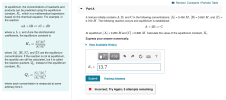 n Review | Constants | Periodic Table Part A At equilibrium, the concentrations of reactants and products can be predicted using the equilibrium constant, Kc, which is a mathematical expression based on the chemical equation. For example, in the reaction A mixture initially contains A, B, and C in the following concentrations: [A] = 0.450 M, [B] = 0.650 M, and [C] = 0.700 M. The following reaction occurs and equilibrium is established: aA + bB = CC + dD...
Based on a Kc value of 0.150 and the initial concentrations given in the table, determine...
Based on a Kc value of 0.150 and the initial concentrations given in the table, determine in which direction the net reaction will proceed to attain equilibrium. Will Mixture A, Mixture B, and Mixture C either go: 1) forward, or 2) reverse? Initial concentrations (M) Mixture [XY] [X] [Y] A 0.100 0 0 B 0.500 0.100 0.100 C 0.200 0.300 0.300
Consider mixture B, which will cause the net reaction to proceed forward. Concentration (M)initial:change:equilibrium:[XY]0.500?x0.500?xnet??[X]0.100+x0.100+x+[Y]0.100+x0.100+x The change...
Consider mixture B, which will cause the net reaction to proceed forward. Concentration (M)initial:change:equilibrium:[XY]0.500?x0.500?xnet??[X]0.100+x0.100+x+[Y]0.100+x0.100+x The change in concentration, x, is negative for the reactants because they are consumed and positive for the products because they are produced. Based on a Kc value of 0.250 and the given data table, what are the equilibrium concentrations of XY, X, and Y, respectively?
Based on a Kc value of 0.140 and the initial concentrations given in the table, determine...
Based on a Kc value of 0.140 and the initial concentrations given in the table, determine in which direction the net reaction will proceed to attain equilibrium. Initial concentrations (M) Mixture [XY] [X] [Y] A 0.100 0 0 B 0.500 0.100 0.100 C 0.200 0.300 0.300 Part A Based on a Kc value of 0.140 and the given data table, what are the equilibrium concentrations of XY, X, and Y, respectively? Part B Based on a Kc value of 0.140...
Constants | Periodic Table Learning Goal: To calculate the pH at the equivalence point for various...
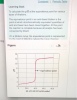 Constants | Periodic Table Learning Goal: To calculate the pH at the equivalence point for various types of titrations. The equivalence point in an acid-base titration is the point at which stoichiometrically equivalent quantities of acid and base have been mixed together. At this point the reaction is complete because all analyte has been consumed by titrant. On a titration curve, the equivalence point is represented hv the noint of inflection (where the curve changes ring Figure 1o1 12 10...
 B) Based on a Kc value of 0.220 and
the given data table, what are the equilibrium concentrations of
XY, X, and Y, respectively?
Express the molar concentrations numerically.
C) Based on a Kc value of 0.220 and
the data table given, what are the equilibrium concentrations of
XY, X, and Y, respectively?
Express the molar concentrations numerically.
o determine equilibrium concentrations from in Calculating equilibrium concentrations when the net reaction proceeds forward conditions The reversible reaction has a reaction...
B) Based on a Kc value of 0.220 and
the given data table, what are the equilibrium concentrations of
XY, X, and Y, respectively?
Express the molar concentrations numerically.
C) Based on a Kc value of 0.220 and
the data table given, what are the equilibrium concentrations of
XY, X, and Y, respectively?
Express the molar concentrations numerically.
o determine equilibrium concentrations from in Calculating equilibrium concentrations when the net reaction proceeds forward conditions The reversible reaction has a reaction...
 Calculating equilibrium concentrations when the net reaction proceeds forward Consider mixture B, which will cause the net reaction to proceed forward. net → [X] + 0:00 Concentration (M) (XY) initial: 0.500 change: equilibrium: 0.500 - 2 [Y] 0.100 + 0.100 + +x 0.100+ The change in concentration, 2, is negative for the reactants because they are consumed and positive for the products because they are produced, Part B Review | Constants Periodic Tabl Based on a Kc value of 0.250...
 Based on a Kc value of 0.240 and the given data table,
what are the equilibrium concentrations of XY, X, and Y,
respectively?
Calculating equilibrium concentrations when the net reaction proceeds in reverse Consider mixture C, which will cause the net reaction to proceed in reverse. net [XY] 0.200 tx 0.200 +x [X] 0.300 ) Concentration M initial: change: equilibrium: 0.300 0.300 x 0.300 The change in concentration, , is positive for the reactants because they are produced and negative...
Based on a Kc value of 0.240 and the given data table,
what are the equilibrium concentrations of XY, X, and Y,
respectively?
Calculating equilibrium concentrations when the net reaction proceeds in reverse Consider mixture C, which will cause the net reaction to proceed in reverse. net [XY] 0.200 tx 0.200 +x [X] 0.300 ) Concentration M initial: change: equilibrium: 0.300 0.300 x 0.300 The change in concentration, , is positive for the reactants because they are produced and negative...
 n Review | Constants | Periodic Table Part A At equilibrium, the concentrations of reactants and products can be predicted using the equilibrium constant, Kc, which is a mathematical expression based on the chemical equation. For example, in the reaction A mixture initially contains A, B, and C in the following concentrations: [A] = 0.450 M, [B] = 0.650 M, and [C] = 0.700 M. The following reaction occurs and equilibrium is established: aA + bB = CC + dD...
 Constants | Periodic Table Learning Goal: To calculate the pH at the equivalence point for various types of titrations. The equivalence point in an acid-base titration is the point at which stoichiometrically equivalent quantities of acid and base have been mixed together. At this point the reaction is complete because all analyte has been consumed by titrant. On a titration curve, the equivalence point is represented hv the noint of inflection (where the curve changes ring Figure 1o1 12 10...
Most questions answered within 3 hours.
-
Where is the error in this code sequence?
String s1 = "Hello";
String s2 = "ello";...
asked 11 months ago -
Financial data for Joel de Paris, Inc., for last year
follow:
Joel de Paris, Inc.
Balance...
asked 11 months ago -
Consider this reaction:
Al2(SO4)3 (aq)+ BaCl3
(aq) Al2Cl6 (aq)- +
3BaSO4(s) . What is the...
asked 11 months ago -
Suppose that Savneet is considering increasing her
recent random sample from 20 car rentals to 40...
asked 11 months ago -
Trucks arrive at an unloading terminal at an average rate of 120
per hour.
Trucks arrive...
asked 11 months ago -
Why are methanol and ethanol completely soluble in water while
octanol is not very little soluble....
asked 11 months ago -
A facilities manager at a university reads in a research report
that the mean amount of...
asked 11 months ago -
When the CuSO4 is rehydrated by adding water to the anhydrous
compound, is this an endothermic...
asked 11 months ago -
A ray of sunlight is passing from diamond into crown glass; the
angle of incidence is...
asked 11 months ago -
A block of mass 0.249 kg is placed on top of a light, vertical
spring of...
asked 11 months ago -
how do the kidneys compensate in the presences of acidosis
a) trigger hyperventilate
b) reserve acid...
asked 11 months ago -
Question 501 pts
The rental rate of capital to the firm increases. Which of the
following...
asked 11 months ago