A 1.8 L flask contains 7.89 × 10⁻¹² mol of CO2, 9.18 × 10⁻¹⁰ mol of...
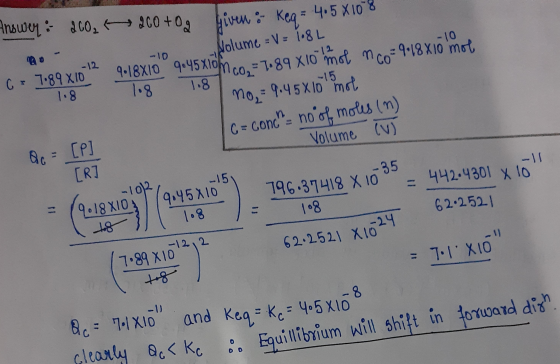
A 1.8 L flask contains 7.89 × 10⁻¹² mol of CO2, 9.18 × 10⁻¹⁰ mol of CO and 9.45 × 10⁻¹⁵ mol of O2. The Keq for the reaction is 4.5 × 10⁻⁸. In which direction will the equilibrium shift? Show calculations. 2CO2 ↔ 2CO + O2
Homework Answers
Add Answer to:
A 1.8 L flask contains 7.89 × 10⁻¹² mol of CO2, 9.18 × 10⁻¹⁰ mol
of...
For the reaction 2CO(g)+O2(g)⇌2CO2(g), the value of K at a certain temperature is 1300. Calculate [CO2]...
For the reaction 2CO(g)+O2(g)⇌2CO2(g), the value of K at a certain temperature is 1300. Calculate [CO2] at equilibrium when [CO] = 9.0×10⁻² mol/L and [O2] = 0.527 mol/L
show all work and equations used pls 2.50 mol CO2 was initially placed into a 1.00-L...
 show all work and equations used pls
2.50 mol CO2 was initially placed into a 1.00-L container and allowed to come to equilibrium. 2CO2(8) = 2CO(g) + O2(8) At equilibrium, 0.95 mol CO2 remains. What is the value of Kc?
show all work and equations used pls
2.50 mol CO2 was initially placed into a 1.00-L container and allowed to come to equilibrium. 2CO2(8) = 2CO(g) + O2(8) At equilibrium, 0.95 mol CO2 remains. What is the value of Kc?
An industrial chemist puts 1.25 mol each of H2(g) and CO2(g) in a 1.00-L container at...
An industrial chemist puts 1.25 mol each of H2(g) and CO2(g) in a 1.00-L container at a certain temperature. When equilibrium is reached, 0.56 mol of CO(g) is in the container. Find Keq at this temperature for the following reaction: H2(g) + CO2(g)↔H2O(g) + CO(g)
2. A 2.0-L reaction flask initially contains 0.010 mol CO, 0.80 mol H2, and 0.50 mol...
 2. A 2.0-L reaction flask initially contains 0.010 mol CO, 0.80 mol H2, and 0.50 mol CH3OH (methanol). If this mixture is brought in contact with zinc oxide-chromium(III) oxide catalyst, the equilibrium CO(g) + 2H2(g) = CH2OH(g) Is obtained. The equilibrium constant, Kc, for this reaction at 300°C is 1.1 x 10⁻². What is the direction of reaction (forward or reverse) as the mixture attains equilibrium?
Suppose a 500. mL flask is filled with 1.5 mol of CO, 1.8 mol of H,O...
 Suppose a 500. mL flask is filled with 1.5 mol of CO, 1.8 mol of H,O and 0.60 mol of CO,. The following reaction becomes possible: CO(g) +H2O(g) + CO2(g)+H2(g) The equilibrium constant K for this reaction is 3.75 at the temperature of the flask. Calculate the equilibrium molarity of 1,0. Round your answer to two decimal places. IM | xs ?
Consider the equilibrium C(s)+ CO2(g) ⇌2 CO(g) A 2.0 L flask contains a mixture of 0.10...
Consider the equilibrium C(s)+ CO2(g) ⇌2 CO(g) A 2.0 L flask contains a mixture of 0.10 mol of CO(g), 0.20 mol of CO2(g) and 0.40 mol of C(s) in equilibrium at 700°C. *Note that only atm pressure values are allowed in the K expression.* The value of the equilibrium constant K is
Calculate the equilibrium constant for the reaction below if a 5.50 L tank contains 0.526 mol...
Calculate the equilibrium constant for the reaction below if a 5.50 L tank contains 0.526 mol O2, 0.1032 mol SO3 and 0.01658 mol SO2. 2SO3 (g) ↔ 2SO2 (g) + O2 (g)
1. At a particular temperature, a 3.0-L flask contains 2.4 mol Cl2, 1.0 mol NOCI, and...
 1. At a particular temperature, a 3.0-L flask contains 2.4 mol Cl2, 1.0 mol NOCI, and 4.5 x 10⁻³ mol NO. Calculate K at this temperature for the following reaction: 2NOCI(g) — 2NO(g) + C13(g) 2. At a particular temperature, 8.0 mol NO2 is placed into a 1.0-L container and the NO2 dissociates by the reaction: 2NO,(8) 2NO(g) + 0,(8) At equilibrium the concentration of NO(g) is 2.0 M. Calculate K for this reaction. 3. Ammonia is produced by the...
1. At a particular temperature, a 3.0-L flask contains 2.4 mol Cl2, 1.0 mol NOCI, and...
 1. At a particular temperature, a 3.0-L flask contains 2.4 mol Cl2, 1.0 mol NOCI, and 4.5 x 10⁻³ mol NO. Calculate K at this temperature for the following reaction: 2NOCI(g) — 2NO(g) + C13(g) 2. At a particular temperature, 8.0 mol NO2 is placed into a 1.0-L container and the NO2 dissociates by the reaction: 2NO,(8) 2NO(g) + 0,(8) At equilibrium the concentration of NO(g) is 2.0 M. Calculate K for this reaction. 3. Ammonia is produced by the...
An equilibrium mixture was found to have the following composition in a 1.00 L flask: H2...
 An equilibrium mixture was
found to have the following composition in a 1.00 L flask: H2 CO2
H2O CO 0.630 0.590 0.210 0.280 moles What is the equilibrium
constant for the following gas phase reaction? H2 + CO2 H2O + CO K
= How many moles of H2O must be removed in order to increase the
number of moles of CO at equilibrium to 0.553 mol? mol H2O
-/12 points v An equilibrium mixture was found to have the following...
An equilibrium mixture was
found to have the following composition in a 1.00 L flask: H2 CO2
H2O CO 0.630 0.590 0.210 0.280 moles What is the equilibrium
constant for the following gas phase reaction? H2 + CO2 H2O + CO K
= How many moles of H2O must be removed in order to increase the
number of moles of CO at equilibrium to 0.553 mol? mol H2O
-/12 points v An equilibrium mixture was found to have the following...
 show all work and equations used pls
2.50 mol CO2 was initially placed into a 1.00-L container and allowed to come to equilibrium. 2CO2(8) = 2CO(g) + O2(8) At equilibrium, 0.95 mol CO2 remains. What is the value of Kc?
show all work and equations used pls
2.50 mol CO2 was initially placed into a 1.00-L container and allowed to come to equilibrium. 2CO2(8) = 2CO(g) + O2(8) At equilibrium, 0.95 mol CO2 remains. What is the value of Kc?
 2. A 2.0-L reaction flask initially contains 0.010 mol CO, 0.80 mol H2, and 0.50 mol CH3OH (methanol). If this mixture is brought in contact with zinc oxide-chromium(III) oxide catalyst, the equilibrium CO(g) + 2H2(g) = CH2OH(g) Is obtained. The equilibrium constant, Kc, for this reaction at 300°C is 1.1 x 10⁻². What is the direction of reaction (forward or reverse) as the mixture attains equilibrium?
 Suppose a 500. mL flask is filled with 1.5 mol of CO, 1.8 mol of H,O and 0.60 mol of CO,. The following reaction becomes possible: CO(g) +H2O(g) + CO2(g)+H2(g) The equilibrium constant K for this reaction is 3.75 at the temperature of the flask. Calculate the equilibrium molarity of 1,0. Round your answer to two decimal places. IM | xs ?
 1. At a particular temperature, a 3.0-L flask contains 2.4 mol Cl2, 1.0 mol NOCI, and 4.5 x 10⁻³ mol NO. Calculate K at this temperature for the following reaction: 2NOCI(g) — 2NO(g) + C13(g) 2. At a particular temperature, 8.0 mol NO2 is placed into a 1.0-L container and the NO2 dissociates by the reaction: 2NO,(8) 2NO(g) + 0,(8) At equilibrium the concentration of NO(g) is 2.0 M. Calculate K for this reaction. 3. Ammonia is produced by the...
 1. At a particular temperature, a 3.0-L flask contains 2.4 mol Cl2, 1.0 mol NOCI, and 4.5 x 10⁻³ mol NO. Calculate K at this temperature for the following reaction: 2NOCI(g) — 2NO(g) + C13(g) 2. At a particular temperature, 8.0 mol NO2 is placed into a 1.0-L container and the NO2 dissociates by the reaction: 2NO,(8) 2NO(g) + 0,(8) At equilibrium the concentration of NO(g) is 2.0 M. Calculate K for this reaction. 3. Ammonia is produced by the...
 An equilibrium mixture was
found to have the following composition in a 1.00 L flask: H2 CO2
H2O CO 0.630 0.590 0.210 0.280 moles What is the equilibrium
constant for the following gas phase reaction? H2 + CO2 H2O + CO K
= How many moles of H2O must be removed in order to increase the
number of moles of CO at equilibrium to 0.553 mol? mol H2O
-/12 points v An equilibrium mixture was found to have the following...
An equilibrium mixture was
found to have the following composition in a 1.00 L flask: H2 CO2
H2O CO 0.630 0.590 0.210 0.280 moles What is the equilibrium
constant for the following gas phase reaction? H2 + CO2 H2O + CO K
= How many moles of H2O must be removed in order to increase the
number of moles of CO at equilibrium to 0.553 mol? mol H2O
-/12 points v An equilibrium mixture was found to have the following...
Most questions answered within 3 hours.
-
Where is the error in this code sequence?
String s1 = "Hello";
String s2 = "ello";...
asked 11 months ago -
Financial data for Joel de Paris, Inc., for last year
follow:
Joel de Paris, Inc.
Balance...
asked 11 months ago -
Consider this reaction:
Al2(SO4)3 (aq)+ BaCl3
(aq) Al2Cl6 (aq)- +
3BaSO4(s) . What is the...
asked 11 months ago -
Suppose that Savneet is considering increasing her
recent random sample from 20 car rentals to 40...
asked 11 months ago -
Trucks arrive at an unloading terminal at an average rate of 120
per hour.
Trucks arrive...
asked 11 months ago -
Why are methanol and ethanol completely soluble in water while
octanol is not very little soluble....
asked 11 months ago -
A facilities manager at a university reads in a research report
that the mean amount of...
asked 11 months ago -
When the CuSO4 is rehydrated by adding water to the anhydrous
compound, is this an endothermic...
asked 11 months ago -
A ray of sunlight is passing from diamond into crown glass; the
angle of incidence is...
asked 11 months ago -
A block of mass 0.249 kg is placed on top of a light, vertical
spring of...
asked 11 months ago -
how do the kidneys compensate in the presences of acidosis
a) trigger hyperventilate
b) reserve acid...
asked 11 months ago -
Question 501 pts
The rental rate of capital to the firm increases. Which of the
following...
asked 11 months ago