Is it axial, equatorial, or ax/eq?

Homework Answers
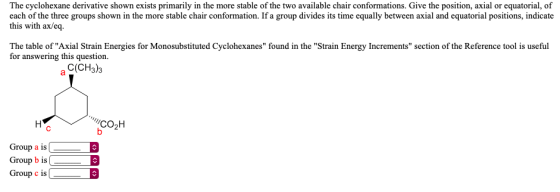
Bulky groups are placed in equatorial position to reduce diaxial repulsion.
Also H atoms can occupy both ax/eq as both the H at that C are
equivalent.
Add Answer to:
Is it axial, equatorial, or ax/eq?
The cyclohexane derivative shown exists primarily in the more stable...
The cyclohexane derivative shown exists primarily in the more stable of the two available chair conformations. Give the position, axial or equatorial, of each of the three groups shown in the more st...
 The cyclohexane derivative shown exists primarily in the more stable of the two available chair conformations. Give the position, axial or equatorial, of each of the three groups shown in the more stable chair conformation. If a group divides its time equally between axial and equatorial positions, indicate this with ax/eq The table of "Axial Strain Energies for Monosubstituted Cyclohexanes" found in the "Strain Energy Increments" section of the Reference tool is useful for answering this question. CH-CH2 CI Group...
The cyclohexane derivative shown exists primarily in the more stable of the two available chair conformations....
 The cyclohexane derivative shown exists primarily in the more
stable of the two available chair conformations. Give the position,
axial or equatorial, of each of the three groups shown in the more
stable chair conformation. If a group divides its time equally
between axial and equatorial positions, indicate this with
ax/eq.
The table of "Axial Strain Energies for Monosubstituted
Cyclohexanes" found in the "Strain Energy Increments" section of
the Reference tool is useful for answering this
question.
The choices are...
The cyclohexane derivative shown exists primarily in the more
stable of the two available chair conformations. Give the position,
axial or equatorial, of each of the three groups shown in the more
stable chair conformation. If a group divides its time equally
between axial and equatorial positions, indicate this with
ax/eq.
The table of "Axial Strain Energies for Monosubstituted
Cyclohexanes" found in the "Strain Energy Increments" section of
the Reference tool is useful for answering this
question.
The choices are...
The cyclohexane derivative shown exists primarily in the more stable of the two available chair conformations....
 The cyclohexane derivative shown exists primarily in the more stable of the two available chair conformations. Give the position, axial or equatorial, of each of the three groups shown in the more stable chair conformation. If a group divides its time equally between axial and equatorial positions, indicate this with ax/eq. The table of "Axial Strain Energies for Monosubstituted Cyclohexanes" found in the "Strain Energy Increments" section of the Reference tool is useful for answering this question. СІ bCH2CH3 Group...
with explanation 1) Draw a chair conformation of cyclohexane. Then, draw and level properly all axial...
 with explanation
1) Draw a chair conformation of cyclohexane. Then, draw and level properly all axial and equatorial positions on chair form of cyclohexane. 2) Draw chair, half-chair and boat conformations of ethyl cyclohexane and draw an energy diagram to explain their relative stability: 3) Draw two possible chair conformations for each of the mono-substituted cyclohexanes and determine their relative stability with proper explanation. OH 4) Draw two possible chair conformations for each of the di-substituted cyclohexanes and determine their...
with explanation
1) Draw a chair conformation of cyclohexane. Then, draw and level properly all axial and equatorial positions on chair form of cyclohexane. 2) Draw chair, half-chair and boat conformations of ethyl cyclohexane and draw an energy diagram to explain their relative stability: 3) Draw two possible chair conformations for each of the mono-substituted cyclohexanes and determine their relative stability with proper explanation. OH 4) Draw two possible chair conformations for each of the di-substituted cyclohexanes and determine their...
ball & stick + labels Name the above compound, identify each substitutent as axial or equatorial,...
 ball & stick + labels Name the above compound, identify each substitutent as axial or equatorial, and tell whether the conformation shown is the more stable or less stable form Omit customary italics from your name. • Substitutents R1 and R2 are designated in the order they appear in the IUPAC name. Axial/oquatorial strain energy increments are available in the table below. 1. The IUPAC name is 2. Position of RI Position of R2 3. The conformation shown is the...
a. Use strain energy increments in the OWL Table Reference (see References button, Strain Energy Increments) to calcula...
 a. Use strain energy increments in the OWL Table Reference (see References button, Strain Energy Increments) to calculate the energy difference between the two chair conformations of the compound below. b. Specify substituent positions axial or equatorial) in the more stable chair. c. Estimate the percent of the more stable chair at equilibrium at 25°C. (To determine the percent of the more stable chair at equilibrium, first calculate Keq, and then use this value to find the percentage.) A CH3...
ssignment/takeCovalentActivity do locator assignment-Take&takeAssignmentsessionlocator assignment-takec be cyclobexane derivative shown exists peimarily is the more stable of...
 ssignment/takeCovalentActivity do locator assignment-Take&takeAssignmentsessionlocator assignment-takec be cyclobexane derivative shown exists peimarily is the more stable of the two available chair cosf hree groups shown in the more stable chair confomatios If a group divides its time equally betweer The table of "Axial Strain Energies for Monosubstitutied Cyelohexanes found in the "Strain Fnergy l Dis questios Group a is Group h is Group is etry Entire Grosp Ne more graup atepts reman DELL
a. Use strain energy increments in the OWL Table Reference (see References button, Strain Energy Increments)...
 a. Use strain energy increments in the OWL Table Reference (see References button, Strain Energy Increments) to calculate the energy difference between the two chair conformations of the compound below. b. Specify substituent positions (axial or equatorial) in the more stable chair. c. Estimate the percent of the more stable chair at equilibrium at 25°C. (To determine the percent of the more stable chair at equilibrium, first calculate Keq, and then use this value to find the percentage.) OH H3C...
need the answer to the question: calculate the difference in energy between the axial and equatorial...
 need the answer to the question:
calculate the difference in energy between the axial and equatorial
conformations.
VII. Calculations of the Conformations of Substituted Cyclohexanes In this exercise, you will examine the conformational equilibrium between axial and equatorial methylcyclohexane. Begin by drawing a methylcyclohexane using ChemDraw. Don't forget about the rings shown at the bottom of the toolbar. Chem3D will automatically put the methyl group in the low energy equatorial conformation. Minimize the energy using the calculations) menu. Select MM2...
need the answer to the question:
calculate the difference in energy between the axial and equatorial
conformations.
VII. Calculations of the Conformations of Substituted Cyclohexanes In this exercise, you will examine the conformational equilibrium between axial and equatorial methylcyclohexane. Begin by drawing a methylcyclohexane using ChemDraw. Don't forget about the rings shown at the bottom of the toolbar. Chem3D will automatically put the methyl group in the low energy equatorial conformation. Minimize the energy using the calculations) menu. Select MM2...
(a) Given a cyclohexane framework in a chair conformation, label each position as axial (ax.) or...
(a) Given a cyclohexane framework in a chair conformation, label each position as axial (ax.) or equatorial (eq.). (b) On the same figure, label all positions that are gauche (ga.) to the Y group on carbon 1. A bin may hold more than one label.
 The cyclohexane derivative shown exists primarily in the more stable of the two available chair conformations. Give the position, axial or equatorial, of each of the three groups shown in the more stable chair conformation. If a group divides its time equally between axial and equatorial positions, indicate this with ax/eq The table of "Axial Strain Energies for Monosubstituted Cyclohexanes" found in the "Strain Energy Increments" section of the Reference tool is useful for answering this question. CH-CH2 CI Group...
 The cyclohexane derivative shown exists primarily in the more
stable of the two available chair conformations. Give the position,
axial or equatorial, of each of the three groups shown in the more
stable chair conformation. If a group divides its time equally
between axial and equatorial positions, indicate this with
ax/eq.
The table of "Axial Strain Energies for Monosubstituted
Cyclohexanes" found in the "Strain Energy Increments" section of
the Reference tool is useful for answering this
question.
The choices are...
The cyclohexane derivative shown exists primarily in the more
stable of the two available chair conformations. Give the position,
axial or equatorial, of each of the three groups shown in the more
stable chair conformation. If a group divides its time equally
between axial and equatorial positions, indicate this with
ax/eq.
The table of "Axial Strain Energies for Monosubstituted
Cyclohexanes" found in the "Strain Energy Increments" section of
the Reference tool is useful for answering this
question.
The choices are...
 The cyclohexane derivative shown exists primarily in the more stable of the two available chair conformations. Give the position, axial or equatorial, of each of the three groups shown in the more stable chair conformation. If a group divides its time equally between axial and equatorial positions, indicate this with ax/eq. The table of "Axial Strain Energies for Monosubstituted Cyclohexanes" found in the "Strain Energy Increments" section of the Reference tool is useful for answering this question. СІ bCH2CH3 Group...
 with explanation
1) Draw a chair conformation of cyclohexane. Then, draw and level properly all axial and equatorial positions on chair form of cyclohexane. 2) Draw chair, half-chair and boat conformations of ethyl cyclohexane and draw an energy diagram to explain their relative stability: 3) Draw two possible chair conformations for each of the mono-substituted cyclohexanes and determine their relative stability with proper explanation. OH 4) Draw two possible chair conformations for each of the di-substituted cyclohexanes and determine their...
with explanation
1) Draw a chair conformation of cyclohexane. Then, draw and level properly all axial and equatorial positions on chair form of cyclohexane. 2) Draw chair, half-chair and boat conformations of ethyl cyclohexane and draw an energy diagram to explain their relative stability: 3) Draw two possible chair conformations for each of the mono-substituted cyclohexanes and determine their relative stability with proper explanation. OH 4) Draw two possible chair conformations for each of the di-substituted cyclohexanes and determine their...
 ball & stick + labels Name the above compound, identify each substitutent as axial or equatorial, and tell whether the conformation shown is the more stable or less stable form Omit customary italics from your name. • Substitutents R1 and R2 are designated in the order they appear in the IUPAC name. Axial/oquatorial strain energy increments are available in the table below. 1. The IUPAC name is 2. Position of RI Position of R2 3. The conformation shown is the...
 a. Use strain energy increments in the OWL Table Reference (see References button, Strain Energy Increments) to calculate the energy difference between the two chair conformations of the compound below. b. Specify substituent positions axial or equatorial) in the more stable chair. c. Estimate the percent of the more stable chair at equilibrium at 25°C. (To determine the percent of the more stable chair at equilibrium, first calculate Keq, and then use this value to find the percentage.) A CH3...
 ssignment/takeCovalentActivity do locator assignment-Take&takeAssignmentsessionlocator assignment-takec be cyclobexane derivative shown exists peimarily is the more stable of the two available chair cosf hree groups shown in the more stable chair confomatios If a group divides its time equally betweer The table of "Axial Strain Energies for Monosubstitutied Cyelohexanes found in the "Strain Fnergy l Dis questios Group a is Group h is Group is etry Entire Grosp Ne more graup atepts reman DELL
 a. Use strain energy increments in the OWL Table Reference (see References button, Strain Energy Increments) to calculate the energy difference between the two chair conformations of the compound below. b. Specify substituent positions (axial or equatorial) in the more stable chair. c. Estimate the percent of the more stable chair at equilibrium at 25°C. (To determine the percent of the more stable chair at equilibrium, first calculate Keq, and then use this value to find the percentage.) OH H3C...
 need the answer to the question:
calculate the difference in energy between the axial and equatorial
conformations.
VII. Calculations of the Conformations of Substituted Cyclohexanes In this exercise, you will examine the conformational equilibrium between axial and equatorial methylcyclohexane. Begin by drawing a methylcyclohexane using ChemDraw. Don't forget about the rings shown at the bottom of the toolbar. Chem3D will automatically put the methyl group in the low energy equatorial conformation. Minimize the energy using the calculations) menu. Select MM2...
need the answer to the question:
calculate the difference in energy between the axial and equatorial
conformations.
VII. Calculations of the Conformations of Substituted Cyclohexanes In this exercise, you will examine the conformational equilibrium between axial and equatorial methylcyclohexane. Begin by drawing a methylcyclohexane using ChemDraw. Don't forget about the rings shown at the bottom of the toolbar. Chem3D will automatically put the methyl group in the low energy equatorial conformation. Minimize the energy using the calculations) menu. Select MM2...
Most questions answered within 3 hours.
-
Where is the error in this code sequence?
String s1 = "Hello";
String s2 = "ello";...
asked 10 months ago -
Financial data for Joel de Paris, Inc., for last year
follow:
Joel de Paris, Inc.
Balance...
asked 10 months ago -
Consider this reaction:
Al2(SO4)3 (aq)+ BaCl3
(aq) Al2Cl6 (aq)- +
3BaSO4(s) . What is the...
asked 10 months ago -
Suppose that Savneet is considering increasing her
recent random sample from 20 car rentals to 40...
asked 10 months ago -
Trucks arrive at an unloading terminal at an average rate of 120
per hour.
Trucks arrive...
asked 10 months ago -
Why are methanol and ethanol completely soluble in water while
octanol is not very little soluble....
asked 10 months ago -
A facilities manager at a university reads in a research report
that the mean amount of...
asked 10 months ago -
When the CuSO4 is rehydrated by adding water to the anhydrous
compound, is this an endothermic...
asked 10 months ago -
A ray of sunlight is passing from diamond into crown glass; the
angle of incidence is...
asked 10 months ago -
A block of mass 0.249 kg is placed on top of a light, vertical
spring of...
asked 10 months ago -
how do the kidneys compensate in the presences of acidosis
a) trigger hyperventilate
b) reserve acid...
asked 10 months ago -
Question 501 pts
The rental rate of capital to the firm increases. Which of the
following...
asked 10 months ago