
Homework Answers
Answer :
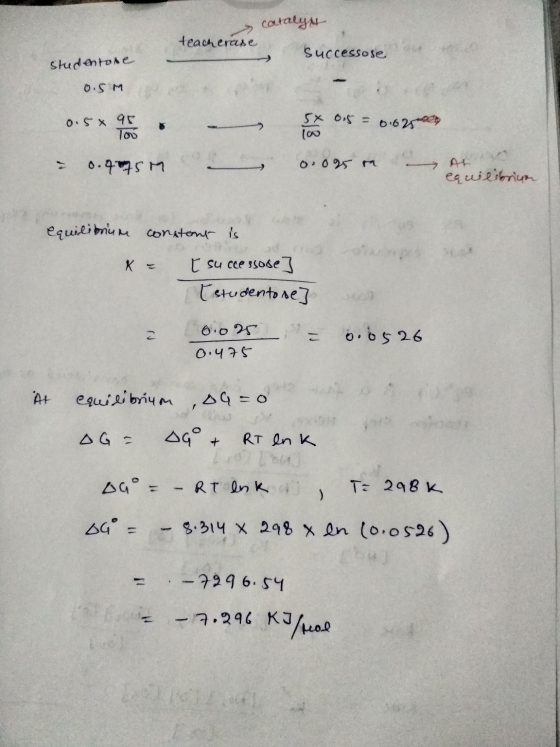
Studentose --------------:> successose
∆G° = -7.296 KJ /mol
EXPLANATION ::-
Add Answer to:
2. Hydrolysis of 0.5 M studentose catalyzed by teacherase to become successose is 95% complete at...
2. Hydrolysis of 0.5 M studentose catalyzed by teacherase to become successose is 95% complete at...
 2. Hydrolysis of 0.5 M studentose catalyzed by teacherase to become successose is 95% complete at equilibrium (i.e., only 5% of the studentose remains). What is AG"? (R = 8.315 J/mol K; T = 298 K) 3. The standard free-energy changes for the reactions below are given. Phosphocreatine creatine + Pi AG"=-43.0 kJ/mol ATP → ADP + Pi AG" = -30.5 kJ/mol The overall AG" for the reaction: Phosphocreatine + ADP creatine + ATP, is _ A) -73.5 kJ/mol C)...
1)Hydrolysis of 1M studentose catalyzed by teacherase to become successose is 99% complete at equilibrium(i.e.,only 1%...
1)Hydrolysis of 1M studentose catalyzed by teacherase to become successose is 99% complete at equilibrium(i.e.,only 1% of the studentose remains). What is the standard free energy? (R=8.315 j/mol*k; T=298K) ( show your math) 2) which of the following is (are) nucleophilic (cirlcle all that apply)? a. proton b.carbanion c. an imidazole d. hydroxide a. carboxlic acid 3) which is (are) electrophilic? a. proton b. sulfhydryl c. protonated imine d. carbonyl group e. phosphoryl group
1) SHOW WORK 12. During glycolysis, glucose 1-phosphate is converted to fructose 6-phosphate in two successive...
 1) SHOW WORK
12. During glycolysis, glucose 1-phosphate is converted to fructose 6-phosphate in two successive reactions: glucose 1-phosphate → glucose 6-phosphate glucose 6-phosphate + fructose 6-phosphate AG'' = -7.1 kJ/mol AG'º = +1.7 kJ/mol 13. The standard free-energy changes for the reactions below are given. phosphocreatine → creatine + Pi ATP → ADP + Pi AG" = 43.0 kJ/mol AG" = -30.5 kJ/mol What is the overall AG' for the following reaction? Iw a dee Hydrolysis of 1 M...
1) SHOW WORK
12. During glycolysis, glucose 1-phosphate is converted to fructose 6-phosphate in two successive reactions: glucose 1-phosphate → glucose 6-phosphate glucose 6-phosphate + fructose 6-phosphate AG'' = -7.1 kJ/mol AG'º = +1.7 kJ/mol 13. The standard free-energy changes for the reactions below are given. phosphocreatine → creatine + Pi ATP → ADP + Pi AG" = 43.0 kJ/mol AG" = -30.5 kJ/mol What is the overall AG' for the following reaction? Iw a dee Hydrolysis of 1 M...
5. Above what temperature does the following reaction become nonspontaneous AS = -153.2 J/K Given: AH...
 5. Above what temperature does the following reaction become nonspontaneous AS = -153.2 J/K Given: AH = -1036 k); 2 H2(g) + 3 O2(g) → 2 502(g) + 2 H20(g) AG - AH' - TAS 46 = -1036000 -(T)(-153.2) = 0 6. What is the minimum temperature required for the spontaneous conversion of Cla(I) to CCL() Given: AH"vap) is 57.3 kJ/mol and ASva) is 164 J/(mol)? AG AH - TAS = 298 K 06 = 57300 - (298)(164) 46°= 8428...
I changed around the numbers a little from the original problem, so if for some reason...
 I changed around the numbers a little from the original
problem, so if for some reason they dont work thats why, but i
would like to be able to follow what you did and how you did it so
i can complete the actual problem.
R-8.315 J/mol K-0.008315 kJ/mol K and T = 298 K (standard conditions) AG"=-RT In Kca and AG = AG* + RT In Q Raindrop + ATP Raindrop-1-phosphate + ADP Using the information below, calculate I)...
I changed around the numbers a little from the original
problem, so if for some reason they dont work thats why, but i
would like to be able to follow what you did and how you did it so
i can complete the actual problem.
R-8.315 J/mol K-0.008315 kJ/mol K and T = 298 K (standard conditions) AG"=-RT In Kca and AG = AG* + RT In Q Raindrop + ATP Raindrop-1-phosphate + ADP Using the information below, calculate I)...
only do part (c) **please explain how to solve M^-2 The Haber process is used to...
 only do part (c) **please explain how to solve M^-2
The Haber process is used to make ammonia, N2(g) + 3H2(g) = 2NH3(g) a) Write down the condition for equilibrium for this reaction in terms of the concentrations of reactants and products. At 298 K, this reaction has AH° = -46 kJ mol"', and AS° = -100 J K-mol?. Assume that AH° and ASº are independent of temperature. At what temperature does AGº vanish, i.e. AG° = 0? (c) Under...
only do part (c) **please explain how to solve M^-2
The Haber process is used to make ammonia, N2(g) + 3H2(g) = 2NH3(g) a) Write down the condition for equilibrium for this reaction in terms of the concentrations of reactants and products. At 298 K, this reaction has AH° = -46 kJ mol"', and AS° = -100 J K-mol?. Assume that AH° and ASº are independent of temperature. At what temperature does AGº vanish, i.e. AG° = 0? (c) Under...
Please help with Bi. Thank you! We are given that the Keq is 0.5 for this...
 Please help with Bi. Thank you!
We
are given that the Keq is 0.5 for this reaction
CH H-Ic-H The 2nd reaction in glycolysis is the conversion of glucose-6-phosphate to fructose-6-phosphate. The conversion is catalyzed by the enzyme, phosphoglucoisomerase. HC-OH Hoc-H --c-OH 'c-OH O Hc-opo HO -H H-C-OH -'c-OHO H-'c-O-P-O Key=[fructose-6-P] / [glucose-6-P] AG'' = RT In Key AG' = AG' + RT in Ke R=1.987 cal/mol K T=298 K R = 8.314 mol/K 1 cal = 4.184) H0- Glucose-6-phosphate...
Please help with Bi. Thank you!
We
are given that the Keq is 0.5 for this reaction
CH H-Ic-H The 2nd reaction in glycolysis is the conversion of glucose-6-phosphate to fructose-6-phosphate. The conversion is catalyzed by the enzyme, phosphoglucoisomerase. HC-OH Hoc-H --c-OH 'c-OH O Hc-opo HO -H H-C-OH -'c-OHO H-'c-O-P-O Key=[fructose-6-P] / [glucose-6-P] AG'' = RT In Key AG' = AG' + RT in Ke R=1.987 cal/mol K T=298 K R = 8.314 mol/K 1 cal = 4.184) H0- Glucose-6-phosphate...
2. The first step in glycolysis is catalyzed by the enzyme herokinase: glucose + ATP glucose-6-P...
 2. The first step in glycolysis is catalyzed by the enzyme herokinase: glucose + ATP glucose-6-P + ADP This reaction can be thought of as two coupled reactions (P is phosphate): (1) glucose + P + glucose-6-P (2) ATP + ADP + P For the overall reaction, AG" = -16.7 kJ/mol. For the hydrolysis of ATP (equation 2), AG = -310 kJ/mol. All reactions are performed at 37°C. (a) What is AGº for reaction 1? Iglucose - 6-11 if AG...
like me to grade. I vow did the take homeow 1. In glycolysis, the enzyme pyruvate...
 like me to grade. I vow did the take homeow 1. In glycolysis, the enzyme pyruvate the enzyme pyruvate kinase catalyzes this reaction phosphoenolpyruvate + ADP - pyruvate + ATP caction using the information provided a. What is the equilibrium constant for below? (R-8.315 J/mol K; T = 298 K) Reaction 1: ATP - ADP +P Reaction 2: phosphoenolpyruvate vale pyruvate + PAG AG"=-30.5 kJ/mol pyruvate + P AGⓇ = -61.9 kJ/mol ntrations are provided below, what is the actual...
4. What is the commited step of glycolysis and how is this enzyme regulated? 5. Glyceraldehyde-3-phophate...
 4. What is the commited step of glycolysis and how is this enzyme regulated? 5. Glyceraldehyde-3-phophate dehydrogenase (GAPDH) is the most important enzyme in glycolysis. a. What two reactions are coupled by GAPDH? b. Draw the structure of the thiohemiacetal intermediate and show the mechanism for generating the acyl thioester intermediate. A+Bred Ared +B For the reaction: AG = Given: ngAE RT In n[Aj{8,al Nernst Equation: AE=A Use the reduction potentials in Table 14-4 to calculate the electromotive force, AE,...
 2. Hydrolysis of 0.5 M studentose catalyzed by teacherase to become successose is 95% complete at equilibrium (i.e., only 5% of the studentose remains). What is AG"? (R = 8.315 J/mol K; T = 298 K) 3. The standard free-energy changes for the reactions below are given. Phosphocreatine creatine + Pi AG"=-43.0 kJ/mol ATP → ADP + Pi AG" = -30.5 kJ/mol The overall AG" for the reaction: Phosphocreatine + ADP creatine + ATP, is _ A) -73.5 kJ/mol C)...
 1) SHOW WORK
12. During glycolysis, glucose 1-phosphate is converted to fructose 6-phosphate in two successive reactions: glucose 1-phosphate → glucose 6-phosphate glucose 6-phosphate + fructose 6-phosphate AG'' = -7.1 kJ/mol AG'º = +1.7 kJ/mol 13. The standard free-energy changes for the reactions below are given. phosphocreatine → creatine + Pi ATP → ADP + Pi AG" = 43.0 kJ/mol AG" = -30.5 kJ/mol What is the overall AG' for the following reaction? Iw a dee Hydrolysis of 1 M...
1) SHOW WORK
12. During glycolysis, glucose 1-phosphate is converted to fructose 6-phosphate in two successive reactions: glucose 1-phosphate → glucose 6-phosphate glucose 6-phosphate + fructose 6-phosphate AG'' = -7.1 kJ/mol AG'º = +1.7 kJ/mol 13. The standard free-energy changes for the reactions below are given. phosphocreatine → creatine + Pi ATP → ADP + Pi AG" = 43.0 kJ/mol AG" = -30.5 kJ/mol What is the overall AG' for the following reaction? Iw a dee Hydrolysis of 1 M...
 5. Above what temperature does the following reaction become nonspontaneous AS = -153.2 J/K Given: AH = -1036 k); 2 H2(g) + 3 O2(g) → 2 502(g) + 2 H20(g) AG - AH' - TAS 46 = -1036000 -(T)(-153.2) = 0 6. What is the minimum temperature required for the spontaneous conversion of Cla(I) to CCL() Given: AH"vap) is 57.3 kJ/mol and ASva) is 164 J/(mol)? AG AH - TAS = 298 K 06 = 57300 - (298)(164) 46°= 8428...
 I changed around the numbers a little from the original
problem, so if for some reason they dont work thats why, but i
would like to be able to follow what you did and how you did it so
i can complete the actual problem.
R-8.315 J/mol K-0.008315 kJ/mol K and T = 298 K (standard conditions) AG"=-RT In Kca and AG = AG* + RT In Q Raindrop + ATP Raindrop-1-phosphate + ADP Using the information below, calculate I)...
I changed around the numbers a little from the original
problem, so if for some reason they dont work thats why, but i
would like to be able to follow what you did and how you did it so
i can complete the actual problem.
R-8.315 J/mol K-0.008315 kJ/mol K and T = 298 K (standard conditions) AG"=-RT In Kca and AG = AG* + RT In Q Raindrop + ATP Raindrop-1-phosphate + ADP Using the information below, calculate I)...
 only do part (c) **please explain how to solve M^-2
The Haber process is used to make ammonia, N2(g) + 3H2(g) = 2NH3(g) a) Write down the condition for equilibrium for this reaction in terms of the concentrations of reactants and products. At 298 K, this reaction has AH° = -46 kJ mol"', and AS° = -100 J K-mol?. Assume that AH° and ASº are independent of temperature. At what temperature does AGº vanish, i.e. AG° = 0? (c) Under...
only do part (c) **please explain how to solve M^-2
The Haber process is used to make ammonia, N2(g) + 3H2(g) = 2NH3(g) a) Write down the condition for equilibrium for this reaction in terms of the concentrations of reactants and products. At 298 K, this reaction has AH° = -46 kJ mol"', and AS° = -100 J K-mol?. Assume that AH° and ASº are independent of temperature. At what temperature does AGº vanish, i.e. AG° = 0? (c) Under...
 Please help with Bi. Thank you!
We
are given that the Keq is 0.5 for this reaction
CH H-Ic-H The 2nd reaction in glycolysis is the conversion of glucose-6-phosphate to fructose-6-phosphate. The conversion is catalyzed by the enzyme, phosphoglucoisomerase. HC-OH Hoc-H --c-OH 'c-OH O Hc-opo HO -H H-C-OH -'c-OHO H-'c-O-P-O Key=[fructose-6-P] / [glucose-6-P] AG'' = RT In Key AG' = AG' + RT in Ke R=1.987 cal/mol K T=298 K R = 8.314 mol/K 1 cal = 4.184) H0- Glucose-6-phosphate...
Please help with Bi. Thank you!
We
are given that the Keq is 0.5 for this reaction
CH H-Ic-H The 2nd reaction in glycolysis is the conversion of glucose-6-phosphate to fructose-6-phosphate. The conversion is catalyzed by the enzyme, phosphoglucoisomerase. HC-OH Hoc-H --c-OH 'c-OH O Hc-opo HO -H H-C-OH -'c-OHO H-'c-O-P-O Key=[fructose-6-P] / [glucose-6-P] AG'' = RT In Key AG' = AG' + RT in Ke R=1.987 cal/mol K T=298 K R = 8.314 mol/K 1 cal = 4.184) H0- Glucose-6-phosphate...
 2. The first step in glycolysis is catalyzed by the enzyme herokinase: glucose + ATP glucose-6-P + ADP This reaction can be thought of as two coupled reactions (P is phosphate): (1) glucose + P + glucose-6-P (2) ATP + ADP + P For the overall reaction, AG" = -16.7 kJ/mol. For the hydrolysis of ATP (equation 2), AG = -310 kJ/mol. All reactions are performed at 37°C. (a) What is AGº for reaction 1? Iglucose - 6-11 if AG...
 like me to grade. I vow did the take homeow 1. In glycolysis, the enzyme pyruvate the enzyme pyruvate kinase catalyzes this reaction phosphoenolpyruvate + ADP - pyruvate + ATP caction using the information provided a. What is the equilibrium constant for below? (R-8.315 J/mol K; T = 298 K) Reaction 1: ATP - ADP +P Reaction 2: phosphoenolpyruvate vale pyruvate + PAG AG"=-30.5 kJ/mol pyruvate + P AGⓇ = -61.9 kJ/mol ntrations are provided below, what is the actual...
 4. What is the commited step of glycolysis and how is this enzyme regulated? 5. Glyceraldehyde-3-phophate dehydrogenase (GAPDH) is the most important enzyme in glycolysis. a. What two reactions are coupled by GAPDH? b. Draw the structure of the thiohemiacetal intermediate and show the mechanism for generating the acyl thioester intermediate. A+Bred Ared +B For the reaction: AG = Given: ngAE RT In n[Aj{8,al Nernst Equation: AE=A Use the reduction potentials in Table 14-4 to calculate the electromotive force, AE,...
Most questions answered within 3 hours.
-
Where is the error in this code sequence?
String s1 = "Hello";
String s2 = "ello";...
asked 11 months ago -
Financial data for Joel de Paris, Inc., for last year
follow:
Joel de Paris, Inc.
Balance...
asked 11 months ago -
Consider this reaction:
Al2(SO4)3 (aq)+ BaCl3
(aq) Al2Cl6 (aq)- +
3BaSO4(s) . What is the...
asked 11 months ago -
Suppose that Savneet is considering increasing her
recent random sample from 20 car rentals to 40...
asked 11 months ago -
Trucks arrive at an unloading terminal at an average rate of 120
per hour.
Trucks arrive...
asked 11 months ago -
Why are methanol and ethanol completely soluble in water while
octanol is not very little soluble....
asked 11 months ago -
A facilities manager at a university reads in a research report
that the mean amount of...
asked 11 months ago -
When the CuSO4 is rehydrated by adding water to the anhydrous
compound, is this an endothermic...
asked 11 months ago -
A ray of sunlight is passing from diamond into crown glass; the
angle of incidence is...
asked 11 months ago -
A block of mass 0.249 kg is placed on top of a light, vertical
spring of...
asked 11 months ago -
how do the kidneys compensate in the presences of acidosis
a) trigger hyperventilate
b) reserve acid...
asked 11 months ago -
Question 501 pts
The rental rate of capital to the firm increases. Which of the
following...
asked 11 months ago