

Homework Answers
Add Answer to:
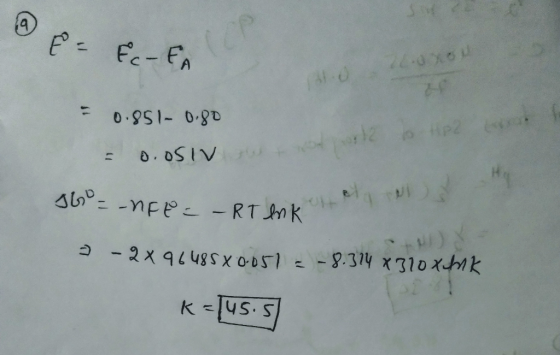
9. (12 pts) Answer parts a-b for the following reaction: Hos?"(aq) + 2 Ag(s) = Hg...
Half-Reaction Fe2+(aq) + 2e Fe(s) Hg2+ (aq) + 2e Hg() Ag+ (aq) + e + Ag(s)...
 Half-Reaction Fe2+(aq) + 2e Fe(s) Hg2+ (aq) + 2e Hg() Ag+ (aq) + e + Ag(s) Cu2+ (aq) + 2e + Cu(s) Zn2+ (aq) + 2e → Zn(s) E (V) -0.44 0.86 0.80 0.34 - 0.76 Using the table, calculate Eºcell for the following electrochemical cell under standard conditions voltmeter a) 1.24 V Fe. salt bridge Ag b) -1.24 V c) 2.04 V d) - 2.04 V Ag a b С
Question 5 Calculate Eº cell for the reaction below, 2 AgBr(aq) + 2 Hg(1) 2 Ag(s)...
 Question 5 Calculate Eº cell for the reaction below, 2 AgBr(aq) + 2 Hg(1) 2 Ag(s) + Hg2Br2(5) given the following standard reduction potentials. Hg2Br2(s) + 2 - 2 Hg(1) + 2 Br"(aq) E = +0.140 V AgBr(aq) + e - Ag(s) + Br" (aq) E = +0.071 V O a. -0.211 V O b. +0.069 V O C. +1.97 v O d. -0.069 V O e. +0.211 V Question 6 Given the following substances and their vapor pressures at...
Question 19 (1 point) What is AG°273 of the reaction 12(s) + Br"(aq) -- 21" (aq)...
 Question 19 (1 point) What is AG°273 of the reaction 12(s) + Br"(aq) -- 21" (aq) + Br2() at 0°C? Br2 (1) + 2e - 2Br (aq) E half = 1.07 V 12 (s) + 2e - 21 (aq) E half = 0.53 V -1.0 * 105 J/mol 1.0 * 105 J/mol 5.0 x 10⁴ J/mol 0.5.0 × 104 /mol
What is the equilibrium constant for the following reaction at 298 K? 2 Ag+(aq) + 2...
What is the equilibrium constant for the following reaction at 298 K? 2 Ag+(aq) + 2 I-(aq) → I2(s) + 2 Ag(s) Eº = +0.265 V Group of answer choices 2.99 x 10⁴ 1.60 x 10⁷ 9.04 x 10⁸ 87.9 7.73 x 10³ Using data from the reduction potential table below and the reaction 2 Ag(s) + Pt2+(aq) → Pt(s) + 2 Ag+(aq) Eº = 0.38 V calculate the standard reduction potential of the half-reaction Pt2+(aq) + 2 e- →...
Consider the following half-reactions: Half-reaction E° (V) Hg2+(aq) + 2e- ----> Hg(l) 0.855V Cd2+(aq) + 2e-...
Consider the following half-reactions: Half-reaction E° (V) Hg2+(aq) + 2e- ----> Hg(l) 0.855V Cd2+(aq) + 2e- --->Cd(s) -0.403V Mg2+(aq) + 2e- --->Mg(s) -2.370V (1) The strongest oxidizing agent is: enter formula (2) The weakest oxidizing agent is: (3) The weakest reducing agent is: (4) The strongest reducing agent is: (5) Will Mg2+(aq) oxidize Hg(l) to Hg2+(aq)? _____yes/no (6) Which species can be reduced by Cd(s)? If none, leave box blank.
Calculate the cell potential for the following reaction: Mg (s) + Ag₂SO₄ (aq) → 2 Ag...
Calculate the cell potential for the following reaction: Mg (s) + Ag₂SO₄ (aq) → 2 Ag (s) + MgSO₄ (aq) E° (Mg²⁺/Mg) = -2.37 V E° (Ag⁺/Ag) = 0.80 V
Consider a cell based on the following reaction: GeO(s) + H2O(l) + 2 Ag+(aq) → GeO2(s)...
Consider a cell based on the following reaction: GeO(s) + H2O(l) + 2 Ag+(aq) → GeO2(s) + 2 H+(aq) + 2 Ag(s) If [Ag+] = 1 M, at 25°C pH = (E - E°)/0.0592 V. pH = 2(E - E°)/0.0592 V. pH = 2(E° - E)/0.0592 V. pH = (E° - E)/0.0592 V.
Consider the following half-reactions: Half-reaction E° (V) Ag+(aq) +e → Ag(s) 0.799V Cu2+(aq) + 2e →...
 Consider the following half-reactions: Half-reaction E° (V) Ag+(aq) +e → Ag(s) 0.799V Cu2+(aq) + 2e → Cu(s) 0.337V Mg2+(aq) + 2e —— Mg(s) -2.370V The strongest oxidizing agent is: enter symbol The weakest oxidizing agent is: The weakest reducing agent is: The strongest reducing agent is: Will Mg(s) oxidize Ag(s) to Ag+(aq)? V Which species can be oxidized by Cu2+(aq)? If none enter none. Consider the following half-reactions: Half-reaction E° (V) 2Br (aq) 1.080V Br2(1) + 2e — Ni2+(aq) +...
help with these please Half-reaction E° (V) Br26) + 2e —> 2Br (aq) 1.080V Ca2+(aq) +...
 help with these please
Half-reaction E° (V) Br26) + 2e —> 2Br (aq) 1.080V Ca2+(aq) + 2e —— Cd) 0.403V Zn2+ (aq) + 2e —— Zn(0.763V (1) The strongest oxidizing agent is: enter formula (2) The weakest oxidizing agent is: (3) The weakest reducing agent is: (4) The strongest reducing agent is: (5) Will Br2(1) oxidize Zn(s) to Zn?"(aq)? O (6) Which species can be oxidized by Ca2+(aq)? If none, leave box blank. Consider the following half-reactions: Half-reaction E° (V)...
help with these please
Half-reaction E° (V) Br26) + 2e —> 2Br (aq) 1.080V Ca2+(aq) + 2e —— Cd) 0.403V Zn2+ (aq) + 2e —— Zn(0.763V (1) The strongest oxidizing agent is: enter formula (2) The weakest oxidizing agent is: (3) The weakest reducing agent is: (4) The strongest reducing agent is: (5) Will Br2(1) oxidize Zn(s) to Zn?"(aq)? O (6) Which species can be oxidized by Ca2+(aq)? If none, leave box blank. Consider the following half-reactions: Half-reaction E° (V)...
What is the Eºcell, AG', and K for the following reaction? 12(s) + Mg(s) → Mg2+(aq)...
 What is the Eºcell, AG', and K for the following reaction? 12(s) + Mg(s) → Mg2+(aq) +2 1. (aq) You must show your work to get credit. Reduction Half-Reaction E° (V) 12 (s) + 2 e- →21 (aq) +0.535 Mg2+ (aq) + 2 e- Mg(s) -2.37 Which compound is being reduced in the following reaction: H2O2 (aq) + 2 Fe2+ (aq) + 2 H3O+ (aq) → 2 Fe3+ (aq) + 4 H20 (1)
 Half-Reaction Fe2+(aq) + 2e Fe(s) Hg2+ (aq) + 2e Hg() Ag+ (aq) + e + Ag(s) Cu2+ (aq) + 2e + Cu(s) Zn2+ (aq) + 2e → Zn(s) E (V) -0.44 0.86 0.80 0.34 - 0.76 Using the table, calculate Eºcell for the following electrochemical cell under standard conditions voltmeter a) 1.24 V Fe. salt bridge Ag b) -1.24 V c) 2.04 V d) - 2.04 V Ag a b С
 Question 5 Calculate Eº cell for the reaction below, 2 AgBr(aq) + 2 Hg(1) 2 Ag(s) + Hg2Br2(5) given the following standard reduction potentials. Hg2Br2(s) + 2 - 2 Hg(1) + 2 Br"(aq) E = +0.140 V AgBr(aq) + e - Ag(s) + Br" (aq) E = +0.071 V O a. -0.211 V O b. +0.069 V O C. +1.97 v O d. -0.069 V O e. +0.211 V Question 6 Given the following substances and their vapor pressures at...
 Question 19 (1 point) What is AG°273 of the reaction 12(s) + Br"(aq) -- 21" (aq) + Br2() at 0°C? Br2 (1) + 2e - 2Br (aq) E half = 1.07 V 12 (s) + 2e - 21 (aq) E half = 0.53 V -1.0 * 105 J/mol 1.0 * 105 J/mol 5.0 x 10⁴ J/mol 0.5.0 × 104 /mol
 Consider the following half-reactions: Half-reaction E° (V) Ag+(aq) +e → Ag(s) 0.799V Cu2+(aq) + 2e → Cu(s) 0.337V Mg2+(aq) + 2e —— Mg(s) -2.370V The strongest oxidizing agent is: enter symbol The weakest oxidizing agent is: The weakest reducing agent is: The strongest reducing agent is: Will Mg(s) oxidize Ag(s) to Ag+(aq)? V Which species can be oxidized by Cu2+(aq)? If none enter none. Consider the following half-reactions: Half-reaction E° (V) 2Br (aq) 1.080V Br2(1) + 2e — Ni2+(aq) +...
 help with these please
Half-reaction E° (V) Br26) + 2e —> 2Br (aq) 1.080V Ca2+(aq) + 2e —— Cd) 0.403V Zn2+ (aq) + 2e —— Zn(0.763V (1) The strongest oxidizing agent is: enter formula (2) The weakest oxidizing agent is: (3) The weakest reducing agent is: (4) The strongest reducing agent is: (5) Will Br2(1) oxidize Zn(s) to Zn?"(aq)? O (6) Which species can be oxidized by Ca2+(aq)? If none, leave box blank. Consider the following half-reactions: Half-reaction E° (V)...
help with these please
Half-reaction E° (V) Br26) + 2e —> 2Br (aq) 1.080V Ca2+(aq) + 2e —— Cd) 0.403V Zn2+ (aq) + 2e —— Zn(0.763V (1) The strongest oxidizing agent is: enter formula (2) The weakest oxidizing agent is: (3) The weakest reducing agent is: (4) The strongest reducing agent is: (5) Will Br2(1) oxidize Zn(s) to Zn?"(aq)? O (6) Which species can be oxidized by Ca2+(aq)? If none, leave box blank. Consider the following half-reactions: Half-reaction E° (V)...
 What is the Eºcell, AG', and K for the following reaction? 12(s) + Mg(s) → Mg2+(aq) +2 1. (aq) You must show your work to get credit. Reduction Half-Reaction E° (V) 12 (s) + 2 e- →21 (aq) +0.535 Mg2+ (aq) + 2 e- Mg(s) -2.37 Which compound is being reduced in the following reaction: H2O2 (aq) + 2 Fe2+ (aq) + 2 H3O+ (aq) → 2 Fe3+ (aq) + 4 H20 (1)
Most questions answered within 3 hours.
-
Where is the error in this code sequence?
String s1 = "Hello";
String s2 = "ello";...
asked 11 months ago -
Financial data for Joel de Paris, Inc., for last year
follow:
Joel de Paris, Inc.
Balance...
asked 11 months ago -
Consider this reaction:
Al2(SO4)3 (aq)+ BaCl3
(aq) Al2Cl6 (aq)- +
3BaSO4(s) . What is the...
asked 11 months ago -
Suppose that Savneet is considering increasing her
recent random sample from 20 car rentals to 40...
asked 11 months ago -
Trucks arrive at an unloading terminal at an average rate of 120
per hour.
Trucks arrive...
asked 11 months ago -
Why are methanol and ethanol completely soluble in water while
octanol is not very little soluble....
asked 11 months ago -
A facilities manager at a university reads in a research report
that the mean amount of...
asked 11 months ago -
When the CuSO4 is rehydrated by adding water to the anhydrous
compound, is this an endothermic...
asked 11 months ago -
A ray of sunlight is passing from diamond into crown glass; the
angle of incidence is...
asked 11 months ago -
A block of mass 0.249 kg is placed on top of a light, vertical
spring of...
asked 11 months ago -
how do the kidneys compensate in the presences of acidosis
a) trigger hyperventilate
b) reserve acid...
asked 11 months ago -
Question 501 pts
The rental rate of capital to the firm increases. Which of the
following...
asked 11 months ago