

Homework Answers
Add Answer to:
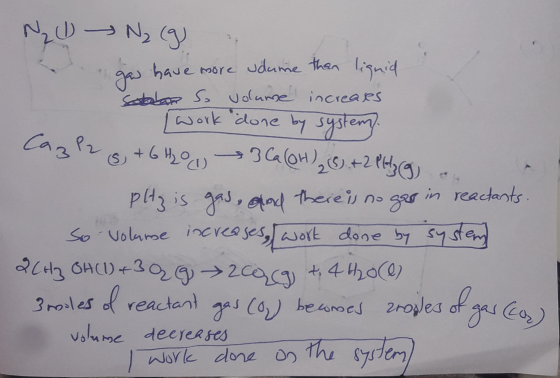
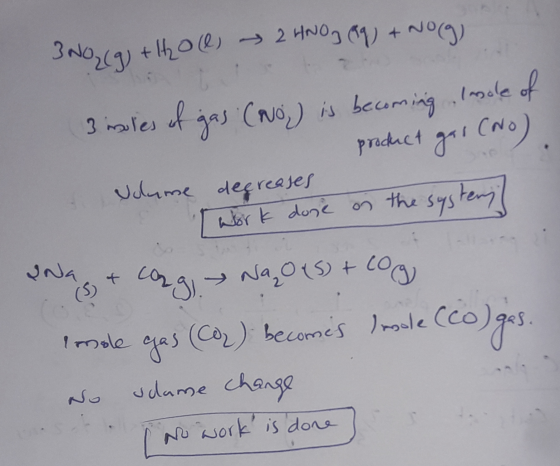
Consider each of the following processes and determine if work is done by the system, work...
1. A gas absorbs 0.0 J of heat and then performs 30.8 J of work. The change in internal energy of the gas is a. 61....
 1. A gas absorbs 0.0 J of heat and then performs 30.8 J of work. The change in internal energy of the gas is a. 61.6 J. b. 30.8 J. c. -61.6 J. d.-30.8 J. e. none of these 2. Which of the following statements correctly describes the signs of q and w for the following exothermic process at P= 1 atm and T = 370 K? H2O(g) → H2O(1) a. q and w are negative. b. is positive, wis...
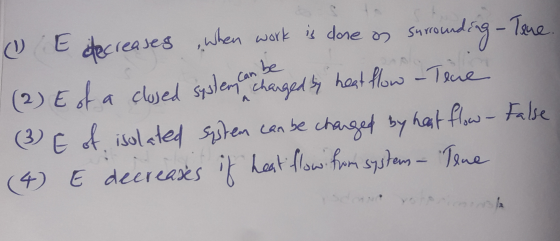
Which of the following statements is correct? The internal energy of a system increases when more...
 Which of the following statements is correct? The internal energy of a system increases when more work is done by the system than heat was flowing into the system. The internal energy of a system decreases when work is done on the system and heat is flowing into the system. The system does work on the surroundings when an ideal gas expands against a constant external pressure. All statements are true. All statements are false.
Three different processes act on a system. In process A, 53 J of work are done...
 Three different processes act
on a system. In process A, 53 J of work are done on the system and
77 J of heat are added to the system. Find the change in the
system's internal energy. In process B, the system does 53 J of
work and 77 J of heat are added to the system. What is the change
in the system's internal energy? In process C, the system's
internal energy decreases by 125 J while the system...
Three different processes act
on a system. In process A, 53 J of work are done on the system and
77 J of heat are added to the system. Find the change in the
system's internal energy. In process B, the system does 53 J of
work and 77 J of heat are added to the system. What is the change
in the system's internal energy? In process C, the system's
internal energy decreases by 125 J while the system...
Suppose the work done to compress a gas is 100 J. If 70 J of heat...
Suppose the work done to compress a gas is 100 J. If 70 J of heat is lost in the process, what is the change in the internal energy of the gas? Hint: Use the first law of thermodynamics. The internal energy of a system changes due to heat (Q) and work (W): U=Q-W. The change in internal energy is equivalent to the difference between the heat added to the system and the work done by the system. Think if...
In process A, 48 J of work are done on the system and 72 J of...
In process A, 48 J of work are done on the system and 72 J of heat are added to the system. Find the change in the system's internal energy. In process B, the system does 48 J of work and 72 J of heat are added to the system. What is the change in the system's internal energy? In process C, the system's internal energy decreases by 129 J while the system performs 129 J of work on its...
The change in internal energy of a system (ΔE) can be described in terms of heat...
The change in internal energy of a system (ΔE) can be described in terms of heat (q) and work (w) according to the equation ΔE = q + w. The conversion of 40 g of liquid H2O to steam at 1.0 atm leads to an increase in its volume. This expansion exerts 4.545 kJ of work on the surroundings. If the increase in internal energy of the H2O is 85.724 kJ, how much heat energy does this vaporization process use?...
explain every answer choice well please and thank you. The picture shows 6 moles of an...
 explain every answer choice well please and thank you.
The picture shows 6 moles of an ideal gas in a piston, undergoing a cyclic process A-B-C-D-A. P(atm) P1 13.What does the expression (V2-V)( P2-P1) show? (A) The internal energy at point B. (B) The heat flowing into the gas going from point A to point B (C) The work done by the gas going around the cycle (D) The temperature difference between point B and point A. (E) None of...
explain every answer choice well please and thank you.
The picture shows 6 moles of an ideal gas in a piston, undergoing a cyclic process A-B-C-D-A. P(atm) P1 13.What does the expression (V2-V)( P2-P1) show? (A) The internal energy at point B. (B) The heat flowing into the gas going from point A to point B (C) The work done by the gas going around the cycle (D) The temperature difference between point B and point A. (E) None of...
Consider another system which gave out 62.55 Cal of heat, what kind of work would be...
 Consider another system which gave out 62.55 Cal of heat, what kind of work would be needed in order to keep the internal energy of the system unchanged? Hint: the magnitude of the work and sign of the work (work done to the system or done by the system to surroundings)
Learning Goal Internal Energy of an ideal gas The internal energy of a system is the...
 Learning Goal Internal Energy of an ideal gas The internal energy of a system is the energy stored in the system. In an ideal gas, the internal energy includes the kinetic energies (translational and rotational) of all the molecules, and other energies due to the interactions among the molecules. The internal energy is proportional to the Absolute Temperature T and the number of moles n (or the number of molecules N). n monatomic ideal gases, the interactions among the molecules...
If a system has 225 kcal of work done to it, and releases 5.00 × 10...
If a system has 225 kcal of work done to it, and releases 5.00 × 10 2 kJ of heat into its surroundings, what is the change in internal energy ( Δ E or Δ U ) of the system?
 1. A gas absorbs 0.0 J of heat and then performs 30.8 J of work. The change in internal energy of the gas is a. 61.6 J. b. 30.8 J. c. -61.6 J. d.-30.8 J. e. none of these 2. Which of the following statements correctly describes the signs of q and w for the following exothermic process at P= 1 atm and T = 370 K? H2O(g) → H2O(1) a. q and w are negative. b. is positive, wis...
 Which of the following statements is correct? The internal energy of a system increases when more work is done by the system than heat was flowing into the system. The internal energy of a system decreases when work is done on the system and heat is flowing into the system. The system does work on the surroundings when an ideal gas expands against a constant external pressure. All statements are true. All statements are false.
 Three different processes act
on a system. In process A, 53 J of work are done on the system and
77 J of heat are added to the system. Find the change in the
system's internal energy. In process B, the system does 53 J of
work and 77 J of heat are added to the system. What is the change
in the system's internal energy? In process C, the system's
internal energy decreases by 125 J while the system...
Three different processes act
on a system. In process A, 53 J of work are done on the system and
77 J of heat are added to the system. Find the change in the
system's internal energy. In process B, the system does 53 J of
work and 77 J of heat are added to the system. What is the change
in the system's internal energy? In process C, the system's
internal energy decreases by 125 J while the system...
 explain every answer choice well please and thank you.
The picture shows 6 moles of an ideal gas in a piston, undergoing a cyclic process A-B-C-D-A. P(atm) P1 13.What does the expression (V2-V)( P2-P1) show? (A) The internal energy at point B. (B) The heat flowing into the gas going from point A to point B (C) The work done by the gas going around the cycle (D) The temperature difference between point B and point A. (E) None of...
explain every answer choice well please and thank you.
The picture shows 6 moles of an ideal gas in a piston, undergoing a cyclic process A-B-C-D-A. P(atm) P1 13.What does the expression (V2-V)( P2-P1) show? (A) The internal energy at point B. (B) The heat flowing into the gas going from point A to point B (C) The work done by the gas going around the cycle (D) The temperature difference between point B and point A. (E) None of...
 Consider another system which gave out 62.55 Cal of heat, what kind of work would be needed in order to keep the internal energy of the system unchanged? Hint: the magnitude of the work and sign of the work (work done to the system or done by the system to surroundings)
 Learning Goal Internal Energy of an ideal gas The internal energy of a system is the energy stored in the system. In an ideal gas, the internal energy includes the kinetic energies (translational and rotational) of all the molecules, and other energies due to the interactions among the molecules. The internal energy is proportional to the Absolute Temperature T and the number of moles n (or the number of molecules N). n monatomic ideal gases, the interactions among the molecules...
Most questions answered within 3 hours.
-
Where is the error in this code sequence?
String s1 = "Hello";
String s2 = "ello";...
asked 10 months ago -
Financial data for Joel de Paris, Inc., for last year
follow:
Joel de Paris, Inc.
Balance...
asked 10 months ago -
Consider this reaction:
Al2(SO4)3 (aq)+ BaCl3
(aq) Al2Cl6 (aq)- +
3BaSO4(s) . What is the...
asked 10 months ago -
Suppose that Savneet is considering increasing her
recent random sample from 20 car rentals to 40...
asked 10 months ago -
Trucks arrive at an unloading terminal at an average rate of 120
per hour.
Trucks arrive...
asked 10 months ago -
Why are methanol and ethanol completely soluble in water while
octanol is not very little soluble....
asked 10 months ago -
A facilities manager at a university reads in a research report
that the mean amount of...
asked 10 months ago -
When the CuSO4 is rehydrated by adding water to the anhydrous
compound, is this an endothermic...
asked 10 months ago -
A ray of sunlight is passing from diamond into crown glass; the
angle of incidence is...
asked 10 months ago -
A block of mass 0.249 kg is placed on top of a light, vertical
spring of...
asked 10 months ago -
how do the kidneys compensate in the presences of acidosis
a) trigger hyperventilate
b) reserve acid...
asked 10 months ago -
Question 501 pts
The rental rate of capital to the firm increases. Which of the
following...
asked 10 months ago