
Homework Answers
Add Answer to:
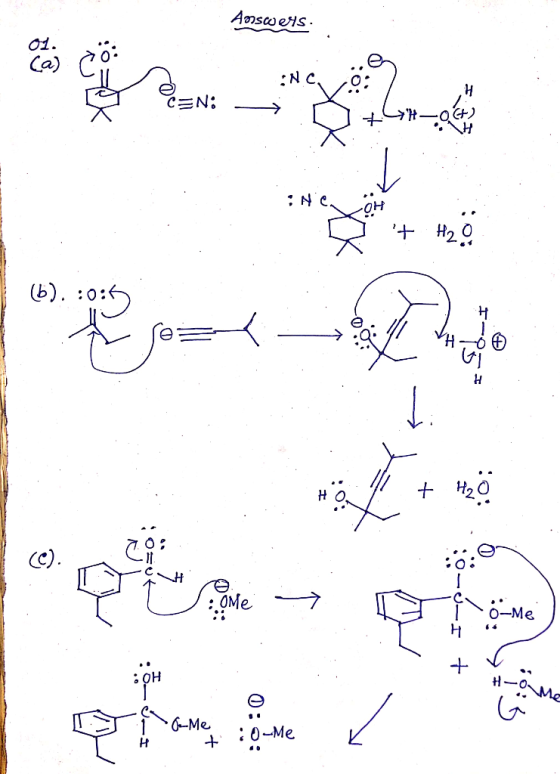
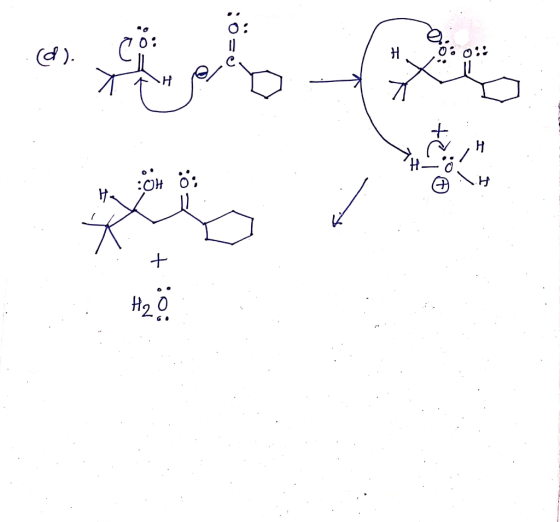
1. Provide the missing lone pairs and curved arrows for the following nucleophilic addition reactions: 2...
2. Complete the following acid/base equation, filling in all missing details: missing lone pairs, curved arrows...
 2. Complete the following acid/base equation, filling in all missing details: missing lone pairs, curved arrows to show electron move and proper formal charge. If there are any resonance structures draw them as well One acid has a pka of 5 and the other acid has a pKa of 15. Match each pka with the proper acid (write it under the acid). Which side is favored and why? Calculate an equilibrium constant (Kog) for the reaction.
Provide mechanisms for the following reactions. Show electron motion using curved arrows. Do not skip or...
 Provide mechanisms for the following reactions. Show electron motion using curved arrows. Do not skip or combine steps. Show all relevant bonds, atoms, charges, and lone pairs. 1) Na OE ethanol 2) H0
Add bonds, nonbonding electron pairs (lone pairs), and curved arrows where indicated. Complete the electron -...
 Add bonds, nonbonding electron pairs (lone pairs), and curved
arrows where indicated.
Complete the electron - pushing mechanism for the following decarboxylation reaction. Add bonds, nonbonding electron pairs (lone pairs), and curved arrows where indicated.
Add bonds, nonbonding electron pairs (lone pairs), and curved
arrows where indicated.
Complete the electron - pushing mechanism for the following decarboxylation reaction. Add bonds, nonbonding electron pairs (lone pairs), and curved arrows where indicated.
11. Draw the products and use curved arrows for the following nucleophilic addition steps. 2. H30+...
 11. Draw the products and use curved arrows for the following nucleophilic addition steps. 2. H30+ qoy a Dola 1. NaBH 2. H20+ joj
For the mechanism, draw the curved arrows as needed. Include lone pairs and charges in your...
 For the mechanism, draw the curved arrows as needed. Include lone pairs and charges in your answer. Do not draw out any or Ph. NH CI NH Step 1 Correct. This is a nucleophilic attack step. Draw Step 1 of the mechanism. HC H₂C. + NH Edit Cl нс NH CH H
Butanone undergoes a nucleophilic addition with a Grignard reagent made from 1-bromopropane and magnesium metal in T...
 Butanone undergoes a nucleophilic addition with a Grignard reagent made from 1-bromopropane and magnesium metal in THF solution. The alkoxide formed from the nucleophilic addition is then conveted into the final product by the careful addition of dilute acid. Complete the mechanism by adding curved arrows and drawing final product. Show all lone-pairs and charges. Nucleophilic Addition Add a series of curved arrows to the sketch to demonstrate a nucleophilic addition. Draw the alkoxide intermediate. Acid workup Use curved arrows...
4. Add curved arrows to show the movement of electrons in each of the following reactions....
 4. Add curved arrows to show the movement of electrons in each of the following reactions. Note that you should draw in any lone pairs that are relevant to the mechanism. (a) OCH2 CH3 -O. H + (b) CH3 IN OH CH2 + +
Draw the curved arrows and the resulting resonance structure for the following structures. Include lone pairs...
 Draw the curved arrows and the resulting resonance structure for the following structures. Include lone pairs and charges in your structure. Edit CH
Draw the curved arrows and the resulting resonance structure for the following structure. Include lone pairs...
 Draw the curved arrows and the resulting resonance structure for the following structure. Include lone pairs and charges in your structure CH3 Edit H3C
Propose a plausible mechanism for the following transformation. Draw curved arrows as needed, lone pairs, and...
 Propose a plausible mechanism for the following
transformation.
Draw curved arrows as needed, lone pairs, and charges for the
4 step mechanism. Need step 3 and 4.
1) NaOH 2) H30* OH HO Step 1 Correct. This is a nucleophilic attack step. Draw Step 1 of the mechanism. -- - Edit + OH SHOW ANSWER Step 2 Correct. This is a loss of leaving group step. Draw Step 2 of the mechanism. OOH OH SHOW ANSWER By accessing this Question...
Propose a plausible mechanism for the following
transformation.
Draw curved arrows as needed, lone pairs, and charges for the
4 step mechanism. Need step 3 and 4.
1) NaOH 2) H30* OH HO Step 1 Correct. This is a nucleophilic attack step. Draw Step 1 of the mechanism. -- - Edit + OH SHOW ANSWER Step 2 Correct. This is a loss of leaving group step. Draw Step 2 of the mechanism. OOH OH SHOW ANSWER By accessing this Question...
 2. Complete the following acid/base equation, filling in all missing details: missing lone pairs, curved arrows to show electron move and proper formal charge. If there are any resonance structures draw them as well One acid has a pka of 5 and the other acid has a pKa of 15. Match each pka with the proper acid (write it under the acid). Which side is favored and why? Calculate an equilibrium constant (Kog) for the reaction.
 Provide mechanisms for the following reactions. Show electron motion using curved arrows. Do not skip or combine steps. Show all relevant bonds, atoms, charges, and lone pairs. 1) Na OE ethanol 2) H0
 Add bonds, nonbonding electron pairs (lone pairs), and curved
arrows where indicated.
Complete the electron - pushing mechanism for the following decarboxylation reaction. Add bonds, nonbonding electron pairs (lone pairs), and curved arrows where indicated.
Add bonds, nonbonding electron pairs (lone pairs), and curved
arrows where indicated.
Complete the electron - pushing mechanism for the following decarboxylation reaction. Add bonds, nonbonding electron pairs (lone pairs), and curved arrows where indicated.
 11. Draw the products and use curved arrows for the following nucleophilic addition steps. 2. H30+ qoy a Dola 1. NaBH 2. H20+ joj
 For the mechanism, draw the curved arrows as needed. Include lone pairs and charges in your answer. Do not draw out any or Ph. NH CI NH Step 1 Correct. This is a nucleophilic attack step. Draw Step 1 of the mechanism. HC H₂C. + NH Edit Cl нс NH CH H
 Butanone undergoes a nucleophilic addition with a Grignard reagent made from 1-bromopropane and magnesium metal in THF solution. The alkoxide formed from the nucleophilic addition is then conveted into the final product by the careful addition of dilute acid. Complete the mechanism by adding curved arrows and drawing final product. Show all lone-pairs and charges. Nucleophilic Addition Add a series of curved arrows to the sketch to demonstrate a nucleophilic addition. Draw the alkoxide intermediate. Acid workup Use curved arrows...
 4. Add curved arrows to show the movement of electrons in each of the following reactions. Note that you should draw in any lone pairs that are relevant to the mechanism. (a) OCH2 CH3 -O. H + (b) CH3 IN OH CH2 + +
 Draw the curved arrows and the resulting resonance structure for the following structures. Include lone pairs and charges in your structure. Edit CH
 Draw the curved arrows and the resulting resonance structure for the following structure. Include lone pairs and charges in your structure CH3 Edit H3C
 Propose a plausible mechanism for the following
transformation.
Draw curved arrows as needed, lone pairs, and charges for the
4 step mechanism. Need step 3 and 4.
1) NaOH 2) H30* OH HO Step 1 Correct. This is a nucleophilic attack step. Draw Step 1 of the mechanism. -- - Edit + OH SHOW ANSWER Step 2 Correct. This is a loss of leaving group step. Draw Step 2 of the mechanism. OOH OH SHOW ANSWER By accessing this Question...
Propose a plausible mechanism for the following
transformation.
Draw curved arrows as needed, lone pairs, and charges for the
4 step mechanism. Need step 3 and 4.
1) NaOH 2) H30* OH HO Step 1 Correct. This is a nucleophilic attack step. Draw Step 1 of the mechanism. -- - Edit + OH SHOW ANSWER Step 2 Correct. This is a loss of leaving group step. Draw Step 2 of the mechanism. OOH OH SHOW ANSWER By accessing this Question...
Most questions answered within 3 hours.
-
Where is the error in this code sequence?
String s1 = "Hello";
String s2 = "ello";...
asked 10 months ago -
Financial data for Joel de Paris, Inc., for last year
follow:
Joel de Paris, Inc.
Balance...
asked 10 months ago -
Consider this reaction:
Al2(SO4)3 (aq)+ BaCl3
(aq) Al2Cl6 (aq)- +
3BaSO4(s) . What is the...
asked 10 months ago -
Suppose that Savneet is considering increasing her
recent random sample from 20 car rentals to 40...
asked 10 months ago -
Trucks arrive at an unloading terminal at an average rate of 120
per hour.
Trucks arrive...
asked 10 months ago -
Why are methanol and ethanol completely soluble in water while
octanol is not very little soluble....
asked 10 months ago -
A facilities manager at a university reads in a research report
that the mean amount of...
asked 10 months ago -
When the CuSO4 is rehydrated by adding water to the anhydrous
compound, is this an endothermic...
asked 10 months ago -
A ray of sunlight is passing from diamond into crown glass; the
angle of incidence is...
asked 10 months ago -
A block of mass 0.249 kg is placed on top of a light, vertical
spring of...
asked 10 months ago -
how do the kidneys compensate in the presences of acidosis
a) trigger hyperventilate
b) reserve acid...
asked 10 months ago -
Question 501 pts
The rental rate of capital to the firm increases. Which of the
following...
asked 10 months ago