
Homework Answers

Add Answer to:
1. Draw the product of hydration (addition of water) of this alkene E DEBY s bowo...
1. Draw a structural formula for the product of each alkene hydration reaction. (a) L +11,0...
 1. Draw a structural formula for the product of each alkene hydration reaction. (a) L +11,0 1,30., o L + 1,0 130, 2. Propose a mechanism for the formation of this alcohol. k + 1,0 1150, 3,3-Dimethyl-1-butene 2,3-Dimethyl-2-butanol
1pt Draw the major product(s) from addition of HBr to the alkene below. 1 pt CH3...
 1pt Draw the major product(s) from addition of HBr to the alkene below. 1 pt CH3 2 pt CHCH=CHCHCHE 1 pt 1 pt • You do not have to consider stereochemistry. . If there is more than one major product possible, draw all of them. • Draw one structure per sketcher. Add additional sketchers using the drop-down menu in the bottom right corner • Separate multiple products using the sign from the drop-down menu. ipt 3 ipt 1 pt -O0O-...
Draw the mechanism and expected product for hydrohalogenation of the folowing alkene with HBr. Draw the...
 Draw the mechanism and expected product for hydrohalogenation of the folowing alkene with HBr. Draw the mechanism and expected product upon Markovnikov hydrohalogenation with HBr of the alkene shown below. Draw the major product for the following reaction The expected major product(s) of HBr addition to the alkene shown would be: Draw the reaction intermediate formed when 4-methylcyclohexene reacts with Br_2
What would be the mechanism VCL 2-4: Alkene Hydration - 2 Alkene Hydration me product, but...
 What would be the mechanism
VCL 2-4: Alkene Hydration - 2 Alkene Hydration me product, but not with the For this assignment, the target compound that you should synthesize is 2-hexanol. Again, electrophilie alkene addition reaction Examine the product to determine the location of the functionality. Keep in mind that different startine materials may give the same product, but same selectivity. Remember to form the more substituted carbocation intermediate Synthesis Procedures 1. Start Virtual Chemlab and select Alkene Hydration -...
What would be the mechanism
VCL 2-4: Alkene Hydration - 2 Alkene Hydration me product, but not with the For this assignment, the target compound that you should synthesize is 2-hexanol. Again, electrophilie alkene addition reaction Examine the product to determine the location of the functionality. Keep in mind that different startine materials may give the same product, but same selectivity. Remember to form the more substituted carbocation intermediate Synthesis Procedures 1. Start Virtual Chemlab and select Alkene Hydration -...
Question 24 Which alkene(s) can undergo acid-catalyzed hydration to give the following product? OH only only
 Question 24 Which alkene(s) can undergo acid-catalyzed hydration to give the following product? OH only only
Alkenes: Hydration & Electrophilic addition of CI2 and H2O to 1-methylcyclohex-1-ene Draw the product formed when...
 Alkenes: Hydration & Electrophilic addition of CI2 and H2O to 1-methylcyclohex-1-ene Draw the product formed when the compound shown below undergoes a reaction with CI_2 in H_2O. Draw the molecule on the canvas by choosing buttons from the Tools (for bonds). Atoms, and Advanced Template toolbars. The single bond Is active by default. Show the appropriate stereochemistry by choosing the dashed or wedged buttons and then clicking a bond on the canvas.
Draw the product for the following addition reaction. Although this alkene forms in the course of the reaction, it will react with the second equivalent of Cl2 to give the final product.
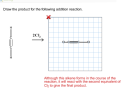 Draw the product for the following addition reaction. Although this alkene forms in the course of the reaction, it will react with the second equivalent of Cl2 to give the final product.
Draw the product for the following addition reaction. Although this alkene forms in the course of the reaction, it will react with the second equivalent of Cl2 to give the final product.
Draw the product for the following addition reaction. Although this alkene forms in the course of the reaction, it will react with the second equivalent of Cl2 to give the final product.
Draw an arrow-pushing mechanism for the sulfuric acid-catalyzed hydration of an alkene. Draw an energy diagram...
 Draw an arrow-pushing mechanism for the sulfuric acid-catalyzed hydration of an alkene. Draw an energy diagram for the reaction. Be sure to include reactants, products, and intermediates.
Complete these alkene E+ addition reactions by giving the products or starting materials. When appropriate, show...
Complete these alkene E+ addition reactions by giving the products or starting materials. When appropriate, show the stereochemistry. a. Addition to HX b. Hydration c. Hydrocarbon d. Halogenation e.Formation of a halohydrin f.Hydrogenation
Characterize the following alkene as having the E or Z configuration. Draw the product(s) of bromination...
 Characterize the following alkene as having the E or Z
configuration.Draw the product(s) of bromination of this compound, including all
expected stereoisomers (if any).Use wedge-and-dash bonds to designate the stereochemistry at any
chirality centers, and make sure to draw an explicit hydrogen if a
chirality center has one.
Characterize the following alkene as having the E or Z
configuration.Draw the product(s) of bromination of this compound, including all
expected stereoisomers (if any).Use wedge-and-dash bonds to designate the stereochemistry at any
chirality centers, and make sure to draw an explicit hydrogen if a
chirality center has one.
 1. Draw a structural formula for the product of each alkene hydration reaction. (a) L +11,0 1,30., o L + 1,0 130, 2. Propose a mechanism for the formation of this alcohol. k + 1,0 1150, 3,3-Dimethyl-1-butene 2,3-Dimethyl-2-butanol
 1pt Draw the major product(s) from addition of HBr to the alkene below. 1 pt CH3 2 pt CHCH=CHCHCHE 1 pt 1 pt • You do not have to consider stereochemistry. . If there is more than one major product possible, draw all of them. • Draw one structure per sketcher. Add additional sketchers using the drop-down menu in the bottom right corner • Separate multiple products using the sign from the drop-down menu. ipt 3 ipt 1 pt -O0O-...
 Draw the mechanism and expected product for hydrohalogenation of the folowing alkene with HBr. Draw the mechanism and expected product upon Markovnikov hydrohalogenation with HBr of the alkene shown below. Draw the major product for the following reaction The expected major product(s) of HBr addition to the alkene shown would be: Draw the reaction intermediate formed when 4-methylcyclohexene reacts with Br_2
 What would be the mechanism
VCL 2-4: Alkene Hydration - 2 Alkene Hydration me product, but not with the For this assignment, the target compound that you should synthesize is 2-hexanol. Again, electrophilie alkene addition reaction Examine the product to determine the location of the functionality. Keep in mind that different startine materials may give the same product, but same selectivity. Remember to form the more substituted carbocation intermediate Synthesis Procedures 1. Start Virtual Chemlab and select Alkene Hydration -...
What would be the mechanism
VCL 2-4: Alkene Hydration - 2 Alkene Hydration me product, but not with the For this assignment, the target compound that you should synthesize is 2-hexanol. Again, electrophilie alkene addition reaction Examine the product to determine the location of the functionality. Keep in mind that different startine materials may give the same product, but same selectivity. Remember to form the more substituted carbocation intermediate Synthesis Procedures 1. Start Virtual Chemlab and select Alkene Hydration -...
 Question 24 Which alkene(s) can undergo acid-catalyzed hydration to give the following product? OH only only
 Alkenes: Hydration & Electrophilic addition of CI2 and H2O to 1-methylcyclohex-1-ene Draw the product formed when the compound shown below undergoes a reaction with CI_2 in H_2O. Draw the molecule on the canvas by choosing buttons from the Tools (for bonds). Atoms, and Advanced Template toolbars. The single bond Is active by default. Show the appropriate stereochemistry by choosing the dashed or wedged buttons and then clicking a bond on the canvas.
 Draw the product for the following addition reaction. Although this alkene forms in the course of the reaction, it will react with the second equivalent of Cl2 to give the final product.
Draw the product for the following addition reaction. Although this alkene forms in the course of the reaction, it will react with the second equivalent of Cl2 to give the final product.
Draw the product for the following addition reaction. Although this alkene forms in the course of the reaction, it will react with the second equivalent of Cl2 to give the final product.
 Draw an arrow-pushing mechanism for the sulfuric acid-catalyzed hydration of an alkene. Draw an energy diagram for the reaction. Be sure to include reactants, products, and intermediates.
 Characterize the following alkene as having the E or Z
configuration.Draw the product(s) of bromination of this compound, including all
expected stereoisomers (if any).Use wedge-and-dash bonds to designate the stereochemistry at any
chirality centers, and make sure to draw an explicit hydrogen if a
chirality center has one.
Characterize the following alkene as having the E or Z
configuration.Draw the product(s) of bromination of this compound, including all
expected stereoisomers (if any).Use wedge-and-dash bonds to designate the stereochemistry at any
chirality centers, and make sure to draw an explicit hydrogen if a
chirality center has one.
Most questions answered within 3 hours.
-
Where is the error in this code sequence?
String s1 = "Hello";
String s2 = "ello";...
asked 11 months ago -
Financial data for Joel de Paris, Inc., for last year
follow:
Joel de Paris, Inc.
Balance...
asked 11 months ago -
Consider this reaction:
Al2(SO4)3 (aq)+ BaCl3
(aq) Al2Cl6 (aq)- +
3BaSO4(s) . What is the...
asked 11 months ago -
Suppose that Savneet is considering increasing her
recent random sample from 20 car rentals to 40...
asked 11 months ago -
Trucks arrive at an unloading terminal at an average rate of 120
per hour.
Trucks arrive...
asked 11 months ago -
Why are methanol and ethanol completely soluble in water while
octanol is not very little soluble....
asked 11 months ago -
A facilities manager at a university reads in a research report
that the mean amount of...
asked 11 months ago -
When the CuSO4 is rehydrated by adding water to the anhydrous
compound, is this an endothermic...
asked 11 months ago -
A ray of sunlight is passing from diamond into crown glass; the
angle of incidence is...
asked 11 months ago -
A block of mass 0.249 kg is placed on top of a light, vertical
spring of...
asked 11 months ago -
how do the kidneys compensate in the presences of acidosis
a) trigger hyperventilate
b) reserve acid...
asked 11 months ago -
Question 501 pts
The rental rate of capital to the firm increases. Which of the
following...
asked 11 months ago