
Homework Answers
Add Answer to:
Question 1 Use the following data for the following problems: Substance Cl2(g) NO(g) Sº (J/K mol)...
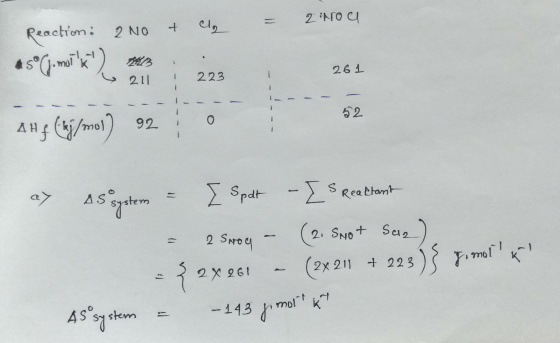
Consider the reaction: 2NO(g) + Cl2(g) → 2NOCI(g) Given the following table of thermodynamic data, Substance...
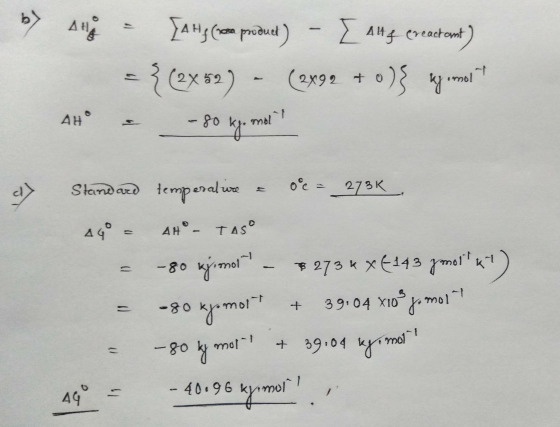
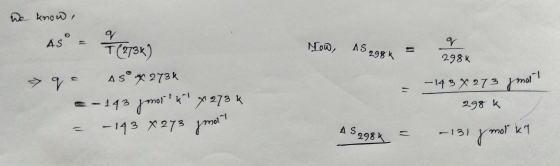
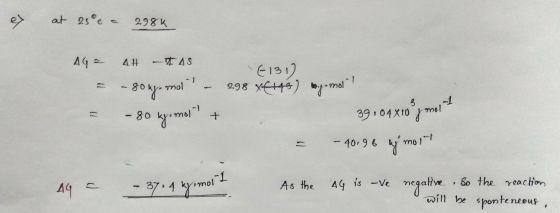
 Consider the reaction: 2NO(g) + Cl2(g) → 2NOCI(g) Given the following table of thermodynamic data, Substance NO (g) Cl2(g) NOCI (g) AH (kJ/mol) 90.3 0 sº (/mol.K) 210.7 223.0 51.7 261.6 Calculate Ahºrxn and AS rxn and determine the temperature at which the reaction switches from being spontaneous to being non-spontaneous.
Consider the reaction: 2NO(g) + C12(8) + 2NOCI(g) Given the following table of thermodynamic data, AHF...
 Consider the reaction: 2NO(g) + C12(8) + 2NOCI(g) Given the following table of thermodynamic data, AHF (kJ/mol) Substance NO (8) Cl2 (8) NOCI (8) 90.3 0 sº (l/mol.K) 210.7 223.0 261.6 51.7 Calculate Ahºrxn and Asºrxn and determine the temperature at which the reaction switches from being spontaneous to being non- spontaneous.
QUESTION Use the given data at 298 K to calculate AGº for the reaction 2012(g) +...
 QUESTION Use the given data at 298 K to calculate AGº for the reaction 2012(g) + SO2(g) → SOC12(g) + Cl20(g) Substance: Cl2 (8) SO2(8) SOCI2(g) Cl20(g) AHºf (kJ/mol): 0 -296.8 -212.5 80.3 Sº (J/mol-K): 223.0 248.1 309.77 266.1 O 129.3 kJ 133.6 k) 196.0 k) 199.8 k) 229.6 kJ
Substance AGP (kJ/mol) AS (J/mol K) NO (g) 86.7 211 NO2 (g) 51.8 240 NOCI (g)...
 Substance AGP (kJ/mol) AS (J/mol K) NO (g) 86.7 211 NO2 (g) 51.8 240 NOCI (g) 66.3 264 N20 (g) 103.6 220 What is the value of AH° (in kJ) at 25.0 °C for the reaction: N20 (g) + NO2 (g) → 3 NO (g) 5.5 kJ 53.2 kJ 109 kJ 156.2 kJ
Consider the reaction: 2NO(g) + Cl2(g) 2NOCl(g) Given the following table of thermodynamic data, Substance...
Consider the reaction: 2NO(g) + Cl2(g) 2NOCl(g) Given the following table of thermodynamic data, Substance ∆Hfo (kJ/mol) So (J/molK) NO (g) 90.3 210.7 Cl2 (g) 0 223.0 NOCl (g) 51.7 261.6 Calculate ∆Horxn and ∆Sorxn and determine the temperature at which the reaction switches from being spontaneous to being non-spontaneous. Please show all work. Provide equations used. Please use correct significant figures and correct units in answers.
Determine ASX for H, (g)+1, (g) $2HI(g) given the following information: Substance Sº (J/mol · K)...
 Determine ASX for H, (g)+1, (g) $2HI(g) given the following information: Substance Sº (J/mol · K) H2(g) 130.58 12(g) 116.73 HI(g) 206.3 -41.10 J/K -165.29 J/K +398.75 J/K d. +165.29 JK e. +41.10 J/K
Nitrogen AHºf (kJ/mol) AG°f (kJ/mol) Sº (J/mol K) N2 (g) 0 0 191.6 472.7 455.6 153.3...
 Nitrogen AHºf (kJ/mol) AG°f (kJ/mol) Sº (J/mol K) N2 (g) 0 0 191.6 472.7 455.6 153.3 N(g) NH3 (g) -46.1 -16.5 192.5 NH3 (aq) -80.0 -27.0 111.0 NH4+ (aq) -132.0 -79.0 113.0 NO (g) 90.3 86.6 210.8 NOCI (g) 51.7 66.1 261.8 NO2 (g) 33.2 51.3 240.1 N20 (g) 82.1 104.2 219.9 N204 (8) 9.2 97.9 304.3 Consider the reaction N2(9) + 202(9)—2NO2(g) Using the standard thermodynamic data in the tables linked above, calculate Grxn for this reaction at 298.15K...
please make sure the answer is correct 100% 1. [15 pts] Nitric oxide reacts with chlorine...
 please make sure the answer is correct 100%
1. [15 pts] Nitric oxide reacts with chlorine to form NOCI. The data refer to 298 K. 2NO (g) + Cl2(g) → 2NOCI (g) Substance: NO (g) Cl2(g) NOCI (g) 90.29 51.71 AHºf (kJ/mol): Sº (J/K-mol): 210.65 223.0 261.6 Calculate ASsurr and determine if the reaction is spontaneous at 298 K. 2. [10 pts] Rank the following compounds in order of decreasing molar entropy (the greatest is on the left). N204(g) at...
please make sure the answer is correct 100%
1. [15 pts] Nitric oxide reacts with chlorine to form NOCI. The data refer to 298 K. 2NO (g) + Cl2(g) → 2NOCI (g) Substance: NO (g) Cl2(g) NOCI (g) 90.29 51.71 AHºf (kJ/mol): Sº (J/K-mol): 210.65 223.0 261.6 Calculate ASsurr and determine if the reaction is spontaneous at 298 K. 2. [10 pts] Rank the following compounds in order of decreasing molar entropy (the greatest is on the left). N204(g) at...
Nitrogen Ahºf (kJ/mol) AG°f (kJ/mol) Sº (J/mol K) 191.6 N2(9) 0 0 N(g) 472.7 455.6 153.3 NH3(g) -46.1 -16.5 192.5 NH3(a...
 Nitrogen Ahºf (kJ/mol) AG°f (kJ/mol) Sº (J/mol K) 191.6 N2(9) 0 0 N(g) 472.7 455.6 153.3 NH3(g) -46.1 -16.5 192.5 NH3(aq) -80.0 -27.0 111.0 NH4+ (aq) -132.0 -79.0 113.0 90.3 86.6 210.8 NO(9) NOCI(g) 51.7 66.1 261.8 NO2(g) 33.2 51.3 240.1 N20(9) 82.1 104.2 219.9 N204(9) 9.2 97.9 304.3 N204(0) -20.0 97.0 209.0 N205(s) -42.0 134.0 178.0 N2H4(0) 50.6 149.3 121.2 N2H3CH3 () 54.0 180.0 166.0 HNO3(aq) -207.4 -111.3 146.4 HNO3(1) -174.1 -80.7 155.6 HNO3(9) -135.1 -74.7 266.4 NH4ClO4(s) -295.0...
AG°= AH-TAS AG=AGº+RTinQ where R=8.314 J/mol K 1. Calculate AGº for the following reaction at 25 °C if AH°= -1854 kJ...
 AG°= AH-TAS AG=AGº+RTinQ where R=8.314 J/mol K 1. Calculate AGº for the following reaction at 25 °C if AH°= -1854 kJ/mol; AS°= -236 J/mol K CH-COCH3(g) + 402(g) → 3C02(g) + 3H2O(1) 2. NH.NO, dissolving in water is a spontaneous process. As it dissolves, the temperature of the solution decreases. Based on this, what must the signs (positive or negative) of AG, AH, and AS be?
 Consider the reaction: 2NO(g) + Cl2(g) → 2NOCI(g) Given the following table of thermodynamic data, Substance NO (g) Cl2(g) NOCI (g) AH (kJ/mol) 90.3 0 sº (/mol.K) 210.7 223.0 51.7 261.6 Calculate Ahºrxn and AS rxn and determine the temperature at which the reaction switches from being spontaneous to being non-spontaneous.
 Consider the reaction: 2NO(g) + C12(8) + 2NOCI(g) Given the following table of thermodynamic data, AHF (kJ/mol) Substance NO (8) Cl2 (8) NOCI (8) 90.3 0 sº (l/mol.K) 210.7 223.0 261.6 51.7 Calculate Ahºrxn and Asºrxn and determine the temperature at which the reaction switches from being spontaneous to being non- spontaneous.
 QUESTION Use the given data at 298 K to calculate AGº for the reaction 2012(g) + SO2(g) → SOC12(g) + Cl20(g) Substance: Cl2 (8) SO2(8) SOCI2(g) Cl20(g) AHºf (kJ/mol): 0 -296.8 -212.5 80.3 Sº (J/mol-K): 223.0 248.1 309.77 266.1 O 129.3 kJ 133.6 k) 196.0 k) 199.8 k) 229.6 kJ
 Substance AGP (kJ/mol) AS (J/mol K) NO (g) 86.7 211 NO2 (g) 51.8 240 NOCI (g) 66.3 264 N20 (g) 103.6 220 What is the value of AH° (in kJ) at 25.0 °C for the reaction: N20 (g) + NO2 (g) → 3 NO (g) 5.5 kJ 53.2 kJ 109 kJ 156.2 kJ
 Determine ASX for H, (g)+1, (g) $2HI(g) given the following information: Substance Sº (J/mol · K) H2(g) 130.58 12(g) 116.73 HI(g) 206.3 -41.10 J/K -165.29 J/K +398.75 J/K d. +165.29 JK e. +41.10 J/K
 Nitrogen AHºf (kJ/mol) AG°f (kJ/mol) Sº (J/mol K) N2 (g) 0 0 191.6 472.7 455.6 153.3 N(g) NH3 (g) -46.1 -16.5 192.5 NH3 (aq) -80.0 -27.0 111.0 NH4+ (aq) -132.0 -79.0 113.0 NO (g) 90.3 86.6 210.8 NOCI (g) 51.7 66.1 261.8 NO2 (g) 33.2 51.3 240.1 N20 (g) 82.1 104.2 219.9 N204 (8) 9.2 97.9 304.3 Consider the reaction N2(9) + 202(9)—2NO2(g) Using the standard thermodynamic data in the tables linked above, calculate Grxn for this reaction at 298.15K...
 please make sure the answer is correct 100%
1. [15 pts] Nitric oxide reacts with chlorine to form NOCI. The data refer to 298 K. 2NO (g) + Cl2(g) → 2NOCI (g) Substance: NO (g) Cl2(g) NOCI (g) 90.29 51.71 AHºf (kJ/mol): Sº (J/K-mol): 210.65 223.0 261.6 Calculate ASsurr and determine if the reaction is spontaneous at 298 K. 2. [10 pts] Rank the following compounds in order of decreasing molar entropy (the greatest is on the left). N204(g) at...
please make sure the answer is correct 100%
1. [15 pts] Nitric oxide reacts with chlorine to form NOCI. The data refer to 298 K. 2NO (g) + Cl2(g) → 2NOCI (g) Substance: NO (g) Cl2(g) NOCI (g) 90.29 51.71 AHºf (kJ/mol): Sº (J/K-mol): 210.65 223.0 261.6 Calculate ASsurr and determine if the reaction is spontaneous at 298 K. 2. [10 pts] Rank the following compounds in order of decreasing molar entropy (the greatest is on the left). N204(g) at...
 Nitrogen Ahºf (kJ/mol) AG°f (kJ/mol) Sº (J/mol K) 191.6 N2(9) 0 0 N(g) 472.7 455.6 153.3 NH3(g) -46.1 -16.5 192.5 NH3(aq) -80.0 -27.0 111.0 NH4+ (aq) -132.0 -79.0 113.0 90.3 86.6 210.8 NO(9) NOCI(g) 51.7 66.1 261.8 NO2(g) 33.2 51.3 240.1 N20(9) 82.1 104.2 219.9 N204(9) 9.2 97.9 304.3 N204(0) -20.0 97.0 209.0 N205(s) -42.0 134.0 178.0 N2H4(0) 50.6 149.3 121.2 N2H3CH3 () 54.0 180.0 166.0 HNO3(aq) -207.4 -111.3 146.4 HNO3(1) -174.1 -80.7 155.6 HNO3(9) -135.1 -74.7 266.4 NH4ClO4(s) -295.0...
 AG°= AH-TAS AG=AGº+RTinQ where R=8.314 J/mol K 1. Calculate AGº for the following reaction at 25 °C if AH°= -1854 kJ/mol; AS°= -236 J/mol K CH-COCH3(g) + 402(g) → 3C02(g) + 3H2O(1) 2. NH.NO, dissolving in water is a spontaneous process. As it dissolves, the temperature of the solution decreases. Based on this, what must the signs (positive or negative) of AG, AH, and AS be?
Most questions answered within 3 hours.
-
Where is the error in this code sequence?
String s1 = "Hello";
String s2 = "ello";...
asked 10 months ago -
Financial data for Joel de Paris, Inc., for last year
follow:
Joel de Paris, Inc.
Balance...
asked 10 months ago -
Consider this reaction:
Al2(SO4)3 (aq)+ BaCl3
(aq) Al2Cl6 (aq)- +
3BaSO4(s) . What is the...
asked 10 months ago -
Suppose that Savneet is considering increasing her
recent random sample from 20 car rentals to 40...
asked 10 months ago -
Trucks arrive at an unloading terminal at an average rate of 120
per hour.
Trucks arrive...
asked 10 months ago -
Why are methanol and ethanol completely soluble in water while
octanol is not very little soluble....
asked 10 months ago -
A facilities manager at a university reads in a research report
that the mean amount of...
asked 10 months ago -
When the CuSO4 is rehydrated by adding water to the anhydrous
compound, is this an endothermic...
asked 10 months ago -
A ray of sunlight is passing from diamond into crown glass; the
angle of incidence is...
asked 10 months ago -
A block of mass 0.249 kg is placed on top of a light, vertical
spring of...
asked 10 months ago -
how do the kidneys compensate in the presences of acidosis
a) trigger hyperventilate
b) reserve acid...
asked 10 months ago -
Question 501 pts
The rental rate of capital to the firm increases. Which of the
following...
asked 10 months ago