
Homework Answers
Add Answer to:
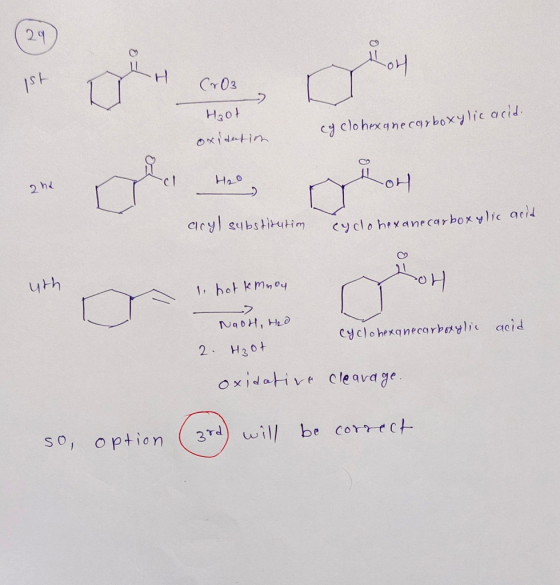
Which of the following reactions would not create
cyclohexanecarboxylic acid as a product?
Question 29 2.5...
2. Draw the major product for the following reactions. 6.Draw the final product for the following reactions 2. Draw th...
 2. Draw the major product for the following reactions.
6.Draw the final product for the following reactions
2. Draw the major product for the following reactions. 1) TCI 2) NaOEL, Heat 3) 0 4) DMS 1) NBS, heat (1 eq.) 2) NaNH, DMS0 3) KMnO4 (aq) NaOH, cold 4) NaCl acetic acid 1) , 2) H.O 3)Ni, 1, 150, 100 atm 1) R RH 2) H.O., NaOH 3) NBS, heat (I eq) 1) KMnO heat 2) Na, NH, CH,OH 3)...
2. Draw the major product for the following reactions.
6.Draw the final product for the following reactions
2. Draw the major product for the following reactions. 1) TCI 2) NaOEL, Heat 3) 0 4) DMS 1) NBS, heat (1 eq.) 2) NaNH, DMS0 3) KMnO4 (aq) NaOH, cold 4) NaCl acetic acid 1) , 2) H.O 3)Ni, 1, 150, 100 atm 1) R RH 2) H.O., NaOH 3) NBS, heat (I eq) 1) KMnO heat 2) Na, NH, CH,OH 3)...
Question 31 es Which of the following reactions would produce a primary amine as the major...
 Question 31 es Which of the following reactions would produce a primary amine as the major product? (Select all that apply if more than one o 0 1 КОН 1. LAHA NH, NH 2. H.O 3. H2NNH. ETOH II INI 2 La 0 - NH Liam Bry, NaOH 1. NaN, 2 heat 1 2 NaOH HO IV CI H20 3.H20 VI v GV v B IV HII
12. What would be the major product of the following reaction? i. Brz, NaOH ii. H20"...
 12. What would be the major product of the following reaction? i. Brz, NaOH ii. H20" ? mo Br НО. O II III Br Br ho IV A. I B. II C. III D. IV E. V 13. What would be the major product of the following reaction sequence? A. I B. II C. III D. IV E. V 2 i. LDA ii. CHEI De ci II I III IV V 14. Which of the following could be used to...
Which of the following sequences of reactions (from those shown below) would yield the desired product...
 Which of the following sequences of reactions (from those shown below) would yield the desired product from the indicated starting material? 1- HBr. CC 2 HBr, ROOR 18 TsCL pyridine 19 NaOEt 20·H/Lindars Catalyst 21 NaNH, (0 22 Brg, hw 8 CH,CHCH CH CI 10- 18-crown-&, KF 25- 0s0, (catalytc), NMO 2) H-O2. NaOH 2) H' (aq) 2) H20 2) DMS 2) NaSH 2) NaBH 2)0% NaOH 2) H,0 12-1) RCOyH 27-1) HglOAc EIOH 14 “ to, 29 1)0 15-...
Draw the final product for the following reactions 6. Draw the final product for the following...
 Draw the final product for the following reactions
6. Draw the final product for the following reactions 19 AICI 2) Zn, HCI 3) Brz, light (1 eq.) 4) NaOH, heat 1) KMnO4, hot 2) HNO3, H2SO4 3) LiAIHA 4) Hot 1) AICI3, tai 2) mCPBA 3) Jones Reagent
Draw the final product for the following reactions
6. Draw the final product for the following reactions 19 AICI 2) Zn, HCI 3) Brz, light (1 eq.) 4) NaOH, heat 1) KMnO4, hot 2) HNO3, H2SO4 3) LiAIHA 4) Hot 1) AICI3, tai 2) mCPBA 3) Jones Reagent
2. Provide the major products from the following reactions. Starting Material Reagent(s) Product? Br2 Place appropri...
 2. Provide the major products from the following reactions. Starting Material Reagent(s) Product? Br2 Place appropriate groups H, Br CH, on scaffold) HCI Place appropriate groups (H, Br, CH, on scaffold) CH Brz/H20 Place appropriate groups H, Br CHs on scaffold] 1) O3 2) Zn/HOÁC LICH H2, Pd/C CH₂ 1. BH3 2. H2O2, NaOH(aq) CH2 hot KMnO4 in H2O - CH₂ CH3CO3H Product from above H30+, H2O
Draw the major product for the following reactions. -OH 2. Draw the major product for the following reactions. 1) T...
 Draw the major product for the following reactions.
-OH 2. Draw the major product for the following reactions. 1) TSCI 2) NaOEt, Heat 3) O; 4) DMS 1) NBS, heat (I cq.) 2) NaNH, DMSO 3) KMnO4 (aq) NaOH, cold 4) NaOCI, acetic acid 1) O 2) H,0 3)NI, H, 150, 100 atm 1) RBH 2) H.O, NaOH 3) NBS, heat (I eq) 1) KMnO heat 2) Na, NH, CH OH 3) Bry, light (I eq) 1) NBS, light 2)...
Draw the major product for the following reactions.
-OH 2. Draw the major product for the following reactions. 1) TSCI 2) NaOEt, Heat 3) O; 4) DMS 1) NBS, heat (I cq.) 2) NaNH, DMSO 3) KMnO4 (aq) NaOH, cold 4) NaOCI, acetic acid 1) O 2) H,0 3)NI, H, 150, 100 atm 1) RBH 2) H.O, NaOH 3) NBS, heat (I eq) 1) KMnO heat 2) Na, NH, CH OH 3) Bry, light (I eq) 1) NBS, light 2)...
3. Predict the product of the following reactions. 1) CH3CH NO2, NaOH 2) HCI, H,0 1)...
 3. Predict the product of the following reactions. 1) CH3CH NO2, NaOH 2) HCI, H,0 1) CH3NO2, NaOH 2) HCI, H,0 1) PhCHO, NaOH 2) HCI, H20
Which of the following compounds would make the best buffer at pH 7.5? Acetic acid, pKa=...
Which of the following compounds would make the best buffer at pH 7.5? Acetic acid, pKa= 4.76 N-tris(hydroxymethyl) methylglycine (Tricine), pKa = 8.15 N-2-hydroxyethylpiperazine-N’-ethansulfonic acid, pKa2= 7.6 Glycine, pKa2= 9.9 Tris(hydroxymethyl)aminomethane (Tris), pKa = 8.3 I believe 3 is the correct answer and therefore I am trying to answer the below question with this information. Using the answer that you selected from question 1 above: a. Explain how you would make the buffer starting with 1M HA and 1M A-...
Would this be right? Determine the product(s) formed in the following reactions, CF3COH KMnO4 H20, HO...
 Would this be right?
Determine the product(s) formed in the following reactions, CF3COH KMnO4 H20, HO OH Na, Cr2O7 H2SO4, H20 (CH)CHOOH Ti[OCH(CH3)2]4 (+)-DET Reset
Would this be right?
Determine the product(s) formed in the following reactions, CF3COH KMnO4 H20, HO OH Na, Cr2O7 H2SO4, H20 (CH)CHOOH Ti[OCH(CH3)2]4 (+)-DET Reset
 2. Draw the major product for the following reactions.
6.Draw the final product for the following reactions
2. Draw the major product for the following reactions. 1) TCI 2) NaOEL, Heat 3) 0 4) DMS 1) NBS, heat (1 eq.) 2) NaNH, DMS0 3) KMnO4 (aq) NaOH, cold 4) NaCl acetic acid 1) , 2) H.O 3)Ni, 1, 150, 100 atm 1) R RH 2) H.O., NaOH 3) NBS, heat (I eq) 1) KMnO heat 2) Na, NH, CH,OH 3)...
2. Draw the major product for the following reactions.
6.Draw the final product for the following reactions
2. Draw the major product for the following reactions. 1) TCI 2) NaOEL, Heat 3) 0 4) DMS 1) NBS, heat (1 eq.) 2) NaNH, DMS0 3) KMnO4 (aq) NaOH, cold 4) NaCl acetic acid 1) , 2) H.O 3)Ni, 1, 150, 100 atm 1) R RH 2) H.O., NaOH 3) NBS, heat (I eq) 1) KMnO heat 2) Na, NH, CH,OH 3)...
 Question 31 es Which of the following reactions would produce a primary amine as the major product? (Select all that apply if more than one o 0 1 КОН 1. LAHA NH, NH 2. H.O 3. H2NNH. ETOH II INI 2 La 0 - NH Liam Bry, NaOH 1. NaN, 2 heat 1 2 NaOH HO IV CI H20 3.H20 VI v GV v B IV HII
 12. What would be the major product of the following reaction? i. Brz, NaOH ii. H20" ? mo Br НО. O II III Br Br ho IV A. I B. II C. III D. IV E. V 13. What would be the major product of the following reaction sequence? A. I B. II C. III D. IV E. V 2 i. LDA ii. CHEI De ci II I III IV V 14. Which of the following could be used to...
 Which of the following sequences of reactions (from those shown below) would yield the desired product from the indicated starting material? 1- HBr. CC 2 HBr, ROOR 18 TsCL pyridine 19 NaOEt 20·H/Lindars Catalyst 21 NaNH, (0 22 Brg, hw 8 CH,CHCH CH CI 10- 18-crown-&, KF 25- 0s0, (catalytc), NMO 2) H-O2. NaOH 2) H' (aq) 2) H20 2) DMS 2) NaSH 2) NaBH 2)0% NaOH 2) H,0 12-1) RCOyH 27-1) HglOAc EIOH 14 “ to, 29 1)0 15-...
 Draw the final product for the following reactions
6. Draw the final product for the following reactions 19 AICI 2) Zn, HCI 3) Brz, light (1 eq.) 4) NaOH, heat 1) KMnO4, hot 2) HNO3, H2SO4 3) LiAIHA 4) Hot 1) AICI3, tai 2) mCPBA 3) Jones Reagent
Draw the final product for the following reactions
6. Draw the final product for the following reactions 19 AICI 2) Zn, HCI 3) Brz, light (1 eq.) 4) NaOH, heat 1) KMnO4, hot 2) HNO3, H2SO4 3) LiAIHA 4) Hot 1) AICI3, tai 2) mCPBA 3) Jones Reagent
 2. Provide the major products from the following reactions. Starting Material Reagent(s) Product? Br2 Place appropriate groups H, Br CH, on scaffold) HCI Place appropriate groups (H, Br, CH, on scaffold) CH Brz/H20 Place appropriate groups H, Br CHs on scaffold] 1) O3 2) Zn/HOÁC LICH H2, Pd/C CH₂ 1. BH3 2. H2O2, NaOH(aq) CH2 hot KMnO4 in H2O - CH₂ CH3CO3H Product from above H30+, H2O
 Draw the major product for the following reactions.
-OH 2. Draw the major product for the following reactions. 1) TSCI 2) NaOEt, Heat 3) O; 4) DMS 1) NBS, heat (I cq.) 2) NaNH, DMSO 3) KMnO4 (aq) NaOH, cold 4) NaOCI, acetic acid 1) O 2) H,0 3)NI, H, 150, 100 atm 1) RBH 2) H.O, NaOH 3) NBS, heat (I eq) 1) KMnO heat 2) Na, NH, CH OH 3) Bry, light (I eq) 1) NBS, light 2)...
Draw the major product for the following reactions.
-OH 2. Draw the major product for the following reactions. 1) TSCI 2) NaOEt, Heat 3) O; 4) DMS 1) NBS, heat (I cq.) 2) NaNH, DMSO 3) KMnO4 (aq) NaOH, cold 4) NaOCI, acetic acid 1) O 2) H,0 3)NI, H, 150, 100 atm 1) RBH 2) H.O, NaOH 3) NBS, heat (I eq) 1) KMnO heat 2) Na, NH, CH OH 3) Bry, light (I eq) 1) NBS, light 2)...
 3. Predict the product of the following reactions. 1) CH3CH NO2, NaOH 2) HCI, H,0 1) CH3NO2, NaOH 2) HCI, H,0 1) PhCHO, NaOH 2) HCI, H20
 Would this be right?
Determine the product(s) formed in the following reactions, CF3COH KMnO4 H20, HO OH Na, Cr2O7 H2SO4, H20 (CH)CHOOH Ti[OCH(CH3)2]4 (+)-DET Reset
Would this be right?
Determine the product(s) formed in the following reactions, CF3COH KMnO4 H20, HO OH Na, Cr2O7 H2SO4, H20 (CH)CHOOH Ti[OCH(CH3)2]4 (+)-DET Reset
Most questions answered within 3 hours.
-
Where is the error in this code sequence?
String s1 = "Hello";
String s2 = "ello";...
asked 11 months ago -
Financial data for Joel de Paris, Inc., for last year
follow:
Joel de Paris, Inc.
Balance...
asked 11 months ago -
Consider this reaction:
Al2(SO4)3 (aq)+ BaCl3
(aq) Al2Cl6 (aq)- +
3BaSO4(s) . What is the...
asked 11 months ago -
Suppose that Savneet is considering increasing her
recent random sample from 20 car rentals to 40...
asked 11 months ago -
Trucks arrive at an unloading terminal at an average rate of 120
per hour.
Trucks arrive...
asked 11 months ago -
Why are methanol and ethanol completely soluble in water while
octanol is not very little soluble....
asked 11 months ago -
A facilities manager at a university reads in a research report
that the mean amount of...
asked 11 months ago -
When the CuSO4 is rehydrated by adding water to the anhydrous
compound, is this an endothermic...
asked 11 months ago -
A ray of sunlight is passing from diamond into crown glass; the
angle of incidence is...
asked 11 months ago -
A block of mass 0.249 kg is placed on top of a light, vertical
spring of...
asked 11 months ago -
how do the kidneys compensate in the presences of acidosis
a) trigger hyperventilate
b) reserve acid...
asked 11 months ago -
Question 501 pts
The rental rate of capital to the firm increases. Which of the
following...
asked 11 months ago