Explain why ionic attractions are weaker in media with high dielectric constants, e. g., aqueous buffers
Explain why ionic attractions are weaker in media with high dielectric constants, e. g., aqueous buffers
Homework Answers
Ionic interactions arise from electrostatic attraction between two groups of opposite charge. This energy is inversely proportional to the dielectric constant of the medium.
The higher the dielectric constant of a solvent, the more polar it is. eg: The dielectric constant of water is higher than that of methanol; water is more polar than methanol.
The ionic strength of a solution is a measure of the concentration of ions in that solution. Ionic compounds, when dissolved in water, dissociate into ions. The total electrolyte concentration in solution will affect important properties such as the dissociation constant or the solubility of different salts.
According to Coulomb's Law:
F∝q1q2 /d2 ϵ
This law, is also applied to chemistry and ionic bonds, since they
are all characterized by electrostatic interactions.
the strength of a ionic bond is directly proportional to the product of the charges on the ions, inversely proportional to the square of their distance, and inversely proportional to the dielectric constant of the solvent. In vacuum, the dielectric constant is ϵ=1.
So, if the dielectric constant is higher , the electrostatic force will be less and hence the ion - ion interaction will be less or weaker .
Add Answer to:
Explain why ionic attractions are weaker in media with high
dielectric constants, e. g., aqueous buffers
Explain why hydrophobic molecules aggregate together when placed in water and aqueous buffers.
Explain why hydrophobic molecules aggregate together when placed in water and aqueous buffers.
can you help please Indicate the most important types of intermolecular attractions in each of the...
 can you help please
Indicate the most important types of intermolecular attractions in each of the following solutions: a. NO(g) in CO(1) b. Cl2(g) in Br2(1) Why are most solid ionic compounds electrically nonconductive, whereas aqueous solutions of ionic compounds are good conductors? Would you expect a liquid (molten) ionic compound to be electrically conductive or nonconductive? Explain. Suppose you are presented with a clear solutionof sodium thiosulfate, Na2S2O3. How could you determine whether the solution is unsaturated saturated, or...
can you help please
Indicate the most important types of intermolecular attractions in each of the following solutions: a. NO(g) in CO(1) b. Cl2(g) in Br2(1) Why are most solid ionic compounds electrically nonconductive, whereas aqueous solutions of ionic compounds are good conductors? Would you expect a liquid (molten) ionic compound to be electrically conductive or nonconductive? Explain. Suppose you are presented with a clear solutionof sodium thiosulfate, Na2S2O3. How could you determine whether the solution is unsaturated saturated, or...
Can you please solve questions 4 and 6 and explain why they are the correct answers?...
 Can you please solve questions 4 and 6 and explain why they
are the correct answers?
Thank you!
D 4 There are two epuations of sae van der Waals oquation, both shown in the table beow A sal at 273 K A student is using these two s the major factor that accounts for most of the diflerence in the two values e. Diatomic nature of shlorine a. Volume of the chlorine particles Chlorine is a halogen b. Forces of...
Can you please solve questions 4 and 6 and explain why they
are the correct answers?
Thank you!
D 4 There are two epuations of sae van der Waals oquation, both shown in the table beow A sal at 273 K A student is using these two s the major factor that accounts for most of the diflerence in the two values e. Diatomic nature of shlorine a. Volume of the chlorine particles Chlorine is a halogen b. Forces of...
Constants | Periodic Table Predict the half-cell reactions that occur when aqueous solutions of the following...
Constants | Periodic Table Predict the half-cell reactions that occur when aqueous solutions of the following salts are electrolyzed in a cell with inert electrodes. What is the overall cell reaction in each case? Part A Part complete anode reaction for LiI Express your answer as a ionic equation. Identify all of the phases in your answer. 2I−(aq)→I2(s)+2e− Previous Answers Answer Requested Part B cathode reaction for LiI: Express your answer as a ionic equation. Identify all of the phases...
1. Someone new is preparing media for lab and adds buffers to the EMB agar that...
1. Someone new is preparing media for lab and adds buffers to the EMB agar that raise the pH to 7.8. The starting pH of EMB plates should be 6.9 – 7.3. No one is aware of the change. The EMB plates are inoculated for identification of unknown bacteria. After the appropriate incubation time, the results are interpreted. A. Discuss the consequences of the change in starting pH to the interpretation of the results. (The answer is not that no...
Let f: C→C be an entire, one-to-one function. (a) Explain why g()-f() f(0) is an entire 1-1 function (b) Explain why th...
 Let f: C→C be an entire, one-to-one function. (a) Explain why g()-f() f(0) is an entire 1-1 function (b) Explain why there exists0 such that B(O,e) C g(B(O, 1)). Hint: Open Mapping thm.] (c) Explain why Ig(z)2є if 221 . [Hint: g is 1-1.] (d) Since g(0)=0, g(z)=2h(z) for some entire function h(z). Explain why h(z) is never 0 (e) Show that there is a constant C>0 such that 1/h2)l C if21 (f) Deduce that 1/h (z) is a constant...
(1) Let G = Z24 = [1]). (a) Explain why (2)-(10) in G. (b) Find all...
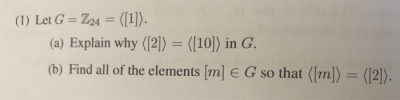 (1) Let G = Z24 = [1]). (a) Explain why (2)-(10) in G. (b) Find all of the elements [m] E G so that (Im) (2]). (c) Find |[6)] in G
#5 the Greate nd discount- to explain close to high even lain why a d more...
 #5
the Greate nd discount- to explain close to high even lain why a d more to ar 2015. at a pre- 4. During the Great Depression of the nal interest rates were close to zero. Explain how real interest rates could be very high even though nominal interest rates were very low. (Hint: Prices fell during parts of the Great Depression.) 5. Assume that after you graduate, you get a job as the chief financial officer of a small...
#5
the Greate nd discount- to explain close to high even lain why a d more to ar 2015. at a pre- 4. During the Great Depression of the nal interest rates were close to zero. Explain how real interest rates could be very high even though nominal interest rates were very low. (Hint: Prices fell during parts of the Great Depression.) 5. Assume that after you graduate, you get a job as the chief financial officer of a small...
Explain why some electrolyte solutions are strongly conducting, whereas others are weakly conducting. 4.2. Def fin...
 Explain why some electrolyte solutions are strongly conducting, whereas others are weakly conducting. 4.2. Def fine the terms strong electrolyte and weak electrolyte. Give an example of each 4.3. Ex plain the terms soluble and insoluble. Use the solubility rules to write the formula of an insoluble ionic compound. 4.4. What are the advantages and disadvantages of using a molecular equation to represent an i reaction? 4.5. What is a spectator ion? IlIlustrate with a complete ionic reaction 4.6. What...
g. Using your experimental results, explain why Zn(s) will reduce Cu?, Ag and H+ ions, but...
 g. Using your experimental results, explain why Zn(s) will reduce Cu?, Ag and H+ ions, but Zn²+ ions are not reduced by Cu(s) or Ag(s) or H, (g). Reaction E (V) Explanation h. When a piece of silver metal is inserted into a solution of Cus or Agt will there be a reaction? Explain why or why not? Reaction E (V) Explanation
 can you help please
Indicate the most important types of intermolecular attractions in each of the following solutions: a. NO(g) in CO(1) b. Cl2(g) in Br2(1) Why are most solid ionic compounds electrically nonconductive, whereas aqueous solutions of ionic compounds are good conductors? Would you expect a liquid (molten) ionic compound to be electrically conductive or nonconductive? Explain. Suppose you are presented with a clear solutionof sodium thiosulfate, Na2S2O3. How could you determine whether the solution is unsaturated saturated, or...
can you help please
Indicate the most important types of intermolecular attractions in each of the following solutions: a. NO(g) in CO(1) b. Cl2(g) in Br2(1) Why are most solid ionic compounds electrically nonconductive, whereas aqueous solutions of ionic compounds are good conductors? Would you expect a liquid (molten) ionic compound to be electrically conductive or nonconductive? Explain. Suppose you are presented with a clear solutionof sodium thiosulfate, Na2S2O3. How could you determine whether the solution is unsaturated saturated, or...
 Can you please solve questions 4 and 6 and explain why they
are the correct answers?
Thank you!
D 4 There are two epuations of sae van der Waals oquation, both shown in the table beow A sal at 273 K A student is using these two s the major factor that accounts for most of the diflerence in the two values e. Diatomic nature of shlorine a. Volume of the chlorine particles Chlorine is a halogen b. Forces of...
Can you please solve questions 4 and 6 and explain why they
are the correct answers?
Thank you!
D 4 There are two epuations of sae van der Waals oquation, both shown in the table beow A sal at 273 K A student is using these two s the major factor that accounts for most of the diflerence in the two values e. Diatomic nature of shlorine a. Volume of the chlorine particles Chlorine is a halogen b. Forces of...
 Let f: C→C be an entire, one-to-one function. (a) Explain why g()-f() f(0) is an entire 1-1 function (b) Explain why there exists0 such that B(O,e) C g(B(O, 1)). Hint: Open Mapping thm.] (c) Explain why Ig(z)2є if 221 . [Hint: g is 1-1.] (d) Since g(0)=0, g(z)=2h(z) for some entire function h(z). Explain why h(z) is never 0 (e) Show that there is a constant C>0 such that 1/h2)l C if21 (f) Deduce that 1/h (z) is a constant...
 (1) Let G = Z24 = [1]). (a) Explain why (2)-(10) in G. (b) Find all of the elements [m] E G so that (Im) (2]). (c) Find |[6)] in G
 #5
the Greate nd discount- to explain close to high even lain why a d more to ar 2015. at a pre- 4. During the Great Depression of the nal interest rates were close to zero. Explain how real interest rates could be very high even though nominal interest rates were very low. (Hint: Prices fell during parts of the Great Depression.) 5. Assume that after you graduate, you get a job as the chief financial officer of a small...
#5
the Greate nd discount- to explain close to high even lain why a d more to ar 2015. at a pre- 4. During the Great Depression of the nal interest rates were close to zero. Explain how real interest rates could be very high even though nominal interest rates were very low. (Hint: Prices fell during parts of the Great Depression.) 5. Assume that after you graduate, you get a job as the chief financial officer of a small...
 Explain why some electrolyte solutions are strongly conducting, whereas others are weakly conducting. 4.2. Def fine the terms strong electrolyte and weak electrolyte. Give an example of each 4.3. Ex plain the terms soluble and insoluble. Use the solubility rules to write the formula of an insoluble ionic compound. 4.4. What are the advantages and disadvantages of using a molecular equation to represent an i reaction? 4.5. What is a spectator ion? IlIlustrate with a complete ionic reaction 4.6. What...
 g. Using your experimental results, explain why Zn(s) will reduce Cu?, Ag and H+ ions, but Zn²+ ions are not reduced by Cu(s) or Ag(s) or H, (g). Reaction E (V) Explanation h. When a piece of silver metal is inserted into a solution of Cus or Agt will there be a reaction? Explain why or why not? Reaction E (V) Explanation
Most questions answered within 3 hours.
-
Where is the error in this code sequence?
String s1 = "Hello";
String s2 = "ello";...
asked 10 months ago -
Financial data for Joel de Paris, Inc., for last year
follow:
Joel de Paris, Inc.
Balance...
asked 10 months ago -
Consider this reaction:
Al2(SO4)3 (aq)+ BaCl3
(aq) Al2Cl6 (aq)- +
3BaSO4(s) . What is the...
asked 10 months ago -
Suppose that Savneet is considering increasing her
recent random sample from 20 car rentals to 40...
asked 10 months ago -
Trucks arrive at an unloading terminal at an average rate of 120
per hour.
Trucks arrive...
asked 10 months ago -
Why are methanol and ethanol completely soluble in water while
octanol is not very little soluble....
asked 10 months ago -
A facilities manager at a university reads in a research report
that the mean amount of...
asked 10 months ago -
When the CuSO4 is rehydrated by adding water to the anhydrous
compound, is this an endothermic...
asked 10 months ago -
A ray of sunlight is passing from diamond into crown glass; the
angle of incidence is...
asked 10 months ago -
A block of mass 0.249 kg is placed on top of a light, vertical
spring of...
asked 10 months ago -
how do the kidneys compensate in the presences of acidosis
a) trigger hyperventilate
b) reserve acid...
asked 10 months ago -
Question 501 pts
The rental rate of capital to the firm increases. Which of the
following...
asked 10 months ago