


Homework Answers
![1 Rake a 0.255 disi Rate : 0255 dpa I tila = 5730 years. line - 5730 1 k cs sco@:00.77 = K [ No ] - luz 5730 CamScanner](http://img.homeworklib.com/questions/694ebaf0-dcd0-11eb-ac4f-852e60803250.png?x-oss-process=image/resize,w_560)
![0.255 = k [N] No = No e-kt . t = I lu No - 1 lu 0.255 0.0077 t = 28933.6063 yeart. Scanned with CamScanner](http://img.homeworklib.com/questions/69eddde0-dcd0-11eb-b714-1b189d153b1e.png?x-oss-process=image/resize,w_560)
Add Answer to:
Need help with these problems
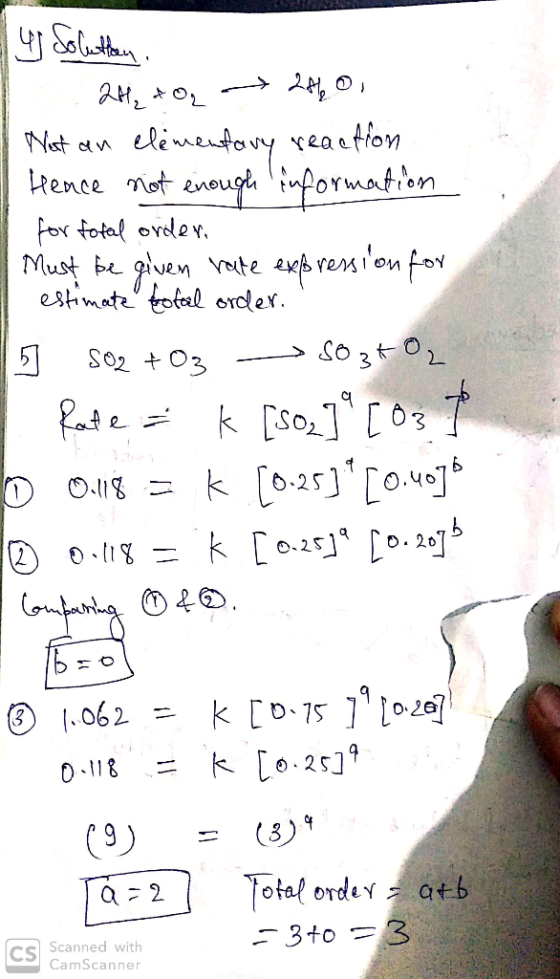
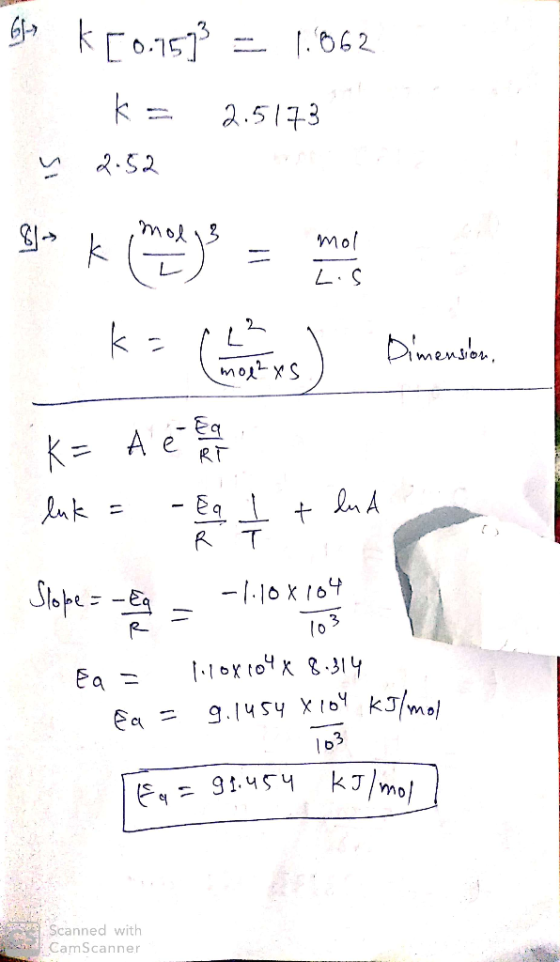
What would be the total order for the following reaction: 2H,...
The rate constant of the second order reaction A→4B+2C is 0.599 L mol−1 s−1. What is...
The rate constant of the second order reaction A→4B+2C is 0.599 L mol−1 s−1. What is the half-life of the reaction given that [A] 0 =0.567 mol L−1? Remember to report your answer with the correct number of significant figures.
please someone help me with question 2. thank you 2. For a second-order reaction where Alaal...
 please someone help me with question 2. thank you
2. For a second-order reaction where Alaal with 0.20 mol/L of A. Baal, the half life is 10.22 min starting A. What is the rate constant? B. How long will it take for 80.0% of a solution of 0.20 M A to react? C. What is the half-life of the reaction when starting with 0.20 MA? Rate = k [A]. – [A]e = kt Rate = k[A] Rate = k[A] k...
please someone help me with question 2. thank you
2. For a second-order reaction where Alaal with 0.20 mol/L of A. Baal, the half life is 10.22 min starting A. What is the rate constant? B. How long will it take for 80.0% of a solution of 0.20 M A to react? C. What is the half-life of the reaction when starting with 0.20 MA? Rate = k [A]. – [A]e = kt Rate = k[A] Rate = k[A] k...
7. What is the reaction order for each reactant and the rate coefficient for the following...
 7. What is the reaction order for each reactant and the rate coefficient for the following reaction? A+B+C ->Z [A] (mol L B (mol L[C] (mol L ](mol L sec1) 0.010 0.020 0.010 0.020 0.0100 0.0100 0.0200 0.0100 0.10 0.10 0.10 0.20 3.0 x 10⁻² 3.0 x 10² 1.2 x 10⁻¹ 1.5 x 10⁻²
Consider the following reaction: H2 + I2 ➞ 2HI They react by a second-order process, first...
Consider the following reaction: H2 + I2 ➞ 2HI They react by a second-order process, first order with respect to each reactant with k = 0.63 L/(mol*sec). a) What is the initial reaction rate when we add 0.50 g H2 and 0.20 g I2 to a 800. mL vessel? b) How does the reaction rate change (by what factor/amount) when we add 0.10 g I2 to the above mixture?
question 12 & 13 12. The following reaction is second order in respect to CH3COOCH3. The...
 question 12 & 13
12. The following reaction is second order in respect to CH3COOCH3. The rate constant is 2.0 X 10³ L/(mol s), what is the concentration of the CH3COOCH3 after 4 minutes if the initial concentration of CH3COOCH3 is 0.25 M? CH3COOCH3 OH CH3COOCH3OH o inao si odool ni 00 o otil-lipd & aart noisassno shoo Aa noitbe 0 PJE (slow) 20 13. Hydrogen peroxide and iodide ion react in the following steps. H2O2 (aq) I' (aq) I0...
question 12 & 13
12. The following reaction is second order in respect to CH3COOCH3. The rate constant is 2.0 X 10³ L/(mol s), what is the concentration of the CH3COOCH3 after 4 minutes if the initial concentration of CH3COOCH3 is 0.25 M? CH3COOCH3 OH CH3COOCH3OH o inao si odool ni 00 o otil-lipd & aart noisassno shoo Aa noitbe 0 PJE (slow) 20 13. Hydrogen peroxide and iodide ion react in the following steps. H2O2 (aq) I' (aq) I0...
help please The following chemical reaction: A → products shows second order kinetics with respect to...
 help please
The following chemical reaction: A → products shows second order kinetics with respect to A; rate k[A2 Assume k = 11.88 x 10⁻⁵ mol-1 L s-1 If the initial concentration of A is 0.28 mol L-1, what is the concentration of A in mol L-1) after 3.03 hours? You have 5 attempts at this question. Remember: if you want to express an answer in scientific notation, use the letter "E". For example "4.32 x 101" should be entered...
help please
The following chemical reaction: A → products shows second order kinetics with respect to A; rate k[A2 Assume k = 11.88 x 10⁻⁵ mol-1 L s-1 If the initial concentration of A is 0.28 mol L-1, what is the concentration of A in mol L-1) after 3.03 hours? You have 5 attempts at this question. Remember: if you want to express an answer in scientific notation, use the letter "E". For example "4.32 x 101" should be entered...
please help me with both. TIA The following chemical reaction: A → products shows zero order...
 please help me with both. TIA
The following chemical reaction: A → products shows zero order kinetics with respect to A; rate = k[A]º. if k = 9.65 x 10⁻³ moll's and the initial concentration of A is 0.622 mol L-1, what is the half life of this reaction in minutes? You have 5 attempts at this question. Remember: if you want to express an answer in scientific notation, use the letter "E". For example "4.32 x 10⁴ should be...
please help me with both. TIA
The following chemical reaction: A → products shows zero order kinetics with respect to A; rate = k[A]º. if k = 9.65 x 10⁻³ moll's and the initial concentration of A is 0.622 mol L-1, what is the half life of this reaction in minutes? You have 5 attempts at this question. Remember: if you want to express an answer in scientific notation, use the letter "E". For example "4.32 x 10⁴ should be...
The kinetics of the following second-order reaction were studied as a function of temperature: C2H5Br(aq)+OH−(aq)→C2H5OH(l)+Br−(aq) Temperature...
The kinetics of the following second-order reaction were studied as a function of temperature: C2H5Br(aq)+OH−(aq)→C2H5OH(l)+Br−(aq) Temperature (∘C) k (L/mol⋅s) 25 8.81×10⁻⁵ 35 0.000285 45 0.000854 55 0.00239 65 0.00633 If a reaction mixture is 0.155 M in C2H5Br, and 0.260 M in OH−, what is the initial rate of the reaction at 80 ∘C? Express your answer using two significant figures.
5. How much faster would a reaction be if a catalyst is used that lowers the...
 5. How much faster would a reaction be if a catalyst is used that lowers the activation energy from 20.0 kJ/mol to 10.0 kJ/mol? Do the calculation at two temperatures: first at 25.0°C and then at 0.0°C. (20 points) (V) Helpful Stuff Thermodynamics: AG° = AH-TAS Nernst Equation: 6 = 6 - (RT/nF)InQ AG=RTIK At 25°C: 8 = 6 - (0.0591/n)logQ AGRT Ke=e AGⓇ =-nF8° Units/Constants: Volt: 1 V = 1 J/C Faraday: 1 F = 96,485 C/mole Arrhenius Equation:...
[time] [Z] 4. Suppose the data shown are for the second order reaction: → products. What...
 [time] [Z] 4. Suppose the data shown are for the second order reaction: → products. What is the value of the rate constant k? O min 50.000 atm 6.250 3.333 2.273. 5. For a first order reaction (G - products) with k = 0.173 min', suppose a chemist runs the reaction starting with an initial concentration [G]. = 12.0 M. a. How many minutes will it take for [G] to decrease to 4.70 M? b. What [G] will remain after...
 please someone help me with question 2. thank you
2. For a second-order reaction where Alaal with 0.20 mol/L of A. Baal, the half life is 10.22 min starting A. What is the rate constant? B. How long will it take for 80.0% of a solution of 0.20 M A to react? C. What is the half-life of the reaction when starting with 0.20 MA? Rate = k [A]. – [A]e = kt Rate = k[A] Rate = k[A] k...
please someone help me with question 2. thank you
2. For a second-order reaction where Alaal with 0.20 mol/L of A. Baal, the half life is 10.22 min starting A. What is the rate constant? B. How long will it take for 80.0% of a solution of 0.20 M A to react? C. What is the half-life of the reaction when starting with 0.20 MA? Rate = k [A]. – [A]e = kt Rate = k[A] Rate = k[A] k...
 7. What is the reaction order for each reactant and the rate coefficient for the following reaction? A+B+C ->Z [A] (mol L B (mol L[C] (mol L ](mol L sec1) 0.010 0.020 0.010 0.020 0.0100 0.0100 0.0200 0.0100 0.10 0.10 0.10 0.20 3.0 x 10⁻² 3.0 x 10² 1.2 x 10⁻¹ 1.5 x 10⁻²
 question 12 & 13
12. The following reaction is second order in respect to CH3COOCH3. The rate constant is 2.0 X 10³ L/(mol s), what is the concentration of the CH3COOCH3 after 4 minutes if the initial concentration of CH3COOCH3 is 0.25 M? CH3COOCH3 OH CH3COOCH3OH o inao si odool ni 00 o otil-lipd & aart noisassno shoo Aa noitbe 0 PJE (slow) 20 13. Hydrogen peroxide and iodide ion react in the following steps. H2O2 (aq) I' (aq) I0...
question 12 & 13
12. The following reaction is second order in respect to CH3COOCH3. The rate constant is 2.0 X 10³ L/(mol s), what is the concentration of the CH3COOCH3 after 4 minutes if the initial concentration of CH3COOCH3 is 0.25 M? CH3COOCH3 OH CH3COOCH3OH o inao si odool ni 00 o otil-lipd & aart noisassno shoo Aa noitbe 0 PJE (slow) 20 13. Hydrogen peroxide and iodide ion react in the following steps. H2O2 (aq) I' (aq) I0...
 help please
The following chemical reaction: A → products shows second order kinetics with respect to A; rate k[A2 Assume k = 11.88 x 10⁻⁵ mol-1 L s-1 If the initial concentration of A is 0.28 mol L-1, what is the concentration of A in mol L-1) after 3.03 hours? You have 5 attempts at this question. Remember: if you want to express an answer in scientific notation, use the letter "E". For example "4.32 x 101" should be entered...
help please
The following chemical reaction: A → products shows second order kinetics with respect to A; rate k[A2 Assume k = 11.88 x 10⁻⁵ mol-1 L s-1 If the initial concentration of A is 0.28 mol L-1, what is the concentration of A in mol L-1) after 3.03 hours? You have 5 attempts at this question. Remember: if you want to express an answer in scientific notation, use the letter "E". For example "4.32 x 101" should be entered...
 please help me with both. TIA
The following chemical reaction: A → products shows zero order kinetics with respect to A; rate = k[A]º. if k = 9.65 x 10⁻³ moll's and the initial concentration of A is 0.622 mol L-1, what is the half life of this reaction in minutes? You have 5 attempts at this question. Remember: if you want to express an answer in scientific notation, use the letter "E". For example "4.32 x 10⁴ should be...
please help me with both. TIA
The following chemical reaction: A → products shows zero order kinetics with respect to A; rate = k[A]º. if k = 9.65 x 10⁻³ moll's and the initial concentration of A is 0.622 mol L-1, what is the half life of this reaction in minutes? You have 5 attempts at this question. Remember: if you want to express an answer in scientific notation, use the letter "E". For example "4.32 x 10⁴ should be...
 5. How much faster would a reaction be if a catalyst is used that lowers the activation energy from 20.0 kJ/mol to 10.0 kJ/mol? Do the calculation at two temperatures: first at 25.0°C and then at 0.0°C. (20 points) (V) Helpful Stuff Thermodynamics: AG° = AH-TAS Nernst Equation: 6 = 6 - (RT/nF)InQ AG=RTIK At 25°C: 8 = 6 - (0.0591/n)logQ AGRT Ke=e AGⓇ =-nF8° Units/Constants: Volt: 1 V = 1 J/C Faraday: 1 F = 96,485 C/mole Arrhenius Equation:...
 [time] [Z] 4. Suppose the data shown are for the second order reaction: → products. What is the value of the rate constant k? O min 50.000 atm 6.250 3.333 2.273. 5. For a first order reaction (G - products) with k = 0.173 min', suppose a chemist runs the reaction starting with an initial concentration [G]. = 12.0 M. a. How many minutes will it take for [G] to decrease to 4.70 M? b. What [G] will remain after...
Most questions answered within 3 hours.
-
Where is the error in this code sequence?
String s1 = "Hello";
String s2 = "ello";...
asked 10 months ago -
Financial data for Joel de Paris, Inc., for last year
follow:
Joel de Paris, Inc.
Balance...
asked 10 months ago -
Consider this reaction:
Al2(SO4)3 (aq)+ BaCl3
(aq) Al2Cl6 (aq)- +
3BaSO4(s) . What is the...
asked 10 months ago -
Suppose that Savneet is considering increasing her
recent random sample from 20 car rentals to 40...
asked 10 months ago -
Trucks arrive at an unloading terminal at an average rate of 120
per hour.
Trucks arrive...
asked 10 months ago -
Why are methanol and ethanol completely soluble in water while
octanol is not very little soluble....
asked 10 months ago -
A facilities manager at a university reads in a research report
that the mean amount of...
asked 10 months ago -
When the CuSO4 is rehydrated by adding water to the anhydrous
compound, is this an endothermic...
asked 10 months ago -
A ray of sunlight is passing from diamond into crown glass; the
angle of incidence is...
asked 10 months ago -
A block of mass 0.249 kg is placed on top of a light, vertical
spring of...
asked 10 months ago -
how do the kidneys compensate in the presences of acidosis
a) trigger hyperventilate
b) reserve acid...
asked 10 months ago -
Question 501 pts
The rental rate of capital to the firm increases. Which of the
following...
asked 10 months ago