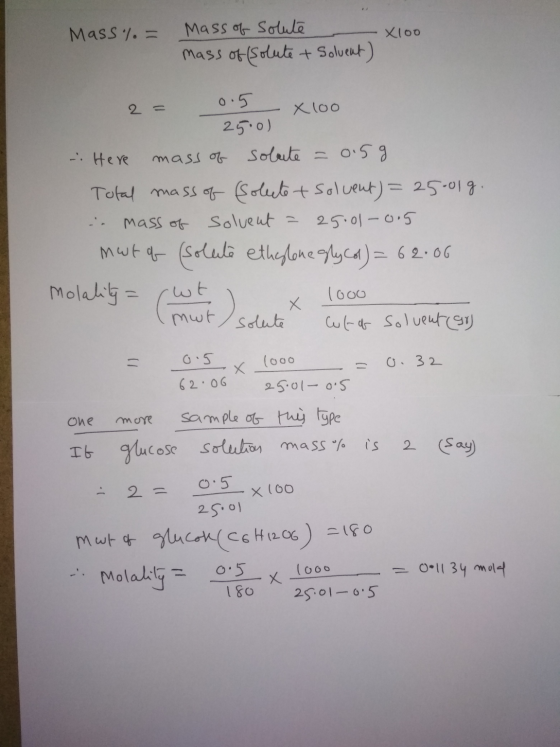
Show one sample calculation to convert from % mass to molality. This is a ethylene glycol...
Show one sample calculation to convert from % mass to molality.
This is a ethylene glycol solution.
Mass % Ethylene glycol= 2.00, molality=0.32
mass %: 2= (0.50/25.01)x100
molality: 0.32=(0.50 x (1/62.06)) / ((25.01-0.50) x 1/1000)
Homework Answers
Add Answer to:
Show one sample calculation to convert from % mass to
molality.
This is a ethylene glycol...
Show one sample calculation to find the Tf for a 52.0% mass solution (again, use the...
Show one sample calculation to find the Tf for a 52.0% mass solution (again, use the trendline from the molality graph). (Hint: convert 52.0% to correct units!) The equation is Tf=0.485(m)+-0.134 where Tf is freezing temperature and m is molality. I'm guessing you have to convert percent mass to molality but I don't know how to do that. EDIT: It is a Ethylene glycol solution, so molar mass is 62.06.
What is the molality of ethylene glycol, C2H4(OH)2, in a solution prepared from 2.22 × 10³...
What is the molality of ethylene glycol, C2H4(OH)2, in a solution prepared from 2.22 × 10³ g of ethylene glycol and 2.00 × 10³ g of water?
What is the molality of the 55.0 mass % ethylene glycol (C2H6O2) solution in the water...
What is the molality of the 55.0 mass % ethylene glycol (C2H6O2) solution in the water used for automobile antifreeze?
15. What is the molality of a solution made from 1 gal of ethylene glycol (density...
 15. What is the molality of a solution made from 1 gal of ethylene glycol (density 1.11 g/ml) and I gal of water (density 1.00 g/ml)? 4 pts 16. Determine the freezing point and boiling point for the aqueous solution in number 15 above. Water is the solvent. 4 pts
A solution of ethylene glycol in water at 20 degrees celsius has a mass percent of...
A solution of ethylene glycol in water at 20 degrees celsius has a mass percent of 9.78% of ethylene glycol with a density of 1.0108 g/mL. The freezing point depression constant for water (solvent for all solutions) is Kf=-1.86 percent celsius kg/mol and the boiling point elevation constant is Kb=0.512 degrees celsius kg/mol. The density of neat water at 20.0 degrees celsius is 0.9982 g/mL. Answer the following: 1. What is the molarity of the solution? 2. What is the...
A solution of ethylene glycol in water at 20.0°C has a mass percent of 8.25% of...
 A solution of ethylene glycol in water at 20.0°C has a mass percent of 8.25% of ethylene glycol with a density of 1.0087 g/mL. The freezing point depression constant for water (which you can assume is the solvent for all solutions) is K1.86°C kg/mol and the boiling point elevation constant is Kb the following: 0.512°C kg/mol. The density of neat water at 20.0°C is 0.9982 g/ml. Answer 1. What is the molarity of the solution? 2. What is the molality...
Antifreeze is ethylene glycol, C2H4(OH)2 and is made from ethylene which is produced from oil. It...
Antifreeze is ethylene glycol, C2H4(OH)2 and is made from ethylene which is produced from oil. It is miscible in water (i.e., dissolves in any proportion), does not dissociate in water, is toxic to drink (especially to dogs who like the sweet taste), but fortunately is biodegradable and at normal automobile operating temperatures, is not flammable. It can prevent freezing of the automobile cooling system down to -34oF and the advertisement says “winter - summer automobile coolant” — it also prevents...
2. Calculate the concentrations of solutions 1-7 from the procedure step 2. Show one sample calculation....
 2. Calculate the concentrations of solutions 1-7 from the procedure step 2. Show one sample calculation. Test Tube # Concentration (M) 2. Prepare one solution at a time by pipeting the following volumes into a small beaker for mixing, then transfer the solution to the appropriate test tube. Test Tube No. 0.150 M COCI, (m.) 2.00 4.00 5.00 6.00 7.00 8.00 10.00 Distilled H,O (mL) 8.00 6.00 5.00 4.00 3.00 2.00 0.00
i need help using the formula in the 3rd picture , to figure picture 2(the molar...
 i need help using the formula in the 3rd picture , to figure
picture 2(the molar mass). I included needed information in picture
1
Pure TBA, T9 Ethylene Glycol/TBA Solution, T Calculation of Molar Mass of Ethylene Glycol Mass of ethylene glycol used (total amount in solution) .94 253 t Mass of TBA used Freezing point of pure TBA, T Freezing point of solution, T, oC oc oC Freezing point depression (total dgpression), 471 Total molal concentration m of ethylene...
i need help using the formula in the 3rd picture , to figure
picture 2(the molar mass). I included needed information in picture
1
Pure TBA, T9 Ethylene Glycol/TBA Solution, T Calculation of Molar Mass of Ethylene Glycol Mass of ethylene glycol used (total amount in solution) .94 253 t Mass of TBA used Freezing point of pure TBA, T Freezing point of solution, T, oC oc oC Freezing point depression (total dgpression), 471 Total molal concentration m of ethylene...
26.)Show the calculation of the mass of NaNO3 needed to make 450 ml of a 0.356...
26.)Show the calculation of the mass of NaNO3 needed to make 450 ml of a 0.356 M solution. 25.)Show the calculation of the molarity of a solution made by dissolving 15.9 grams of Ca3(PO4)2 to make 350 ml of solution. 24.)Show the calculation of the molarity of a solution made by dissolving 12.6 grams of NaNO3 to make 200 ml of solution. 23.Show the calculation of the molality of a solution made by dissolving 15.9 grams of Ca3(PO4)2 in 400...
 15. What is the molality of a solution made from 1 gal of ethylene glycol (density 1.11 g/ml) and I gal of water (density 1.00 g/ml)? 4 pts 16. Determine the freezing point and boiling point for the aqueous solution in number 15 above. Water is the solvent. 4 pts
 A solution of ethylene glycol in water at 20.0°C has a mass percent of 8.25% of ethylene glycol with a density of 1.0087 g/mL. The freezing point depression constant for water (which you can assume is the solvent for all solutions) is K1.86°C kg/mol and the boiling point elevation constant is Kb the following: 0.512°C kg/mol. The density of neat water at 20.0°C is 0.9982 g/ml. Answer 1. What is the molarity of the solution? 2. What is the molality...
 2. Calculate the concentrations of solutions 1-7 from the procedure step 2. Show one sample calculation. Test Tube # Concentration (M) 2. Prepare one solution at a time by pipeting the following volumes into a small beaker for mixing, then transfer the solution to the appropriate test tube. Test Tube No. 0.150 M COCI, (m.) 2.00 4.00 5.00 6.00 7.00 8.00 10.00 Distilled H,O (mL) 8.00 6.00 5.00 4.00 3.00 2.00 0.00
 i need help using the formula in the 3rd picture , to figure
picture 2(the molar mass). I included needed information in picture
1
Pure TBA, T9 Ethylene Glycol/TBA Solution, T Calculation of Molar Mass of Ethylene Glycol Mass of ethylene glycol used (total amount in solution) .94 253 t Mass of TBA used Freezing point of pure TBA, T Freezing point of solution, T, oC oc oC Freezing point depression (total dgpression), 471 Total molal concentration m of ethylene...
i need help using the formula in the 3rd picture , to figure
picture 2(the molar mass). I included needed information in picture
1
Pure TBA, T9 Ethylene Glycol/TBA Solution, T Calculation of Molar Mass of Ethylene Glycol Mass of ethylene glycol used (total amount in solution) .94 253 t Mass of TBA used Freezing point of pure TBA, T Freezing point of solution, T, oC oc oC Freezing point depression (total dgpression), 471 Total molal concentration m of ethylene...
Most questions answered within 3 hours.
-
Where is the error in this code sequence?
String s1 = "Hello";
String s2 = "ello";...
asked 10 months ago -
Financial data for Joel de Paris, Inc., for last year
follow:
Joel de Paris, Inc.
Balance...
asked 10 months ago -
Consider this reaction:
Al2(SO4)3 (aq)+ BaCl3
(aq) Al2Cl6 (aq)- +
3BaSO4(s) . What is the...
asked 10 months ago -
Suppose that Savneet is considering increasing her
recent random sample from 20 car rentals to 40...
asked 10 months ago -
Trucks arrive at an unloading terminal at an average rate of 120
per hour.
Trucks arrive...
asked 10 months ago -
Why are methanol and ethanol completely soluble in water while
octanol is not very little soluble....
asked 10 months ago -
A facilities manager at a university reads in a research report
that the mean amount of...
asked 10 months ago -
When the CuSO4 is rehydrated by adding water to the anhydrous
compound, is this an endothermic...
asked 10 months ago -
A ray of sunlight is passing from diamond into crown glass; the
angle of incidence is...
asked 10 months ago -
A block of mass 0.249 kg is placed on top of a light, vertical
spring of...
asked 10 months ago -
how do the kidneys compensate in the presences of acidosis
a) trigger hyperventilate
b) reserve acid...
asked 10 months ago -
Question 501 pts
The rental rate of capital to the firm increases. Which of the
following...
asked 10 months ago