
Homework Answers

1 mole of P4 gives 4 moles of PH3 as per balanced reaction
Hence Blank 1 will be 1 and Blank 2 will be 4
6 mole of H2 gives 4 moles of PH3 as per balanced reaction
Hence Blank 3 will be 6 and Blank 4 will be 4
1 mole of P4 reacts with 6 moles of H2 as per balanced reaction
Hence Blank 5 will be 1 and Blank 6 will be 6
Note - Post any doubts/queries in comments section.
Add Answer to:
Question 1 P4 (s) + 6 H2(g) → 4 PH3(g) What are the correct mole ratios...
Consider the reaction 4 PH3(g) → P4(g) + 6 H2(g). If, in a certain experiment, over...
Consider the reaction 4 PH3(g) → P4(g) + 6 H2(g). If, in a certain experiment, over a specific time period, 0.0045 mole of PH3 is consumed in a 1.7-L container during each second of the reaction, what are the rates of production of P4 and H2 in this experiment? P4 mol L−1 s−1 H2 mol L−1 s−1
The decomposition of phosphine, PH3, follows first-order kinetics: 4 PH3(g) → P4(g) + 6 H2(g) Calculate...
 The decomposition of phosphine, PH3, follows first-order kinetics: 4 PH3(g) → P4(g) + 6 H2(g) Calculate the activation energy, Eq, in kJ/mol for the reaction, given that the rate constant k (at 25 °C) = 0.00852 s 1 and k (at 50 °C) = 0.756 s 1. 231 kJ/mol 144 kJ/mol O 56.5 kJ/mol О 99.3 kJ/mol O 111 kJ/mol
The balanced equation P4 (s) + 6H2 (g) --> 4PH3 tells us that 2 mol H2 a
8. The balanced equation P4 (s) + 6H2 (g) --> 4PH3 tells us that 2 mol H2 a. reacts with 1 mol 4 b. produces 4 mol PH3 c. cannot react with phosphorus d. produces 2 mol PH3 e. reacts with 2 mol P4 idk y i cant seem to get the answer from the choices above?
For the gas phase decomposition of phosphine at 120 °C 4 PH3(g)P4(g) + 6 H2(g) the...
For the gas phase decomposition of phosphine at 120 °C 4 PH3(g)P4(g) + 6 H2(g) the average rate of disappearance of PH3 over the time period from t = 0 s to t = 27 s is found to be 2.63×10⁻⁴ M s-1. The average rate of formation of H2 over the same time period is________ M s-1.
The gas phase decomposition of phosphine at 120 °C PH3(g)1/4 P4(g) + 3/2 H2(g) is first...
The gas phase decomposition of phosphine at 120 °C PH3(g)1/4 P4(g) + 3/2 H2(g) is first order in PH3 with a rate constant of 1.80×10⁻² s-1. If the initial concentration of PH3 is 5.86×10⁻² M, the concentration of PH3 will be 1.43×10⁻² M after s have passed.
Question 4 1 pts Which of the following mole ratios CANNOT be derived from the reaction 2 502 (g) + O2 (g) + 2 H2...
 Question 4 1 pts Which of the following mole ratios CANNOT be derived from the reaction 2 502 (g) + O2 (g) + 2 H20 (1) --> 2 H2SO4 (aq) ? 02 mol SO2 2 mol H2SO4 2 mol H2SO4 2 mol O2 0 1 mol O2 2 mol H20 O 2 mol O2 1 mol O2 2 mol H20 2 mol SO2 Question 1 1 pts What do the coefficients in a balanced equation tell us? Mark ALL that...
[14.117] The rate of the reaction 4 PH3() → P4(3) + 6 H2(8) was studied by...
 [14.117] The rate of the reaction 4 PH3() → P4(3) + 6 H2(8) was studied by charging PHz(8) into a constant-volume reac- tion vessel and measuring the total pressure. Time (s) 0 30 60 90 120 13.3 18.5 20.9 22.1 22.8 Determine the reaction order and also the rate constant for the reaction. total (kPa)
The following data are for the gas phase decomposition of phosphine at 120 °C. PH3(g) 1/4...
The following data are for the gas phase decomposition of phosphine at 120 °C. PH3(g) 1/4 P4(g) + 3/2 H2(g) [ PH3 ], M 4.94×10⁻² 2.47×10⁻² 1.24×10⁻² 6.20×10⁻³ time, s 0 25.8 51.6 77.4 Hint: It is not necessary to graph these data. (1) The half life observed for this reaction is__ s . (2) Based on these data, the rate constant for this order reaction is__ s -1
Question 1 --> 2NH3 Determine the correct mole ratios based on the following reaction: N2 +...
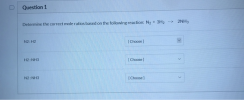 Question 1 --> 2NH3 Determine the correct mole ratios based on the following reaction: N2 + 3H2 N2:H2 [Choose H2: NH3 [Choose N2: NH3 [Choose]
3(20 pts) Consider the data: P4(s) + 6 Cl2(g) ----> 4 PC13(g) P4(s) + 5 O2(g)...
 3(20 pts) Consider the data: P4(s) + 6 Cl2(g) ----> 4 PC13(g) P4(s) + 5 O2(g) -----> P4010(s) PC13(g) + Cl2(g) ---> PCls(g) PC13(g) + 1/2O2(g) ----> C13PO(g) AH° (kJ/mol) -1226.6 -2967.3 -84.2 -285.7 Using only the above reaction data, compute the AHX of P4010(s) + 6 PCls(8) ----> 10 C13PO (g)
 The decomposition of phosphine, PH3, follows first-order kinetics: 4 PH3(g) → P4(g) + 6 H2(g) Calculate the activation energy, Eq, in kJ/mol for the reaction, given that the rate constant k (at 25 °C) = 0.00852 s 1 and k (at 50 °C) = 0.756 s 1. 231 kJ/mol 144 kJ/mol O 56.5 kJ/mol О 99.3 kJ/mol O 111 kJ/mol
 Question 4 1 pts Which of the following mole ratios CANNOT be derived from the reaction 2 502 (g) + O2 (g) + 2 H20 (1) --> 2 H2SO4 (aq) ? 02 mol SO2 2 mol H2SO4 2 mol H2SO4 2 mol O2 0 1 mol O2 2 mol H20 O 2 mol O2 1 mol O2 2 mol H20 2 mol SO2 Question 1 1 pts What do the coefficients in a balanced equation tell us? Mark ALL that...
 [14.117] The rate of the reaction 4 PH3() → P4(3) + 6 H2(8) was studied by charging PHz(8) into a constant-volume reac- tion vessel and measuring the total pressure. Time (s) 0 30 60 90 120 13.3 18.5 20.9 22.1 22.8 Determine the reaction order and also the rate constant for the reaction. total (kPa)
 Question 1 --> 2NH3 Determine the correct mole ratios based on the following reaction: N2 + 3H2 N2:H2 [Choose H2: NH3 [Choose N2: NH3 [Choose]
 3(20 pts) Consider the data: P4(s) + 6 Cl2(g) ----> 4 PC13(g) P4(s) + 5 O2(g) -----> P4010(s) PC13(g) + Cl2(g) ---> PCls(g) PC13(g) + 1/2O2(g) ----> C13PO(g) AH° (kJ/mol) -1226.6 -2967.3 -84.2 -285.7 Using only the above reaction data, compute the AHX of P4010(s) + 6 PCls(8) ----> 10 C13PO (g)
Most questions answered within 3 hours.
-
Where is the error in this code sequence?
String s1 = "Hello";
String s2 = "ello";...
asked 10 months ago -
Financial data for Joel de Paris, Inc., for last year
follow:
Joel de Paris, Inc.
Balance...
asked 10 months ago -
Consider this reaction:
Al2(SO4)3 (aq)+ BaCl3
(aq) Al2Cl6 (aq)- +
3BaSO4(s) . What is the...
asked 10 months ago -
Suppose that Savneet is considering increasing her
recent random sample from 20 car rentals to 40...
asked 10 months ago -
Trucks arrive at an unloading terminal at an average rate of 120
per hour.
Trucks arrive...
asked 10 months ago -
Why are methanol and ethanol completely soluble in water while
octanol is not very little soluble....
asked 10 months ago -
A facilities manager at a university reads in a research report
that the mean amount of...
asked 10 months ago -
When the CuSO4 is rehydrated by adding water to the anhydrous
compound, is this an endothermic...
asked 10 months ago -
A ray of sunlight is passing from diamond into crown glass; the
angle of incidence is...
asked 10 months ago -
A block of mass 0.249 kg is placed on top of a light, vertical
spring of...
asked 10 months ago -
how do the kidneys compensate in the presences of acidosis
a) trigger hyperventilate
b) reserve acid...
asked 10 months ago -
Question 501 pts
The rental rate of capital to the firm increases. Which of the
following...
asked 10 months ago