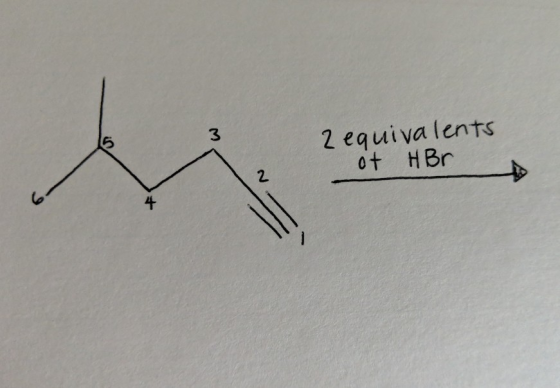
What is the name of the product of the reaction?
(please explain, show work)
a. 1,1-dibromo-5-methylhexane
b. 1,2-dibromo-5-methylhexane
c. 1,2-dibromo-5-methyl-1-hexene
d. 2,2-dibromo-5-methylhexane
e. 1,1,2,2-tetrabromo-5-methylhexane
Homework Answers
Answer:-
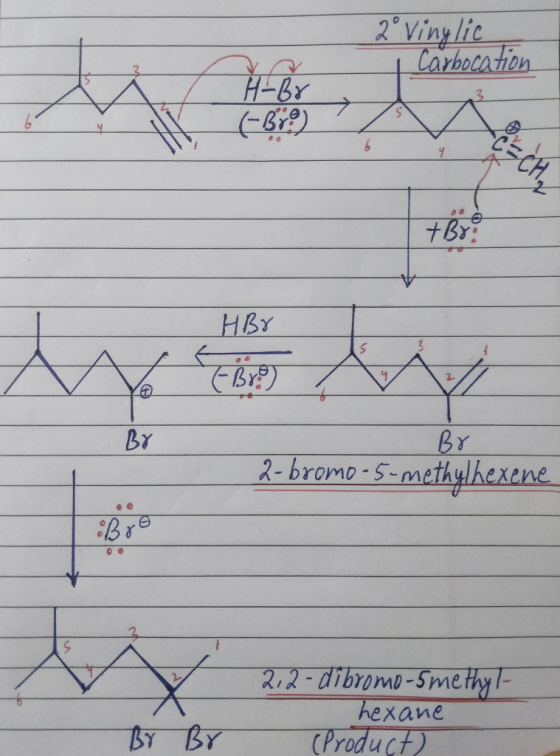
"Option d): 2,2-dibromo-5-methylhexane " is correct answer.
Terminal alkynes add two molecules of HBr to form a dibromoalkane. The addition occurs according to markovnikov's rule.
Mechanism:-
-----------------------------------------------------------------------------
Add Answer to:
What is the name of the product of the reaction?
(please explain, show work)
a. 1,1-dibromo-5-methylhexane...
1.1What is the major product formed upon radical bromination of (S)-3-methylhexane? Select the best response. Draw...
1.1What is the major product formed upon radical bromination of (S)-3-methylhexane? Select the best response. Draw the full mechanism. A. (S)-3-bromo-3-methylhexane B. (R)-3-bromo-3-methylhexane C. A mixture of (R) and (S) 3-Bromo-3-methylhexane D. (3R)-1-bromo-3-methylhexane 1.2 What is the major product obtained from the reaction of 2-methyl-2-butene with hydrogen bromide in the presence of peroxides?Select the best response. Draw the mechanism. A. 2,3-dibromo-2-methylbutane B. 2-bromo-3-methylbutane C. 2-bromo-2-methylbutane D. (E)-1-bromo-2-methyl-2-butene 1.3 There are 4 major products formed upon treatment of (E)-3-methyl-2-hexene with HBr...
please help me with questions from 3-10! and the bonus. thank you so much Directions: Place...
 please help me with questions from 3-10! and the bonus.
thank you so much
Directions: Place your answers to the following questions in the provided spaces. (12 PTS) 1. What is the hybridization of the carbon atoms numbered 1 and 2 respectively in the following structure? -CU CECH A. B sp,sp? sp, sp sp, sp sp', sp sp, sp Ans. 2. What is the IUPAC name for the molecule shown below? os B. C. D. E. (E)-5-methyl-5-hepten-1-yne (2)-5-methyl-5-hepten-1-yne (E)-3-methyl-2-hepten-6-yne (2)-3-methyl-2-hepten-6-yne...
please help me with questions from 3-10! and the bonus.
thank you so much
Directions: Place your answers to the following questions in the provided spaces. (12 PTS) 1. What is the hybridization of the carbon atoms numbered 1 and 2 respectively in the following structure? -CU CECH A. B sp,sp? sp, sp sp, sp sp', sp sp, sp Ans. 2. What is the IUPAC name for the molecule shown below? os B. C. D. E. (E)-5-methyl-5-hepten-1-yne (2)-5-methyl-5-hepten-1-yne (E)-3-methyl-2-hepten-6-yne (2)-3-methyl-2-hepten-6-yne...
please help me with Organic Chemistry/Alkynes. Thank you! Directions: Place your answers to the following questio...
 please help me with Organic Chemistry/Alkynes. Thank you!
Directions: Place your answers to the following questions in the provided spaces. (12 PTS) 1. What is the hybridization of the carbon atoms numbered 1 and 2 respectively in the following structure? -CI CECH A. B sp,sp? sp?sp? sp, sp sp, sp sp, sp E. Ans. - 2. What is the IUPAC name for the molecule shown below? 6b А. B. (E)-5-methyl-5-hepten-1-yne (2)-5-methyl-5-hepten-1-yne (E)-3-methyl-2-hepten-6-yne (2)-3-methyl-2-hepten-6-yne (E)-2-butynyl-2-butene E. Ans. Select the best explanation...
please help me with Organic Chemistry/Alkynes. Thank you!
Directions: Place your answers to the following questions in the provided spaces. (12 PTS) 1. What is the hybridization of the carbon atoms numbered 1 and 2 respectively in the following structure? -CI CECH A. B sp,sp? sp?sp? sp, sp sp, sp sp, sp E. Ans. - 2. What is the IUPAC name for the molecule shown below? 6b А. B. (E)-5-methyl-5-hepten-1-yne (2)-5-methyl-5-hepten-1-yne (E)-3-methyl-2-hepten-6-yne (2)-3-methyl-2-hepten-6-yne (E)-2-butynyl-2-butene E. Ans. Select the best explanation...
Draw the structure for 3-isobutyl-4-methylhexane. What is the correct IUPAC name for this structure? Select one:...
 Draw the structure for 3-isobutyl-4-methylhexane. What is the correct IUPAC name for this structure? Select one: a. 2,3-diethyl-5-methylhexane O b. 2-methyl-4-isobutylhexane c. 3-methyl-4-isobutylhexane d. 1,1-dimethyl-3-ethylhexane O e. 4-ethyl-2,5-dimethylheptane
Draw the structure for 3-isobutyl-4-methylhexane. What is the correct IUPAC name for this structure? a. 3-methyl-4-isobutylhexane...
Draw the structure for 3-isobutyl-4-methylhexane. What is the correct IUPAC name for this structure? a. 3-methyl-4-isobutylhexane b. 2,3-diethyl-5-methylhexane c. 4-ethyl-2,5-dimethylheptane d. 2-methyl-4-isobutylhexane e. 1,1-dimethyl-3-ethylhexane
Name: 5. Identify the correct statement for the given reactions given. - Reaction A Reaction B...
 Name: 5. Identify the correct statement for the given reactions given. - Reaction A Reaction B Room Temp. CH, a. Reaction A is an allylic halogenation reaction, and reaction B is an electrophilic addition reaction. b. Reaction A is an electrophilic addition reaction, and reaction B is an allylic substitution reaction. c. Reactions A and B are allylic substitution reactions. d. Reaction A is a displacement reaction, and reaction B is an allylic halogenation reaction. 6. The reaction of methyl...
Match the compounds (1-5) below with the correct IUPAC name (A-E) on the right. Use the...
 Match the compounds (1-5) below with the correct IUPAC name
(A-E) on the right. Use the dropdown menus to select the
answer.
Match the compounds (1-5) below with the correct IUPAC name (A-E) on the right. Use the dropdown menus to select the answer. Compound 1 Br Compound 2 Br A. 2,2-dibromo-3,4-dimethylpentane B. 1,3-dibromo-2-methylcyclohexane Compound 3 Br Br C. 1,5-dibromoheptane es D. 3,5-dibromo-2-methylhexane E. 2,4-dibromo-3-ethylpentane Compound 4 Compound 2 Br A. 2,2-dibromo-3,4-dimethylpentane Compound 3 Br Br B. 1,3-dibromo-2-methylcyclohexane C. 1,5-dibromoheptane...
Match the compounds (1-5) below with the correct IUPAC name
(A-E) on the right. Use the dropdown menus to select the
answer.
Match the compounds (1-5) below with the correct IUPAC name (A-E) on the right. Use the dropdown menus to select the answer. Compound 1 Br Compound 2 Br A. 2,2-dibromo-3,4-dimethylpentane B. 1,3-dibromo-2-methylcyclohexane Compound 3 Br Br C. 1,5-dibromoheptane es D. 3,5-dibromo-2-methylhexane E. 2,4-dibromo-3-ethylpentane Compound 4 Compound 2 Br A. 2,2-dibromo-3,4-dimethylpentane Compound 3 Br Br B. 1,3-dibromo-2-methylcyclohexane C. 1,5-dibromoheptane...
1. What is the IUPAC name for the following compound? CH3 CI CH3-CH-C- CH-CH CH3 CH3...
 1. What is the IUPAC name for the following compound? CH3 CI CH3-CH-C- CH-CH CH3 CH3 A) 4-chloro-4,5-dimethyl-2-hexene B) 3-chloro-1,3,4-trimethyl-1-pentene C) 3-chloro-2,3-dimethyl-4-hexene D) 3-chloro-2,3,5-trimethyl-4-pentene E) 3-chloro-1,3,4,4-tetramethyl-1-butene 2. Name the following compound. CH-CH2 CH,CH CH CCH H-CH A) 2,2-diethylpenatane B) 2,2-diethylpentene C) 4-ethyl-4-methyl-5-hexene D) 3-ethyl-3-methyl-1-hexene E) 4-ethyl-4-methylhexane 3. Name the following compound. CH CH CH, CH,CH CC CH CH2CH CH A) 3-butyl-3-propyl-1-pentyne B) 3-butyl-3-propyl-4-pentyne C) 3-ethyl-3-propyl-1-heptyne D) 5-ethyl-5-propyl-6-heptyne E) 3-ethyl-3-butyl-1-hexyne
write condensed structures fore each of the following compounds Homework Problems 7.1 Write condensed structures for...
 write condensed structures fore each of the following
compounds
Homework Problems 7.1 Write condensed structures for each of the following compounds: a. 2,2,4-trimethylpentane b. 5-isopropyl-2-methyloctane c. 1,1,3,3-tetrabromopropane d. 1,1-dichlorocyclopentane e. 1,4-diethylcyclohexane f. 1-bromo-2-methylcyclobutane What are the IUPAC names of the following compounds? 7.2 CH2CH, CH3 a) CH, C CH, CH, CH СH,CH, сн, CH2CH, b) CH2CH d) (CH),CCH2CH e) F Br Br Write the structural formulas and names for FOUR isomers of cycloalkane, CSH10. 7.3 7.4 Propose structures for molecules...
write condensed structures fore each of the following
compounds
Homework Problems 7.1 Write condensed structures for each of the following compounds: a. 2,2,4-trimethylpentane b. 5-isopropyl-2-methyloctane c. 1,1,3,3-tetrabromopropane d. 1,1-dichlorocyclopentane e. 1,4-diethylcyclohexane f. 1-bromo-2-methylcyclobutane What are the IUPAC names of the following compounds? 7.2 CH2CH, CH3 a) CH, C CH, CH, CH СH,CH, сн, CH2CH, b) CH2CH d) (CH),CCH2CH e) F Br Br Write the structural formulas and names for FOUR isomers of cycloalkane, CSH10. 7.3 7.4 Propose structures for molecules...
1.1 What is the major product formed upon treatment of (R) 1-bromo-4-methylhexane with sodium cyanide? Draw...
 1.1 What is the major product formed upon treatment of (R)
1-bromo-4-methylhexane with sodium cyanide? Draw the structure of
your selection.
a.(R) 1-cyano-4-methylhexane
b.(S) 1-cyano-4-methylhexane
c.(R) 4-methyl-1-hexene
d.(S) 4-methyl-1-hexene
1.2 What is the major product formed upon treatment of (R)
2-bromohexane with sodium cyanide? Draw the structure of your
selection
a.(R) 2-cyanohexane
b.(S)2-cyanohexane
c. 1-hexene
d. 2-hexene
1.3 Select the major organic product obtained from the following
reaction
1.4 Select the major organic product obtained from the following
reaction
1.5...
1.1 What is the major product formed upon treatment of (R)
1-bromo-4-methylhexane with sodium cyanide? Draw the structure of
your selection.
a.(R) 1-cyano-4-methylhexane
b.(S) 1-cyano-4-methylhexane
c.(R) 4-methyl-1-hexene
d.(S) 4-methyl-1-hexene
1.2 What is the major product formed upon treatment of (R)
2-bromohexane with sodium cyanide? Draw the structure of your
selection
a.(R) 2-cyanohexane
b.(S)2-cyanohexane
c. 1-hexene
d. 2-hexene
1.3 Select the major organic product obtained from the following
reaction
1.4 Select the major organic product obtained from the following
reaction
1.5...
 please help me with questions from 3-10! and the bonus.
thank you so much
Directions: Place your answers to the following questions in the provided spaces. (12 PTS) 1. What is the hybridization of the carbon atoms numbered 1 and 2 respectively in the following structure? -CU CECH A. B sp,sp? sp, sp sp, sp sp', sp sp, sp Ans. 2. What is the IUPAC name for the molecule shown below? os B. C. D. E. (E)-5-methyl-5-hepten-1-yne (2)-5-methyl-5-hepten-1-yne (E)-3-methyl-2-hepten-6-yne (2)-3-methyl-2-hepten-6-yne...
please help me with questions from 3-10! and the bonus.
thank you so much
Directions: Place your answers to the following questions in the provided spaces. (12 PTS) 1. What is the hybridization of the carbon atoms numbered 1 and 2 respectively in the following structure? -CU CECH A. B sp,sp? sp, sp sp, sp sp', sp sp, sp Ans. 2. What is the IUPAC name for the molecule shown below? os B. C. D. E. (E)-5-methyl-5-hepten-1-yne (2)-5-methyl-5-hepten-1-yne (E)-3-methyl-2-hepten-6-yne (2)-3-methyl-2-hepten-6-yne...
 please help me with Organic Chemistry/Alkynes. Thank you!
Directions: Place your answers to the following questions in the provided spaces. (12 PTS) 1. What is the hybridization of the carbon atoms numbered 1 and 2 respectively in the following structure? -CI CECH A. B sp,sp? sp?sp? sp, sp sp, sp sp, sp E. Ans. - 2. What is the IUPAC name for the molecule shown below? 6b А. B. (E)-5-methyl-5-hepten-1-yne (2)-5-methyl-5-hepten-1-yne (E)-3-methyl-2-hepten-6-yne (2)-3-methyl-2-hepten-6-yne (E)-2-butynyl-2-butene E. Ans. Select the best explanation...
please help me with Organic Chemistry/Alkynes. Thank you!
Directions: Place your answers to the following questions in the provided spaces. (12 PTS) 1. What is the hybridization of the carbon atoms numbered 1 and 2 respectively in the following structure? -CI CECH A. B sp,sp? sp?sp? sp, sp sp, sp sp, sp E. Ans. - 2. What is the IUPAC name for the molecule shown below? 6b А. B. (E)-5-methyl-5-hepten-1-yne (2)-5-methyl-5-hepten-1-yne (E)-3-methyl-2-hepten-6-yne (2)-3-methyl-2-hepten-6-yne (E)-2-butynyl-2-butene E. Ans. Select the best explanation...
 Draw the structure for 3-isobutyl-4-methylhexane. What is the correct IUPAC name for this structure? Select one: a. 2,3-diethyl-5-methylhexane O b. 2-methyl-4-isobutylhexane c. 3-methyl-4-isobutylhexane d. 1,1-dimethyl-3-ethylhexane O e. 4-ethyl-2,5-dimethylheptane
 Name: 5. Identify the correct statement for the given reactions given. - Reaction A Reaction B Room Temp. CH, a. Reaction A is an allylic halogenation reaction, and reaction B is an electrophilic addition reaction. b. Reaction A is an electrophilic addition reaction, and reaction B is an allylic substitution reaction. c. Reactions A and B are allylic substitution reactions. d. Reaction A is a displacement reaction, and reaction B is an allylic halogenation reaction. 6. The reaction of methyl...
 Match the compounds (1-5) below with the correct IUPAC name
(A-E) on the right. Use the dropdown menus to select the
answer.
Match the compounds (1-5) below with the correct IUPAC name (A-E) on the right. Use the dropdown menus to select the answer. Compound 1 Br Compound 2 Br A. 2,2-dibromo-3,4-dimethylpentane B. 1,3-dibromo-2-methylcyclohexane Compound 3 Br Br C. 1,5-dibromoheptane es D. 3,5-dibromo-2-methylhexane E. 2,4-dibromo-3-ethylpentane Compound 4 Compound 2 Br A. 2,2-dibromo-3,4-dimethylpentane Compound 3 Br Br B. 1,3-dibromo-2-methylcyclohexane C. 1,5-dibromoheptane...
Match the compounds (1-5) below with the correct IUPAC name
(A-E) on the right. Use the dropdown menus to select the
answer.
Match the compounds (1-5) below with the correct IUPAC name (A-E) on the right. Use the dropdown menus to select the answer. Compound 1 Br Compound 2 Br A. 2,2-dibromo-3,4-dimethylpentane B. 1,3-dibromo-2-methylcyclohexane Compound 3 Br Br C. 1,5-dibromoheptane es D. 3,5-dibromo-2-methylhexane E. 2,4-dibromo-3-ethylpentane Compound 4 Compound 2 Br A. 2,2-dibromo-3,4-dimethylpentane Compound 3 Br Br B. 1,3-dibromo-2-methylcyclohexane C. 1,5-dibromoheptane...
 1. What is the IUPAC name for the following compound? CH3 CI CH3-CH-C- CH-CH CH3 CH3 A) 4-chloro-4,5-dimethyl-2-hexene B) 3-chloro-1,3,4-trimethyl-1-pentene C) 3-chloro-2,3-dimethyl-4-hexene D) 3-chloro-2,3,5-trimethyl-4-pentene E) 3-chloro-1,3,4,4-tetramethyl-1-butene 2. Name the following compound. CH-CH2 CH,CH CH CCH H-CH A) 2,2-diethylpenatane B) 2,2-diethylpentene C) 4-ethyl-4-methyl-5-hexene D) 3-ethyl-3-methyl-1-hexene E) 4-ethyl-4-methylhexane 3. Name the following compound. CH CH CH, CH,CH CC CH CH2CH CH A) 3-butyl-3-propyl-1-pentyne B) 3-butyl-3-propyl-4-pentyne C) 3-ethyl-3-propyl-1-heptyne D) 5-ethyl-5-propyl-6-heptyne E) 3-ethyl-3-butyl-1-hexyne
 write condensed structures fore each of the following
compounds
Homework Problems 7.1 Write condensed structures for each of the following compounds: a. 2,2,4-trimethylpentane b. 5-isopropyl-2-methyloctane c. 1,1,3,3-tetrabromopropane d. 1,1-dichlorocyclopentane e. 1,4-diethylcyclohexane f. 1-bromo-2-methylcyclobutane What are the IUPAC names of the following compounds? 7.2 CH2CH, CH3 a) CH, C CH, CH, CH СH,CH, сн, CH2CH, b) CH2CH d) (CH),CCH2CH e) F Br Br Write the structural formulas and names for FOUR isomers of cycloalkane, CSH10. 7.3 7.4 Propose structures for molecules...
write condensed structures fore each of the following
compounds
Homework Problems 7.1 Write condensed structures for each of the following compounds: a. 2,2,4-trimethylpentane b. 5-isopropyl-2-methyloctane c. 1,1,3,3-tetrabromopropane d. 1,1-dichlorocyclopentane e. 1,4-diethylcyclohexane f. 1-bromo-2-methylcyclobutane What are the IUPAC names of the following compounds? 7.2 CH2CH, CH3 a) CH, C CH, CH, CH СH,CH, сн, CH2CH, b) CH2CH d) (CH),CCH2CH e) F Br Br Write the structural formulas and names for FOUR isomers of cycloalkane, CSH10. 7.3 7.4 Propose structures for molecules...
 1.1 What is the major product formed upon treatment of (R)
1-bromo-4-methylhexane with sodium cyanide? Draw the structure of
your selection.
a.(R) 1-cyano-4-methylhexane
b.(S) 1-cyano-4-methylhexane
c.(R) 4-methyl-1-hexene
d.(S) 4-methyl-1-hexene
1.2 What is the major product formed upon treatment of (R)
2-bromohexane with sodium cyanide? Draw the structure of your
selection
a.(R) 2-cyanohexane
b.(S)2-cyanohexane
c. 1-hexene
d. 2-hexene
1.3 Select the major organic product obtained from the following
reaction
1.4 Select the major organic product obtained from the following
reaction
1.5...
1.1 What is the major product formed upon treatment of (R)
1-bromo-4-methylhexane with sodium cyanide? Draw the structure of
your selection.
a.(R) 1-cyano-4-methylhexane
b.(S) 1-cyano-4-methylhexane
c.(R) 4-methyl-1-hexene
d.(S) 4-methyl-1-hexene
1.2 What is the major product formed upon treatment of (R)
2-bromohexane with sodium cyanide? Draw the structure of your
selection
a.(R) 2-cyanohexane
b.(S)2-cyanohexane
c. 1-hexene
d. 2-hexene
1.3 Select the major organic product obtained from the following
reaction
1.4 Select the major organic product obtained from the following
reaction
1.5...
Most questions answered within 3 hours.
-
Where is the error in this code sequence?
String s1 = "Hello";
String s2 = "ello";...
asked 11 months ago -
Financial data for Joel de Paris, Inc., for last year
follow:
Joel de Paris, Inc.
Balance...
asked 11 months ago -
Consider this reaction:
Al2(SO4)3 (aq)+ BaCl3
(aq) Al2Cl6 (aq)- +
3BaSO4(s) . What is the...
asked 11 months ago -
Suppose that Savneet is considering increasing her
recent random sample from 20 car rentals to 40...
asked 11 months ago -
Trucks arrive at an unloading terminal at an average rate of 120
per hour.
Trucks arrive...
asked 11 months ago -
Why are methanol and ethanol completely soluble in water while
octanol is not very little soluble....
asked 11 months ago -
A facilities manager at a university reads in a research report
that the mean amount of...
asked 11 months ago -
When the CuSO4 is rehydrated by adding water to the anhydrous
compound, is this an endothermic...
asked 11 months ago -
A ray of sunlight is passing from diamond into crown glass; the
angle of incidence is...
asked 11 months ago -
A block of mass 0.249 kg is placed on top of a light, vertical
spring of...
asked 11 months ago -
how do the kidneys compensate in the presences of acidosis
a) trigger hyperventilate
b) reserve acid...
asked 11 months ago -
Question 501 pts
The rental rate of capital to the firm increases. Which of the
following...
asked 11 months ago