

Homework Answers
Add Answer to:
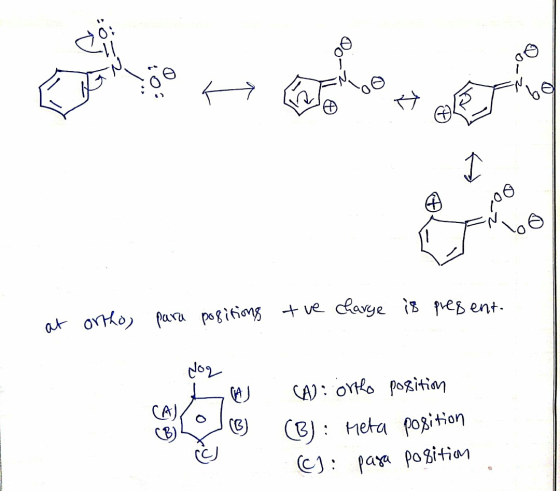
Part B The main resonance contributors of nitrobenzene are shown below. Use curved arrows to show...
Part A Use curved arrows to keep track of the electrons during the formation of an...
 Part A Use curved arrows to keep track of the electrons during the formation of an enclate 3,3-dimethylbutan-2-one methode anion methanololate anion of 3,3-dimethylbutan-2-one Edit the reaction by drawing all steps in the appropriate boxes and connecting them with reaction arrows. Add charges where needed. Electron flow arrows should start on an om or a bond and should and on an atom, bond, or location where a new bond should be created DHO ISO 1 Part B The acid catalyzed...
An Exercise in Drawing Curved Arrows: Pushing Electrons Use curved arrows to keep track of the...
 An Exercise in Drawing Curved Arrows: Pushing Electrons Use curved arrows to keep track of the electrons shown in the following reaction 1-odomethylcyclohexane r tiary cation + iodide anion Edit the reaction by drawing all steps in the appropriate boxes and connecting them with reaction arrows. Add charges where needed should end on an atom, bond, or location where a new bond should be created. View Available Hint(s) DOCH Om 0 + OZEE: ' ot' - Type here to search...
In the box on the right, draw the best resonance structure of the compound on the...
 In the box on the right, draw the best resonance structure of the compound on the left. Draw electron-flow arrows on the structure on the how the electrons reorganize to give the structure on the right. Edit the reaction by drawing all steps in the appropriate boxes and connecting them with reaction arrows. Add charges where needed, Electron flow arrows should start on an atom or a bond and should end on an atom, bond, or location where a new...
Use curved arrows to show the movement of electrons in the following reaction steps. (Hint: Look...
 Use curved arrows to show the movement of electrons in the following reaction steps. (Hint: Look at the reactants and look at the products and then draw the arrows to convert the reactants to products.) Part A Draw electron flow arrows. Electron flow arrows should start on an atom or a bond and should end on an atom, bond, or location where a new bond should be created. D ®, H: 6 mm 0 + i \' z o LOH...
The minor diol product is shown in this synthesis. Draw all missing curved arrows in the...
 The minor diol product is shown in this synthesis. Draw all missing curved arrows in the appropriate boxes by placing atoms on the canvas and connecting them with bonds. Electron flow arrows should start on an atom or a bond and should end on an atom, bond, or location where a new bond should be created.
Part Draw electron flow arrows. Electron flow arrows should start on an atom or a bond...
 Part Draw electron flow arrows. Electron flow arrows should start on an atom or a bond and should end on an atom, bond, or location where a new bond should be created DaH + 330 Hot 30.5 Draw electron flow arrows. Electron flow arrows should start on an atom or a bond and should end on an atom, bond, or location where a new bond should be created. D C H O + . \'330' %
Complete the mechanism of the following Diels-Alder reaction by drawing the curved arrows for the concerted...
Complete the mechanism of the following Diels-Alder reaction by drawing the curved arrows for the concerted reaction and the final product formed. (Note that the COOH group is a carboxylic acid group, which is electron withdrawing.) Interactive 3D display mode Draw all missing reactants and/or products in the appropriate boxes by placing atoms on the grid and connecting them with bonds, including charges where needed. Indicate the mechanism by drawing the electron-flow arrows on the molecules. Arrows should start on...
Draw all major resonance structures of the conjugate base of acetophenone. The most acidic hydrogen atom...
 Draw all major resonance structures of the conjugate base of acetophenone. The most acidic hydrogen atom in acetophenone is drawn in red. Interactive 3D display mode Draw the molecule on the canvas by choosing buttons from the Tools (for bonds), Atoms, and Advanced Template toolbars, including charges where needed. The single bond is active by default. Draw a mechanism for this reaction. Interactive 3D display mode Edit the reaction by drawing all steps in the appropriate boxes and connecting them...
Electrophilic Addition Mechanisms 1830 the electron flow arrows on the molecules. Arrows should start on an atom a...
 Electrophilic Addition Mechanisms 1830 the electron flow arrows on the molecules. Arrows should start on an atom a bond and should end on an atom, bond, or where a new bood should be created View Available Hints) D &HO
4. Consider the molecule BF3. Two possible resonance structures are shown below. :: a) Use curved...
 4. Consider the molecule BF3. Two possible resonance structures are shown below. :: a) Use curved arrows to show electron movement. b) Assign formal charges to each resonance contributor. c) Are both structures equally contributing to the resonance hybrid? Which is the better structure and why?
 Part A Use curved arrows to keep track of the electrons during the formation of an enclate 3,3-dimethylbutan-2-one methode anion methanololate anion of 3,3-dimethylbutan-2-one Edit the reaction by drawing all steps in the appropriate boxes and connecting them with reaction arrows. Add charges where needed. Electron flow arrows should start on an om or a bond and should and on an atom, bond, or location where a new bond should be created DHO ISO 1 Part B The acid catalyzed...
 An Exercise in Drawing Curved Arrows: Pushing Electrons Use curved arrows to keep track of the electrons shown in the following reaction 1-odomethylcyclohexane r tiary cation + iodide anion Edit the reaction by drawing all steps in the appropriate boxes and connecting them with reaction arrows. Add charges where needed should end on an atom, bond, or location where a new bond should be created. View Available Hint(s) DOCH Om 0 + OZEE: ' ot' - Type here to search...
 In the box on the right, draw the best resonance structure of the compound on the left. Draw electron-flow arrows on the structure on the how the electrons reorganize to give the structure on the right. Edit the reaction by drawing all steps in the appropriate boxes and connecting them with reaction arrows. Add charges where needed, Electron flow arrows should start on an atom or a bond and should end on an atom, bond, or location where a new...
 Use curved arrows to show the movement of electrons in the following reaction steps. (Hint: Look at the reactants and look at the products and then draw the arrows to convert the reactants to products.) Part A Draw electron flow arrows. Electron flow arrows should start on an atom or a bond and should end on an atom, bond, or location where a new bond should be created. D ®, H: 6 mm 0 + i \' z o LOH...
 The minor diol product is shown in this synthesis. Draw all missing curved arrows in the appropriate boxes by placing atoms on the canvas and connecting them with bonds. Electron flow arrows should start on an atom or a bond and should end on an atom, bond, or location where a new bond should be created.
 Part Draw electron flow arrows. Electron flow arrows should start on an atom or a bond and should end on an atom, bond, or location where a new bond should be created DaH + 330 Hot 30.5 Draw electron flow arrows. Electron flow arrows should start on an atom or a bond and should end on an atom, bond, or location where a new bond should be created. D C H O + . \'330' %
 Draw all major resonance structures of the conjugate base of acetophenone. The most acidic hydrogen atom in acetophenone is drawn in red. Interactive 3D display mode Draw the molecule on the canvas by choosing buttons from the Tools (for bonds), Atoms, and Advanced Template toolbars, including charges where needed. The single bond is active by default. Draw a mechanism for this reaction. Interactive 3D display mode Edit the reaction by drawing all steps in the appropriate boxes and connecting them...
 Electrophilic Addition Mechanisms 1830 the electron flow arrows on the molecules. Arrows should start on an atom a bond and should end on an atom, bond, or where a new bood should be created View Available Hints) D &HO
 4. Consider the molecule BF3. Two possible resonance structures are shown below. :: a) Use curved arrows to show electron movement. b) Assign formal charges to each resonance contributor. c) Are both structures equally contributing to the resonance hybrid? Which is the better structure and why?
Most questions answered within 3 hours.
-
Where is the error in this code sequence?
String s1 = "Hello";
String s2 = "ello";...
asked 10 months ago -
Financial data for Joel de Paris, Inc., for last year
follow:
Joel de Paris, Inc.
Balance...
asked 10 months ago -
Consider this reaction:
Al2(SO4)3 (aq)+ BaCl3
(aq) Al2Cl6 (aq)- +
3BaSO4(s) . What is the...
asked 10 months ago -
Suppose that Savneet is considering increasing her
recent random sample from 20 car rentals to 40...
asked 10 months ago -
Trucks arrive at an unloading terminal at an average rate of 120
per hour.
Trucks arrive...
asked 10 months ago -
Why are methanol and ethanol completely soluble in water while
octanol is not very little soluble....
asked 10 months ago -
A facilities manager at a university reads in a research report
that the mean amount of...
asked 10 months ago -
When the CuSO4 is rehydrated by adding water to the anhydrous
compound, is this an endothermic...
asked 10 months ago -
A ray of sunlight is passing from diamond into crown glass; the
angle of incidence is...
asked 10 months ago -
A block of mass 0.249 kg is placed on top of a light, vertical
spring of...
asked 10 months ago -
how do the kidneys compensate in the presences of acidosis
a) trigger hyperventilate
b) reserve acid...
asked 10 months ago -
Question 501 pts
The rental rate of capital to the firm increases. Which of the
following...
asked 10 months ago