A mixture of CH4 and H2O is passed over a catalyst at 1000 K. The emerging...
A mixture of CH4 and H2O is passed over a catalyst at 1000 K. The emerging gas is collected into a 5.00 L flask and is found to contain 8.62 g of CO, 2.60 g of H2, 43.0 g of CH4, and 48.4 g of H2O. The reaction is at equilibrium in the flask. Calculate Kc. The reaction is shown. HINT: calculate the [M] at equilibrium of each compound by converting g to moles and dividing by L. Show your Kc expression. [5pts]
CH4(g) + H2O(g) ⇋ CO(g) + 3 H2(g).
Homework Answers
The flask contains:-
8.62 g of CO
2.60 g of H2
43.0 g of CH4
48.4 g of H2O
First, we will convert the given mass of compounds into no. of moles and then using the no. of moles of compound and volume of flask we will find their concentrations:-
Finding the no. of moles of each compound:-
Molecular weight of CO = 28.01 g/mol
i.e., 28.01 g of CO = 1 mole
1 g of CO = (1/28.01) mole
8.62 g of CO = 8.62(1/28.01) moles
= 0.3077 moles
Molecular weight of H2 = 2.01 g/mol
i.e., 2.01 g of H2 = 1 mole
1 g of H2 = (1/2.01) mole
2.60 g of H2 = 2.60(1/2.01) moles
= 1.2935 moles
Molecular weight of CH4 = 16.04 g/mol
i.e., 16.04 g of CH4 = 1 mole
1 g of CH4 = (1/16.04) mole
43.0 g of CH4 = 43(1/16.04) moles
= 2.6808 moles
Molecular weight of H2O = 18.01 g/mol
i.e., 18.01 g of H2O = 1 mole
1 g of H2O = (1/18.01) mole
48.4 g of H2O = 48.4(1/18.01) moles
= 2.6874 moles
Finding the concentration of each compound:-
using the formula,

Volume of flask = 5.0 L -----(Given)
Concentration of CO = (0.3077/5) -----using equation(a)
[CO] = 0.0615 M
Concentration of H2 = (1.2935/5) -----using equation(a)
[H2] = 0.2587 M
Concentration of CH4 = (2.6808/5) -----using equation(a)
[CH4] = 0.5362 M
Concentration of H2O = (2.6874/5) -----using equation(a)
[H2O] = 0.5375 M
Balanced chemical equation at equilibrium:-
CH4(g) + H2O(g) ⇋ CO(g) + 3 H2(g)
The equilibrium constant, Kc, is the ratio of the equilibrium concentrations of products over the equilibrium concentrations of reactants each raised to the power of their stoichiometric coefficients.
Therefore, the expression for Kc can be written as,

putting the concentrations of each compound in equation(b), we get,
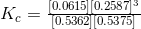
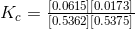

Kc = 0.0038
The value of Kc for the given reaction at equilibrium is
0.0038
Add Answer to:
A mixture of CH4 and H2O is passed over a catalyst at 1000 K.
The emerging...
A mixture of CH4 and H2O is passed over a nickel catalyst at 1000 K. The...
A mixture of CH4 and H2O is passed over a nickel catalyst at 1000 K. The emerging gas is collected at 5.00 L flask and is found to contain 8.62 g of CO 2.60 g of H2 43.0g of CH4 and 48.4g of H2O. Assuming that equilibrium has been reached calculate Keq for the reaction
A mixture of 0.05621 mol of H2O, 0.03410 mol of CH4, 0.04592 mol of CO, and...
 A mixture of 0.05621 mol of H2O, 0.03410 mol of
CH4, 0.04592 mol of CO, and 0.04764 mol of H2
is placed in a 1.0-L steel pressure vessel at 1350 K. The following
equilibrium is established:
1 H2O(g) + 1 CH4(g) 1 CO(g) + 3 H2(g)
At equilibrium 0.01484 mol of CH4 is found in the
reaction mixture.
(a) Calculate the equilibrium partial pressures of H2O,
CH4, CO, and H2.
Peq(H2O) = .
Peq(CH4) = .
Peq(CO) = .
Peq(H2) = .
(b) Calculate...
A mixture of 0.05621 mol of H2O, 0.03410 mol of
CH4, 0.04592 mol of CO, and 0.04764 mol of H2
is placed in a 1.0-L steel pressure vessel at 1350 K. The following
equilibrium is established:
1 H2O(g) + 1 CH4(g) 1 CO(g) + 3 H2(g)
At equilibrium 0.01484 mol of CH4 is found in the
reaction mixture.
(a) Calculate the equilibrium partial pressures of H2O,
CH4, CO, and H2.
Peq(H2O) = .
Peq(CH4) = .
Peq(CO) = .
Peq(H2) = .
(b) Calculate...
A mixture of 1.71e-02 mol of H2O, 6.70e-02 mol of CH4, 5.69e-02 mol of CO, and...
A mixture of 1.71e-02 mol of H2O, 6.70e-02 mol of CH4, 5.69e-02 mol of CO, and 8.50e-02 mol of H2 is placed in a 1.0-L steel pressure vessel at 1307 K. The following equilibrium is established: H2O(g) + CH4(g) CO(g) + 3 H2(g) At equilibrium 1.21e-02 mol of H2O is found in the reaction mixture. Calculate the equilibrium pressures of all gases in the reaction vessel and the value of KP for the reaction. Pick the correct statement from the...
The equilibrium constant Kc for the following reaction is 8.30. H2(g) + CO2(g) ↔ H2O(g) +...
The equilibrium constant Kc for the following reaction is 8.30. H2(g) + CO2(g) ↔ H2O(g) + CO(g) Initially, 0.40 moles each of H2 and CO2 are injected into a 9.00 L flask. Calculate the concentration of the CO(g) at equilibrium.
The equilibrium constant Kc for the following reaction is 6.40. H2(g) + CO2(g) ↔ H2O(g) +...
The equilibrium constant Kc for the following reaction is 6.40. H2(g) + CO2(g) ↔ H2O(g) + CO(g) Initially, 0.70 moles each of H2 and CO2 are injected into a 3.50 L flask. Calculate the concentration of the CO(g) at equilibrium.
A mixture of gases is at equilibrium: CH4 (g) + H2O (g) → CO (g) +...
A mixture of gases is at equilibrium: CH4 (g) + H2O (g) → CO (g) + 3 H2 (g) ∆H = 206.103 kJ (a) Does the equilibrium shift to the left or to the right when some H2O (g) is removed from the reaction mixture? (b) Does the equilibrium shift to the left or to the right when some CO (g) is removed from the reaction mixture? (c) In which direction does the equilibrium shift as the temperature is raised?...
Enter your answer in the provided box. For the reaction H2(g) + CO2(g) ⇆ H2O(g) +...
Enter your answer in the provided box. For the reaction H2(g) + CO2(g) ⇆ H2O(g) + CO(g) at 700°C, Kc = 0.534. Calculate the number of moles of H2 that are present at equilibrium if a mixture of 0.760 mole of CO and 0.760 mole of H2O is heated to 700°C in a 40.0−L container.
16. Enter your answer in the provided box. For the reaction H2(g) + CO2(g) ⇆ H2O(g)...
16. Enter your answer in the provided box. For the reaction H2(g) + CO2(g) ⇆ H2O(g) + CO(g) at 700°C, Kc = 0.534. Calculate the number of moles of H2 that are present at equilibrium if a mixture of 0.720 mole of CO and 0.720 mole of H2O is heated to 700°C in a 50.0−L container. _______ mol
Consider the following reaction: CO(g)+2H2(g)⇌CH3OH(g) A reaction mixture in a 5.17 −L flask at a certain...
Consider the following reaction: CO(g)+2H2(g)⇌CH3OH(g) A reaction mixture in a 5.17 −L flask at a certain temperature contains 27.0 g CO and 2.35 g H2. At equilibrium, the flask contains 8.67 g CH3OH. Calculate the equilibrium constant (Kc) for the reaction at this temperature. Kc=?
w ten species is the catalyst? 6. A mixture with [N:04) - 0.90 and [NO:] =...
 w ten species is the catalyst? 6. A mixture with [N:04) - 0.90 and [NO:] = 0.134 at 25°C is at equilibrium as follows: N:04(g) = 2 NOxg) What is the equilibrium constant, Ke, for the reaction? 7. Consider the reaction: C(s) + CO (g) = 2 CO(g), Ke=0.113 at 25°C An equilibrium mixture at 25°C was found to have a CO, concentration of 0.200 M. What is the CO concentration? 8. If Kc - 35 x 10 at 500...
 A mixture of 0.05621 mol of H2O, 0.03410 mol of
CH4, 0.04592 mol of CO, and 0.04764 mol of H2
is placed in a 1.0-L steel pressure vessel at 1350 K. The following
equilibrium is established:
1 H2O(g) + 1 CH4(g) 1 CO(g) + 3 H2(g)
At equilibrium 0.01484 mol of CH4 is found in the
reaction mixture.
(a) Calculate the equilibrium partial pressures of H2O,
CH4, CO, and H2.
Peq(H2O) = .
Peq(CH4) = .
Peq(CO) = .
Peq(H2) = .
(b) Calculate...
A mixture of 0.05621 mol of H2O, 0.03410 mol of
CH4, 0.04592 mol of CO, and 0.04764 mol of H2
is placed in a 1.0-L steel pressure vessel at 1350 K. The following
equilibrium is established:
1 H2O(g) + 1 CH4(g) 1 CO(g) + 3 H2(g)
At equilibrium 0.01484 mol of CH4 is found in the
reaction mixture.
(a) Calculate the equilibrium partial pressures of H2O,
CH4, CO, and H2.
Peq(H2O) = .
Peq(CH4) = .
Peq(CO) = .
Peq(H2) = .
(b) Calculate...
 w ten species is the catalyst? 6. A mixture with [N:04) - 0.90 and [NO:] = 0.134 at 25°C is at equilibrium as follows: N:04(g) = 2 NOxg) What is the equilibrium constant, Ke, for the reaction? 7. Consider the reaction: C(s) + CO (g) = 2 CO(g), Ke=0.113 at 25°C An equilibrium mixture at 25°C was found to have a CO, concentration of 0.200 M. What is the CO concentration? 8. If Kc - 35 x 10 at 500...
Most questions answered within 3 hours.
-
Where is the error in this code sequence?
String s1 = "Hello";
String s2 = "ello";...
asked 11 months ago -
Financial data for Joel de Paris, Inc., for last year
follow:
Joel de Paris, Inc.
Balance...
asked 11 months ago -
Consider this reaction:
Al2(SO4)3 (aq)+ BaCl3
(aq) Al2Cl6 (aq)- +
3BaSO4(s) . What is the...
asked 11 months ago -
Suppose that Savneet is considering increasing her
recent random sample from 20 car rentals to 40...
asked 11 months ago -
Trucks arrive at an unloading terminal at an average rate of 120
per hour.
Trucks arrive...
asked 11 months ago -
Why are methanol and ethanol completely soluble in water while
octanol is not very little soluble....
asked 11 months ago -
A facilities manager at a university reads in a research report
that the mean amount of...
asked 11 months ago -
When the CuSO4 is rehydrated by adding water to the anhydrous
compound, is this an endothermic...
asked 11 months ago -
A ray of sunlight is passing from diamond into crown glass; the
angle of incidence is...
asked 11 months ago -
A block of mass 0.249 kg is placed on top of a light, vertical
spring of...
asked 11 months ago -
how do the kidneys compensate in the presences of acidosis
a) trigger hyperventilate
b) reserve acid...
asked 11 months ago -
Question 501 pts
The rental rate of capital to the firm increases. Which of the
following...
asked 11 months ago