
Homework Answers
Please find the attached answers and kindly rate my answers.
Thanks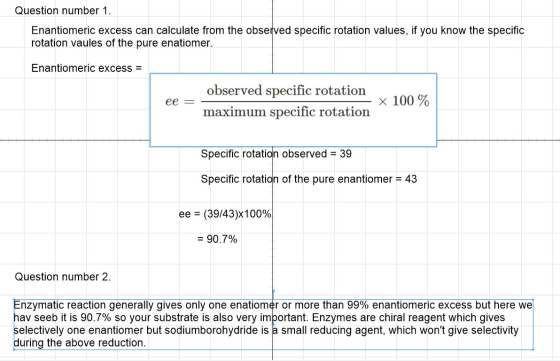
Add Answer to:
6. Please answer the following questions related to Optical Activity: 1. Given the following experimental data...
optical activity problems.. please show all steps i dont understand You have a sample (Sample X)...
 optical activity problems.. please show all steps i dont
understand
You have a sample (Sample X) which is a mixture of +/- Carvone. The solution was made by dissolving 4.50 g of the sample in enough methanol to bring the volume of solution to 10,0 ml. Some of the solution is placed in a 100 cm polarimeter cell and its optical rotation is measured at 25°C using light of the sodium D line wavelength (589.6 nm). The observed rotation is...
optical activity problems.. please show all steps i dont
understand
You have a sample (Sample X) which is a mixture of +/- Carvone. The solution was made by dissolving 4.50 g of the sample in enough methanol to bring the volume of solution to 10,0 ml. Some of the solution is placed in a 100 cm polarimeter cell and its optical rotation is measured at 25°C using light of the sodium D line wavelength (589.6 nm). The observed rotation is...
Based on the melting point and specific rotation experimental data: a.draw the structure(s) of the product(s)...
 Based on the melting point and specific rotation experimental
data:
a.draw the structure(s) of the product(s) of the trans-cinnamic
acid addition reaction with bromine.
b. State whether the addition of Br2followed asyn or
antiaddition or both. Give reasons.
c. Is this product chiral? If so, identify the chirality
centers.
d. Is the product of the trans-cinnamic acid addition reaction
with bromine optically active? Give reasons.
e. Is your answer to Question 2d what you expected? Give
reasons.
f. What is...
Based on the melting point and specific rotation experimental
data:
a.draw the structure(s) of the product(s) of the trans-cinnamic
acid addition reaction with bromine.
b. State whether the addition of Br2followed asyn or
antiaddition or both. Give reasons.
c. Is this product chiral? If so, identify the chirality
centers.
d. Is the product of the trans-cinnamic acid addition reaction
with bromine optically active? Give reasons.
e. Is your answer to Question 2d what you expected? Give
reasons.
f. What is...
2. Given the following experimental data calculate the percent yield for the product of the Sodium...
 2. Given the following experimental data calculate the percent yield for the product of the Sodium Borohydride Reduction portion of the experiment. Compound Amount Ethyl Acetoacetate 2.45 mL NaBH4 0.4327 (g) Product + Round Bottom Flask 60.335 Round Bottom Flask 59.660 3. Given the following experimental data calculate the percent yield for the product of the Enzymatic Reduction portion of the experiment Compound Amount Ethyl Acetoacetate 2.45 mL Na2HPO4 0.254 g Sucrose 40.035 g Yeast 7.050 g Celite 10.130 g...
Please answer the following questions/fill in the data tables based on the following experiment. EXPERIMENTAL PROCEDURE:...
Please answer the following questions/fill in the data tables based on the following experiment. EXPERIMENTAL PROCEDURE: Place sodium hydroxide (2.500 g) in a 100 mL Erlenmeyer flask and add water (25.0 mL) and ethanol (20.0 mL). Add a magnetic stirrer bar and stir until all the NaOH has dissolved. To a second reaction vessel, add benzaldehyde (2.650 g, 0.025 mol) and acetone (0.725 g, 0.0125 mol). Add approximately half of the aldehyde-ketone solution to the sodium hydroxide solution, and stir...
1. Percent Enantiomerie Excess (ee) is given by the equation if in moless (The difference between Rand S isomers/su...
 1. Percent Enantiomerie Excess (ee) is given by the equation if in moless (The difference between Rand S isomers/sum of R & S isomer) - 100. Thus, the sample prepared by Dr. Z. Evans in the PSB 340 Lab contained 12.8 moles of isomer and 3.2 moles of the S isomer. a. Which isomer is in excess in Dr. Evans product? 3.2 moles b. By how much: 12.8 - 3.2 x100 c. What is the percent ce? 2. Enantiomeric Excess...
please exlpain each answer! Reductive Amination Pro-Labour VI. Pre-Lab Problems 1. In reductive amination, what is...
 please exlpain each answer!
Reductive Amination Pro-Labour VI. Pre-Lab Problems 1. In reductive amination, what is the advantage of using sodium triacetoxyborohydride instead of sodium borohydride and instead of sodium cyanoborohydride? Be specific (2 points) 2. Why are benzylamine and sodium triacetoxyborohydride used in excess relative to methyl (or ethyl) pyruvate? (1 point) 3. Draw the product for the reaction below involving the synthesis of an aplaviroc derivative. (2 points) OH OH NaBH(OAC), CH2CH2 HN
please exlpain each answer!
Reductive Amination Pro-Labour VI. Pre-Lab Problems 1. In reductive amination, what is the advantage of using sodium triacetoxyborohydride instead of sodium borohydride and instead of sodium cyanoborohydride? Be specific (2 points) 2. Why are benzylamine and sodium triacetoxyborohydride used in excess relative to methyl (or ethyl) pyruvate? (1 point) 3. Draw the product for the reaction below involving the synthesis of an aplaviroc derivative. (2 points) OH OH NaBH(OAC), CH2CH2 HN
Please answer all 3 questions QUESTION What is the major product of the following reaction? 8R...
 Please answer all 3 questions
QUESTION What is the major product of the following reaction? 8R QUESTION 2 From the data given in the right-hand box, what is the specific rotation, (alp, of the alcohol produced in the Sy2 reaction shown below? H H гон OH Сонуснан, HOCHE CECH CH Br Cotia lale -99 lalo = ? lalo = -34.6 34,6 -9.9 0.0 -9.9 QUESTION 3 Which of the following best describes the reaction of sodium metal with methanol to...
Please answer all 3 questions
QUESTION What is the major product of the following reaction? 8R QUESTION 2 From the data given in the right-hand box, what is the specific rotation, (alp, of the alcohol produced in the Sy2 reaction shown below? H H гон OH Сонуснан, HOCHE CECH CH Br Cotia lale -99 lalo = ? lalo = -34.6 34,6 -9.9 0.0 -9.9 QUESTION 3 Which of the following best describes the reaction of sodium metal with methanol to...
1) Draw the major product for the following reaction and use the given data to answer...
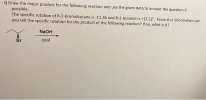 1) Draw the major product for the following reaction and use the given data to answer the question if possible. The specific rotation of R-2-bromobutane is -11.36 and R-2-butanol is +13.52. From this information can you tell the specific rotation for the product of the following reaction? If so, what is it? NaOH cool Br
answer B & C asap please 4. Consider the following reaction and answer the questions: -...
 answer B & C asap please
4. Consider the following reaction and answer the questions: - Br HSCH, SCHE нс" HC HEC a) Draw the structure of the expected cation intermediate if the reactant underwent an SNl reaction b) The reaction produces almost an equal mixture of diastereomer products, does this indicate an Snl or Sn2 mechanism, explain your choice briefly? c) Even though a good nucleophile is present, explain in terms of reaction rates, why a mixture of products...
answer B & C asap please
4. Consider the following reaction and answer the questions: - Br HSCH, SCHE нс" HC HEC a) Draw the structure of the expected cation intermediate if the reactant underwent an SNl reaction b) The reaction produces almost an equal mixture of diastereomer products, does this indicate an Snl or Sn2 mechanism, explain your choice briefly? c) Even though a good nucleophile is present, explain in terms of reaction rates, why a mixture of products...
please help on questions 2 ans 3 EX AA = = = = Es Styles Style...
 please help on questions 2 ans 3
EX AA = = = = Es Styles Style X ASA abr - Pane 2. Given the following experimental data calculate the percent yield for the product of the So- dium Borohydride Reduction portion of the experiment. Compound Amount Ethyl Acetoacetate 2.45 mL NaBH 0.4327 (9) Product + Round Bottom Flask 60.335 Round Bottom Flask 59.660 3. Given the following experimental data calculate the percent yield for the product of the En- zymatic...
please help on questions 2 ans 3
EX AA = = = = Es Styles Style X ASA abr - Pane 2. Given the following experimental data calculate the percent yield for the product of the So- dium Borohydride Reduction portion of the experiment. Compound Amount Ethyl Acetoacetate 2.45 mL NaBH 0.4327 (9) Product + Round Bottom Flask 60.335 Round Bottom Flask 59.660 3. Given the following experimental data calculate the percent yield for the product of the En- zymatic...
 optical activity problems.. please show all steps i dont
understand
You have a sample (Sample X) which is a mixture of +/- Carvone. The solution was made by dissolving 4.50 g of the sample in enough methanol to bring the volume of solution to 10,0 ml. Some of the solution is placed in a 100 cm polarimeter cell and its optical rotation is measured at 25°C using light of the sodium D line wavelength (589.6 nm). The observed rotation is...
optical activity problems.. please show all steps i dont
understand
You have a sample (Sample X) which is a mixture of +/- Carvone. The solution was made by dissolving 4.50 g of the sample in enough methanol to bring the volume of solution to 10,0 ml. Some of the solution is placed in a 100 cm polarimeter cell and its optical rotation is measured at 25°C using light of the sodium D line wavelength (589.6 nm). The observed rotation is...
 Based on the melting point and specific rotation experimental
data:
a.draw the structure(s) of the product(s) of the trans-cinnamic
acid addition reaction with bromine.
b. State whether the addition of Br2followed asyn or
antiaddition or both. Give reasons.
c. Is this product chiral? If so, identify the chirality
centers.
d. Is the product of the trans-cinnamic acid addition reaction
with bromine optically active? Give reasons.
e. Is your answer to Question 2d what you expected? Give
reasons.
f. What is...
Based on the melting point and specific rotation experimental
data:
a.draw the structure(s) of the product(s) of the trans-cinnamic
acid addition reaction with bromine.
b. State whether the addition of Br2followed asyn or
antiaddition or both. Give reasons.
c. Is this product chiral? If so, identify the chirality
centers.
d. Is the product of the trans-cinnamic acid addition reaction
with bromine optically active? Give reasons.
e. Is your answer to Question 2d what you expected? Give
reasons.
f. What is...
 2. Given the following experimental data calculate the percent yield for the product of the Sodium Borohydride Reduction portion of the experiment. Compound Amount Ethyl Acetoacetate 2.45 mL NaBH4 0.4327 (g) Product + Round Bottom Flask 60.335 Round Bottom Flask 59.660 3. Given the following experimental data calculate the percent yield for the product of the Enzymatic Reduction portion of the experiment Compound Amount Ethyl Acetoacetate 2.45 mL Na2HPO4 0.254 g Sucrose 40.035 g Yeast 7.050 g Celite 10.130 g...
 1. Percent Enantiomerie Excess (ee) is given by the equation if in moless (The difference between Rand S isomers/sum of R & S isomer) - 100. Thus, the sample prepared by Dr. Z. Evans in the PSB 340 Lab contained 12.8 moles of isomer and 3.2 moles of the S isomer. a. Which isomer is in excess in Dr. Evans product? 3.2 moles b. By how much: 12.8 - 3.2 x100 c. What is the percent ce? 2. Enantiomeric Excess...
 please exlpain each answer!
Reductive Amination Pro-Labour VI. Pre-Lab Problems 1. In reductive amination, what is the advantage of using sodium triacetoxyborohydride instead of sodium borohydride and instead of sodium cyanoborohydride? Be specific (2 points) 2. Why are benzylamine and sodium triacetoxyborohydride used in excess relative to methyl (or ethyl) pyruvate? (1 point) 3. Draw the product for the reaction below involving the synthesis of an aplaviroc derivative. (2 points) OH OH NaBH(OAC), CH2CH2 HN
please exlpain each answer!
Reductive Amination Pro-Labour VI. Pre-Lab Problems 1. In reductive amination, what is the advantage of using sodium triacetoxyborohydride instead of sodium borohydride and instead of sodium cyanoborohydride? Be specific (2 points) 2. Why are benzylamine and sodium triacetoxyborohydride used in excess relative to methyl (or ethyl) pyruvate? (1 point) 3. Draw the product for the reaction below involving the synthesis of an aplaviroc derivative. (2 points) OH OH NaBH(OAC), CH2CH2 HN
 Please answer all 3 questions
QUESTION What is the major product of the following reaction? 8R QUESTION 2 From the data given in the right-hand box, what is the specific rotation, (alp, of the alcohol produced in the Sy2 reaction shown below? H H гон OH Сонуснан, HOCHE CECH CH Br Cotia lale -99 lalo = ? lalo = -34.6 34,6 -9.9 0.0 -9.9 QUESTION 3 Which of the following best describes the reaction of sodium metal with methanol to...
Please answer all 3 questions
QUESTION What is the major product of the following reaction? 8R QUESTION 2 From the data given in the right-hand box, what is the specific rotation, (alp, of the alcohol produced in the Sy2 reaction shown below? H H гон OH Сонуснан, HOCHE CECH CH Br Cotia lale -99 lalo = ? lalo = -34.6 34,6 -9.9 0.0 -9.9 QUESTION 3 Which of the following best describes the reaction of sodium metal with methanol to...
 1) Draw the major product for the following reaction and use the given data to answer the question if possible. The specific rotation of R-2-bromobutane is -11.36 and R-2-butanol is +13.52. From this information can you tell the specific rotation for the product of the following reaction? If so, what is it? NaOH cool Br
 answer B & C asap please
4. Consider the following reaction and answer the questions: - Br HSCH, SCHE нс" HC HEC a) Draw the structure of the expected cation intermediate if the reactant underwent an SNl reaction b) The reaction produces almost an equal mixture of diastereomer products, does this indicate an Snl or Sn2 mechanism, explain your choice briefly? c) Even though a good nucleophile is present, explain in terms of reaction rates, why a mixture of products...
answer B & C asap please
4. Consider the following reaction and answer the questions: - Br HSCH, SCHE нс" HC HEC a) Draw the structure of the expected cation intermediate if the reactant underwent an SNl reaction b) The reaction produces almost an equal mixture of diastereomer products, does this indicate an Snl or Sn2 mechanism, explain your choice briefly? c) Even though a good nucleophile is present, explain in terms of reaction rates, why a mixture of products...
 please help on questions 2 ans 3
EX AA = = = = Es Styles Style X ASA abr - Pane 2. Given the following experimental data calculate the percent yield for the product of the So- dium Borohydride Reduction portion of the experiment. Compound Amount Ethyl Acetoacetate 2.45 mL NaBH 0.4327 (9) Product + Round Bottom Flask 60.335 Round Bottom Flask 59.660 3. Given the following experimental data calculate the percent yield for the product of the En- zymatic...
please help on questions 2 ans 3
EX AA = = = = Es Styles Style X ASA abr - Pane 2. Given the following experimental data calculate the percent yield for the product of the So- dium Borohydride Reduction portion of the experiment. Compound Amount Ethyl Acetoacetate 2.45 mL NaBH 0.4327 (9) Product + Round Bottom Flask 60.335 Round Bottom Flask 59.660 3. Given the following experimental data calculate the percent yield for the product of the En- zymatic...
Most questions answered within 3 hours.
-
Where is the error in this code sequence?
String s1 = "Hello";
String s2 = "ello";...
asked 11 months ago -
Financial data for Joel de Paris, Inc., for last year
follow:
Joel de Paris, Inc.
Balance...
asked 11 months ago -
Consider this reaction:
Al2(SO4)3 (aq)+ BaCl3
(aq) Al2Cl6 (aq)- +
3BaSO4(s) . What is the...
asked 11 months ago -
Suppose that Savneet is considering increasing her
recent random sample from 20 car rentals to 40...
asked 11 months ago -
Trucks arrive at an unloading terminal at an average rate of 120
per hour.
Trucks arrive...
asked 11 months ago -
Why are methanol and ethanol completely soluble in water while
octanol is not very little soluble....
asked 11 months ago -
A facilities manager at a university reads in a research report
that the mean amount of...
asked 11 months ago -
When the CuSO4 is rehydrated by adding water to the anhydrous
compound, is this an endothermic...
asked 11 months ago -
A ray of sunlight is passing from diamond into crown glass; the
angle of incidence is...
asked 11 months ago -
A block of mass 0.249 kg is placed on top of a light, vertical
spring of...
asked 11 months ago -
how do the kidneys compensate in the presences of acidosis
a) trigger hyperventilate
b) reserve acid...
asked 11 months ago -
Question 501 pts
The rental rate of capital to the firm increases. Which of the
following...
asked 11 months ago