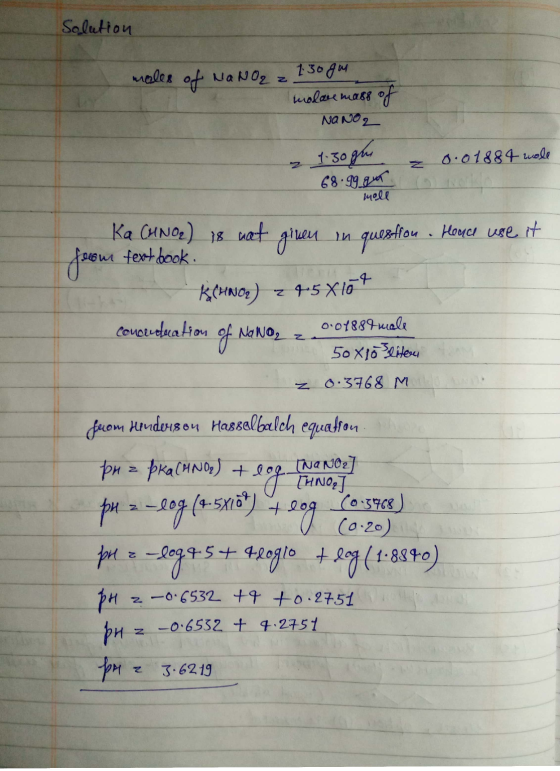
Suppose 1.30 g of NaNO2 is added to enough 0.20 M HNO2 to make exactly 50...
Suppose 1.30 g of NaNO2 is added to enough 0.20 M HNO2 to make exactly 50 mL of solution. What is the expected pH of the resulting solution? How do I know what the Ka for this problem is? Do I need to look it up in my textbook?
Homework Answers
Add Answer to:
Suppose 1.30 g of NaNO2 is added to enough 0.20 M HNO2 to make
exactly 50...
A buffer solution consists of 0.10 M HNO2 and 0.20 M NaNO2. If 0.010 moles of...
A buffer solution consists of 0.10 M HNO2 and 0.20 M NaNO2. If 0.010 moles of sodium hydroxide are added to 200. ml the solution , what is the new pH of the solution (pKa (HNO2) = 3.40)?
A 1.00 L solution contains 20.52 g of nitrous acid, HNO2.What mass of sodium nitrite, NaNO2, should...
A 1.00 L solution contains 20.52 g of nitrous acid, HNO2.What mass of sodium nitrite, NaNO2, should be added to it to make a buffer with a pH of 3.56? Ka (HNO2) = 4.0 × 10⁻⁴.
1.) A 1.00 L solution contains 18.52 g of nitrous acid, HNO2.What mass of sodium nitrite, NaNO2,...
1.) A 1.00 L solution contains 18.52 g of nitrous acid, HNO2.What mass of sodium nitrite, NaNO2, should be added to it to make a buffer with a pH of 2.76? Ka (HNO2) = 4.0 × 10⁻⁴. 2.) Calculate the change in pH when 0.310 mol H+ is added to 1.00 L of each of the following buffers. a) a 0.580 M solution of pyridine (py) containing 0.480 M pyH+ (CHANGE IN PH?) b)a 0.600 M solution of aniline (an) containing...
1) 20. mL sample of 0.20 M HOCl is added to 25.0mL of 0.20M KOH. What...
1) 20. mL sample of 0.20 M HOCl is added to 25.0mL of 0.20M KOH. What is the pH of the solution? -8 HOCl (Ka = 3.5 x 10 ) 2) The ideal pH for the pool is 7.4. What is the ratio of (OCl- ) to (HOCl) needed to maintain the swimming pool at a pH of 7.4? 3) What would be the new pH if you added 0.3 moles of NaOH to 1.0L of the pool water at...
with work please 4) Suppose 50 mL of 0.1 M NaOH is added to 50 mL...
 with work please
4) Suppose 50 mL of 0.1 M NaOH is added to 50 mL of 0.1 M HC2H302 (Ka = 1.8 X 10⁻⁵). This is a titration at its equivalence point. Calculate the pH of the resulting mixture.
with work please
4) Suppose 50 mL of 0.1 M NaOH is added to 50 mL of 0.1 M HC2H302 (Ka = 1.8 X 10⁻⁵). This is a titration at its equivalence point. Calculate the pH of the resulting mixture.
A solution is prepared by dissolving 0.5892 g oxalic acid (H2C2O4) in enough water to make...
A solution is prepared by dissolving 0.5892 g oxalic acid (H2C2O4) in enough water to make 100.0 mL of solution. A 10.00-mL aliquot (portion) of this solution is then diluted to a final volume of 250.0 mL. What is the final molarity of the diluted oxalic acid solution? I do not know if the answer of 0.00187 or 1.87 x 10^ -3 is correct. It is incorrect in my perspective, so i do not expect that answer, if you think...
1) enough of solution A (0.16 M HAc) is added to solution B (6.4x10^-3 M NaAc)...
1) enough of solution A (0.16 M HAc) is added to solution B (6.4x10^-3 M NaAc) to form a solution that is equimolar in HAc and Ac-. What volume of solution A must be added to 50mL of solution B to produce an equimolar solution? 2) You are asked to prepare 10.00 mL of buffer solution consisting of 0.10 M weak acid (HA) and 0.10 M conjugate base (A-). The target pH of the buffer solution is 5.25. Ka of...
If 1.85 g MgO is combined with enough 1.00 M HCl to make 100.0 mL of...
 If 1.85 g MgO is combined with enough 1.00 M HCl to make 100.0 mL of solution in a coffee-cup calorimeter, the temperature of the resulting solution increases from 21.3°C to 35.7 °C. Calculate the enthalpy change for the reaction per mole of Mgo. Assume that the specific heat capacity of the solution is 4.18 J/g.K, and the density of the solution is 1.00 g/mL. A 0.704 g of a pure acid, HA, is dissolved in water and an acid-base...
I need help with questions 1,3,4,5 1.0.15 M ammonium chloride is added to a 0.05 M...
 I need help with questions 1,3,4,5
1.0.15 M ammonium chloride is added to a 0.05 M solution of ammonia. How does the pH change? NHs(aq) + H2O(1) NH(aq) + OH(aq) A. pH goes up B. pH goes down C. pH does not change 2. Which of the following would make buffer system? A. a weak asid and NaCl B. a weak acident's conjugate base C. a strong acid and a weak acid D. alveak acid and a strong acid E....
I need help with questions 1,3,4,5
1.0.15 M ammonium chloride is added to a 0.05 M solution of ammonia. How does the pH change? NHs(aq) + H2O(1) NH(aq) + OH(aq) A. pH goes up B. pH goes down C. pH does not change 2. Which of the following would make buffer system? A. a weak asid and NaCl B. a weak acident's conjugate base C. a strong acid and a weak acid D. alveak acid and a strong acid E....
Hello I need help with number # 2. as it’s asking me to make predictions and...
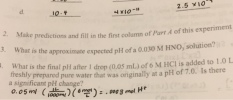 Hello I need help with number # 2. as it’s asking me to make
predictions and fill in the first column of Part A of this
experiment
Please help as I don’t know what problem two means by
predicting for the first column?
d. 2.5 xIO 10.t 2. Make predictions and fill in the first column of Part A of this experiment 3. What is the app roximate expected pH ofa 0.030 M HNo, solution? hat is the final pH...
Hello I need help with number # 2. as it’s asking me to make
predictions and fill in the first column of Part A of this
experiment
Please help as I don’t know what problem two means by
predicting for the first column?
d. 2.5 xIO 10.t 2. Make predictions and fill in the first column of Part A of this experiment 3. What is the app roximate expected pH ofa 0.030 M HNo, solution? hat is the final pH...
 with work please
4) Suppose 50 mL of 0.1 M NaOH is added to 50 mL of 0.1 M HC2H302 (Ka = 1.8 X 10⁻⁵). This is a titration at its equivalence point. Calculate the pH of the resulting mixture.
with work please
4) Suppose 50 mL of 0.1 M NaOH is added to 50 mL of 0.1 M HC2H302 (Ka = 1.8 X 10⁻⁵). This is a titration at its equivalence point. Calculate the pH of the resulting mixture.
 If 1.85 g MgO is combined with enough 1.00 M HCl to make 100.0 mL of solution in a coffee-cup calorimeter, the temperature of the resulting solution increases from 21.3°C to 35.7 °C. Calculate the enthalpy change for the reaction per mole of Mgo. Assume that the specific heat capacity of the solution is 4.18 J/g.K, and the density of the solution is 1.00 g/mL. A 0.704 g of a pure acid, HA, is dissolved in water and an acid-base...
 I need help with questions 1,3,4,5
1.0.15 M ammonium chloride is added to a 0.05 M solution of ammonia. How does the pH change? NHs(aq) + H2O(1) NH(aq) + OH(aq) A. pH goes up B. pH goes down C. pH does not change 2. Which of the following would make buffer system? A. a weak asid and NaCl B. a weak acident's conjugate base C. a strong acid and a weak acid D. alveak acid and a strong acid E....
I need help with questions 1,3,4,5
1.0.15 M ammonium chloride is added to a 0.05 M solution of ammonia. How does the pH change? NHs(aq) + H2O(1) NH(aq) + OH(aq) A. pH goes up B. pH goes down C. pH does not change 2. Which of the following would make buffer system? A. a weak asid and NaCl B. a weak acident's conjugate base C. a strong acid and a weak acid D. alveak acid and a strong acid E....
 Hello I need help with number # 2. as it’s asking me to make
predictions and fill in the first column of Part A of this
experiment
Please help as I don’t know what problem two means by
predicting for the first column?
d. 2.5 xIO 10.t 2. Make predictions and fill in the first column of Part A of this experiment 3. What is the app roximate expected pH ofa 0.030 M HNo, solution? hat is the final pH...
Hello I need help with number # 2. as it’s asking me to make
predictions and fill in the first column of Part A of this
experiment
Please help as I don’t know what problem two means by
predicting for the first column?
d. 2.5 xIO 10.t 2. Make predictions and fill in the first column of Part A of this experiment 3. What is the app roximate expected pH ofa 0.030 M HNo, solution? hat is the final pH...
Most questions answered within 3 hours.
-
Where is the error in this code sequence?
String s1 = "Hello";
String s2 = "ello";...
asked 11 months ago -
Financial data for Joel de Paris, Inc., for last year
follow:
Joel de Paris, Inc.
Balance...
asked 11 months ago -
Consider this reaction:
Al2(SO4)3 (aq)+ BaCl3
(aq) Al2Cl6 (aq)- +
3BaSO4(s) . What is the...
asked 11 months ago -
Suppose that Savneet is considering increasing her
recent random sample from 20 car rentals to 40...
asked 11 months ago -
Trucks arrive at an unloading terminal at an average rate of 120
per hour.
Trucks arrive...
asked 11 months ago -
Why are methanol and ethanol completely soluble in water while
octanol is not very little soluble....
asked 11 months ago -
A facilities manager at a university reads in a research report
that the mean amount of...
asked 11 months ago -
When the CuSO4 is rehydrated by adding water to the anhydrous
compound, is this an endothermic...
asked 11 months ago -
A ray of sunlight is passing from diamond into crown glass; the
angle of incidence is...
asked 11 months ago -
A block of mass 0.249 kg is placed on top of a light, vertical
spring of...
asked 11 months ago -
how do the kidneys compensate in the presences of acidosis
a) trigger hyperventilate
b) reserve acid...
asked 11 months ago -
Question 501 pts
The rental rate of capital to the firm increases. Which of the
following...
asked 11 months ago