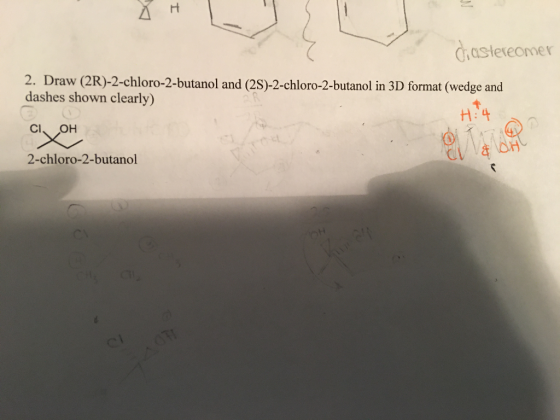
I have the answer to this problem but I do not understand for R and S how to determine which atom gets a wedge or dash. Please explain
Homework Answers
Add Answer to:
I have the answer to this problem but I do not understand for R
and S...
Draw (2R)-2-chloro-2-butanol and (2S)-2-chloro-2 butanol in 3D ( wedges and dashes shown clearly) Ciastereomer 2. Draw...
 Draw (2R)-2-chloro-2-butanol and (2S)-2-chloro-2 butanol in 3D (
wedges and dashes shown clearly)
Ciastereomer 2. Draw (2R)-2-chloro-2-butanol and (2S)-2-chloro-2-butanol in 3D format (wedge and dashes shown clearly) CI, OH Ev & DH 2-chloro-2-butanol
Draw (2R)-2-chloro-2-butanol and (2S)-2-chloro-2 butanol in 3D (
wedges and dashes shown clearly)
Ciastereomer 2. Draw (2R)-2-chloro-2-butanol and (2S)-2-chloro-2-butanol in 3D format (wedge and dashes shown clearly) CI, OH Ev & DH 2-chloro-2-butanol
1 Determine the R/S orientation of the indicated chiral center(s) in the following molecules. If there...
 1 Determine the R/S orientation of the indicated chiral center(s) in the following molecules. If there is only one chiral center in the molecule, choose (none). H3C CH3 a Visited b H H3C Molecule #1 (B-thujene ): Center a: Center b: CH3 CH2 HO CH3 Molecule #2 ( rhodinol): Center a: Center b: CH3 OH CH, H3C CH3 H H H H CHE H H HO H CH3 H HO H 2-butanol OH CH3 CH a H b с The...
please do all of 1 and please explain number 2, I dont understand. 1. a. (4...
 please do all of 1 and please explain number 2, I dont
understand.
1. a. (4 points) Draw the dash-wedge structure of (2,3S)-2,3-dichloropentane. b. (4 points) Draw the Fischer projection of enantiomer of the compound drawn in part a. Name the enantiomers. c. (6 points) Draw the Newman projections (looking down the C2-C3 bonds) of the diastereomers of the compound drawn in part b. Name the diastereomers. 2. (6 points) Draw the mechanisms of the propagation steps of the reaction...
please do all of 1 and please explain number 2, I dont
understand.
1. a. (4 points) Draw the dash-wedge structure of (2,3S)-2,3-dichloropentane. b. (4 points) Draw the Fischer projection of enantiomer of the compound drawn in part a. Name the enantiomers. c. (6 points) Draw the Newman projections (looking down the C2-C3 bonds) of the diastereomers of the compound drawn in part b. Name the diastereomers. 2. (6 points) Draw the mechanisms of the propagation steps of the reaction...
Which of the following are meso compounds? (i) (R)-2-methylcyclobutanone (ii) (S)-2-methylcyclobutanone (iii) (1S,2S)-1,2-dimethylcyclohexane (iv) (1R,2R)-1-chloro-2-methylcyclobutane (v)...
Which of the following are meso compounds? (i) (R)-2-methylcyclobutanone (ii) (S)-2-methylcyclobutanone (iii) (1S,2S)-1,2-dimethylcyclohexane (iv) (1R,2R)-1-chloro-2-methylcyclobutane (v) (1S,2S)-1-chloro-2-methylcyclobutane
Please explain how to approach solving this problem and how to get the correct solution. I...
 Please explain how to approach solving this problem and how to
get the correct solution. I know the little triangle above the
arrow means its being heated. Thank you so much in advance.
(2) Predict the major product(s) for each of the following reactions. Be sure to indicate stereochemistry and draw enantiomers when appropriate. Clearly show stereochemistry with two lines in the plane and a wedge and/or dash at the chirality center(s) No reaction mechanisms are necessary C3 C3
Please explain how to approach solving this problem and how to
get the correct solution. I know the little triangle above the
arrow means its being heated. Thank you so much in advance.
(2) Predict the major product(s) for each of the following reactions. Be sure to indicate stereochemistry and draw enantiomers when appropriate. Clearly show stereochemistry with two lines in the plane and a wedge and/or dash at the chirality center(s) No reaction mechanisms are necessary C3 C3
Can someone please help me draw the Fischer projection for (2R,4S) methyl-4-amino-4-chloro-2-methoxypentanoate? I understand the nomenclature...
Can someone please help me draw the Fischer projection for (2R,4S) methyl-4-amino-4-chloro-2-methoxypentanoate? I understand the nomenclature and process on how to draw a Fischer projection, but I am stuck on where to draw the CH2 between both chiral centers. Thank you!
please help Problem: Some of the molecules listed here have a chirality center; some do not....
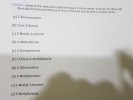 please help
Problem: Some of the molecules listed here have a chirality center; some do not. Write 3D formulas for both enantiomers of those molecules that do have a chirality center (a) 2-Fluoropropane (b) trans-2-Butene (c) 2-Methyl-2-pentene (d) 2-Methylbutane (e) 2-Bromopentane (f) 1-Chloro-2-methylbutane (g) 2-Chlorobutane (h) 3-Methylpentane (i) 2-Methyl-1-butanol G) 3-Methylhexane
please help
Problem: Some of the molecules listed here have a chirality center; some do not. Write 3D formulas for both enantiomers of those molecules that do have a chirality center (a) 2-Fluoropropane (b) trans-2-Butene (c) 2-Methyl-2-pentene (d) 2-Methylbutane (e) 2-Bromopentane (f) 1-Chloro-2-methylbutane (g) 2-Chlorobutane (h) 3-Methylpentane (i) 2-Methyl-1-butanol G) 3-Methylhexane
i have missed yhis 5 times. the first one had “x” in place of the F,...
 i have missed yhis 5 times. the first one had “x” in place of
the F, Cl, Br, F
Draw every stereoisomer for 1-bromo-2-chloro-1,2-difluorocyclopentane. Use wedge-and-dash bonds for the substituent groups, and be sure that they are drawn on the outside of the ring, adjacent to each other. The skeletal structure of one molecule is included to indicate the proper format; modify the X's on the given structure to create the first stereoisomer. AATE || Br
i have missed yhis 5 times. the first one had “x” in place of
the F, Cl, Br, F
Draw every stereoisomer for 1-bromo-2-chloro-1,2-difluorocyclopentane. Use wedge-and-dash bonds for the substituent groups, and be sure that they are drawn on the outside of the ring, adjacent to each other. The skeletal structure of one molecule is included to indicate the proper format; modify the X's on the given structure to create the first stereoisomer. AATE || Br
I understand how to do this problem. My problem is that I do not understand where the Ro variable is coming from. Can s...
 I understand how to do this problem. My problem is that I do not
understand where the Ro variable is coming from. Can someone please
explain how Ro=0.231 Bq was found? I would really appreciate
it.
Example On September 19, 1991, a German couple hiking in the Italian Alps discovered a body trapped in the ice. Subsequent investigation revealed the remarkably well- preserved body to be that of a Stone Age man. When the carbon-14 (T1/2=5730 y) dating method was...
I understand how to do this problem. My problem is that I do not
understand where the Ro variable is coming from. Can someone please
explain how Ro=0.231 Bq was found? I would really appreciate
it.
Example On September 19, 1991, a German couple hiking in the Italian Alps discovered a body trapped in the ice. Subsequent investigation revealed the remarkably well- preserved body to be that of a Stone Age man. When the carbon-14 (T1/2=5730 y) dating method was...
Do not worry about the plotting portion but I do want explanation throughout the problem in...
 Do not worry about the plotting portion but I do want
explanation throughout the problem in order for me to understand
the methodology, especially in applying boundary conditions.
Problem 1 grounded, but the end at r = a is held at The bottom and top of the of the wedge shown in the figure are V 5V. Usiing separation of variables find the potential everywhere inside the wedge by using separa- tion of variables, and plot it as a surface...
Do not worry about the plotting portion but I do want
explanation throughout the problem in order for me to understand
the methodology, especially in applying boundary conditions.
Problem 1 grounded, but the end at r = a is held at The bottom and top of the of the wedge shown in the figure are V 5V. Usiing separation of variables find the potential everywhere inside the wedge by using separa- tion of variables, and plot it as a surface...
 Draw (2R)-2-chloro-2-butanol and (2S)-2-chloro-2 butanol in 3D (
wedges and dashes shown clearly)
Ciastereomer 2. Draw (2R)-2-chloro-2-butanol and (2S)-2-chloro-2-butanol in 3D format (wedge and dashes shown clearly) CI, OH Ev & DH 2-chloro-2-butanol
Draw (2R)-2-chloro-2-butanol and (2S)-2-chloro-2 butanol in 3D (
wedges and dashes shown clearly)
Ciastereomer 2. Draw (2R)-2-chloro-2-butanol and (2S)-2-chloro-2-butanol in 3D format (wedge and dashes shown clearly) CI, OH Ev & DH 2-chloro-2-butanol
 1 Determine the R/S orientation of the indicated chiral center(s) in the following molecules. If there is only one chiral center in the molecule, choose (none). H3C CH3 a Visited b H H3C Molecule #1 (B-thujene ): Center a: Center b: CH3 CH2 HO CH3 Molecule #2 ( rhodinol): Center a: Center b: CH3 OH CH, H3C CH3 H H H H CHE H H HO H CH3 H HO H 2-butanol OH CH3 CH a H b с The...
 please do all of 1 and please explain number 2, I dont
understand.
1. a. (4 points) Draw the dash-wedge structure of (2,3S)-2,3-dichloropentane. b. (4 points) Draw the Fischer projection of enantiomer of the compound drawn in part a. Name the enantiomers. c. (6 points) Draw the Newman projections (looking down the C2-C3 bonds) of the diastereomers of the compound drawn in part b. Name the diastereomers. 2. (6 points) Draw the mechanisms of the propagation steps of the reaction...
please do all of 1 and please explain number 2, I dont
understand.
1. a. (4 points) Draw the dash-wedge structure of (2,3S)-2,3-dichloropentane. b. (4 points) Draw the Fischer projection of enantiomer of the compound drawn in part a. Name the enantiomers. c. (6 points) Draw the Newman projections (looking down the C2-C3 bonds) of the diastereomers of the compound drawn in part b. Name the diastereomers. 2. (6 points) Draw the mechanisms of the propagation steps of the reaction...
 Please explain how to approach solving this problem and how to
get the correct solution. I know the little triangle above the
arrow means its being heated. Thank you so much in advance.
(2) Predict the major product(s) for each of the following reactions. Be sure to indicate stereochemistry and draw enantiomers when appropriate. Clearly show stereochemistry with two lines in the plane and a wedge and/or dash at the chirality center(s) No reaction mechanisms are necessary C3 C3
Please explain how to approach solving this problem and how to
get the correct solution. I know the little triangle above the
arrow means its being heated. Thank you so much in advance.
(2) Predict the major product(s) for each of the following reactions. Be sure to indicate stereochemistry and draw enantiomers when appropriate. Clearly show stereochemistry with two lines in the plane and a wedge and/or dash at the chirality center(s) No reaction mechanisms are necessary C3 C3
 please help
Problem: Some of the molecules listed here have a chirality center; some do not. Write 3D formulas for both enantiomers of those molecules that do have a chirality center (a) 2-Fluoropropane (b) trans-2-Butene (c) 2-Methyl-2-pentene (d) 2-Methylbutane (e) 2-Bromopentane (f) 1-Chloro-2-methylbutane (g) 2-Chlorobutane (h) 3-Methylpentane (i) 2-Methyl-1-butanol G) 3-Methylhexane
please help
Problem: Some of the molecules listed here have a chirality center; some do not. Write 3D formulas for both enantiomers of those molecules that do have a chirality center (a) 2-Fluoropropane (b) trans-2-Butene (c) 2-Methyl-2-pentene (d) 2-Methylbutane (e) 2-Bromopentane (f) 1-Chloro-2-methylbutane (g) 2-Chlorobutane (h) 3-Methylpentane (i) 2-Methyl-1-butanol G) 3-Methylhexane
 i have missed yhis 5 times. the first one had “x” in place of
the F, Cl, Br, F
Draw every stereoisomer for 1-bromo-2-chloro-1,2-difluorocyclopentane. Use wedge-and-dash bonds for the substituent groups, and be sure that they are drawn on the outside of the ring, adjacent to each other. The skeletal structure of one molecule is included to indicate the proper format; modify the X's on the given structure to create the first stereoisomer. AATE || Br
i have missed yhis 5 times. the first one had “x” in place of
the F, Cl, Br, F
Draw every stereoisomer for 1-bromo-2-chloro-1,2-difluorocyclopentane. Use wedge-and-dash bonds for the substituent groups, and be sure that they are drawn on the outside of the ring, adjacent to each other. The skeletal structure of one molecule is included to indicate the proper format; modify the X's on the given structure to create the first stereoisomer. AATE || Br
 I understand how to do this problem. My problem is that I do not
understand where the Ro variable is coming from. Can someone please
explain how Ro=0.231 Bq was found? I would really appreciate
it.
Example On September 19, 1991, a German couple hiking in the Italian Alps discovered a body trapped in the ice. Subsequent investigation revealed the remarkably well- preserved body to be that of a Stone Age man. When the carbon-14 (T1/2=5730 y) dating method was...
I understand how to do this problem. My problem is that I do not
understand where the Ro variable is coming from. Can someone please
explain how Ro=0.231 Bq was found? I would really appreciate
it.
Example On September 19, 1991, a German couple hiking in the Italian Alps discovered a body trapped in the ice. Subsequent investigation revealed the remarkably well- preserved body to be that of a Stone Age man. When the carbon-14 (T1/2=5730 y) dating method was...
 Do not worry about the plotting portion but I do want
explanation throughout the problem in order for me to understand
the methodology, especially in applying boundary conditions.
Problem 1 grounded, but the end at r = a is held at The bottom and top of the of the wedge shown in the figure are V 5V. Usiing separation of variables find the potential everywhere inside the wedge by using separa- tion of variables, and plot it as a surface...
Do not worry about the plotting portion but I do want
explanation throughout the problem in order for me to understand
the methodology, especially in applying boundary conditions.
Problem 1 grounded, but the end at r = a is held at The bottom and top of the of the wedge shown in the figure are V 5V. Usiing separation of variables find the potential everywhere inside the wedge by using separa- tion of variables, and plot it as a surface...
Most questions answered within 3 hours.
-
Where is the error in this code sequence?
String s1 = "Hello";
String s2 = "ello";...
asked 10 months ago -
Financial data for Joel de Paris, Inc., for last year
follow:
Joel de Paris, Inc.
Balance...
asked 10 months ago -
Consider this reaction:
Al2(SO4)3 (aq)+ BaCl3
(aq) Al2Cl6 (aq)- +
3BaSO4(s) . What is the...
asked 10 months ago -
Suppose that Savneet is considering increasing her
recent random sample from 20 car rentals to 40...
asked 10 months ago -
Trucks arrive at an unloading terminal at an average rate of 120
per hour.
Trucks arrive...
asked 10 months ago -
Why are methanol and ethanol completely soluble in water while
octanol is not very little soluble....
asked 10 months ago -
A facilities manager at a university reads in a research report
that the mean amount of...
asked 10 months ago -
When the CuSO4 is rehydrated by adding water to the anhydrous
compound, is this an endothermic...
asked 10 months ago -
A ray of sunlight is passing from diamond into crown glass; the
angle of incidence is...
asked 10 months ago -
A block of mass 0.249 kg is placed on top of a light, vertical
spring of...
asked 10 months ago -
how do the kidneys compensate in the presences of acidosis
a) trigger hyperventilate
b) reserve acid...
asked 10 months ago -
Question 501 pts
The rental rate of capital to the firm increases. Which of the
following...
asked 10 months ago